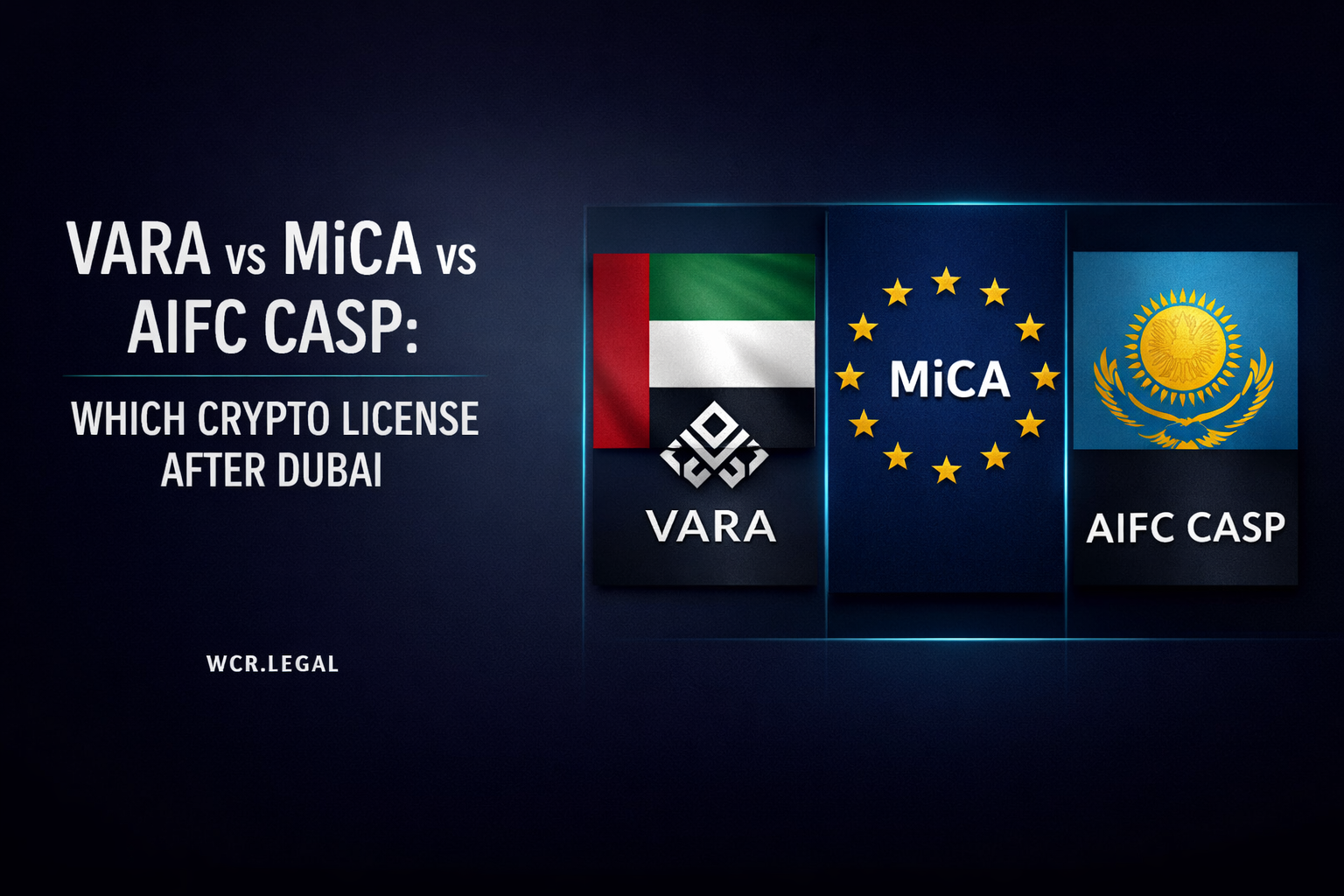
MiCA vs VARA vs AIFC CASP: how the regulatory routes actually differ
Crypto licensing frameworks are often discussed as alternative jurisdictions that can be selected based on speed, cost, or perceived regulatory friendliness. In practice, this approach is legally incomplete. MiCA, VARA and AIFC CASP are different regulatory models built around different policy objectives, supervisory logic and risk allocation.
These regimes are not interchangeable. They regulate different categories of activity, apply different concepts of investor and consumer protection, and impose structurally different expectations on licensed entities. As a result, the same business model may be acceptable under one framework, conditionally acceptable under another, or fall outside the regulatory perimeter of a third.
- the regulatory intent behind each framework and how it shapes supervision;
- how each regime defines the licensing perimeter and activity scope;
- what “ongoing compliance” means in practice and where the risk exposure sits after authorisation;
- what founders and investors typically underestimate when selecting a licensing route.
From a regulatory perspective, licensing should be treated as a structural decision, not a checkbox. A framework that appears “lighter” at entry may impose stronger ongoing supervisory engagement, while a harmonised regime may offer higher predictability at the cost of rigidity.
The sections below explain how each regime works in practice and what the differences mean for governance, compliance capacity and risk allocation in a regulated crypto or tokenization project.
In discussions around crypto licensing, regulatory frameworks are often compared using simplified criteria such as speed of approval, headline costs, or perceived regulatory strictness. From a legal standpoint, this approach is methodologically incorrect. Regulatory regimes are not products with comparable feature sets, but legal systems built around different regulatory assumptions.
MiCA, VARA and AIFC CASP are designed to address different regulatory problems. As a result, they operate with different definitions of regulated activity, different expectations of license holders, and different approaches to supervisory intervention. Comparing them mechanically obscures these differences and creates false expectations at both the structuring and compliance stages.
- comparing frameworks based on entry cost without considering long-term compliance exposure;
- focusing on time to licence rather than post-authorisation supervisory intensity;
- treating licensing regimes as jurisdictional labels instead of regulatory models;
- assuming that similar activities are regulated identically across different legal systems.
In practice, projects that rely on mechanical comparisons often discover incompatibilities only after entering the licensing process or, worse, after commencing regulated operations. At that stage, restructuring becomes costly and may trigger additional regulatory scrutiny.
For this reason, regulatory choice should start with an assessment of regulatory intent and supervisory philosophy, not with headline comparisons of cost or speed.
A meaningful comparison between MiCA, VARA and AIFC CASP starts with regulatory intent. These frameworks were created to solve different policy problems, which is why they produce different licensing perimeters, different supervisory intensity and different expectations of regulated firms.
In practice, the same product may be evaluated differently depending on whether the regulator views the activity primarily through a financial services lens, a market integrity and consumer protection lens, or a principles-based risk management lens.
MiCA is designed to create a uniform EU rulebook for crypto-asset services, reduce fragmentation and standardise conduct and disclosure expectations.
The practical consequence is higher rule density and a stronger focus on organisational safeguards, reporting and client-facing protections.
VARA is designed to regulate crypto activity through activity-based supervision within a controlled market environment.
The practical consequence is a stronger reliance on supervisory engagement, staged readiness and ongoing regulator expectations that can evolve with the market.
AIFC CASP is designed to permit digital asset activity under a common law, principles-based regulatory approach with proportionality.
The practical consequence is that substance and controls matter more than labels, and the regulator evaluates whether risks are identified, governed and documented.
- It shapes how the regulator defines the regulated perimeter and interprets borderline activities.
- It determines whether the framework is rule-driven (MiCA), supervision-driven (VARA), or principles-driven (AIFC).
- It affects the project’s long-term compliance operating model and exposure to supervisory interventions post-authorisation.
For this reason, a licensing route should be selected only after mapping the business model to each regime’s regulatory intent and determining where the supervisory focus will sit in practice.
The Markets in Crypto-Assets Regulation (MiCA) is built around a clear policy objective: to integrate crypto-asset activities into the EU financial regulatory architecture through a single, harmonised rulebook. This objective explains both MiCA’s strengths and its structural limitations.
From a regulatory perspective, MiCA prioritises legal certainty and uniform application across Member States. Once an activity falls within scope, the regulatory perimeter is largely fixed, and the regulator’s discretion is intentionally constrained by detailed legislative rules.
- a harmonised EU-wide framework with limited national deviation;
- detailed, prescriptive rules defining organisational, prudential and conduct requirements;
- strong emphasis on consumer and investor protection;
- reduced scope for informal regulatory negotiation once the activity is classified.
In practice, this means that MiCA is relatively predictable at the level of formal requirements, but significantly less flexible when a business model evolves or operates at the edges of defined categories. Regulatory classification under MiCA tends to be binary: either the activity is in scope, or it is not.
For founders and investors, MiCA typically works best where the business model is already mature, stable and aligned with traditional compliance structures. Projects that rely on rapid iteration, experimental token mechanics or evolving revenue models often encounter friction once the MiCA framework is applied in full.
Understanding this trade-off is critical when assessing whether MiCA is an appropriate regulatory route for a particular crypto or tokenization project.
The Dubai Virtual Assets Regulatory Authority (VARA) is built around an activity-based supervisory model. Unlike harmonised rulebooks, VARA regulates discrete virtual asset activities and applies supervision proportionally to the risks associated with each authorised function.
In practice, this means that regulatory outcomes depend less on formal labels and more on how activities are performed, how risks are managed, and how operational readiness is demonstrated at each stage of the licensing process.
Licensing is typically staged and tied to demonstrable readiness. Supervisory engagement continues after authorisation, with an emphasis on controls, disclosures and governance rather than formal rule compliance alone.
Regulatory expectations may evolve as the market develops. Interpretation, supervisory dialogue and regulator comfort play a meaningful role in how requirements are applied over time.
This supervisory philosophy creates flexibility at entry but introduces a different form of regulatory risk. Projects must be prepared for ongoing interaction with the regulator and potential adjustments to internal processes after authorisation.
- licensing timelines depend on operational readiness rather than fixed statutory periods;
- governance, risk management and disclosures are assessed continuously;
- post-authorisation changes may require renewed supervisory engagement.
For founders and investors, VARA is often suitable where flexibility and market proximity are priorities, but only if the organisation is capable of sustaining an active compliance operating model aligned with supervisory expectations.
The AIFC framework for Crypto Asset Service Providers (CASP) is built on a principles-based regulatory model rooted in English common law. Unlike highly prescriptive regimes, it focuses on whether risks are identified, assessed and controlled in a manner proportionate to the scale and nature of the business.
From a regulatory perspective, this approach places emphasis on substance over form. Labels, terminology and formal positioning are less important than the actual economic activity, governance arrangements and control environment implemented by the licensed entity.
In practice, this model allows greater flexibility at the structuring stage, but it also requires a higher level of internal discipline. Documentation, governance frameworks and risk controls must be coherent, internally consistent and defensible to the regulator.
AIFC CASP regulation does not reward minimal compliance. Where risks are identified, the regulator expects them to be addressed in a manner that is reasonable, documented and actively monitored.
For founders and investors, AIFC CASP is often suitable where a project requires regulatory flexibility without abandoning formal oversight. However, the absence of rigid rules means that responsibility for compliance design rests more heavily on the licensed entity itself.
One of the most underestimated aspects of crypto regulation is how licensing scope is defined and interpreted. MiCA, VARA and AIFC CASP approach scoping in fundamentally different ways, which directly affects whether an activity is regulated, how broad the authorisation must be, and how much regulatory exposure the project carries.
Licensing scope is determined by formal classification. Once an activity matches a regulated service under MiCA, the full set of corresponding obligations applies.
Borderline activities tend to be resolved through strict inclusion rather than contextual interpretation.
Licensing scope is shaped by actual activities performed and how they are operationally implemented.
Scope may be refined during staged licensing and revisited as the business model evolves.
Licensing scope is assessed through a substance-based analysis of risks, controls and client exposure.
Formal labels are secondary to how the activity affects market, client and systemic risk.
These differences mean that two projects with similar commercial goals may require very different licensing scopes depending on the chosen regulatory framework. Misalignment at this stage often leads to either over-licensing or regulatory gaps that surface during supervision.
For founders and investors, careful scoping before submitting a licence application is critical to avoiding unnecessary compliance burden or post-authorisation corrective action.
Beyond initial authorisation, regulatory frameworks differ most visibly in how compliance is supervised in practice. Identical legal requirements may translate into continuous reporting, periodic review, or ongoing supervisory dialogue depending on the regime.
| Framework | Supervisory focus | Compliance in practice |
|---|---|---|
| MiCA | Rule adherence and reporting accuracy | Structured reporting, predefined disclosures and limited scope for deviation once obligations apply. Post-authorisation changes often require formal regulatory reassessment. |
| VARA | Operational readiness and conduct | Ongoing supervisory engagement, staged approvals and iterative feedback. Regulatory expectations may evolve alongside market developments. |
| AIFC CASP | Risk management and governance effectiveness | Contextual review of controls, proportionality and consistency between documented policies and actual operations. Substance typically prevails over formal structure. |
These supervisory styles influence not only reporting frequency and audit readiness, but also how quickly and in what form regulators intervene when issues arise. A rule-based framework may prioritise formal enforcement, while a principles-based regime typically focuses on remediation and governance improvements.
For founders and investors, understanding supervisory behaviour is as important as understanding formal rules. Internal compliance capacity and management involvement determine whether regulatory engagement remains predictable or becomes disruptive over time.
Selecting a regulatory framework is not a neutral or reversible decision. An incorrectly chosen licensing route typically creates structural risks that materialise only after the project has already committed resources, built governance processes and engaged with a regulator.
In practice, these risks rarely appear at the application stage. They tend to surface during implementation, scaling or supervisory review, when correcting course becomes significantly more complex and costly.
These risks are often underestimated because regulatory choice is treated as an administrative step rather than a long-term operating constraint. Once embedded, regulatory architecture influences decision-making far beyond compliance functions.
For founders and investors, early regulatory misalignment is one of the most common sources of downstream legal and operational complexity in regulated crypto and tokenization projects.
Choosing between MiCA, VARA and AIFC CASP is not a question of identifying a “better” or “lighter” jurisdiction. In practice, it is a structural legal decision that should be made only after aligning the regulatory framework with the project’s governance capacity, risk profile and long-term operating model.
A sound regulatory approach typically starts with analysing what the project actually does, how client assets and data are handled, where decision-making authority sits, and how compliance will function after licensing — not only at the point of authorisation.
Identify which functions are actually performed, rather than how the business is described in presentations or pitch decks.
Determine whether the organisation can sustain the supervisory model imposed by the chosen framework over time.
Consider how easily the framework accommodates product changes, geographic expansion and evolving token mechanics.
Only after this analysis does it make sense to compare regulatory routes and determine whether MiCA’s harmonisation, VARA’s supervisory discretion or AIFC’s principles-based proportionality aligns with the project’s strategic objectives.
If you are assessing a crypto or tokenization project and need to understand which regulatory route is structurally appropriate, see our overview of crypto and Web3 licensing support and how regulatory structuring is typically approached in practice.
Regulatory choice, when made correctly, reduces downstream friction. When made mechanically, it often becomes a source of long-term legal and operational constraint.