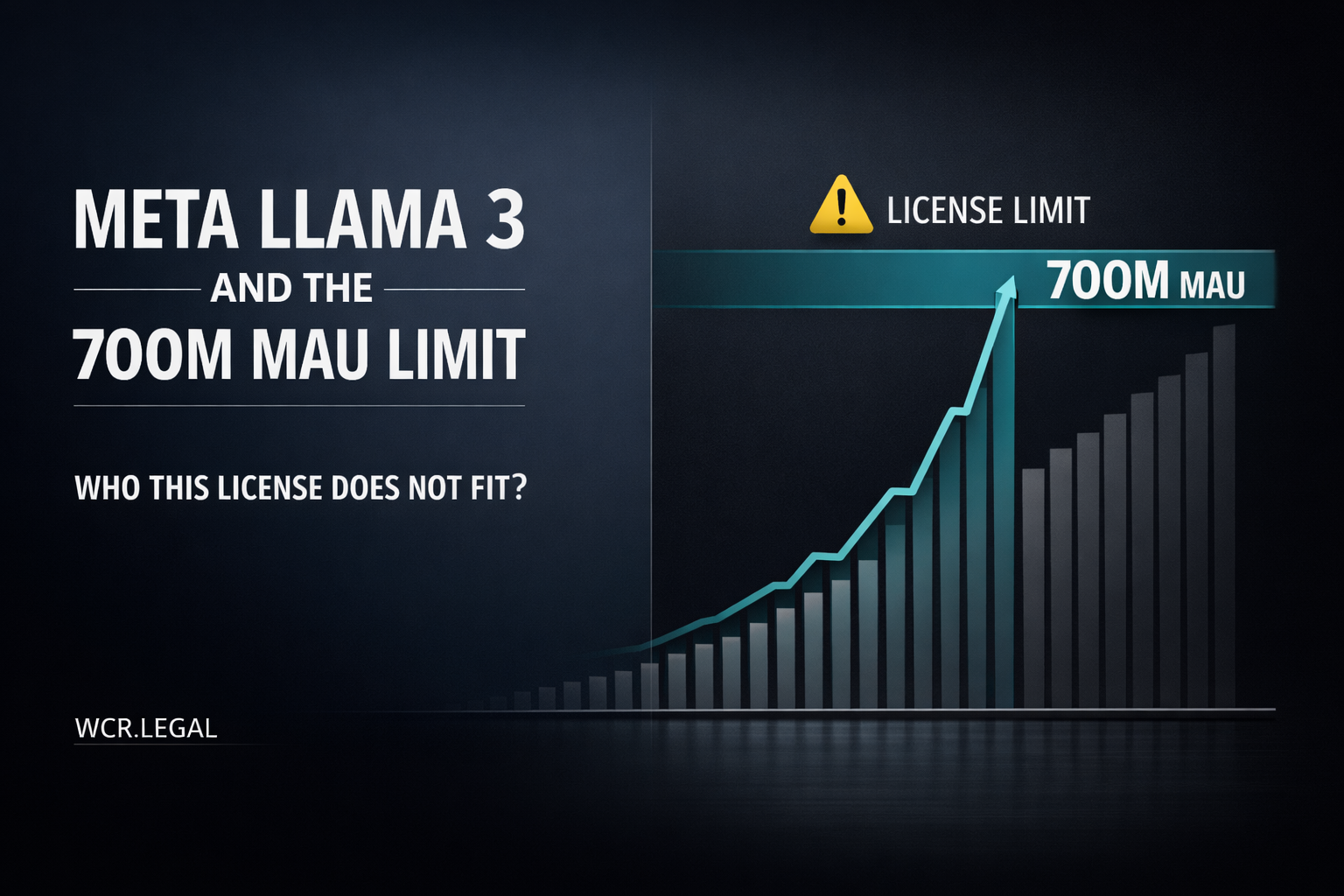
Meta Llama 3 and the 700M MAU Limit: Who This License Does Not Fit?
Meta Llama 3 and the 700M MAU Limit: Who This License Does Not Fit?
The Llama 3 Community License allows commercial use — but it contains a clause that has no equivalent in any open-source licence: a 700 million monthly active user threshold above which your free licence automatically expires, a competitor restriction that blocks entire industries, and a ban on using Llama to train other models. This guide maps who the Llama 3 licence does not fit, and when a separate deal with Meta is the only path forward.
The 700M MAU Threshold — What the Clause Actually Says
The exact wording of the licence limit, how it applies to your product, and what “sole discretion” means for your business continuity
How MAU Is Counted in Practice — End-Users, B2B Clients, and Internal Users
The licence doesn’t define “monthly active user” — who counts, what interpretations apply to B2B, platform, and enterprise products
Additional Restrictions — Competitor Clause, Model Training Ban, and Naming Rules
The restrictions that operate independently of the MAU threshold: who is a competitor, what training uses are prohibited, and what you cannot name your product
When You Need a Separate Commercial Agreement with Meta
The triggers, the process, and what a post-threshold or competitor-adjacent product should do before building on Llama 3
Introduction — The Llama 3 Community License and Its Hidden Conditions
Meta’s Llama 3 model family is widely described as an “open” AI model — and the Llama 3 Community License does permit commercial use for most businesses. But the Llama License is not Apache-2.0, MIT, or any OSI-approved open-source licence. It is a custom document that contains three categories of restriction that exist in no true open-source licence: a scale threshold that caps free commercial use at 700 million monthly active users, a competitor restriction that blocks entire classes of product regardless of user count, and a ban on using Llama to improve or train competing AI models.
For the majority of startups, none of these restrictions will bind during the early product stages. But the 700M MAU clause is not a theoretical risk: it is a dependency that belongs in every commercial risk register from day one, because it affects how investors value your IP stack and how acquirers model the cost of a model transition. And the competitor restriction is a present-day constraint — one that eliminates Llama 3 as an option for specific categories of product regardless of their size.
Common misconception
“Llama 3 is open source — it has no commercial restrictions.”
The Llama 3 Community License is not an open-source licence by any OSI-approved definition. It contains a scale threshold, a competitor restriction, and a training ban — none of which appear in Apache-2.0, MIT, or any other open-source licence. “Open weights” does not mean “no strings attached.”
Common misconception
“700 million users? That will never affect my startup.”
The 700M MAU threshold matters before you reach it. Investors and acquirers identify it in due diligence as an unquantified future liability — a dependency on Meta’s sole discretion for continued operation at scale. At Series B or acquisition, “we’ll deal with it if we hit 700M” is not a satisfying answer to a legal team.
Common misconception
“I can fine-tune Llama 3 and use it to improve any model I want.”
The Llama 3 licence explicitly prohibits using the model — or its outputs — to train, improve, or build any other AI model outside of Llama derivatives. Using Llama 3 to generate synthetic training data for a competing foundation model is a breach of the licence, regardless of fine-tuning.
The 700M MAU threshold
The exact clause, how it measures usage, and what “Meta’s sole discretion” means for the post-threshold licence. Section 1 covers this in detail.
How MAU is actually counted
The licence does not define “monthly active user.” Section 2 maps the interpretations that apply to B2C, B2B, and enterprise products.
Additional restrictions
The competitor restriction, the training ban, prohibited use categories, and naming rules — present-day constraints that apply regardless of your user count. Section 3.
When you need Meta’s agreement
The triggers, the process for obtaining a commercial licence, and what alternative models to consider if the Llama licence does not fit. Section 4.
IP ownership context: The Llama 3 Community License governs your right to use Meta’s model weights — it does not determine who owns your training data, your fine-tuning outputs, or the IP structure of your AI product for investment or acquisition purposes. For analysis of AI IP ownership in commercial deployments, see AI IP Ownership — wcr.legal.
Section 1 — The 700M MAU Threshold: What the Clause Actually Says
The 700 million monthly active user threshold is the most discussed — and most misunderstood — provision in the Llama 3 Community License. It is not a prohibition on large-scale deployment. It is a conditional licence that converts from “free commercial use” to “subject to Meta’s sole discretion” at the moment your product crosses a defined scale. Understanding the exact wording, what it measures, and what “sole discretion” means in practice is the starting point for any commercial risk assessment of a Llama 3-based product.
Llama 3 Community License — Section 1 (paraphrased)
If the products or services made available by or for Licensee, or Licensee’s affiliates, are used by or for more than 700 million monthly active users in the preceding calendar month, Licensee must request a license from Meta, which Meta may grant to you in its sole discretion and which you must obtain prior to any such use.
Key elements: (1) The threshold applies to the product or service as a whole, not just to AI feature usage. (2) It includes affiliates — a corporate group must aggregate user counts across entities. (3) “Sole discretion” means Meta is not required to grant a licence, may impose any terms it chooses, and may decline without explanation. (4) The obligation to request arises before reaching that threshold — continued use without a Meta licence above 700M MAU is a breach of the Llama Licence.
What “products or services” means — product-level, not feature-level
The threshold applies to the full product MAU, not just to users who interact with the AI componentThe clause refers to “products or services made available by or for Licensee” — not to users of the Llama-powered feature within those products. If you integrate Llama 3 into a messaging or productivity application as one feature among many, the 700M MAU counter is the total monthly active user count of that product, not the subset of users who trigger the AI component.
This matters significantly for companies building AI features into existing large-scale products. A platform with 900 million registered users, 800 million of whom are monthly active, that adds a Llama 3-powered search feature has already crossed the threshold — even if only 10 million users have tried the AI feature.
Meta’s “sole discretion” — no guaranteed continuity
Post-threshold licensing is not guaranteed, the terms are unspecified, and Meta cannot be compelled to grant accessThe phrase “which Meta may grant to you in its sole discretion” is the most commercially significant language in the clause. It means that crossing 700M MAU does not give you a right to a commercial licence — it gives you the right to ask. Meta may:
Decline entirely — especially for products Meta views as competitive. Grant on terms it sets unilaterally — including significant revenue sharing, data access, or product modifications. Impose conditions inconsistent with your existing product architecture or investor commitments. There is no public pricing or published term sheet for the post-threshold commercial licence. The terms are negotiated (or refused) on a case-by-case basis.
Affiliates are included — group-level aggregation
The 700M MAU count aggregates across all entities in a corporate group that deploy Llama 3The threshold applies to products made available “by or for Licensee, or Licensee’s affiliates.” In a multi-entity corporate structure — holding companies, subsidiaries, sister companies — MAU counts from each entity using Llama 3 aggregate toward the threshold. A group where each subsidiary individually has 100M MAU in a shared product ecosystem is not necessarily below the threshold at the group level.
For venture-backed companies, “affiliates” may also encompass portfolio companies that share investors — the exact scope depends on how the licence defines affiliation. This is a non-trivial legal question for larger groups and PE-backed entities before a multi-entity Llama 3 deployment is planned.
Risk Profile by Company Type
700M MAU threshold — materiality by business model and stage
Section 2 — How MAU Is Counted in Practice: End-Users, B2B Clients, and Internal Users
The Llama 3 Community License uses the phrase “monthly active users” without defining it. This is not an oversight — it is an ambiguity that creates material uncertainty for businesses with non-consumer user models. How MAU is calculated depends significantly on whether your product is B2C, B2B, a platform, or an internal enterprise deployment — and the licence provides no explicit guidance on any of these cases.
The absence of a definition means that a company approaching the threshold cannot be certain whether it has crossed it. The interpretations below are grounded in how “monthly active user” is conventionally calculated across different business models, but they are interpretations — not confirmed guidance from Meta. Legal counsel should be engaged before any product approaches a scale where the threshold becomes commercially material.
Direct end-user products
Consumer applications where individual users sign up and interact with your product directly.
For a standard B2C consumer app, the most natural reading of “monthly active users” is individual registered users who interact with the product at least once in a calendar month. This is consistent with how platforms like Meta itself reports MAU for regulatory and reporting purposes.
The risk is straightforward: if your app has more than 700M individuals who open or use it in a given month, you require a separate commercial licence. Consumer social, messaging, entertainment, and marketplace products with global scale are the most directly exposed category.
Business clients, not end-users
SaaS platforms where customers are businesses — the question is whether your MAU is measured by business accounts or by the employees of those businesses.
The licence does not distinguish between B2B and B2C models. The question for a B2B SaaS product is: does “monthly active users” mean your paying business clients (e.g., 10,000 companies), or does it mean every employee of those companies who touches your product?
Under a conservative interpretation, the MAU count includes every individual who interacts with your product, regardless of whether they are an end-user or an enterprise client’s employee. A mid-size B2B product with 5,000 enterprise customers, each with 200,000 employees using the platform, could theoretically be at 1 billion MAU despite having 5,000 paying accounts.
Developer platforms and API products
Products where your customers are developers and your downstream users are the end-users of apps built by those developers.
For an AI API or developer platform built on Llama 3, the MAU question becomes: do the end-users of apps built using your platform count toward your MAU threshold?
The licence clause refers to “products or services made available by or for Licensee.” If a developer uses your Llama-powered API to build an app, the end-users of that app are interacting with a product made available “by or for” the API provider — potentially bringing their user counts into the MAU calculation. This is the highest-risk interpretation and directly affects AI API and infrastructure businesses.
Employee-facing and internal tools
Deployments where Llama 3 powers an internal tool used by a company’s own employees — no external users.
Internal deployments — where Llama 3 is used by a company’s own employees and never exposed to external users — present the lowest MAU threshold risk. Even large enterprises rarely have 700 million employees. The “products or services made available by or for Licensee” language most naturally reads as covering external product offerings, not internal tooling.
However: if the same Llama 3 deployment serves both internal users and external product features, the MAU calculation would include the external product users. Pure internal deployment remains relatively low-risk, but the line must be drawn carefully if the model is later extended to customer-facing features.
Key interpretive uncertainties — what the licence does not answer
MAU Exposure Summary by Business Model
Interpretation risk by product type and user model
Section 3 — Additional Restrictions: Competitor Clause, Training Ban, and Naming Rules
The 700M MAU threshold is the most discussed aspect of the Llama 3 licence — but it is not the only commercial constraint, and for many companies it is not the most immediately binding one. Three additional categories of restriction operate independently of user counts and apply from day one of any Llama 3 deployment: the competitor restriction, the ban on using Llama to train other AI models, and the prohibition on using “Llama” in product names or branding. These apply to every Llama 3 user regardless of their scale.
The Competitor Restriction
You cannot use Llama 3 to build or improve products that compete with Meta’s core businessesThe Llama 3 Community License prohibits using the model to “enable or provide” products or services that compete with Meta’s own offerings. Meta’s commercial interests span social networking (Facebook, Instagram), messaging (Messenger, WhatsApp), virtual reality (Meta Quest), and AI assistants (Meta AI). Any product that directly competes in one of these categories requires careful legal analysis before using Llama 3 as the underlying model.
The restriction is not limited to companies that are the same size as Meta. A seed-stage social networking application that uses Llama 3 for its AI features is — in the most literal reading of the clause — building a product that competes with Meta’s social network. Whether Meta would enforce the restriction at that scale is a separate question from whether the product is in technical breach of the licence.
The Model Training and Improvement Ban
Llama 3 and its outputs cannot be used to train, distil, or improve any AI model that is not itself a Llama derivativeThe Llama 3 Community License explicitly prohibits using “the Llama Materials or any output or results of the Llama Materials, to improve any other large language model (other than Llama 3).” This is one of the most commercially significant provisions in the licence for AI-native companies, and one of the most commonly overlooked.
The prohibition operates at two levels. First, you cannot fine-tune Llama 3 and then use that fine-tuned model as a teacher model for distilling a non-Llama model. Second — and more broadly — you cannot use outputs generated by Llama 3 as training data for any other model. Synthetic data generation using Llama 3 for the purpose of training a competitor model is a breach of the licence, regardless of whether the synthetic data is labelled as AI-generated or how many intermediate steps are involved.
Naming and Trademark Restrictions
“Llama” cannot be used in product names, company names, or marketing without Meta’s prior written consentThe Llama 3 Community License explicitly states: “You will not use Meta’s trademarks or trade names in a way that might suggest your products or services are endorsed or sponsored by, or associated in a way with Meta or the Llama 3 Community License.” This includes — but is not limited to — incorporating “Llama” into your product name, company name, domain, or marketing materials.
Products called “LlamaLegal,” “LlamaCode,” “LlamaAssist,” or any variant that incorporates “Llama” as a naming element are using a Meta trademark without authorisation. This is one of the most frequently encountered compliance failures in Llama 3 deployments, because naming decisions are made early in product development without trademark clearance.
Prohibited Use Categories
Hard prohibitions on specific application categories — apply regardless of commercial intent or product architectureLike most custom model licences, the Llama 3 Community License contains a list of prohibited applications that go beyond general illegality. These are hard restrictions — breach is not mitigated by arguing commercial intent, beneficial purpose, or technical safeguards.
Restriction Overview — Llama 3 vs Comparable Licences
Section 4 — When You Need a Separate Commercial Agreement with Meta
There are four distinct situations in which the Llama 3 Community License is insufficient for your intended use — and in which a separate commercial agreement with Meta is either required by the licence terms or necessary to reduce legal risk to an acceptable level. Understanding these triggers before building is not optional for companies at scale or in competitor-adjacent categories.
You exceed or approach 700M MAU
The licence explicitly requires you to “request a licence from Meta” before your product or service reaches 700M monthly active users. The obligation arises before you cross the threshold — not after. A company whose growth trajectory suggests it will reach 700M MAU within 12–18 months should initiate contact with Meta well in advance of that point, because the approval process has no defined timeline and Meta’s decision is in its sole discretion.
Your product competes with Meta’s offerings
If your product falls within — or is adjacent to — the competitor restriction, the Community License does not provide a clean basis for commercial deployment. The competitor restriction is a present-day constraint that applies regardless of user count. A commercial agreement with Meta — if obtainable — would be the only mechanism for securing clear authorisation to operate in that category using Llama 3.
You want to use Llama outputs for non-Llama model training
If your business model involves using Llama 3-generated data as training material for a competing or distinct AI model, the Community License prohibits this use. A separate commercial agreement — one that explicitly permits this use case — would be required. In practice, Meta is unlikely to grant such an agreement for direct competitor model training.
Acquisition by a company above the threshold
If your company is acquired by a larger entity whose affiliated group has total MAU above 700M, the licence may be triggered at the point of acquisition — not before. The acquirer’s MAU count aggregates with your product’s count after the transaction. M&A due diligence for companies using Llama 3 must assess whether the combined group would exceed the threshold post-close.
How to Approach Meta for a Commercial Licence
Alternative Models for Llama-Incompatible Use Cases
Mistral 7B / Mixtral
Released under Apache-2.0 — no competitor restriction, no MAU threshold, no training ban. Commercially equivalent in most benchmarks for instruction-following tasks. The standard alternative for risk-conscious commercial deployments.
Apache-2.0 — unrestrictedGemma 2 (Google)
No competitor restriction and no MAU threshold — but subject to Google’s Prohibited Use Policy and flow-down obligations. For companies in social/messaging categories excluded by the Llama restriction, Gemma may be usable where Llama is not — with its own compliance framework.
Custom ToU — PUP appliesProprietary API (OpenAI, Anthropic)
Proprietary API agreements provide custom commercial terms and no open-weight licence constraints. No MAU threshold or competitor restriction at the model level — commercial constraints are governed by the API provider’s terms of service and enterprise agreements.
Enterprise terms requiredPre-Deployment Compliance Checklist
Conclusion — Llama 3 Is Not for Everyone
For most early-stage companies building AI products, the Llama 3 Community License is a workable commercial foundation. The permissions are real, the model is capable, and the 700M MAU threshold is a future planning concern rather than a present operational constraint. But for three categories of company — those in competitor-adjacent product categories, those whose business depends on using Llama outputs to train other models, and those approaching or being acquired by entities near the MAU threshold — the Community License is simply the wrong document.
The cost of identifying this misfit before building is a legal review. The cost of identifying it at Series B due diligence or at acquisition is a model replacement project, a delayed close, or a materially reduced valuation. The decision about which Llama 3 restriction is relevant to your product is not a technical decision — it is a legal one that belongs in the product architecture phase, not the fundraising phase.