Classic OSS Licenses (Apache, MIT) vs Custom Model Licenses
Classic OSS Licenses (Apache, MIT) vs Custom Model Licenses
Apache-2.0 and MIT are the gold standard of open-source licensing — legally clear, commercially friendly, and universally understood by enterprise legal teams. Custom AI model licences from Meta, Google, and NVIDIA are none of these things. This guide explains how the two categories differ, why copyleft has largely failed to reach LLM licensing, and which licence types enterprise clients actually prefer — and why.
How Apache-2.0 and MIT Work — For Code and for AI Models
The legal architecture of permissive licences: what they permit, what they require, and how those rules transfer — and don’t — to model weights
How Custom Model Licences Differ from Apache/MIT in Terms of Risk
The structural gap between permissive open-source licences and custom licences from Gemma, Llama 3, and NVIDIA — and what that gap means commercially
Copyleft and Why It Is Mostly Absent from LLM Licences
The GPL principle, why it is technically and commercially problematic for AI models, and what RAIL licences do instead
Which Licence Types Enterprise Clients Prefer — and Why
What enterprise legal teams look for in model licences, why Apache-2.0 is the benchmark, and when enterprise contracts accept custom model licence terms
Introduction — Why the Classic OSS Framework Does Not Fully Apply to AI Models
Apache-2.0 and MIT are the two most widely used open-source licences in commercial software development. Legal teams at Fortune 500 companies know exactly what they mean, procurement departments have standard approval workflows for them, and developers can use them in commercial products without a legal review. For AI model licences, none of that clarity currently exists — and the gap between a model labelled “open” and one that actually carries Apache-2.0 or MIT terms is larger than most product teams appreciate.
The reason is structural. Classic OSS licences were designed for source code — a defined artefact with well-understood legal characteristics. AI model weights are not source code in the traditional sense: they are the compressed output of a training process on data that is typically proprietary, scraped, or otherwise encumbered. Whether weights are even “software” for copyright and licensing purposes remains an open legal question in most jurisdictions. Custom model licences — from Meta, Google, and NVIDIA — sidestep this ambiguity by using contractual restrictions rather than copyright licensing as their primary enforcement mechanism.
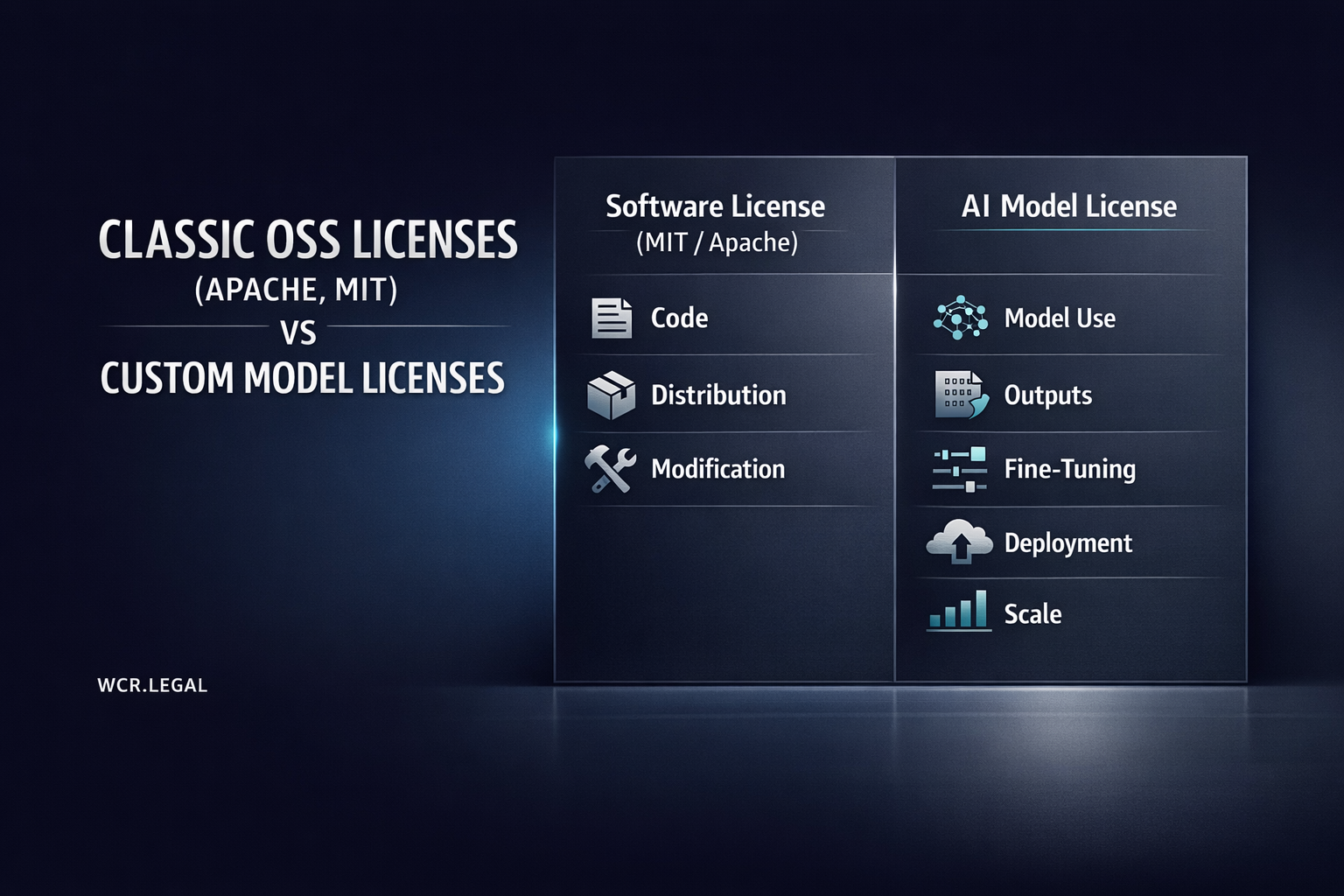
What classic OSS licences govern
Apache-2.0 and MIT license source code as a copyrighted work — a human-readable artefact with clear copyright ownership. The licence grants downstream users rights under copyright law that would otherwise be reserved.
What model licences must also govern
Model weights are not source code. Custom model licences use contractual terms (terms of use, acceptable use policies) that bind users through contract law — a distinct and less settled legal mechanism than copyright licensing.
The enforcement gap
Copyright-based licences like Apache-2.0 are enforceable regardless of whether the user agreed to anything. Contract-based model licences require acceptance of terms — a condition custom licences attempt to satisfy through click-through or continued-use acceptance clauses.
The AI model licence permissiveness spectrum
No use restrictions
Standard OSS
Termination right
restriction + training ban
into every derivative
IP ownership context: Licence type determines your right to use a model — it does not determine who owns your fine-tuning data, inference outputs, or the IP structure of a product built on top of a model. For analysis of AI IP ownership in commercial and investment contexts, see AI IP Ownership — wcr.legal.
Section 1 — How Apache-2.0 and MIT Work: For Code and for AI Models
Apache-2.0 and MIT are called “permissive licences” because they impose minimal conditions on downstream use. Both allow commercial use, modification, redistribution, and sublicensing without requiring the downstream user to open-source their own code. The legal architecture underlying each licence is well-understood, widely litigated, and broadly consistent across jurisdictions. Understanding that architecture — and where it does and does not map to AI model weights — is the foundation for any comparison with custom model licences.
Apache License, Version 2.0
The most commercially complete permissive licence — includes an explicit patent grant and a patent termination clause that no other major permissive licence provides.
Apache-2.0 grants users a perpetual, worldwide, royalty-free copyright licence to reproduce, prepare derivative works, publicly display, publicly perform, sublicense, and distribute the licensed work and derivatives. Critically, it also grants an explicit patent licence covering patents necessarily infringed by the contribution or the work itself — something MIT does not do explicitly.
The patent termination clause is Apache-2.0’s most distinctive feature: if a downstream user initiates patent litigation claiming the licensed work infringes a patent, their patent licence under Apache-2.0 terminates automatically. This creates a deterrent against patent assertions by licensees and makes Apache-2.0 the preferred licence in patent-sensitive commercial environments.
Conditions: Preserve copyright notices. Include the Apache-2.0 licence text in any distribution. If modifications are made to the original, state that changes were made. Include a NOTICE file if one exists in the original.
MIT License (Expat License)
The shortest and simplest major permissive licence — maximum freedom with minimal conditions. Universally recognised and the most commonly used licence in open-source software.
MIT grants permission to use, copy, modify, merge, publish, distribute, sublicense, and sell copies of the licensed software, and to permit recipients to do the same — subject only to the condition that the original copyright notice and permission text be included in all copies or substantial portions.
MIT does not contain an explicit patent grant. In jurisdictions where patent licences must be explicit, this creates a theoretical exposure: the copyright licence grants rights to the code, but does not explicitly license patents that may be practised by using it. In practice, this gap is rarely material for library code — but becomes more significant for AI model weights where training and inference methods may be patent-encumbered.
Why MIT dominates small projects: Its brevity (under 200 words) and minimal conditions make it frictionless for individual contributors. Enterprise legal teams generally understand MIT and have standard approval workflows for it — making it commercially easier to consume than more complex licences.
BSD 2-Clause and 3-Clause Licenses
A family of permissive licences predating MIT and Apache — historically important, still widely encountered, and functionally similar to MIT in commercial practice.
BSD 2-Clause (“Simplified BSD”) requires preservation of copyright notices and disclaimer text in source and binary distributions. BSD 3-Clause adds a non-endorsement clause: the licensee may not use the copyright holder’s name to endorse or promote products derived from the software without written permission. BSD 4-Clause (the original) added an advertising clause that has been dropped in modern usage due to GPL incompatibility and commercial friction.
In commercial AI product contexts, BSD licences are less commonly encountered in model weights than Apache-2.0 or MIT. They provide equivalent commercial freedom but lack the explicit patent grant of Apache-2.0. The non-endorsement clause in BSD 3-Clause serves a similar function to the trademark restriction in custom model licences — but operates more narrowly and is derived from copyright rather than contract.
Permissive Licence Feature Matrix — Code vs Model Weight Application
What each major permissive licence provides for code and for AI model weights
Section 2 — How Custom Model Licences Differ from Apache/MIT in Terms of Risk
Apache-2.0 and MIT share a defining characteristic: they impose no restrictions on use and cannot be revoked once granted. Custom model licences from Meta, Google, and NVIDIA share neither of these properties. The legal distance between an Apache-2.0 licence and a custom model licence is not a matter of degree — it is a structural difference that changes how the licence functions, how it can be enforced, and what risks it creates for products built on top of those models.
Three vendor licences currently dominate the commercial open-weight landscape: Meta’s Llama 3 Community License, Google’s Gemma Terms of Use, and NVIDIA’s Open Model License. Each takes a different approach to use restrictions, but all three share characteristics that place them in a fundamentally different risk category from Apache-2.0 or MIT.
The Llama 3 licence permits commercial use for most companies, but embeds three restrictions that have no equivalent in Apache-2.0 or MIT. First, the 700 million monthly active users clause converts the licence from unconditional to conditional: above that threshold, continued commercial use requires a separate agreement with Meta on terms Meta sets unilaterally. Second, the competitor restriction bars use in products that directly compete with Meta’s core businesses — including social networking, messaging, and AI assistant categories — regardless of user count. Third, the training ban prohibits using Llama 3 outputs or fine-tunes to train, distil, or improve any AI model that is not itself a Llama derivative.
From a commercial risk perspective, the critical issue with the 700M clause is not whether a given company will reach that threshold. It is that investors and acquirers evaluate the clause as an unquantified contingent liability during due diligence — a dependency on Meta’s discretion for continued operation at scale that has no equivalent cost or mechanism in an Apache-2.0 product.
Google — Gemma Terms of Use
Prohibited Use Policy with flow-down obligation and unilateral termination right
The Gemma Terms of Use introduce two risk vectors not present in Llama 3 and entirely absent from Apache-2.0: a flow-down obligation and a unilateral termination right. The flow-down obligation requires that every product built on Gemma passes the Prohibited Use Policy restrictions to downstream users — meaning a B2B platform using Gemma must ensure its enterprise clients do not use the platform for any prohibited purpose. This creates a compliance monitoring obligation with no parallel in permissive open-source licensing.
The termination right gives Google authority to revoke a licensee’s rights on breach — a power that Apache-2.0 and MIT simply do not grant licensors. Combined with Google’s right to update the Terms of Use with continued use constituting acceptance, the Gemma licence creates a dynamic legal relationship rather than the static, irrevocable grant characteristic of true OSS licences. For enterprise software products built on Gemma, both features require contractual attention that would never arise with an Apache-2.0 model.
NVIDIA — Open Model License
Hardware-agnostic use permitted with output ownership retained by licensee
NVIDIA’s Open Model License is the most permissive of the three major custom model licences, but it is still not Apache-2.0. It permits commercial use, allows deployment on non-NVIDIA hardware, and does not include the scale thresholds or competitor restrictions found in Llama 3. It explicitly confirms that inference outputs belong to the user — a provision that is useful to have in writing even if it should be the default position.
However, the licence retains use-case restrictions via an Acceptable Use Policy, prohibits using NVIDIA models to train competing foundation models, and reserves the right to modify terms. It also does not include a patent grant for methods embedded in or used by the model — leaving potential exposure for inference techniques or fine-tuning methods that touch NVIDIA’s patent portfolio. For commercial deployments, the absence of a patent grant and the training restriction are the two terms that require legal review before treating NVIDIA’s Open Model License as equivalent to Apache-2.0.
Risk Dimension Comparison — Apache-2.0 vs Custom Model Licences
The following matrix maps six risk dimensions across Apache-2.0 (the OSS benchmark), the Llama 3 Community License, the Gemma Terms of Use, and NVIDIA’s Open Model License. All custom model licences carry risk characteristics that do not exist in Apache-2.0 or MIT.
The choice of model determines which licence binds the product. With Apache-2.0, the licence analysis ends here. With a custom model licence, it is the beginning of a compliance chain.
Custom licences restrict what the product can do (competitor clause, AUP) and how it must be distributed (flow-down, relicensing restrictions). These are design constraints with no Apache-2.0 equivalent.
Gemma’s flow-down obligation means enterprise customer agreements must incorporate the Prohibited Use Policy. This creates sales friction and legal overhead not present with Apache-2.0 products.
At Series B or acquisition, custom model licences are reviewed as contingent liabilities. Llama 3’s 700M clause, Gemma’s termination right, and NVIDIA’s absent patent grant each require specific legal analysis and disclosure. Apache-2.0 requires none.
Practical implication: The risk gap between Apache-2.0 and a custom model licence is not visible at deployment — it surfaces during fundraising, customer contract negotiations, and acquisition due diligence. Companies that model their IP stack as if a Llama 3 or Gemma licence were equivalent to Apache-2.0 will encounter friction at these stages that could have been avoided or priced in at the model selection stage.
Section 3 — Copyleft and Why It Is Mostly Absent from LLM Licences
Copyleft is the most powerful mechanism in open-source licensing. Under the GPL, any software that incorporates GPL-licensed code and is distributed externally must itself be released under the GPL — a requirement that makes proprietary products built on copyleft code commercially unviable. For AI models, copyleft has largely failed to take hold, and the reasons go beyond commercial preference: the standard copyleft mechanism does not cleanly map onto how model weights are created, distributed, or used.
The GPL principle
The GPL grants the right to use, modify, and distribute software — but only on the condition that any derivative work distributed externally is also released under the GPL. This “share-alike” obligation propagates through the code, ensuring that no commercial entity can build a proprietary product from GPL foundations and keep it closed.
Why it works for source code
GPL copyleft works because derivative works in software have a clear legal definition: a work that incorporates, links to, or is derived from GPL code. The boundary between the GPL work and the derivative is identifiable — the source code is either present or absent. This clarity makes the copyleft obligation both detectable and enforceable.
Three Barriers to GPL-Style Copyleft in AI Models
Even if a model developer wanted to apply true copyleft terms to their weights, three structural barriers make it technically, legally, and commercially problematic.
RAIL Licences — Copyleft’s Nearest AI Equivalent
Responsible AI Licences (RAIL) as a hybrid approach to use restriction propagation
The Responsible AI License (RAIL) framework, developed by the BigScience community and used in licences like the CreativeML Open RAIL-M (Stable Diffusion), is the closest the AI licensing ecosystem has come to a copyleft analogue. RAIL licences do not attempt to reproduce GPL’s source-disclosure requirement — they instead embed use restrictions directly into every downstream licence, requiring that anyone who distributes a RAIL-licensed model or derivative must pass the same use restrictions to their downstream recipients.
This “use restriction propagation” is structurally similar to copyleft: it creates obligations that travel with the model through the distribution chain. But it differs in two important ways. First, RAIL restrictions are use-based (prohibiting specific harmful applications) rather than openness-based (requiring open distribution). Second, RAIL licences still permit commercial use and proprietary products — they are closer to a non-commercial restriction on specific uses than to the full copyleft requirement to open-source derivatives.
Use restrictions propagate to every downstream recipient and derivative — no one in the distribution chain can strip them out.
Does not require open-sourcing derivatives. Proprietary fine-tunes and commercial products are permitted — only specific harmful uses are restricted.
RAIL licences create the same flow-down monitoring obligation as Gemma’s ToU: every downstream product must contractually pass the restrictions to its users.
Major commercial LLM providers have not adopted RAIL licences. Meta, Google, and NVIDIA use custom AUP-based licences rather than RAIL, because RAIL’s propagation requirement adds downstream compliance complexity.
Comparing Copyleft Mechanisms Across Licence Types
(Llama/Gemma)
The practical conclusion for product and legal teams is straightforward: copyleft as traditionally understood in software licensing does not currently operate in the commercial LLM space. GPL and AGPL are absent from the licences of all major open-weight models. RAIL licences exist but are uncommon in commercial deployments. The dominant licence architecture for open-weight models is custom AUP-based contractual restriction — which is neither as protective as copyleft nor as permissive as Apache-2.0, and occupies a distinct risk category that standard OSS compliance workflows are not designed to handle.
Section 4 — Which Licence Types Enterprise Clients Prefer — and Why
Enterprise procurement teams apply a fundamentally different standard to AI model licences than to other software dependencies. For SaaS tools and standard software libraries, Apache-2.0 and MIT are considered approved by default in most Fortune 500 organisations. Custom model licences — regardless of how “open” they are marketed — require individual legal review because the risk categories they introduce (updatable terms, termination rights, use restrictions, flow-down obligations) have no equivalent in the standard OSS review workflow.
What Enterprise Legal Teams Look for in Model Licences
When enterprise procurement or legal teams evaluate whether a product built on an open-weight model can be approved for internal or customer-facing use, four requirements consistently determine the outcome.
Immutability — terms that cannot change unilaterally
Enterprise contracts are built on the assumption that licence terms are fixed at the point of procurement. Updatable licences (Gemma, Llama 3, NVIDIA) require ongoing monitoring and create compliance exposure that cannot be addressed through standard software procurement workflows. Apache-2.0 and MIT cannot be updated by the licensor — a version-specific grant is permanent.
No use-case restrictions — or clearly scoped exceptions
Enterprise products are deployed across many contexts simultaneously. Use restrictions in custom model licences require an enterprise to audit every deployment against every prohibited use category — a review process with no equivalent for Apache-2.0 or MIT products. Restrictions must be clearly written and narrowly scoped to be acceptable; broad AUP categories like “any harmful application” create interpretive uncertainty.
No flow-down obligation — or clear mechanism for compliance
The Gemma flow-down requirement is the most commercially disruptive characteristic for B2B enterprise products. It requires contract amendments with every enterprise customer to pass through the Prohibited Use Policy — a sales friction that makes Gemma-based products more difficult to sell to regulated industry clients, financial institutions, and government buyers whose standard agreement forms do not accommodate third-party use restrictions.
Patent clarity — express grants or clear scope
Apache-2.0 includes an express patent grant for the licensed code. Custom model licences typically do not include patent grants for model methods, inference techniques, or training processes. For enterprise buyers in patent-heavy industries (financial services, healthcare, semiconductors), the absence of a patent grant leaves residual IP exposure that must be addressed through indemnity provisions — a negotiation with no Apache-2.0 equivalent.
Enterprise Licence Approval — Procurement Comparison Matrix
The following matrix maps how standard enterprise procurement workflows respond to four licence categories. “Standard approval” means the licence passes enterprise legal review without a dedicated IP or contracts team engagement.
If an enterprise product is in a well-defined vertical (e.g., internal HR tooling, code completion, document summarisation) that is unambiguously outside all prohibited use categories, AUP restrictions can be accepted with a documented scope analysis rather than ongoing monitoring.
For B2B products with standardised subscription agreements, incorporating Gemma-style use restrictions into ToS is operationally achievable — though it must be reviewed by legal and disclosed in enterprise MSA negotiations.
The Llama 3 700M clause does not automatically block enterprise approval — it must be disclosed in IP schedules during fundraising and M&A, with a documented model transition plan or a clear argument for why the threshold is not reachable within the product’s intended scope.
For regulated sectors where Apache-2.0 alternatives (Mistral, certain Qwen releases) perform comparably, enterprise procurement teams will default to the simpler licence. Custom model licences are typically accepted only when the model provides a material capability advantage that cannot be replicated with a cleaner licence.
Enterprise Compliance Checklist — Before Deploying on a Custom Model Licence
Apache-2.0 Remains the Benchmark — Custom Model Licences Require a Different Framework
Apache-2.0 and MIT are the most permissive and commercially reliable licences available for software — including AI models. Where they apply (most notably to Mistral models), they provide the full set of enterprise procurement benefits: immutable terms, no use restrictions, no flow-down obligations, a patent grant, and standard OSS compliance workflows.
Custom model licences from Meta, Google, and NVIDIA operate differently. They are contractual instruments rather than copyright licences, their terms can change, their use restrictions require ongoing compliance monitoring, and they introduce risk categories — scale thresholds, termination rights, training bans, flow-down obligations — that the standard enterprise OSS approval workflow was not designed to handle.
Copyleft, which might have provided a different but equally clear framework, has largely failed to reach the LLM licensing layer for structural reasons: the legal definition of a model derivative is unsettled, the equivalent of “source code” for a model involves proprietary training data, and most model use occurs via API rather than through distributable weight files.
The practical conclusion is that model licence type is a product architecture decision, not an afterthought for the legal team. Choosing an Apache-2.0 model where one exists at the required capability level eliminates an entire class of commercial and legal risk. Where a custom model licence is the right choice on performance or capability grounds, the checklist and framework in this guide provide the minimum required compliance infrastructure.
For analysis of how licence type interacts with AI IP ownership, fine-tuning rights, and investment structuring, see AI IP Ownership — wcr.legal.