How the AI Services Market Is Changing in the Age of Free Models

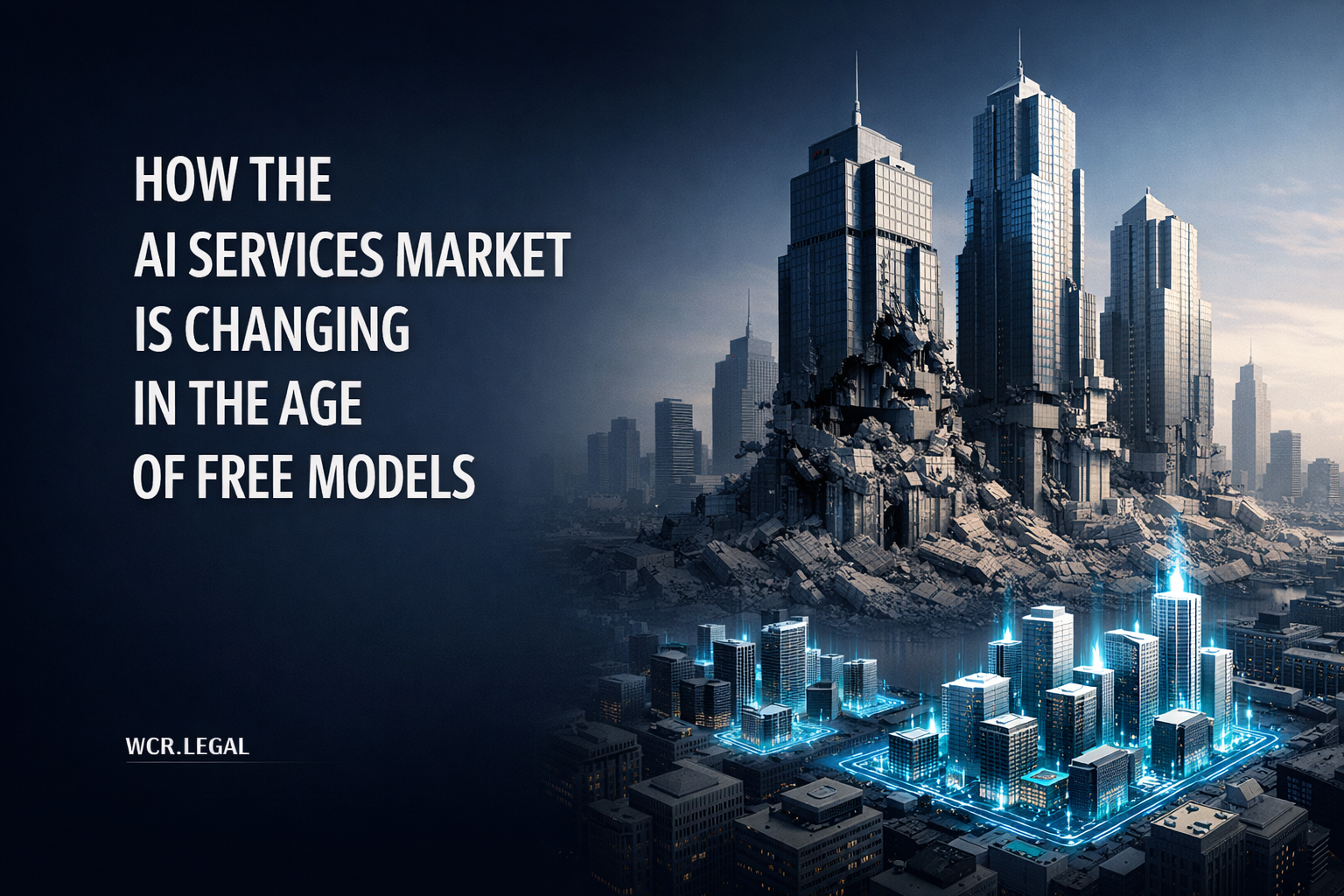
How the AI Services Market Is Changing in the Age of Free Models

How the AI Services Market Is Changing in the Age of Free Models

📈 AI Business Strategy · Market Analysis

How the AI Services Market Is Changing in the Age of Free Models

Powerful AI models are now available at zero cost. DeepSeek, LLaMA, Mistral, and Gemma have made capabilities that cost millions to build freely downloadable. The AI services market is restructuring fast — and the businesses that understand where value is migrating, and where legal risk remains, will be the ones that come out ahead.

📊 Base-model layer: commoditising
⚖️ Regulatory obligations: unchanged by price
🏆 Value: migrating up-stack
🌍 Cross-border risk: increasing
Topics: AI Commoditisation Free AI Models AI Market Strategy Open Weights AI Services Disruption EU AI Act Compliance Cross-Border AI AI Procurement AI Competitive Advantage
📈 Section 1

The Death of the AI Price Floor — What "Free" Actually Means

The AI services market was built on the assumption that access to frontier model capability required frontier-level spend. That assumption is now obsolete. A wave of open-weight and permissively licensed models has erased the price floor for base AI capability — but understanding what "free" actually costs, and what it changes in the market structure, is essential before drawing strategic conclusions.

🔀 The Two Tracks of AI Availability — Open Weights vs. Free API Access
⚖️
Open-Weight Models (Download & Run)
The model weights are publicly released under a licence that permits download, local deployment, and in many cases fine-tuning and commercial use. You pay for compute to run the model — but not for the model itself. Examples: Meta LLaMA 3, Mistral 7B/8x7B, Google Gemma 2, DeepSeek-V3, Qwen 2.5.
No per-token API cost — run on your own infrastructure
Full model control — fine-tune on proprietary data
Data privacy by design — no third-party data transmission
Licence restrictions still apply — commercial use, AUP violations, geographic restrictions
🌐
Free API Tiers (Hosted Access)
Leading AI providers — Groq, Hugging Face Inference, Cloudflare Workers AI, and others — offer free or heavily subsidised API access to frontier-class open models. This gives businesses access to powerful AI without infrastructure costs, though with rate limits and shared infrastructure.
Zero infrastructure cost at low/medium volumes — immediate integration
No fine-tuning control — provider's hosted version only
Data processed by third-party — privacy and GDPR implications
"Free" is often a loss-leader — pricing may change at scale
🕐 Timeline: How Base AI Capability Was Commoditised (2023–2025)
  • 2023
    Meta releases LLaMA 2 under commercial licence Game-changer
    The first large-scale, commercially usable open-weight model from a major lab. 7B to 70B parameter variants. Gave any developer GPT-3.5-level capability at zero model cost. Within weeks, thousands of fine-tuned derivatives appeared.
  • 2023
    Mistral AI releases Mistral 7B and Mixtral 8x7B with Apache 2.0 licence
    No use restrictions whatsoever on the base model. Mixtral achieved GPT-3.5 parity at a fraction of the compute cost, becoming the most deployed open model in enterprise applications within six months of release.
  • 2024
    Google releases Gemma 2 (2B and 9B) and Meta releases LLaMA 3 (8B to 405B)
    Both families hit GPT-4 class performance at larger sizes. LLaMA 3 405B — trained on over 15 trillion tokens at an estimated cost exceeding $100 million — made freely available. The gap between "open" and "frontier" closed substantially.
  • 2025
    DeepSeek-V3 and DeepSeek-R1 released — triggering a market inflection point Inflection
    DeepSeek's models — built for a fraction of conventional training cost — matched GPT-4o on benchmarks and were released as fully open-weight. The R1 reasoning model demonstrated that frontier reasoning capability no longer required frontier training budgets. Global stock markets reacted; AI service pricing across the industry fell within weeks.
  • 2025
    API pricing for proprietary models collapses — race-to-zero dynamic begins
    Anthropic, OpenAI, and Google all cut API prices by 60–80% in response to open-model competition. By mid-2025, GPT-4-class capability was available for under $1 per million tokens via API — and for zero cost via locally deployed equivalents. The base-model price floor effectively ceased to exist.
🖥️
Compute Cost
Real Running a 70B parameter model in production requires significant GPU capacity — typically $2,000–$10,000+/month for a single production deployment on cloud infrastructure. "Free model" does not mean free operation. Smaller models (7B–13B) can run economically on mid-range GPU servers.
👩‍💻
Engineering Cost
Significant Deploying, fine-tuning, maintaining, and monitoring open-weight models requires ML engineering expertise that is both scarce and expensive. Businesses that lack this capability effectively cannot access "free" models without service intermediaries — recreating a cost structure.
⚖️
Compliance Cost
Underestimated Licence compliance, EU AI Act deployer obligations, data protection, export control checks, and liability structuring add real cost to any AI deployment — and these costs do not reduce because the model is free. Many businesses discover this only after deployment.
⚡ The Core Insight
The base-model layer of the AI value chain is commoditising — and that process is largely complete. But commodity base models do not mean commodity AI services. The compute, the data, the expertise, the compliance infrastructure, and the domain-specific application layer above the model remain genuinely costly and difficult to replicate. Understanding this distinction determines whether the commoditisation wave is a threat or an opportunity for your business.
🏆 Section 2

How the Market Is Restructuring — Winners, Losers, and New Entrants

Commoditisation of the base-model layer does not affect all players in the AI market equally. It is profoundly disruptive for some business models and powerfully enabling for others. Understanding which side of the disruption your business sits on — and why — is the starting point for strategic adaptation.

📈
Positioned to Win
↑ Advantage
🌩️ Hyperscale Cloud Providers (AWS, Azure, GCP)
Every open-weight model deployed needs to run somewhere. Cloud GPU capacity demand explodes as the model cost drops to zero — the infrastructure layer captures more value as the model layer commoditises. AWS, Azure, and GCP offer managed model hosting, removing engineering barriers for enterprise customers.
Infrastructure moat strengthens
🏥 Vertical Domain Specialists
Firms that combine deep domain knowledge (legal, medical, financial, compliance) with AI capabilities find that free base models dramatically reduce their build cost — but the domain expertise that makes their service valuable is unaffected by commoditisation. Their competitive moat deepens relative to generalist competitors.
Domain + AI = durable differentiation
⚖️ AI Governance, Risk & Compliance Advisers
The proliferation of free models increases AI deployment volume across all business sizes. Every deployment creates governance, compliance, and liability obligations — demand for AI legal and regulatory expertise scales with deployment volume, not model cost.
Demand scales with proliferation
🔧 System Integrators with AI Orchestration Skills
Businesses need someone to deploy, fine-tune, connect, monitor, and maintain AI systems built on open models. Integrators who develop genuine orchestration expertise — RAG pipelines, agent architectures, evaluation frameworks — are in high demand as the model procurement decision simplifies.
Engineering scarcity = premium pricing
📉
Under Structural Pressure
↓ Disrupted
🤖 Undifferentiated AI SaaS Vendors
Businesses selling AI-powered tools where the core capability is "access to a good language model" — writing assistants, basic chatbots, generic Q&A tools — face severe pricing pressure. Customers can build equivalent products themselves using free models, or switch to lower-cost alternatives built on open weights.
Margin compression: severe
📊 Generalist AI Consulting Firms
Consulting firms whose AI value proposition was primarily built on access to frontier model APIs (acting as GPT-4 resellers with consultancy wrapper) lose their access advantage. If the model capability is free, the consultant's distinctive value must come from something else — domain expertise, implementation quality, governance capability.
Commoditisation of the access layer
🔒 Closed-Model API-Only Players
AI model providers who do not offer open-weight releases face a painful trade-off: match open-model pricing (eroding margins) or maintain premium pricing (and watch market share erode). The mid-tier of model providers — good but not frontier — faces existential margin compression from open-weight equivalents.
Pricing power diminishing
🏢 Enterprise Software Vendors (AI Feature Parity Race)
Major enterprise software vendors (SAP, Salesforce, ServiceNow) that charged premiums for "AI-enhanced" products now face customers who question whether the AI premium is justified when open models achieve comparable results. Commoditisation accelerates the expectation that AI features are table stakes, not premium add-ons.
AI premium pricing eroding
📊 Margin Compression Analysis — Three Segments of the AI Services Market
🔴 High Pressure
Commodity AI Tools & Access Layers
Generic writing, summarisation, chatbot, and Q&A tools with no proprietary data or workflow advantage. Customers can self-serve with open models. The value proposition — access to AI — is now available for free.
Existential margin pressure
🟡 Medium Pressure
Mid-Tier AI Platforms & APIs
AI platforms with some differentiation — better UX, managed infrastructure, basic fine-tuning — but no deep domain advantage or proprietary data moat. Customers weigh build cost vs. subscription cost as open models lower the build cost curve.
Pricing power erosion
🔵 Low Pressure
Vertical AI & Compliance-First Deployments
AI services built on proprietary data, deep domain expertise, auditability, compliance infrastructure, or regulated-sector specialisation. These services solve problems that free models make harder (liability, explainability, data sovereignty) rather than easier.
Competitive position strengthening
🚀 New Entrants Enabled by Free Models — Who Is Emerging
🏗️
Solo Builders and Micro-SaaS
Individual developers and small teams can now build commercially viable AI products without model training costs or API budgets. Vertical micro-SaaS products — AI for niche law firm workflows, specific manufacturing QC use cases, narrow regulatory reporting tools — are proliferating at lower capital cost than ever before.
🌍
Emerging Market AI Companies
Businesses in jurisdictions where OpenAI and Google APIs are restricted, expensive, or culturally misaligned can now build on open models without dependency on US-based providers. This is reshaping the competitive geography of the global AI services market — and creating cross-border AI compliance complexity in the process.
🏛️
Public Sector & Government AI
Governments and public institutions that could not use US-based closed-model APIs due to data sovereignty requirements can now deploy open-weight models on sovereign infrastructure. EU public sector AI adoption is accelerating as a result — creating new demand for public-sector-focused AI service providers.
🔬
Research-to-Market Accelerators
Academic and research institutions that previously could not afford frontier model access for applied research are now building commercially relevant AI tools on open models and spinning them out. The time from research prototype to market-ready product has collapsed dramatically, increasing competitive intensity across all verticals.
⚡ The Structural Conclusion
Market restructuring from AI commoditisation follows a clear pattern: businesses whose value was access to AI capability are disrupted; businesses whose value is what they do with AI capability — in specific domains, for specific regulated clients, with specific data advantages — are strengthened. The question is not "are you using AI?" but "what about your AI service is genuinely hard to replicate now that the model is free?"
🏆 Section 3

Where Value Migrates — The New Sources of Competitive Advantage

When a capability becomes free, value does not disappear — it moves. Understanding exactly where value is migrating in the AI services stack determines which investments generate durable competitive advantage and which will be competed away as quickly as they are built. Five distinct value pools are now clearly visible as the base-model layer commoditises.

🗄️
Proprietary Data and Fine-Tuning Advantage
Data Moats · Training Differentiation
⭐ Highly Durable
The Advantage
A free model fine-tuned on your proprietary data — customer interactions, domain-specific documents, sector-specific labelled datasets — produces outputs that competitors cannot replicate without that data. The model is free; the data that makes it uniquely valuable is not. This is the deepest and most durable moat available in the age of commoditised models.
Who Has It
Financial institutions with decades of structured client data. Healthcare systems with longitudinal patient records. Legal firms with documented case outcomes and precedent libraries. E-commerce platforms with purchasing and behaviour data. Any organisation with a long-running, digitised, domain-specific record of human decision-making has a latent data moat.
What to Do
Audit your proprietary data assets now — before competitors do. The organisations that will dominate vertical AI are those that pair systematically collected, high-quality proprietary data with the now-free model capability layer. The window for early moat-building is closing as every sector becomes aware of this dynamic.
🏥
Deep Domain Expertise and Workflow Integration
Vertical Specialisation · Workflow Embedding
⭐ Highly Durable
The Advantage
A model that understands general language is not the same as a service that understands the specific workflow, regulatory context, and decision logic of a given profession or industry. Building an AI service that is genuinely integrated into how a specific type of professional works — rather than sitting alongside their workflow — creates a switching cost that survives base-model commoditisation entirely.
Examples
AI that understands contract drafting conventions in a specific jurisdiction, not just language generation. AI that understands clinical decision protocols, not just medical vocabulary. AI that knows how a specific regulatory form interacts with specific submission requirements. The deeper the workflow integration, the more durable the advantage — domain knowledge is expensive to replicate regardless of model cost.
The Risk
Domain expertise that is undocumented — living in the heads of a few senior practitioners — is a fragile moat. Building durable AI advantage from domain expertise requires systematically codifying it: into training data, evaluation frameworks, prompt engineering, and output validation pipelines that will outlast the individuals who created them.
⚖️
Compliance Infrastructure and Auditability
Regulated Sectors · Trust Layer · Legal Risk Management
⭐ Highly Durable
The Advantage
The EU AI Act, financial services AI regulation, healthcare AI frameworks, and data protection law all create compliance requirements that apply equally to cheap and expensive AI deployments. Building AI services with auditable decision trails, human oversight mechanisms, explainability, and documented risk management creates trust that free-model deployments cannot quickly replicate — particularly in regulated sectors.
Why It's Scarce
Most AI builders focus on capability, not compliance. The ability to deliver AI outputs that are not just accurate but legally defensible, auditable, explainable, and compliant with sector-specific regulation is rare. Financial services firms, healthcare providers, and law firms are willing to pay premium prices for AI services that have this infrastructure built in — and cannot easily self-build it.
The Multiplier
Compliance capability does not just protect against fines and liability — it is a positive selling point in regulated sector procurement. Buyers who need to satisfy their own regulators about AI governance will pay a premium to suppliers who make that governance burden manageable. The compliance layer becomes a sales enabler, not just a cost centre.
🎨
User Experience and Distribution
UX Design · Product Distribution · Customer Relationships
◆ Moderately Durable
The Advantage
The raw capability of a model is only one determinant of adoption. How the AI is presented, how naturally it fits into existing workflows, and how reliably it produces the right output for the specific user's context determine whether people actually use it. Strong UX and distribution advantages create switching costs independently of model quality — and they have historically been the primary driver of enterprise software adoption.
The Risk
UX advantages are less durable than data moats or domain expertise. Competitors can replicate good UX faster than they can replicate proprietary data or deep domain knowledge. This is why the strongest AI businesses pair UX investment with one of the more durable moat types — distribution and data together are far stronger than distribution alone.
Distribution Matters More Than Ever
As AI capability commoditises, the winners increasingly are those with existing customer relationships into which AI features can be embedded — not those building AI-first products that require customers to change their existing workflows. Existing enterprise software vendors have a structural distribution advantage that new AI-first entrants must work hard to overcome.
🔒
Data Sovereignty and Private Deployment
Air-Gapped Deployment · Regulatory Sovereignty · Public Sector
⭐ Highly Durable
The Advantage
Open-weight models uniquely enable deployment in environments where data cannot leave a specific jurisdiction or infrastructure boundary — government networks, healthcare systems, financial institution data centres, and organisations with data residency requirements. This capability did not exist with closed-model APIs and creates an entirely new market for AI services.
Who Needs It
EU public sector bodies operating under data sovereignty requirements. Regulated financial institutions with strict data residency obligations. Healthcare organisations processing patient data. Defence and intelligence sector. Any organisation that has historically been unable to use cloud-based AI services due to data protection constraints can now deploy equivalent capability locally.
The Business Opportunity
Firms that can manage the technical complexity of private deployment — infrastructure selection, model management, security hardening, ongoing maintenance, and compliance documentation for on-premise AI — serve a large, underserved market willing to pay significant premiums for this capability. The cross-border AI compliance dimension is increasingly significant as jurisdictions diverge on AI data rules.
📐 The New AI Value Stack — Where Value Lives in 2025
🏆 Domain + Data + Compliance
Proprietary data moats combined with deep domain expertise and compliance infrastructure. Durable premium pricing power. Cannot be replicated by model commoditisation.
Premium Value
🔧 AI Orchestration & Fine-Tuning
RAG pipelines, agent architectures, fine-tuning on proprietary data, evaluation frameworks, and deployment management. High demand; limited supply of genuine expertise.
Rising Value
🖥️ Managed Inference & Infrastructure
Managed hosting, scaling, security hardening, and monitoring for open-weight models. Valuable but increasingly contested by cloud hyperscalers with structural advantages.
Contested
🔌 API Access & Wrappers
Providing API access to models with basic UX wrappers or integration layers. Rapidly commoditising. Value depends entirely on what differentiates the wrapper — not on the model beneath it.
Eroding
🤖 Base Model Capability
Language generation, reasoning, summarisation, code generation. LLaMA, Mistral, Gemma, DeepSeek. Effectively free — commoditised. No durable margin available here.
Commoditised
⚡ The Migration Thesis
Value in the AI market is not disappearing — it is migrating upward in the stack, from the model layer toward the data, domain expertise, compliance infrastructure, and workflow integration layers above it. Businesses that are still investing primarily in model access are investing in the wrong layer. The race to own proprietary data assets, build genuine domain depth, and construct compliance-ready AI infrastructure has already begun — and the window for first-mover advantage in most verticals is measured in months, not years.
⚖️ Section 4

Legal Complexity Doesn't Come with a Discount — Regulatory Dimensions of Free AI

The widespread assumption that free or open-weight AI is legally simpler than proprietary AI is wrong. In many respects, the opposite is true. When you deploy an open-weight model, you assume direct compliance responsibility that would otherwise sit with the API provider. The legal and regulatory obligations that apply to AI services — licence compliance, export control, EU AI Act deployer duties, data protection, and AI liability — are unchanged by the price tag on the model. Here is what businesses need to understand.

📄
Open-Weight Licence Compliance
AUP · Commercial Restrictions · Derivatives
High Risk
Issue
Most open-weight models are not "open source" in the OSI sense. LLaMA 3, Gemma, and Falcon all contain commercial use restrictions, Acceptable Use Policy (AUP) prohibitions, or user-threshold licensing conditions. Violation of these conditions creates contractual liability — and in some cases, copyright infringement exposure — without any notice or invoice to flag the risk.
Common Traps
LLaMA 3 requires a separate licence for services with over 700 million monthly active users. Gemma prohibits use in certain high-risk regulated contexts without additional compliance steps. DeepSeek's licence restricts use in ways that may affect US-China technology transfer compliance. Most businesses deploy without reading the licence in full.
Action
For every open-weight model you deploy: identify the licence (Apache 2.0, LLaMA Community Licence, Gemma Terms), review the AUP, check commercial use permissions, and document your compliance analysis. Treat this like software licence compliance — because legally, it is exactly that.
🌍
Export Controls and Cross-Border AI Use
EAR · BIS Controls · Technology Transfer · Jurisdiction
High Risk
Issue
AI model weights may be subject to export control under the US Export Administration Regulations (EAR), particularly for models above certain capability thresholds. The US Bureau of Industry and Security (BIS) published a framework in 2024 linking model capability (measured in compute/FLOPs) to export licensing requirements. This applies even to "open" releases.
Deployment Risk
Operating an AI service accessible from restricted jurisdictions — Iran, North Korea, Russia, certain Chinese entities — without export licence compliance can constitute a federal violation. Cloud-hosted open-weight model services require geographic access controls and user screening that many developers do not implement. Cross-border data flows and AI outputs also trigger EU, UK, and national data protection rules that vary significantly by jurisdiction.
Action
Conduct export control classification for AI systems you develop or deploy. Implement geographic access controls for restricted jurisdictions. For EU-facing businesses, map your AI data flows against GDPR Chapter V requirements for international transfers. Review cross-border AI compliance obligations before deploying open-weight models in multi-jurisdictional contexts.
🔒
Data Protection and Privacy Obligations
GDPR · Training Data · Fine-Tuning · Output Privacy
High Risk
Issue
Fine-tuning an open-weight model on personal data triggers GDPR obligations as a data controller — including data minimisation, purpose limitation, data subject rights, and lawful basis requirements. Using open-weight model outputs in customer contexts creates data controller obligations that did not exist when using a third-party API provider's hosted model.
Privacy Inversion Risk
A model fine-tuned on personal data can "memorise" and subsequently reproduce elements of that data in outputs to unrelated users. This is a well-documented AI privacy risk that creates both GDPR exposure (unauthorised data disclosure) and reputational harm. The absence of a third-party model provider does not reduce this risk — it increases it, because you assume the full compliance burden.
Action
Conduct a Data Protection Impact Assessment (DPIA) before fine-tuning on personal data. Implement data de-identification and minimum retention standards for training datasets. Establish GDPR Article 22 compliance for any automated decision-making. Review adequacy of your privacy notices to cover AI processing of user data.
⚠️
AI Liability Does Not Reduce with Model Price
False Outputs · Deployer Responsibility · Negligence
Overlooked Risk
Common Misconception
Many businesses assume that using a free model reduces their liability exposure — either because there is no contractual relationship creating warranties, or because they assume the model developer bears more risk than a business paying for a premium API. Both assumptions are wrong. When you deploy an open-weight model directly, you become the deployer with full EU AI Act deployer obligations and civil liability exposure.
The Accountability Shift
With a closed-model API, contractual liability partly sits with the provider — their terms of service, their AUP, their safety guardrails. With a self-deployed open-weight model, you have removed those protections. If the model produces harmful outputs — false statements, discriminatory decisions, privacy violations — there is no provider upstream to share liability. You own the deployment; you own the risk.
Action
Treat open-weight model deployment with at least as much liability rigour as closed-model API deployment. Implement output monitoring, human oversight for high-risk use cases, and incident response protocols. Understand your AI liability exposure as a deployer — it is unchanged by the absence of an invoice.
🇪🇺 EU AI Act — What Open-Weight Model Deployers Must Know
Obligation Area What It Requires for Open-Weight Deployers
Provider vs. Deployer Status If you deploy an open-weight model "under your own name or trademark" or make material modifications, you may be reclassified as a provider under the EU AI Act — with much more extensive obligations than a deployer. This affects any business that fine-tunes, modifies, or brands an open-weight model as their own AI product. High Impact
High-Risk System Classification The EU AI Act's risk classification applies to the use case — not the model source. A free open-weight model deployed in an employment screening, credit scoring, or healthcare diagnostic application is a high-risk AI system with full compliance obligations regardless of whether the model cost $0 or $1 million to license. Applies Equally
GPAI Provider Obligations The GPAI obligations under Articles 51–55 apply to the GPAI model provider (typically Meta, Google, Mistral for their models) — but deployers who build on GPAI models must ensure they receive adequate information about model limitations and known failure modes to discharge their own deployer obligations. Absent this, the deployer assumes greater liability for harmful outputs. Documentation Key
Transparency to Users Deployers must inform users they are interacting with AI, and for many high-risk systems must provide information about system capabilities and limitations. This applies regardless of whether the underlying model is open-weight or proprietary. The transparency obligation cannot be outsourced to the model provider — the deployer owns it. Direct Obligation
Fines for Non-Compliance Deployers of high-risk AI systems that fail to meet conformity obligations face fines of up to €15 million or 3% of global annual turnover. Deployers of prohibited AI applications face fines up to €35 million or 7% of global turnover. These fines apply equally to deployments built on free models and paid models. Up to 7% Turnover
⚡ The Legal Reality
Free and open-weight AI is not legally simpler than proprietary AI — it is often legally more complex, because the deployer assumes compliance obligations that would otherwise be shared with a provider. Businesses that move to open-weight models to reduce cost must simultaneously invest in the legal and compliance infrastructure to manage the increased regulatory exposure that comes with direct deployment. The model is free; the governance framework is not.
🛒 Section 5

Procuring AI Services in a Commoditised Market — What Businesses Need to Know

The commoditisation of base AI capability has transformed the procurement decision for businesses buying AI services. The question is no longer simply "which model is best?" — it is a more complex build-versus-buy-versus-integrate analysis, layered with due diligence requirements, vendor-lock-in considerations, and contractual protections that are specific to the new market structure. Here is how to approach AI services procurement intelligently in 2025.

🔀 The Core Procurement Decision: Build · Buy · Integrate
🔧
Build
Deploy open-weight models on your own infrastructure
✅ Advantages
Full control over model, data, and outputs
No per-token costs at scale
Data sovereignty — no third-party data transfer
Fine-tune on proprietary data for domain advantage
⚠️ Challenges
High infrastructure and ML engineering cost
Full compliance burden falls on you
Ongoing model maintenance and security responsibility
🎯 Best for: Organisations with proprietary data, data sovereignty requirements, or high-volume production AI workloads
💳
Buy
Subscribe to a managed AI service or SaaS product
✅ Advantages
Fast deployment — minimal engineering requirements
Provider handles infrastructure, updates, and safety
Shared compliance responsibility — provider's AUP applies
Predictable costs for low-to-medium volumes
⚠️ Challenges
Vendor lock-in and pricing risk at scale
Limited customisation or fine-tuning control
Data processed by third party — GDPR implications
🎯 Best for: SMEs, rapid prototyping, non-regulated contexts, or use cases where speed-to-market outweighs cost at scale
🔌
Integrate
Use managed open-weight API (Groq, Cloudflare, HuggingFace Inference)
✅ Advantages
Low or zero cost at low volumes
Open-weight model capability without infrastructure management
Flexibility to switch models without rebuilding infrastructure
Minimal engineering overhead vs. self-hosting
⚠️ Challenges
Free tiers are loss-leaders — pricing may change
No fine-tuning control on hosted inference
Data still processed by third party
🎯 Best for: Early-stage products, cost-sensitive startups, or businesses needing open-model access without infrastructure investment
🔍 Vendor Due Diligence — Questions to Ask Before Procuring Any AI Service in 2025
🤖 Technical & Model Questions
1
Which model or models power the service? Open-weight or proprietary? Are model versions pinned or subject to silent updates?
2
What are the known hallucination rates and accuracy benchmarks for your specific use case? Does the vendor provide a model card or technical documentation?
3
What fine-tuning or customisation options exist? Can you bring your own data, and if so, what happens to that data?
4
What output monitoring, filtering, or safety guardrails are in place? Can you configure these for your use case?
5
What is the vendor's approach to model updates? Will accuracy or behaviour change without notice, and what is the rollback procedure?
6
What SLAs apply to uptime, latency, and accuracy? Are there remedies for service degradation or unexpected model behaviour changes?
⚖️ Legal & Compliance Questions
1
What data processing agreement is offered? Where is data processed, and are international transfer mechanisms (SCCs, adequacy decisions) in place for EU data?
2
Is input data used to train or improve the model? Can you opt out, and what contractual protections apply to your proprietary data?
3
Does the vendor's EU AI Act compliance status align with your use case? Can they provide conformity documentation for high-risk deployments?
4
What indemnity does the vendor provide for AI output errors? What is their liability cap, and does it cover third-party claims arising from AI-generated false statements?
5
What exit provisions exist? Can you export your data, fine-tuned models, and integration configurations if you change vendors?
6
Does the vendor have cyber insurance, SOC 2 Type II certification, and a clear incident response and breach notification process?
🔒 Vendor Lock-In Risk — How It Has Changed in the Commoditised AI Market
📉
Model Lock-In: Reduced
With open-weight equivalents for almost every model capability tier, switching the underlying model is now feasible for most use cases. Model API lock-in is lower than at any previous point — this is one of the genuine consumer benefits of commoditisation.
🔧
Integration Lock-In: Unchanged
Rebuilding an AI integration that is deeply embedded in a specific API format, output schema, or vendor-specific SDK takes significant engineering time regardless of model availability. Vendor integration lock-in is unchanged by commoditisation and often underestimated in procurement decisions.
📊
Data Lock-In: Increased Risk
As businesses fine-tune on proprietary data, training datasets and fine-tuned model weights may sit with the vendor. Ensuring contractual rights to export all training data and fine-tuned model weights on exit is now a critical procurement term that many standard agreements do not provide.
⚠️
Pricing Lock-In: New Risk
"Free tier" AI services are often subsidised to acquire customers. Once dependencies are built, pricing changes. Managed open-weight API providers (Groq, Hugging Face) have shown pricing volatility. Build your AI procurement strategy on sustainable pricing assumptions, not loss-leader offers.
🏆
Workflow Lock-In: Highest Risk
AI services that embed deeply into business workflows — document management, decision workflows, customer communication — create switching costs that have nothing to do with the AI model and everything to do with process change management. This is the most underestimated lock-in type in AI procurement.
📄
Regulatory Lock-In: New Consideration
EU AI Act conformity assessments, GDPR DPIAs, and sector-specific AI compliance documentation are built for a specific system configuration. Switching AI vendors mid-deployment requires repeating compliance steps — creating a new switching cost that was not relevant before the regulatory framework matured.
⚡ Procurement in the New Market
In a commoditised AI market, procurement sophistication becomes a genuine competitive differentiator. The businesses that negotiate robust exit rights, conduct proper compliance due diligence, understand their lock-in exposure, and build on sustainable pricing assumptions will outperform those that make procurement decisions on model benchmarks and headline price alone. The model layer is free; the strategic and legal intelligence that wraps it is not.
🚀 Section 6

Strategic Adaptation — Positioning Your Business for the New AI Market

The AI services market is not going back. The commoditisation of base-model capability is permanent, the market restructuring is ongoing, and the regulatory obligations are increasing in parallel. The businesses that thrive in this environment are not those with the best model — they are those that respond to the new market reality most intelligently. Here are five strategic moves and the sector-specific context that makes them actionable.

🎯 Five Strategic Moves for the Age of Free Models
1
Audit and Activate Your Proprietary Data Assets
Data Strategy · First Priority
Inventory every data asset your organisation holds that is domain-specific, longitudinally collected, and not available to competitors or the open market. This is your primary AI moat.
Assess its quality for fine-tuning: size, labelling, cleanliness, relevance to target AI tasks. Most organisations have significant data assets that are either inaccessible (siloed), low quality (un-labelled), or both. Remediating this is the highest-return AI investment available.
Ensure your data governance — consent, retention, accuracy, subject rights — is robust before you use it for AI training. GDPR non-compliance in fine-tuning creates a liability that erases the competitive value of the data advantage.
2
Invest in Domain Depth, Not Generic AI Capability
Differentiation · Competitive Positioning
Generic AI capability is now available to everyone. The margin is in combining AI with genuine, sector-specific expertise that competitors cannot easily acquire. Codify your domain knowledge — into evaluation frameworks, annotated datasets, prompt engineering, and output validation logic — so it outlasts the individuals who hold it.
Build or hire for the intersection of domain expertise and AI technical skill — not for general ML engineering. The scarcest and most valuable skill set in the new AI market is someone who deeply understands your sector's regulatory, technical, and workflow context and can build AI systems that serve it.
Assess which parts of your domain knowledge are genuinely proprietary versus easily replicated from public sources. Focus AI investment on automating and scaling the genuinely proprietary elements.
3
Build the Compliance and Governance Layer as Infrastructure
Legal Risk Management · Competitive Advantage
Treat AI compliance as product infrastructure, not as a legal overhead. Businesses that build auditable, explainable, GDPR-compliant, and EU AI Act-aligned AI deployments gain access to regulated-sector markets that free-model competitors cannot enter. Compliance capability is a market access condition, not just a cost.
Implement an AI governance framework now — before regulators require it. Organisations that have functioning governance frameworks before enforcement begins will face significantly lower compliance remediation costs than those that build them reactively.
In cross-border deployments, map your AI services against the regulatory requirements of every jurisdiction you operate in. Cross-border AI compliance complexity is increasing, not decreasing, as jurisdictions diverge on AI rules — and early compliance investment has outsized returns.
4
Renegotiate Your AI Vendor Relationships
Procurement · Contract Strategy
The availability of open-weight alternatives has shifted negotiating leverage in AI procurement. If your current AI vendor cannot match the cost structure of open-weight equivalents for your use case, you have genuine alternatives to leverage in renegotiation.
Review all existing AI vendor agreements for data portability clauses, fine-tuned model ownership terms, and exit provisions. Any agreement that does not give you full ownership of your fine-tuned models and training data should be renegotiated. The training data and fine-tuned weights you create have the highest strategic value in the new market — do not leave them contractually trapped with a vendor.
For new agreements: require SLA commitments on model accuracy, pricing stability provisions, and compliance documentation delivery as standard terms — not optional extras.
5
Structure AI Liability Exposure Proactively
Legal Strategy · Risk Management
The proliferation of AI deployments driven by free models will increase AI-related litigation and regulatory enforcement across all sectors. Businesses that have structured their AI liability exposure — through appropriate corporate structures, contract terms, governance frameworks, and insurance — before a claim arises will be in a fundamentally better position than those that have not.
Conduct an AI liability audit: map every AI system deployment against the relevant liability regime (EU AI Act deployer obligations, sector regulation, common law negligence, GDPR enforcement). Identify the highest-exposure deployments and prioritise governance investment accordingly.
Review your insurance coverage for AI-related exposures and ensure it covers your actual deployment risk profile. Understanding your AI risk and liability profile proactively is the single highest-return legal investment available to AI-deploying businesses in the current environment.
6
Communicate Your AI Approach as a Trust Signal
Commercial Strategy · Customer Trust
As AI becomes ubiquitous, customers — especially enterprise and regulated-sector buyers — will increasingly differentiate vendors on the basis of AI governance quality, not just AI capability. The ability to demonstrate auditable, explainable, compliant AI is becoming a procurement criterion in regulated sector RFPs.
Develop a clear, accurate external AI policy that explains what AI you use, for what purposes, with what governance, and how it affects your customers. This serves both regulatory compliance (EU AI Act transparency obligations) and commercial trust-building.
Proactively engage your major customers on AI governance — do not wait for them to ask. The businesses that lead on AI transparency in customer communications will build trust that late movers will struggle to replicate in a market where AI use is assumed but governance quality varies enormously.
🏭 Sector-Specific Impact — How the Free Model Wave Hits Different Industries
Sector Primary Opportunity Primary Risk Strategic Priority
⚖️ Legal Services Fine-tune on case law & precedents AI-assisted drafting, research, due diligence at fraction of current tool cost Hallucinated citations Malpractice exposure Bar association scrutiny of AI use Verification protocols + AI governance framework + explicit client disclosure policy
🏥 Healthcare Clinical data fine-tuning Sovereign infrastructure for patient data processing; diagnostic support with on-premise models High-risk EU AI Act classification Liability for AI diagnostic errors DPIA + conformity assessment + human oversight architecture before deployment
💰 Financial Services Transaction data advantage Risk model fine-tuning; private deployment for data-sensitive trading & compliance workflows FCA/SEC AI governance requirements Credit AI Act classification Explainability infrastructure + regulator engagement + model documentation
🏛️ Public Sector Data sovereignty now achievable EU public bodies can deploy open models on sovereign infrastructure for the first time EU AI Act high-risk for public services Procurement rule compliance Sovereign deployment architecture + cross-border data compliance + conformity assessment
🛒 E-Commerce & Retail Purchase data moat Personalisation and recommendation at near-zero model cost; customer service automation Consumer protection AI rules GDPR profiling restrictions Consent architecture + GDPR Article 22 compliance for automated decisions + user transparency
🏗️ Manufacturing Operational data advantage Quality control, predictive maintenance, supply chain optimisation with proprietary sensor data Safety-critical AI classification Product liability for AI-influenced decisions Safety validation + EU AI Act safety component analysis + product liability review
📌 Five Things to Take Away from This Article
  • 🤖
    The base AI model layer is commoditised. Frontier-class AI capability is now available for free or near-free. This is permanent, not a temporary pricing anomaly — plan your AI strategy accordingly.
  • 📈
    Value has not disappeared — it has migrated up the stack to proprietary data, domain expertise, compliance infrastructure, and workflow integration. These are where durable competitive advantage now lives.
  • ⚖️
    Free models are not legally simpler. Open-weight deployment often increases your regulatory burden by removing the shared compliance relationship with a provider. Legal complexity scales with deployment, not with model cost.
  • 🌍
    Cross-border AI complexity is increasing as jurisdictions diverge on AI rules. Export controls, data residency requirements, and jurisdiction-specific regulatory obligations all apply equally to free and paid AI deployments.
  • 🏆
    The businesses that win in the age of free models are not those with the cheapest AI — they are those that combine accessible AI capability with the data assets, domain expertise, governance frameworks, and legal structuring that competitors cannot easily replicate.
⚖️ Get Strategic Legal Guidance

Navigate the New AI Market with Legal and Regulatory Confidence

Whether you are deploying open-weight models for the first time, restructuring your AI vendor relationships, managing cross-border AI compliance, or building governance frameworks for regulated-sector AI, our team provides the legal expertise that the new AI market demands.

Open-Weight Licence Review EU AI Act Compliance AI Vendor Contract Review Cross-Border AI Structuring AI Governance Framework AI Liability Audit

Oleg Prosin is the Managing Partner at WCR Legal, focusing on international business structuring, regulatory frameworks for FinTech companies, digital assets, and licensing regimes across various jurisdictions. Works with founders and investment firms on compliance, operating models, and cross-border expansion strategies.