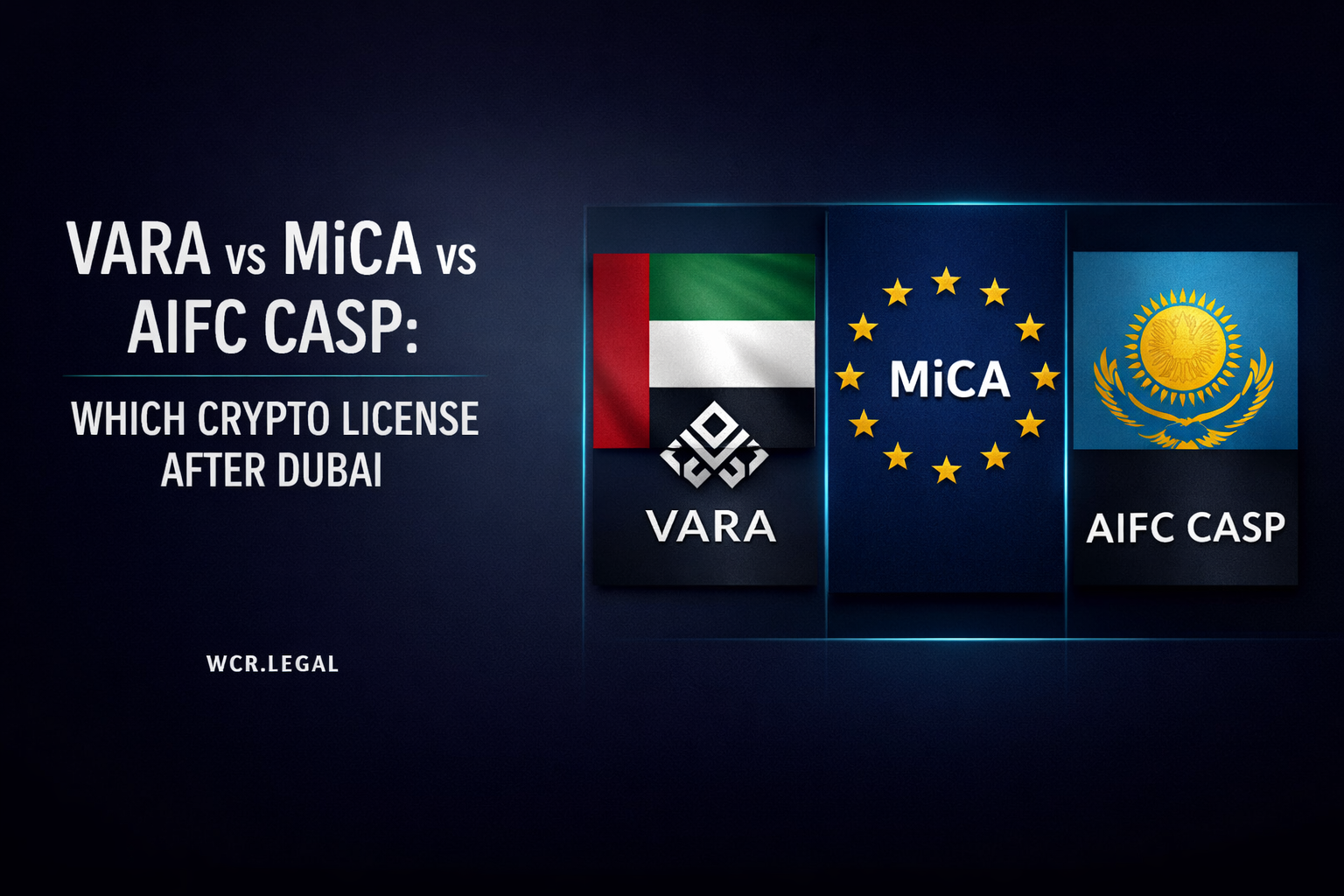
VARA vs MiCA vs AIFC CASP: Which Crypto License After Dubai

VARA vs MiCA vs AIFC CASP: Which Crypto License After Dubai

VARA vs MiCA vs AIFC CASP: Which Crypto License After Dubai

🔐 Crypto Licensing · 2026 Comparison

VARA vs MiCA vs AIFC CASP: Which Crypto Licence After Dubai?

March 2026 changed the calculus for VARA-licensed founders. If your banking access is tightening or your EU counterparties are asking questions, here is the regulated path forward — compared honestly.

🏛️ VARA
🇪🇺 MiCA
🇰🇿 AIFC CASP
2026 Guide
Crypto Founders
⚡ Section 1

Why VARA Alone Is No Longer Enough

This is not about VARA failing. The VARA regulatory framework is still one of the most comprehensive crypto licensing regimes in the world. The problem is what has shifted around it — and what your VARA licence can no longer do for you in 2026. See also our overview of Dubai alternatives for business relocation for the broader picture.

Three pressures that a VARA licence alone cannot solve
March 2026 context
1
Banking friction has become a structural issue, not an incident Banking

If you are VARA-licensed, you already know this. Since Q4 2025, UAE banks have been applying significantly more rigorous due diligence to crypto-related accounts — including those held by entities with active VARA licences. The situation is not that VARA-licensed businesses are being refused banking. It is that the process is slower, the documentation requirements are heavier, and the onboarding timelines have extended to a point where operational liquidity is affected.

The underlying driver is not regulatory — it is geopolitical. UAE correspondent banking relationships with US and EU institutions now carry elevated scrutiny, and UAE banks are absorbing that scrutiny by passing it downstream to their crypto clients. VARA has not changed. The macroeconomic context around it has.

What this means for you: A second regulated entity in a jurisdiction with stronger correspondent banking — Singapore, Lithuania, Mauritius — provides a banking path that your VARA entity cannot, regardless of how well-run it is.
2
EU counterparties are asking for MiCA status — and VARA does not satisfy that question EU counterparties

Since MiCA came into full effect, EU-regulated exchanges, custodians, and institutional investors have been aligning their counterparty frameworks around CASP status. The practical consequence: if you approach an EU-regulated exchange about listing or liquidity, or an EU family office about raising capital, the first question in their compliance checklist is increasingly "are you MiCA-registered or in the process?" VARA does not answer that question, because MiCA is a distinct regime with no mutual recognition agreement with UAE.

This is not yet a hard block in every case — many EU counterparties still accept well-regulated non-EU licences alongside enhanced due diligence. But the trajectory is clear. By end of 2026, MiCA status is likely to become a default requirement for substantive EU institutional relationships rather than a nice-to-have.

The immediate impact: If more than 20% of your revenue or counterparty relationships are EU-facing, you are already operating in territory where a MiCA CASP licence has concrete commercial value.
3
Operational complexity is increasing for single-jurisdiction crypto businesses Operational

The broader shift is this: the era of running a global crypto business from a single regulated jurisdiction is ending. The businesses that built on a single VARA licence and assumed that was sufficient are now finding that their operational dependencies — banking, counterparties, investor onboarding, stablecoin rails — each map to a different jurisdictional standard. Managing those dependencies from a single entity is becoming structurally difficult.

Multi-jurisdictional licensing used to be an enterprise-scale concern. In 2026, it is becoming the baseline expectation for any crypto business with international exposure. The question is no longer whether to add a second regulated jurisdiction — it is which one to add first, and in what sequence.

The core question this guide answers
If VARA is your foundation and you need to add regulated coverage — for EU access, for banking stability, or for speed — which licence do you add first, and why? The three options compared in this guide are not competitors. They are different tools for different parts of the same problem.
🏛️ Section 2

VARA: What Still Works in 2026

The answer is: quite a lot. The case for adding a second jurisdiction is not a case against VARA. It is a case for understanding precisely where your VARA licence is genuinely strong — and where it has reached its geographic and counterparty limits. See also how VARA compares to RAK DAO in 2026 for the UAE-internal picture.

💪
Operational strengths
What VARA delivers that others do not
Still leading

VARA remains the most comprehensive and operationally detailed crypto licensing regime in the MENA region. The rulebooks — covering exchange, brokerage, investment management, lending, custody, and advisory — are more granular than most equivalent frameworks globally. That granularity is operationally useful: it gives you clear compliance parameters rather than the interpretive ambiguity that plagues lighter-touch regimes.

VARA-licensed entities are recognised by UAE financial institutions, including CBUAE-regulated banks, without the secondary DD burden that unlicensed entities face. Within the Gulf market specifically, your VARA licence carries weight that no other crypto regulatory badge currently matches.

  • Recognised across all seven Emirates
  • Accepted by UAE banks and financial counterparties
  • Most detailed crypto rulebooks in MENA
  • FSRA (ADGM) parallel track also available for offshore structures
🏦
Banking reality
The honest picture in 2026
Friction increasing

VARA-licensed entities are not being frozen out of UAE banking. That framing overstates the problem. But the onboarding process has materially lengthened since Q4 2025, and the documentation requirements are more extensive. Businesses that opened accounts smoothly in 2023–2024 are finding that renewal reviews and new account requests are considerably slower.

The underlying issue is correspondent banking. UAE banks that maintain USD correspondent relationships with US institutions are applying the compliance standards those correspondent banks demand — which include elevated scrutiny of crypto-related flows, regardless of VARA status.

3–6×
longer onboarding timelines for crypto accounts at major UAE banks versus 2023

The VARA Dubai licensing service page has current guidance on the most crypto-friendly banking options within the UAE ecosystem.

⏱️
Licensing cost and timeline
No significant changes in 2026
No update

VARA's licensing framework has not been materially revised in 2026. The timeline from initial application to full licence remains 6–12 months for standard cases, with more complex structures — particularly those involving proprietary exchange infrastructure or novel product types — extending to 18 months or beyond.

Costs remain substantial. Application fees, compliance officer appointments, AML programme build-out, and the ongoing supervisory levy make VARA one of the more expensive crypto licensing processes globally. This is by design — VARA is explicitly a premium-tier licence, not a gateway for early-stage or budget-constrained operators.

  • Application fees: AED 30,000–120,000 depending on category
  • Ongoing annual supervisory fee: significant for most licence types
  • Minimum capital: varies by activity — up to AED 200M for certain exchange licences
  • No material framework changes announced for 2026
💡
The honest assessment
VARA is still worth keeping if you have Gulf-facing clients — the regional credibility, counterparty acceptance, and regulatory completeness of the framework are genuine advantages for the MENA market. It is not sufficient as a sole jurisdiction if you have EU or US counterparties, if your banking needs extend beyond the UAE correspondent network, or if your client base is becoming globally distributed. Keep VARA. Add to it.
🇪🇺 Section 3

MiCA: The EU Option

If your business has European clients, European investors, or European banking relationships, MiCA is not optional — it is the regulatory standard your counterparties are aligning toward. See the full EU regulatory environment overview and the VASP-to-CASP MiCA deadline guide for the transition timeline.

What MiCA gives you
The commercial and regulatory case
EU passport
27 member states
🛂
CASP passport across all 27 EU member states
A CASP authorisation under MiCA issued by any EU national competent authority (NCA) allows you to passport CASP services across all 27 member states without separate national licences. One authorisation, one compliance framework, 27 markets. This is a structurally significant advantage that no non-EU licence can replicate. The MiCA EU crypto licence service page covers the full process.
Highest EU market access
🏦
Recognised by EU banks, investors, and exchanges as the baseline standard
MiCA CASP status is fast becoming the minimum credentialing requirement for EU institutional relationships. EU-regulated exchanges, custodians, and payment institutions are aligning their counterparty frameworks to MiCA. EU family offices and institutional investors are including CASP status in their standard LP due diligence. If you want to transact with EU regulated entities, MiCA is becoming unavoidable.
Counterparty acceptance
🌍
MiCA-compliant entities treated as regulated globally — not just in Europe
Because MiCA is the most technically rigorous crypto-specific regulation currently in force, MiCA compliance is being used as a proxy for regulatory credibility by non-EU institutions as well. US institutional counterparties, Singapore-regulated entities, and major custodians are applying MiCA compliance as a positive signal in their own due diligence. The EU passport opens EU markets; the MiCA badge helps globally.
Deadline: all VASPs serving EU users must comply or apply by end of 2025
Transitional provisions under MiCA expired at the end of 2025. VASPs that were operating in EU markets under national transitional regimes without a formal MiCA application submitted are now operating without legal basis in those markets. If you have EU users and have not applied, this is urgent — not a planning consideration.
Deadline passed — act now
What MiCA requires
The honest cost and substance picture
Real substance
EUR 80–150K/year
🏢
Real EU substance: registered office, compliance officer, governance
MiCA requires genuine establishment in the home member state — not just a registered office address. The NCA will expect a physically accessible office, a locally active compliance officer (or CCO equivalent), and governance documentation that reflects real operational control from the EU entity. Nominee arrangements that satisfy company registration requirements will not satisfy the NCA's substance expectations for CASP authorisation.
⏱️
Application timeline: 4–9 months depending on jurisdiction and preparation quality
Lithuania's Bank of Lithuania processes well-prepared applications in 4–6 months. The Netherlands Authority for the Financial Markets (AFM) runs 6–9 months. Ireland's Central Bank is 9–12 months for complex structures. The timeline is substantially affected by the quality of your application package — incomplete applications that require supplementary rounds add 2–4 months to any NCA's timeline.
💰
Ongoing compliance costs: EUR 80–150K per year
Budget for: annual audit (EUR 15–30K), compliance officer (in-house or outsourced, EUR 30–60K equivalent), registered office and local services (EUR 8–15K), AML/KYC compliance programme maintenance, ongoing NCA reporting. The EUR 80–150K range is realistic for a mid-complexity CASP — exchange or custody operations at scale will be higher.
🗺️
Best jurisdictions: Lithuania, Netherlands, Malta, Estonia
Lithuania offers the best combination of processing speed and cost. Netherlands has strong banking infrastructure and a sophisticated NCA. Malta has legacy crypto-friendly positioning but is slower post-FATF. Estonia is well-priced and efficient for straightforward CASP categories. All four offer the same EU passport once authorised — the choice is between processing speed, banking access, and ongoing compliance overhead.
⚠️
MiCA does not grandfather VARA
MiCA does not grandfather VARA licences. There is no mutual recognition agreement between VARA and any EU NCA under MiCA. If you have EU users or EU investors — even a minority of your client base — you need a separate CASP registration regardless of your VARA status. This is not a gap you can bridge with enhanced due diligence or a legal opinion. It requires an active application.
🇰🇿 Section 4

AIFC CASP: The Fastest Regulated Path

If you need a regulated crypto licence in under six months, at a fraction of MiCA or VARA cost, the AIFC jurisdiction is the only credible option currently available. The AIFC CASP licence is not a lite-touch registration — it is a full VASP-equivalent authorisation under an IOSCO-aligned framework, enforced by English common law.

2–4
months from application to CASP licence
60–70%
cheaper than equivalent MiCA or VARA authorisation
0
physical presence required at application stage
AIFC CASP: the fast-track regulated option
2–4 months
1
What the AIFC CASP licence covers Scope

The AFSA (Astana Financial Services Authority) CASP framework covers the full spectrum of VASP-equivalent activities: exchange, OTC brokerage, custody, investment management of digital assets, and digital asset advisory. The scope is comparable to what VARA covers for UAE, or what a MiCA CASP authorisation covers for the EU — it is not a restricted-activity registration.

AIFC operates under its own legal framework based on English common law, administered by the AIFC Court — a permanent international court with judges drawn from English, Singaporean, and common law jurisdictions. Contracts governed by AIFC law are enforceable internationally under the New York Convention. This is not a soft offshore framework — it is a properly functioning legal system designed for international commercial relationships.

AML/KYC requirements: AFSA applies FATF-standard AML/KYC compliance requirements to CASP licensees. Expect to build and document a full AML programme — the cost saving versus VARA or MiCA is in application fees and substance requirements, not in compliance rigour.
2
Timeline and cost Speed + cost

AIFC CASP applications submitted with complete documentation are processed by AFSA in 2–4 months. This is not an aspirational timeline — it is the consistent experience for well-prepared applications. Applications that are submitted incomplete or that require supplementary rounds will take longer, but 6 months is a realistic worst case rather than the norm.

The cost advantage is substantial. AFSA application fees are in the range of USD 5,000–15,000 depending on activity category. Minimum capital requirements are lower than equivalent VARA or MiCA thresholds. No physical presence in Astana is required at the application stage, which eliminates the office setup and local hire costs that add significantly to MiCA first-year expenditure. All-in first-year costs for a standard AIFC CASP are typically USD 25,000–50,000 — versus USD 80,000–200,000 for MiCA or USD 150,000+ for VARA.

Comparison: For the same regulated activity scope, AIFC CASP costs 60–70% less than MiCA and 75–80% less than VARA. The trade-off is counterparty geography, not regulatory rigour.
3
Banking access Practical reality

AIFC-licensed entities can access Kazakhstani banking through Halyk Bank, Kaspi, and Forte Bank — all of which maintain correspondent relationships covering USD, EUR, and RUB operations. This is functional and operationally usable. It is not at the level of Singapore or EU banking in terms of correspondent network depth, but it is materially better than the situation facing VARA-licensed entities trying to open new accounts in 2026.

International correspondent access for AIFC entities is improving. Some tier-2 European banks and several Asian correspondent banks now accept AFSA-licensed entities for account opening. The trajectory is positive — AIFC's inclusion in international financial centre dialogues is translating into improved banking access over time.

4
Who AIFC CASP is for Fit

AIFC CASP is the right first move for founders who need a regulated licence fast while building toward MiCA or MAS — the AIFC licence demonstrates regulatory credibility and regulatory track record, which strengthens a subsequent MiCA or MAS application. It is also the right permanent licence for businesses whose primary client base is in Central Asia, South Asia, or the CIS, where AFSA authorisation carries significant counterparty weight.

It is also appropriate for VARA-licensed businesses that need a second regulated entity to solve banking — an AIFC entity provides an alternative banking access point and a parallel compliance structure while the VARA entity continues to serve Gulf-facing operations.

Multi-licence sequence: AIFC CASP now → operational, banking, credibility → MiCA CASP within 12–18 months → full global regulated coverage. This is the most commercially efficient path for most VARA-licensed businesses in 2026.
⚠️
AIFC CASP does not give you EU market access
Do not position your AIFC CASP licence as a MiCA substitute to EU counterparties. It is not. AFSA authorisation does not provide MiCA passporting rights or EU CASP status. If you have EU clients, EU investors, or EU banking relationships that require MiCA compliance, you need a separate MiCA CASP application. AIFC CASP is a complement and a stepping stone — it is not a shortcut around EU regulation.
📊 Section 5

Side-by-Side: VARA vs MiCA vs AIFC CASP

Seven dimensions that matter operationally. No marketing spin — just the practical picture as of March 2026. For the deeper regulatory analysis of how these frameworks actually differ in structure, see VARA vs MiCA vs AIFC CASP: how the regulatory routes actually differ.

VARA vs MiCA vs AIFC CASP at a glance
2026 snapshot
Dimension
🏛️ VARA (UAE)
🇪🇺 MiCA CASP (EU)
🇰🇿 AIFC CASP
Regulatory authority
VARA (Virtual Assets Regulatory Authority, Dubai)
National Competent Authority of chosen EU member state (e.g. Bank of Lithuania, AFM Netherlands, MFSA Malta)
AFSA (Astana Financial Services Authority, AIFC)
Geographic coverage
UAE + MENA / Gulf institutional market
UAE only
All 27 EU member states via passport — single authorisation covers entire EU market
27-country passport
CIS, Central Asia, South Asia, Middle East — strongest acceptance outside Western markets
Regional strength
Application timeline
6–12 months standard; 18+ months for complex structures
Slowest
4–9 months depending on NCA and jurisdiction — Lithuania 4–6 months, Ireland 9–12 months
Medium
2–4 months for well-prepared applications — consistent AFSA processing
Fastest
Annual compliance cost
USD 150,000+ year one including supervisory levy, compliance infrastructure, minimum capital requirements
Highest
EUR 80–150K/year ongoing — audit, compliance officer, office, NCA reporting, AML programme
Medium–high
USD 25–50K year one all-in — significantly lower application fees and no mandatory physical presence at application
Lowest
Banking access
UAE banks — historically strong but increasingly slow onboarding; limited correspondent depth for crypto flows post-2025
Friction increasing
EU banking — strong correspondent networks, functional multi-currency; best overall banking access of the three options
Strongest
Kazakhstani banks + some international correspondents — functional and improving; not at EU or Singapore level
Functional + improving
EU counterparty recognition
Not recognised as equivalent — EU entities require additional DD; increasing friction in 2026
Not equivalent
Full recognition — baseline requirement for EU institutional relationships; no secondary DD for CASP-to-CASP relationships
Full recognition
Accepted by non-EU counterparties; EU entities treat as credible non-EU licence with enhanced DD — not equivalent to MiCA
Partial recognition
Best suited for
Gulf-facing operations, MENA institutional clients, UAE-based treasury and banking relationships
EU client base, EU investors, EU institutional counterparties, global operations requiring Tier 1 regulatory credentialing
Founders who need regulated coverage fast; CIS/South Asia client base; VARA operators adding a second jurisdiction; MiCA build-up stage
🧭 Section 6

Which One to Choose: Decision Framework

Four scenarios — mapped to the right licence. Find your situation, read the logic, and if you need guidance on the AML/KYC compliance implications of a jurisdiction switch, that guide covers the compliance transition in detail.

Which licence is right for you?
Decision tool
🌍
Your clients and counterparties are Gulf-facing — no material EU or US exposure
Your revenue comes from UAE and MENA clients. Your banking is with UAE institutions. Your investors are Gulf-based. Your counterparties — exchanges, custodians, OTC desks — are regional and do not require MiCA status. You are not raising from EU family offices or EU venture funds.
Keep and maintain your VARA licence. It is the right tool for this market. You do not need a second jurisdiction right now — but review this quarterly as the counterparty landscape evolves.
🇪🇺
You have EU clients, EU investors, or EU banking relationships — or you are targeting them
Any of the following applies: you have retail or institutional clients based in EU member states, you are in a fundraising process that includes EU-regulated investors, your payment rails or custodian is EU-regulated, or you are actively building toward EU market distribution. MiCA compliance is not a future consideration — it is a current requirement if EU users are already using your product.
A MiCA CASP authorisation is required. Start the process now — Lithuania is the fastest NCA for most VARA operators. Your VARA licence stays in place for Gulf operations. See the EU regulatory environment overview for jurisdiction selection.
You need a regulated licence fast, at low cost — as a standalone or while building toward MiCA or MAS
You are launching a new product or entity that requires regulated status. You need operational credibility with counterparties in CIS, South Asia, or the Middle East. Your timeline cannot accommodate a 6–12 month VARA process or a 4–9 month MiCA application. Or you are deliberately sequencing: get regulated now, build revenue, then apply for MiCA or MAS from a stronger position.
The AIFC CASP licence is the right first move. Apply now — 2–4 months to licence, 60–70% cheaper than alternatives. Keep the MiCA application on your 12–18 month roadmap. See the AIFC jurisdiction overview for full details.
🌐
You are running a genuinely global operation — or building toward one
Your client base spans multiple regions. You need to bank in multiple currencies through multiple correspondent networks. Your institutional counterparties include both EU-regulated entities and non-EU players. You are either already multi-jurisdictional or you recognise that a single licence cannot serve your operational requirements. You are building infrastructure, not just a product.
Multi-licence is the correct architecture. The most commercially efficient sequence in 2026: AIFC CASP now (2–4 months, low cost, operational immediately) + MiCA CASP within 18 months (EU market access, institutional relationships). Keep VARA if you have Gulf-facing revenue that justifies the cost. Three licences, three market segments, one coherent compliance framework.
💡
The direction of travel
Multi-licensing is becoming the norm, not the exception. The crypto businesses that are scaling in 2026 are not the ones with the single cleanest licence — they are the ones that planned for regulatory diversification from the start. Build your licensing roadmap the same way you build your infrastructure: with redundancy, with flexibility, and with the next stage already scoped before you need it.
VARA Operator. What Comes Next?

WCR Legal advises VARA-licensed businesses on second-jurisdiction strategy, MiCA CASP applications, and AIFC CASP licensing. We handle the process end-to-end — from jurisdiction selection to application submission and NCA liaison — while your VARA entity continues to operate.

No commitment required · Confidential initial consultation · Response within 1 business day

Oleg Prosin is the Managing Partner at WCR Legal, focusing on international business structuring, regulatory frameworks for FinTech companies, digital assets, and licensing regimes across various jurisdictions. Works with founders and investment firms on compliance, operating models, and cross-border expansion strategies.