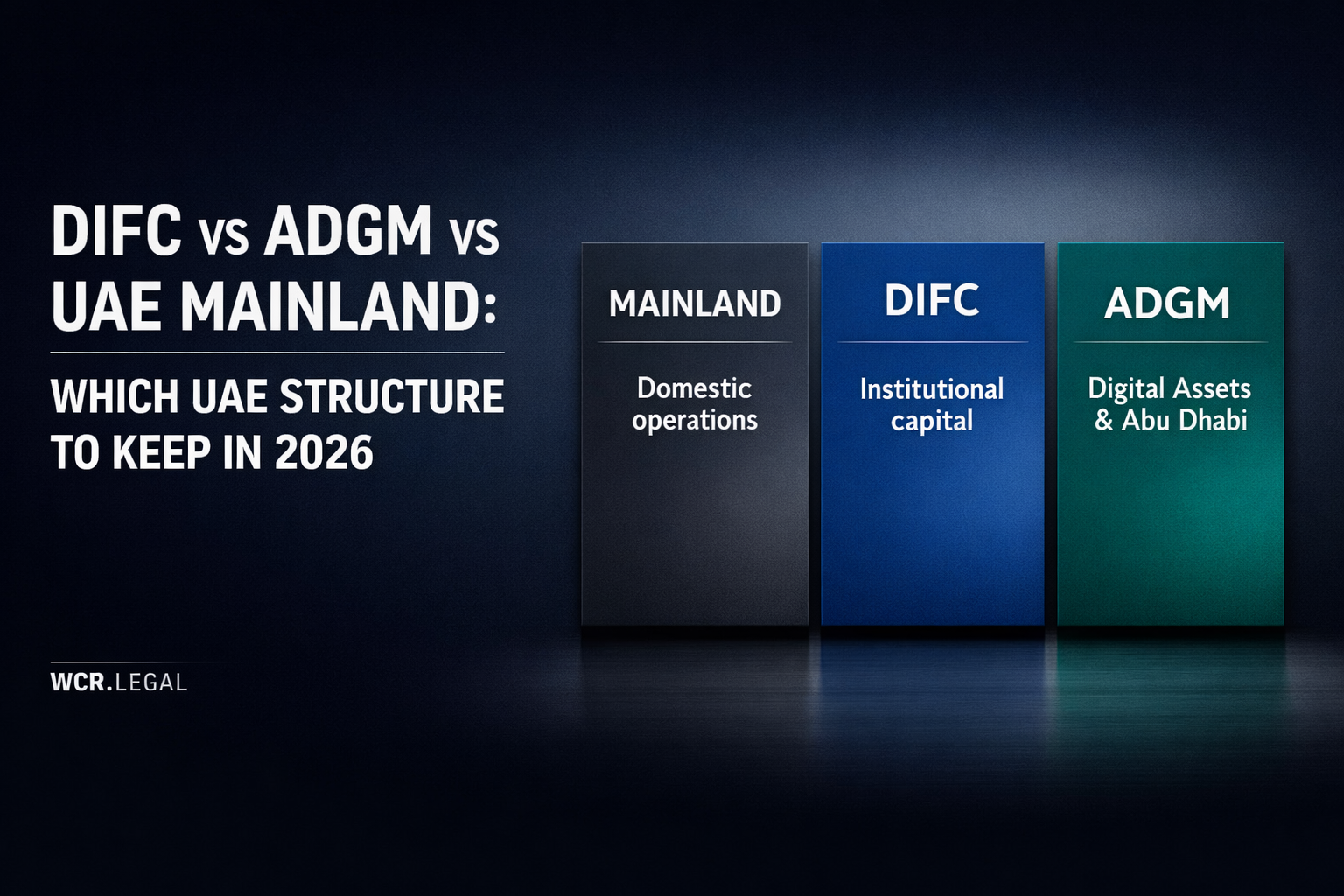
DIFC vs ADGM vs UAE Mainland: Which UAE Structure to Keep in 2026
DIFC vs ADGM vs UAE Mainland:
Which Structure to Keep or Exit in 2026
The three dominant UAE corporate frameworks serve fundamentally different purposes — and the wrong structure for your stage and business type costs you more than the setup fee. This guide tells you which one to keep, which to exit, and why.
The 2026 Question: Stay or Exit?
Most founders chose their UAE structure because it was available, cheap, or fast — not because it was the right fit for their business model. In 2026, those early choices carry real commercial consequences: the wrong structure costs you banking access, client credibility, or the ability to raise institutional capital. This section explains why the question of which structure to keep matters more now than it did at formation.
The introduction of the 9% UAE corporate tax in June 2023 changed the financial model for every UAE entity. Free Zone businesses can still access the 0% Free Zone regime — but only if they satisfy the qualifying income and substance requirements that many founders assumed were formalities. Mainland entities are subject to the standard 9% rate on profits above AED 375,000. The structure you chose in 2020 or 2021 may have been optimised for a tax environment that no longer applies.
DIFC and ADGM entities have their own tax treatment under the respective frameworks, with nuances around financial services activities and qualifying activity that require specific advice. The blanket "Free Zones are tax-free" assumption is no longer accurate as a planning position in 2026.
Since the UAE was placed on the FATF grey list in 2022 (and removed in February 2024), UAE banks have applied significantly tighter due diligence to business accounts. The structure of your entity — Mainland, DIFC, or ADGM — materially affects how UAE and international banks assess your account relationship. DIFC and ADGM entities, operating under common law frameworks with DFSA or FSRA oversight, face fewer correspondent banking friction points than many Mainland Free Zone entities.
For businesses with international client payments, supplier payments, or fund flows, the banking relationship has become the operative constraint — not the licence or the tax rate. Founders who chose their structure based on cost or speed at formation are now discovering that their structure determines which banks will bank them and on what terms.
A structure decision is not a one-time cost — it is a recurring constraint. A business in the wrong structure pays more in compliance overhead, loses transactions because counterparties won't accept its jurisdiction, misses fund-raising because institutional investors require a different governance framework, or wastes management time working around structural limitations. These costs are not always visible on a P&L, but they compound.
The cost of switching structures is significant — typically AED 30,000–100,000 in fees, 3–6 months of management time, and a period of operational disruption. But the cost of staying in the wrong structure for another 3 years is usually higher. The 2026 question is not "which structure is cheapest?" — it is "which structure is right for where this business is going?"
UAE Mainland: When It Works, When It Traps You
A DED-licensed Mainland company is the right structure for businesses that genuinely trade in the UAE domestic market. It is the wrong structure for businesses that chose Mainland because it was cheaper or faster — and are now finding it creates banking friction, credibility gaps with institutional counterparties, or tax treatment that no longer matches their model.
A Mainland DED licence is the only UAE structure that allows unrestricted trading with UAE government entities, federal contractors, and businesses that require UAE-domiciled suppliers for procurement purposes. If your revenue comes primarily from UAE government contracts, local retail operations, or B2B service delivery to UAE-incorporated clients, Mainland is the right structure — and moving to DIFC or ADGM creates friction, not value.
Mainland is also the correct structure for businesses that operate physical premises across the UAE — retail, hospitality, healthcare, education. Free Zone and financial centre entities cannot directly operate consumer-facing businesses on the UAE Mainland without a Mainland licence or distributor arrangement.
- No restrictions on UAE government contracts and federal procurement
- Physical operations across all seven Emirates without restriction
- Full ownership now permitted across most business activities post-2021 reforms
- No DFSA or FSRA regulatory overhead for non-financial businesses
Mainland entities are subject to the 9% UAE corporate tax on profits above AED 375,000 with no qualifying income exemptions available to standard DED companies. For businesses that previously modelled on zero tax, this is a material change. The Free Zone Qualifying Income regime is not accessible to Mainland entities.
For businesses with significant international client flows, Mainland banking can be more cumbersome. Correspondent banks applying enhanced due diligence post-FATF apply greater scrutiny to Mainland entities from certain activity categories than to DIFC or ADGM entities operating under a common law framework with financial centre regulatory oversight.
- Subject to 9% corporate tax — no qualifying income exemption
- Some institutional investors and fund administrators prefer DIFC/ADGM governance
- Financial services activities require additional CBUAE or SCA licensing on top of DED
- Not suitable for regulated financial activity (investment, fund management, crypto-asset services)
A standard DED Mainland licence typically costs AED 15,000–40,000 in annual fees depending on activity type, with lower initial setup costs than DIFC or ADGM. Renewal is annual. The corporate tax compliance overhead (VAT, CIT) is similar across all three structures for businesses meeting the relevant thresholds.
The hidden cost of Mainland for internationally mobile businesses is the management overhead of operating a regulated entity without the supporting ecosystem (legal, compliance, banking) that DIFC and ADGM provide as part of their framework. For businesses above USD 1M annual revenue with international operations, the total cost of the Mainland structure often exceeds the stated licence fee once compliance and banking friction are accounted for.
- Annual DED licence: AED 15,000–40,000 typical range for most activities
- No minimum capital requirement for most business activities
- Physical office lease required (no flexi-desk option for most DED licences)
- Visa quota based on office space — typically 1 visa per 9 sqm
DIFC: The Financial Centre Framework
The Dubai International Financial Centre is not a Free Zone — it is a financial centre with its own civil and commercial law, courts, regulator (the DFSA), and regulatory framework. That distinction matters enormously. DIFC gives you something no other UAE structure provides: a common law framework enforced by an independent judiciary, with a DFSA-regulated financial services licence that is recognised by institutional counterparties globally. The cost of that framework is real. Whether it is worth it depends on what you are building.
ADGM: Abu Dhabi's Challenger Framework
The Abu Dhabi Global Market is a younger financial centre than DIFC — established in 2015, regulated by the FSRA — but it has built a distinct identity and in several specific areas now leads DIFC. ADGM is not simply a cheaper DIFC: it has a different client profile, a different regulatory style, and a different set of advantages and limitations. Understanding which framework fits your business requires understanding those distinctions, not just comparing the fees.
ADGM established its digital asset regulatory framework in 2018 — several years before VARA and ahead of most global financial centres. The FSRA's digital asset regime for crypto-asset businesses, digital securities, and virtual asset exchanges is mature, detailed, and familiar to the global digital asset industry. For businesses in this space, the FSRA framework is better developed and the regulatory engagement more experienced than DIFC's equivalent.
ADGM's approach to stablecoins, security tokens, and the intersection of digital assets with financial services is more sophisticated than any other UAE regulatory framework. If your business operates at that intersection, ADGM is the UAE jurisdiction that understands your model best.
ADGM operates under English common law (Application of English Law Regulations 2015) and has its own courts — the ADGM Courts, staffed by common law judges — with jurisdiction equivalent to DIFC Courts for entities within the centre. Annual registration and licence fees are typically 20–30% lower than equivalent DIFC structures. For non-regulated entities using the framework for holding, SPV, or consulting structures, ADGM provides essentially the same legal infrastructure as DIFC at lower cost.
For FSRA-regulated entities, the regulatory capital requirements and annual levy are comparable to DFSA — the cost advantage is primarily in administrative and office fees, not regulatory capital.
For fund managers, investment advisers, and businesses whose client and counterparty base is in Abu Dhabi — Mubadala, ADQ, ADIA, and the wider Abu Dhabi sovereign and government-linked ecosystem — physical proximity matters. ADGM's Al Maryah Island location puts regulated entities within the same ecosystem as Abu Dhabi's institutional capital. This is a genuine commercial advantage that DIFC (in Dubai) does not provide for businesses whose primary relationships are in Abu Dhabi.
The Abu Dhabi government has also made deliberate decisions to concentrate financial centre activity in ADGM — sovereign fund mandates, ADNOC advisory relationships, and Abu Dhabi family office structures increasingly use ADGM as the natural framework.
The FSRA has historically been more willing to engage with smaller, earlier-stage regulated businesses than the DFSA. Category 4 FSRA licences (non-custodial, low-risk regulated activities) have lower minimum capital requirements than their DFSA equivalents. For fund managers with AUM under USD 100M, investment advisers, and financial planning businesses, ADGM's cost structure and regulatory minimum thresholds are meaningfully more accessible than DIFC.
This does not mean ADGM is a lighter-touch regulator — it is not. The FSRA runs a rigorous licensing process and ongoing supervision. But the initial entry threshold is lower, making ADGM the more accessible financial centre framework for businesses that are not yet at full DIFC scale.
Side-by-Side Comparison: All Three Frameworks
The table below compares UAE Mainland, DIFC, and ADGM across the factors that matter most in 2026 — tax treatment, regulatory framework, banking access, cost, and suitability by business type. Use this alongside Section 6 to make your structure decision.
| Factor | UAE Mainland (DED) | DIFC | ADGM |
|---|---|---|---|
| Legal framework | UAE civil law (federal) | English common law (DIFC Courts) | English common law (ADGM Courts) |
| Corporate tax (2026) | 9% on profits > AED 375K | 0% qualifying income; 9% on non-qualifying | 0% qualifying income; 9% on non-qualifying |
| Regulator | DED / CBUAE / SCA (activity-specific) | DFSA (single integrated regulator) | FSRA (single integrated regulator) |
| Financial services regulation | CBUAE/SCA additional licence required; fragmented | DFSA — globally recognised; full financial services | FSRA — strong; leading for digital assets |
| Digital asset regulation | VARA licence required (Dubai only) | DFSA digital asset framework (developing) | FSRA — most mature digital asset framework in UAE |
| Banking access | Good for domestic; friction for international institutional flows | Best in UAE for international institutional banking | Strong; Abu Dhabi sovereign relationships |
| Institutional counterparty acceptance | Variable; limited for prime brokerage | Highest in UAE — DFSA equivalent to FCA/ASIC | High, especially for digital assets and Abu Dhabi capital |
| UAE government contracts | Unrestricted — the only structure for federal procurement | Limited — cannot hold DED licence directly | Limited — cannot hold DED licence directly |
| Annual operating cost | AED 15K–40K (licence only) | AED 35K+ non-regulated; USD 200K+ regulated | AED 25K+ non-regulated; USD 150K+ regulated |
| Minimum capital (regulated) | Varies by CBUAE/SCA category | USD 500K–2M+ (DFSA Cat 3C and above) | USD 150K–750K (FSRA Cat 4 upward) |
| Setup timeline | 2–6 weeks (non-regulated) | 2–4 weeks entity; 6–12 months DFSA licence | 2–4 weeks entity; 4–9 months FSRA licence |
| Location | All UAE — flexible | Dubai, Gate District | Abu Dhabi, Al Maryah Island |
| Best suited for | UAE domestic trade, retail, government supply, local B2B services | Regulated financial services, fund management, investment banking, institutional capital | Digital assets, Abu Dhabi capital relationships, lower-entry regulated businesses |
Which One to Keep If You Can Only Keep One
Most founders with multiple UAE entities are maintaining structures they no longer need. Below are three decision profiles — matched to the most common business types we advise. Find the one that fits your situation and act on it. Indecision here is itself a cost.
If more than 60% of your revenue comes from UAE-based clients, UAE government contracts, or physical operations across the seven Emirates, Mainland is correct and you should stay. The cost of switching to DIFC or ADGM — in fees, operational disruption, and lost Mainland access — is not justified unless you are also building a regulated financial services business that requires a DFSA or FSRA licence.
- Revenue primarily from UAE government or semi-government entities
- Physical retail, hospitality, healthcare, or education operations
- B2B services to UAE-incorporated clients who require local suppliers
- Construction, contracting, or logistics on UAE federal projects
If your business model depends on institutional counterparties — prime brokers, custodians, fund administrators, international family offices — who require a DFSA-regulated entity or the DIFC Courts framework, DIFC is not optional: it is the structure that makes the business work. The cost premium is real but justified. For investment managers, DFSA-authorised broker-dealers, and fund vehicles that require English common law governance with UAE enforcement, DIFC is the only framework that delivers all three.
- Investment management or fund management with institutional AUM
- DFSA-regulated activity: investment advisory, broker-dealer, custody
- Financial products requiring DIFC Courts jurisdiction for counterparty contracts
- Business with prime brokerage or international custodian relationships
ADGM is the correct structure for two distinct business profiles: digital asset and crypto businesses that need the most mature UAE regulatory framework for this activity, and businesses whose primary capital and institutional relationships are with Abu Dhabi sovereign and government-linked entities. In both cases, ADGM's specific advantages — the FSRA digital asset framework and the Abu Dhabi institutional ecosystem — provide genuine commercial value that DIFC and Mainland do not replicate.
- Digital asset exchanges, tokenised securities, digital asset fund managers
- Businesses seeking FSRA VASP/CASP authorisation as primary UAE regulated status
- Fund managers and advisers with AUM primarily from Abu Dhabi sovereign entities
- Earlier-stage regulated businesses: lower FSRA entry thresholds than DFSA
WCR Legal advises foreign founders and operators on UAE structure decisions — including structure switches, DFSA and FSRA licence applications, and entity exits. We give you a direct recommendation, not a framework for deciding yourself.