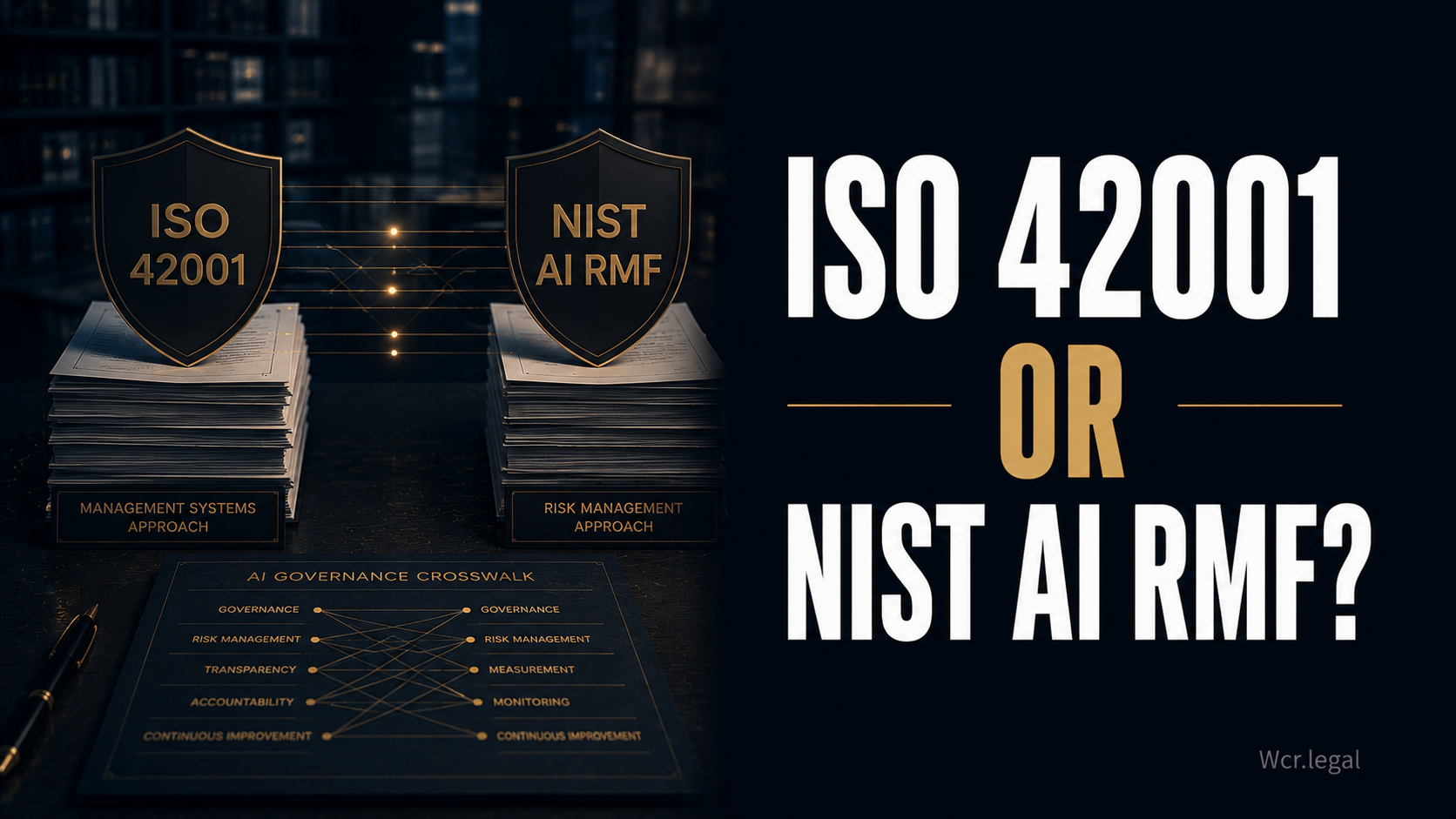
ISO 42001 vs NIST AI RMF: Which Framework Should Your Company Implement First?
AI Law · Governance Framework
ISO 42001 vs NIST AI RMF: Which Framework Should Your Company Implement First?
The wrong sequencing costs months of rework. The right choice is determined by your audience — not the technical specs. Here is how to decide.
1
Key differences — 3 dimensions
Certification · Jurisdiction · Structure
2
Comparison table
5 parameters side by side
3
Interactive decision tool
Select your profile → get a recommendation
4
Implementation sequence
4 phases · NIST then ISO 42001
5
Pre-implementation checklist
5 questions before you start
6
Common questions
Certification · EU AI Act · Timeline
Section 1
Three Dimensions That Determine the Right Choice
Enterprise AI adoption is accelerating — and the compliance question boards are now asking isn’t “should we govern AI?” It’s “which standard do we implement first?” ISO 42001 and NIST AI RMF are not competing alternatives. They are complementary tools built for different purposes. See also: our NIST / ISO 42001 / EU AI Act services and How to Build an AI Governance Framework Step by Step.
“The framework you implement first isn’t a technical choice. It’s a statement about who you’re accountable to.”
01
Certification
Certifiable vs Voluntary
Third-party audit vs self-attestation
ISO 42001 is an auditable standard published by the International Organization for Standardization. Organizations achieve third-party certification through an accredited audit body — the ISO 27001 equivalent for AI management systems.
NIST AI RMF is a voluntary framework. There is no certificate. Adoption is self-attested and no third party verifies conformance. This distinction is decisive when your audience demands external assurance rather than self-declaration.
02
Jurisdiction
International vs US-Anchored
Global recognition vs US baseline
ISO 42001 was designed for global applicability — recognized across EU member states, APAC regulatory bodies, and international enterprise procurement. It carries direct weight with EU AI Act compliance programs.
NIST AI RMF is anchored in US federal agency expectations. It applies internationally wherever NIST frameworks are the baseline, but carries no weight with EU regulators and limited traction in non-US procurement.
03
Structure
Management System vs Risk Playbook
Organizational change vs operational tool
ISO 42001 establishes an AI Management System (AIMS): defined roles, documented policies, internal audit cycles, top management accountability. It reshapes how your organization is structured around AI.
NIST AI RMF is a risk management playbook — four core functions (Govern, Map, Measure, Manage) with actionable sub-categories. It gives your team an operational workflow. ISO 42001 is an organizational commitment. NIST is an operational tool.
Section 2
ISO 42001 vs NIST AI RMF — 5 Parameters Compared
A side-by-side comparison of the five parameters that matter most for a sequencing decision. The right column determines which framework to prioritize for your context.
Framework Comparison
5 parameters · Updated 2025
| Parameter | ISO 42001 | NIST AI RMF |
|---|---|---|
| Type | International Standard (AIMS) | Voluntary Framework |
| Certifiable | Yes — third-party audit | No — self-attestation only |
| Primary Audience | EU & global enterprise, regulators, procurement | US federal agencies, internal governance teams |
| EU AI Act Alignment | Strong — direct AIMS mapping | Moderate — supplemental only |
| Implementation Time | 3–6 months to certification | 4–8 weeks to operational baseline |
ISO 42001
Choose when your audience requires verified assurance
EU enterprise · regulators · investors · global procurement
Signal
Third-party certification verifiable by clients, procurement, and regulators — not a self-reported claim
EU AI Act
Strong alignment with AIMS requirements and Annex IV documentation obligations; cross-reference to GPAI code of practice
Existing ISO
If you hold ISO 27001 or ISO 9001, implementation timeline compresses to 6–12 weeks — infrastructure already exists
RFP ready
Increasingly listed alongside ISO 27001 in EU enterprise vendor assessments and procurement questionnaires
NIST AI RMF
Choose when you need operational structure fast
US-only · internal governance · federal agencies · Series A prep
Speed
4–8 weeks to an operational baseline — immediate structure for risk taxonomy, ownership, and controls
US gov
Referenced directly in US federal agency guidance, Executive Orders, and sector-specific regulatory requirements
Foundation
Most NIST AI RMF subcategories map directly to ISO 42001 Annex A controls — NIST work is not wasted when ISO 42001 follows
Cost
No external certification cost; self-attestation is sufficient for US-only procurement and internal governance purposes
Section 3
Which Framework Is Right for You?
Select your primary market and primary audience below. The recommendation updates immediately. If your situation spans multiple options, select the one that describes your most immediate compliance pressure.
Framework Decision Tool
Select your profile → see the recommendation
Interactive
Your Primary Market
EU / European Clients
US / North America
Both / Global
Your Primary Audience
Enterprise Clients / Procurement
Investors / Series A DD
Regulators / EU AI Act
Internal Governance Only
Not sure which framework fits your business? WCR Legal runs framework strategy sessions for legal and compliance teams before implementation begins.
Book a Framework Assessment
Section 4
The Recommended Implementation Sequence
For most organizations with global or EU exposure, the optimal build order layers NIST AI RMF first as operational infrastructure, then ISO 42001 as the certifiable management layer on top. EU AI Act obligations map across both. See: EU AI Act August 2026 High-Risk Deadline.
Build Order — 4 Phases
NIST AI RMF foundation → ISO 42001 AIMS → Certification → EU AI Act crosswalk
~7 months total
1
Weeks 1–8
Implement NIST AI RMF
Establish AI taxonomy, inventory all systems by risk tier, and operationalize the four core functions: Govern, Map, Measure, Manage. Build the risk register and assign accountability. This creates the operational substrate ISO 42001 will formalize — none of this work is wasted.
2
Months 1–6
Build ISO 42001 AIMS Over NIST Base
Layer the ISO 42001 AI Management System structure on your existing NIST controls: formalize policies, define top management accountability, establish internal audit cadence, document AIMS scope. Most NIST AI RMF subcategory artifacts map directly to ISO 42001 Annex A controls. Avoid duplicating work.
3
Months 4–7
ISO 42001 Certification Audit
Engage an accredited certification body for Stage 1 (documentation review) and Stage 2 (on-site audit). Remediate non-conformities. Upon a successful audit, receive ISO 42001 certification — an independently verified signal to EU enterprise procurement, international clients, and institutional investors.
4
Ongoing
EU AI Act Crosswalk
Map EU AI Act obligations — high-risk system requirements, prohibited use restrictions, transparency duties — to your NIST AI RMF controls and ISO 42001 AIMS clauses. This crosswalk prevents duplicated compliance effort and demonstrates integrated governance to regulators.
Existing ISO holders
If your organization already holds ISO 27001 or ISO 9001, Phase 2 compresses significantly. The management system infrastructure — audit cycles, documented policies, top management review — already exists. Many organizations with an existing IMS can reach ISO 42001 certification in 6–12 weeks from the start of Phase 2.
Section 5
Five Questions Before You Start
Answer these before committing to a sequencing strategy. They reveal which framework delivers immediate value — and whether organizational preconditions exist to execute. For internal policy context, see: Internal AI Usage Policy under the EU AI Act.
Pre-Implementation Checklist
Click each item to mark it reviewed
Who is your primary audience — enterprise clients, institutional investors, or regulators?
The answer determines certification need. EU enterprise buyers and regulators require third-party assurance. US internal governance does not — yet. If EU procurement is in scope within 12 months, ISO 42001 should start now.
Do you have a complete AI inventory — every system, model, and automated decision tool in scope?
Both frameworks require a complete inventory as a foundation. Without one, governance is theatrical. Start here before any framework implementation begins.
Do you hold ISO 27001 or ISO 9001 certification?
If yes, ISO 42001 implementation time drops significantly. The management system infrastructure, audit cycles, and documentation practices already exist. This makes ISO 42001 first the operationally efficient choice even for companies not yet under EU pressure.
Do EU AI Act high-risk system obligations apply to your organization?
If you deploy AI in employment decisions, credit scoring, critical infrastructure, or biometric identification, high-risk obligations apply from August 2026. This accelerates the ISO 42001 timeline — it is the closest available standard to AIMS-based EU AI Act compliance. See the August 2026 deadline guide.
Does your budget include third-party certification costs?
ISO 42001 certification requires an accredited audit body. Initial audit costs typically range from €8,000–€25,000+ depending on organization size. NIST AI RMF carries no external certification cost. If budget is constrained, NIST first while building toward ISO 42001 is a defensible interim position.
Ready to Map Your Framework Strategy?
WCR Legal advises enterprise and scale-up organizations on ISO 42001 implementation, NIST AI RMF alignment, and EU AI Act compliance — integrated into a single governance architecture. Learn more about our NIST / ISO 42001 / EU AI Act services and our AI Governance & Risk practice.
FAQ
ISO 42001 vs NIST AI RMF — Common Questions
For broader AI governance questions, see our AI Governance & Risk services page.
Frequently Asked Questions
Click a question to expand
1
Can we implement NIST AI RMF and ISO 42001 simultaneously?
+
Yes — and for organizations under time pressure (EU AI Act deadlines, investor due diligence timelines), a parallel approach can work. The practical risk is resource dilution: ISO 42001 requires sustained management attention and documentation, while NIST AI RMF demands operational implementation. Most organizations benefit from a phased approach — NIST first to build inventory and controls, then ISO 42001 formalization on top — rather than running both concurrently from zero. The exceptions: organizations with existing ISO management systems, or those with imminent EU regulatory exposure, where ISO 42001 first (or parallel) is justified.
2
Does ISO 42001 certification satisfy EU AI Act requirements?
+
Partially. ISO 42001 provides strong alignment with EU AI Act requirements for AI management systems and risk governance — particularly for quality management, transparency, and human oversight obligations under Articles 9–17. However, ISO 42001 certification alone does not constitute EU AI Act conformity assessment for high-risk systems, which may require additional technical documentation per Annex IV and, in some cases, notified body involvement under Article 43. Treat ISO 42001 as a strong foundation and the most credible available management system standard — not a complete substitute for Article-specific conformity assessment.
3
How long does ISO 42001 certification actually take?
+
For most organizations starting from scratch, 3–6 months is a realistic target for initial certification. Organizations that already hold ISO 27001 or ISO 9001 can compress this to 6–12 weeks. The timeline depends on: organizational complexity, existing documentation maturity, the speed of your certification body’s scheduling, and how quickly non-conformities identified at Stage 1 can be remediated. Plan for remediation time — it is rarely zero. Certification bodies are currently experiencing high demand for ISO 42001, which may extend scheduling lead times in some markets.
4
Is NIST AI RMF sufficient for a US-only company with no EU clients?
+
For a US-only company with no EU operations, no EU personal data in scope, and no EU enterprise clients in the near-term pipeline, NIST AI RMF is the natural starting point and may be fully sufficient for the near term. It aligns with federal agency expectations, sector-specific US guidance, and US investor due diligence frameworks. That said, even US-only companies should anticipate EU exposure as they scale — through EU data subjects, EU enterprise client acquisition, or EU investor participation in funding rounds. Building ISO 42001 readiness before that exposure materializes is lower cost than retrofitting it under deadline pressure.
5
What does ISO 42001 certification signal to enterprise procurement?
+
ISO 42001 certification signals three things that enterprise procurement teams increasingly require: (1) your AI governance is independently verified by a third-party auditor, not self-reported; (2) your organization has defined accountability for AI risk at the management level with documented evidence; and (3) your governance is maintained through an ongoing audit cycle, not a one-time exercise. In EU enterprise procurement, ISO 42001 is increasingly listed in RFP requirements alongside ISO 27001. In regulated industries — financial services, healthcare, critical infrastructure — it is rapidly moving from differentiator to baseline expectation.


Post Comment