Does ISO 42001 Certification Satisfy EU AI Act Requirements?
AI Law · EU AI Act Compliance
Does ISO 42001 Certification Satisfy EU AI Act Requirements?
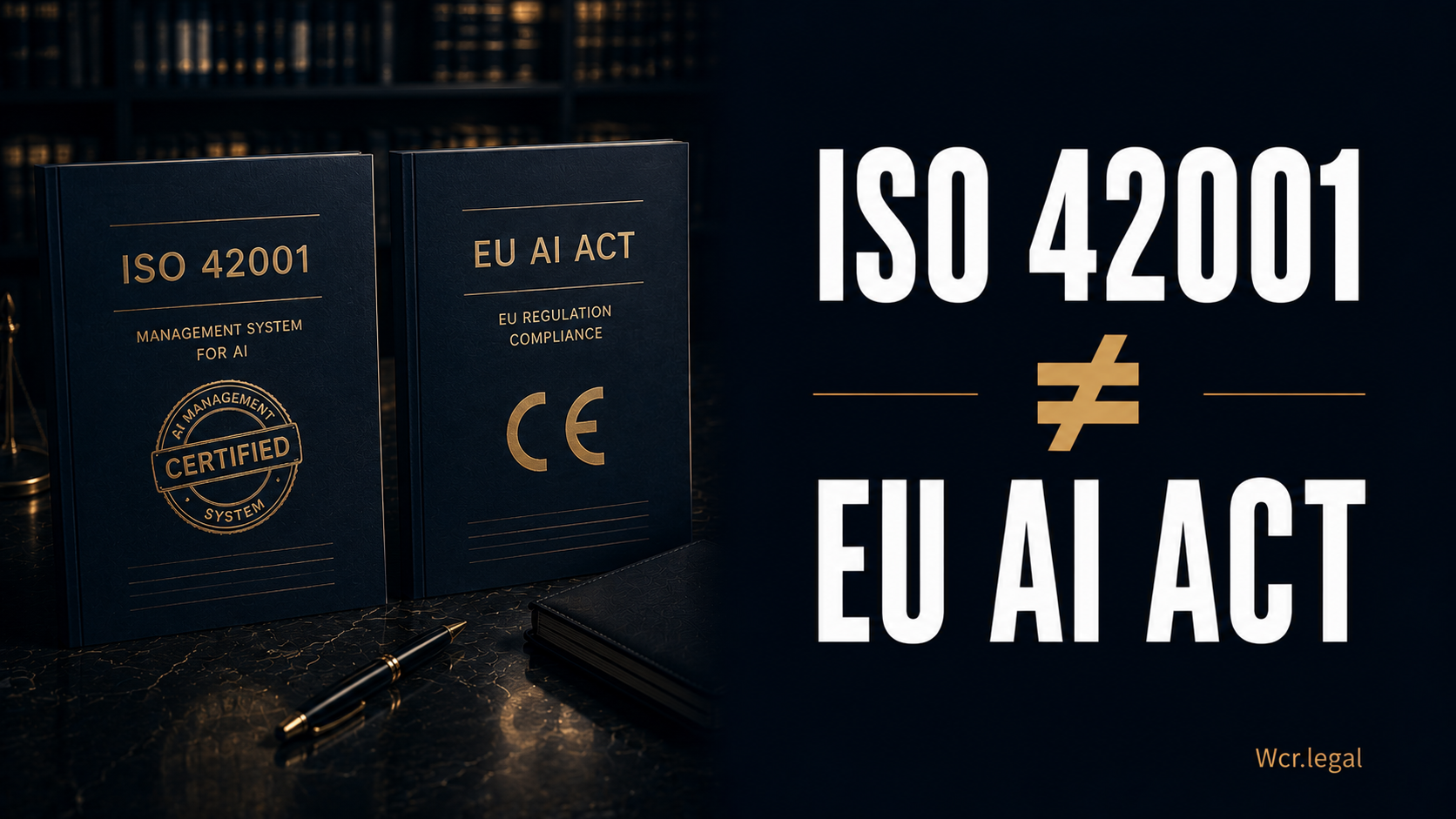
Short answer: partially. ISO 42001 certifies your organisation’s AI management system. The EU AI Act regulates AI products. These are different objects of conformity — and the gap matters.
1
What ISO 42001 covers
AIMS scope · 3 dimensions
2
Interactive article mapping
12 items · covered / partial / not covered
3
What you still need
6-item gap checklist
4
Have ISO 42001 vs don’t
Two paths to EU AI Act compliance
5
Map your gaps
WCR Legal · AI Governance & Risk
6
Common questions
Conformity · CE marking · GPAI
Section 1
What ISO 42001 Actually Certifies
ISO 42001 is the international standard for AI Management Systems (AIMS). It certifies that your organisation has the structures, policies, roles, and processes to govern AI responsibly. It says nothing about whether any individual AI system you build or deploy meets regulatory requirements. The EU AI Act — by contrast — regulates AI products. See our NIST / ISO 42001 / EU AI Act services for how these frameworks fit together.
Critical distinction
ISO 42001 certifies your organisation’s AI management system. The EU AI Act regulates AI systems — products. These are fundamentally different objects of conformity. A certified AIMS proves your governance is structured. It does not prove your AI product complies. Both are required; one does not substitute for the other.
ISO 42001 Scope — 3 Dimensions
What the standard certifies and where it falls short
AIMS
1
What it certifies
Your AI Management System (AIMS)
ISO 42001 certifies that your organisation has a structured, documented, and auditable AI governance function: defined roles and responsibilities for AI oversight, a risk management process applied across AI systems, documented policies for AI use and procurement, top management accountability and review cycles, and internal audit processes. This is organisational infrastructure — not product-level compliance.
2
Where it overlaps with EU AI Act
7 EU AI Act Articles Directly Mapped
ISO 42001 clauses map meaningfully onto seven EU AI Act articles: Article 9 (risk management system), Article 10 (data governance), Article 11 (technical documentation — partially), Article 12 (record-keeping), Article 13 (transparency), Article 14 (human oversight), and Article 17 (quality management system). For organisations subject to high-risk AI obligations, ISO 42001 provides a strong foundation — but only a foundation.
3
What it does not cover
Product-Level Regulatory Requirements
ISO 42001 does not cover: EU AI Act conformity assessment (Article 43), CE marking, EU AI database registration (Article 71), GPAI model obligations under Articles 53–55, Annex IV technical documentation per individual system, or deployer-specific obligations such as the 6-month log retention requirement and Fundamental Rights Impact Assessment (FRIA). These are regulatory requirements — not addressable through a management system standard.
Section 2
EU AI Act Articles — Interactive Coverage Map
Click any row to see the precise ISO 42001 clause mapping and what remains unaddressed. Use this as a gap analysis reference before your compliance planning session.
ISO 42001 → EU AI Act Article Coverage
Covered
Partial
Not covered
Art. 9
Risk management system
Covered
+
ISO 42001 Clause 6.1.2
ISO 42001 Clause 6.1.2 requires a documented risk assessment and treatment process for AI-related risks. This directly satisfies the Article 9 requirement for a risk management system that is established, implemented, documented, and maintained on a continuous basis. The AIMS risk framework covers identification, analysis, evaluation, and treatment of risks across the AI lifecycle.
Art. 10
Data governance
Covered
+
ISO 42001 Clause 8.4
ISO 42001 Clause 8.4 addresses data management practices for AI systems, including data quality, relevance, and governance procedures. This maps to Article 10’s requirements for training, validation, and testing data governance — covering data examination, bias identification, and data management practices at the organisational level.
Art. 11
Technical documentation
Partial
+
ISO 42001 Clause 7.5 (partial)
ISO 42001 requires documented information about the AIMS — policies, procedures, and records of AI system governance. However, Article 11 requires Annex IV technical documentation: system-specific architecture, training data description, performance metrics, and risk assessment per individual AI system. AIMS documentation is organisational; Annex IV documentation is product-specific. The gap is substantial and must be addressed separately for each high-risk system.
Art. 12
Record-keeping / logging
Covered
+
ISO 42001 Clause 9.1
ISO 42001 Clause 9.1 requires monitoring, measurement, analysis, and evaluation of AI system performance, with documented results. This supports Article 12’s logging requirements. Note: deployers must retain automatically generated logs for at least 6 months (Article 26(5)) — this is an operational obligation that must be embedded into system design and data retention policies, beyond AIMS documentation alone.
Art. 13
Transparency and instructions for use
Covered
+
ISO 42001 Clause 7.4
ISO 42001 Clause 7.4 requires documented communication policies for AI-related information — internally and externally. This maps to Article 13’s requirement that high-risk AI systems be designed to enable users to understand the system’s purpose, capabilities, and limitations. AIMS transparency policies provide the governance framework; product-specific instructions for use must still be drafted per system.
Art. 14
Human oversight
Covered
+
ISO 42001 Annex A (A.6.1)
ISO 42001 Annex A Control A.6.1 addresses human oversight of AI systems — establishing that AI systems should be designed to enable human intervention, monitoring, and override capability. This aligns directly with Article 14’s requirement that high-risk AI systems be designed to allow natural persons to oversee, interrupt, and override. The AIMS provides the governance structure; technical implementation of oversight mechanisms must be verified at the system level.
Art. 15
Accuracy, robustness and cybersecurity
Partial
+
ISO 42001 Clause 6.1.2 (general only)
ISO 42001 addresses accuracy and robustness at the AIMS level — requiring that risks related to AI performance be identified and managed. However, Article 15 requires measurable, documented accuracy levels per individual system, with testing against defined performance metrics and demonstrated resilience against adversarial inputs. This per-system technical testing is product-level work that an AIMS cannot substitute for. ISO 42001 creates the governance framework; the testing must still happen.
Art. 17
Quality management system
Covered
+
ISO 42001 core (Clauses 4–10)
ISO 42001 is itself a management system standard modelled on ISO’s Annex SL High Level Structure — the same framework as ISO 9001. Its core clauses directly satisfy Article 17’s requirement for a quality management system encompassing strategy, design, development, testing, and post-market monitoring processes for AI systems. Organisations with an existing ISO 9001 QMS will find significant overlap and can integrate ISO 42001 requirements with minimal duplication.
Art. 43
Conformity assessment
Not covered
+
No ISO 42001 mapping
Article 43 requires conformity assessment of high-risk AI systems before market placement — either by internal assessment against the harmonised standards or, for certain Annex III categories, by a notified body. ISO 42001 certification is not a conformity assessment under Article 43. These are entirely separate processes. ISO 42001 certifies the management system; Article 43 conformity assessment certifies the product against the regulatory requirements of the EU AI Act.
Art. 71
EU AI database registration
Not covered
+
No ISO 42001 mapping
Article 71 requires providers of high-risk AI systems to register their systems in the EU AI public database before placing them on the market or putting them into service. This is a regulatory registration obligation administered by the European AI Office. It has no equivalent in ISO 42001. No management system certification substitutes for regulatory registration. This step must be completed independently and before deployment.
CE Mark
CE marking + EU Declaration of Conformity
Not covered
+
No ISO 42001 mapping
CE marking for high-risk AI systems is affixed after successful conformity assessment under Article 43 and the drawing up of an EU Declaration of Conformity. It is a product-level regulatory mark signalling compliance with the EU AI Act’s essential requirements. ISO 42001 certification is not CE marking and does not enable CE marking. The two processes are entirely separate regulatory and standardisation tracks.
GPAI
General Purpose AI model obligations
Not covered
+
No ISO 42001 mapping
Articles 53–55 impose specific obligations on providers of GPAI models: technical documentation, compliance with copyright law, publication of training data summaries, and — for systemic risk models — adversarial testing, incident reporting, and cybersecurity obligations. ISO 42001 does not address these model-level obligations, which apply regardless of whether the model is deployed in a high-risk context. GPAI compliance requires a separate regulatory track.
Section 3
What You Still Need After ISO 42001
ISO 42001 certification is a strong foundation — but these six obligations remain regardless of your AIMS certification status. Each must be addressed separately before the August 2, 2026 high-risk enforcement deadline. Click each item to mark it reviewed.
EU AI Act Gap Checklist — Post ISO 42001
6 obligations ISO 42001 does not satisfy · click to track
Annex IV technical documentation per each high-risk AI system
ISO 42001 covers AIMS documentation. Article 11 requires system-specific documentation: architecture, training data, performance benchmarks, risk assessment, and post-market monitoring plan — separately for each high-risk system in scope.
Article 11 · Annex IV
Conformity assessment (Article 43)
High-risk AI systems must undergo conformity assessment before market placement. For most Annex III categories this can be internal; for certain categories (biometric, critical infrastructure) a notified body is required. ISO 42001 certification is not a conformity assessment.
Article 43
CE marking + EU Declaration of Conformity
After conformity assessment, providers must draw up an EU Declaration of Conformity and affix CE marking before placing the high-risk AI system on the EU market. This is a separate product-level step with no management system equivalent.
Articles 47–48
EU AI database registration (Article 71)
Providers must register high-risk AI systems in the EU AI public database before deployment. This is a mandatory regulatory registration step administered by the European AI Office. No certification substitutes for registration.
Article 71
6-month log retention (deployer obligation)
Deployers must retain automatically generated logs for at least 6 months (Article 26(5)). This must be embedded in system design, data retention architecture, and operational procedures — not just governance documentation.
Article 26(5)
Fundamental Rights Impact Assessment (FRIA) where required
Public bodies and certain private entities deploying high-risk AI in listed contexts must conduct a FRIA under Article 26(8). This is a regulatory assessment — not a management system control — and requires structured methodology, stakeholder consultation, and documented outcomes.
Article 26(8)
Already have ISO 42001? Let’s map your gaps to EU AI Act obligations and build a targeted compliance plan for August 2026.
Map Your Gaps
Section 4
Two Paths to EU AI Act Compliance — Your Starting Point Matters
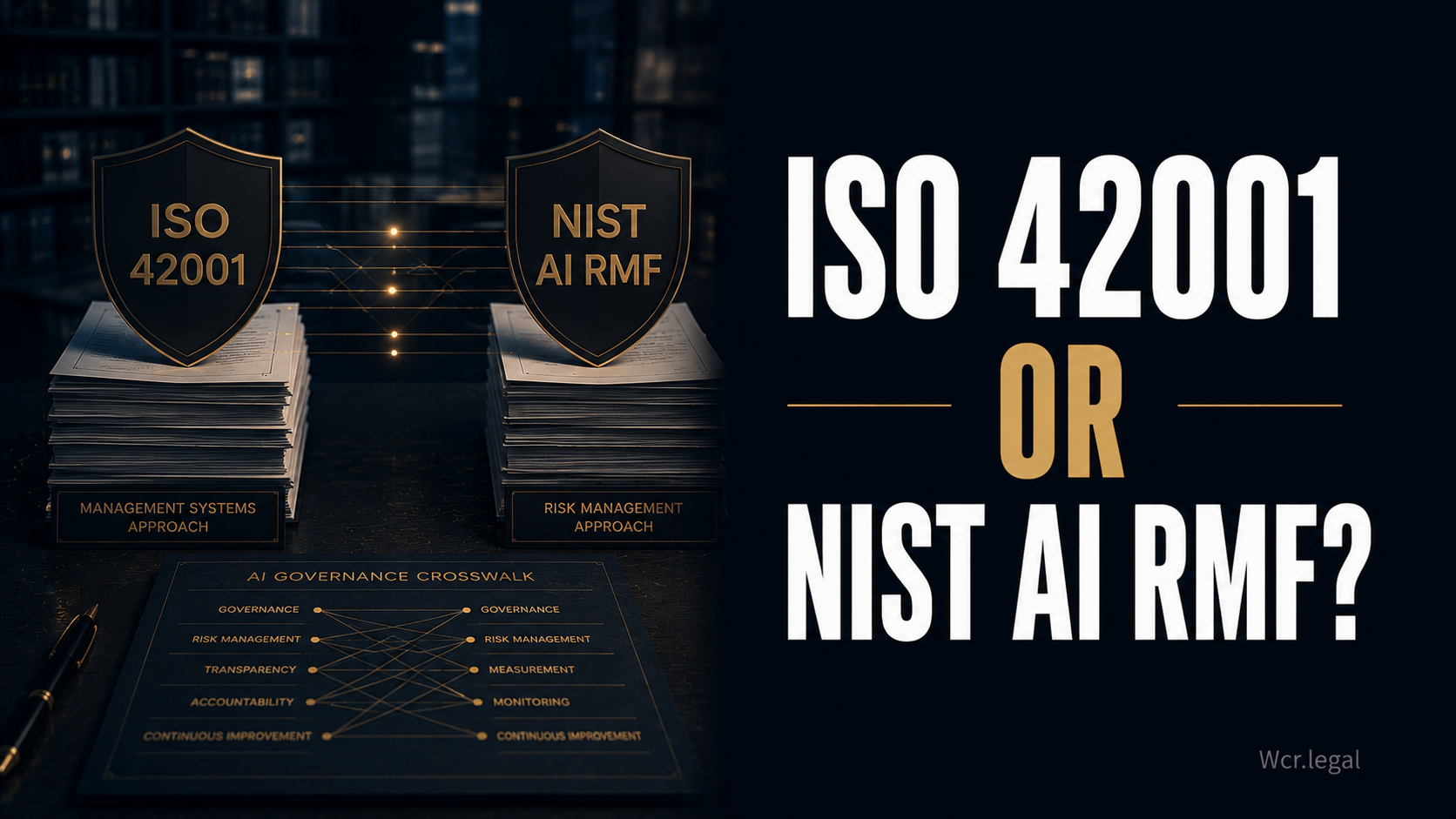
Whether you already hold ISO 42001 certification or are starting from zero, the path to EU AI Act compliance is different. See also: ISO 42001 vs NIST AI RMF: Which Framework First?
You Have ISO 42001
30–40% faster EU AI Act compliance
AIMS foundation in place · focus on product-level gaps
Advantage
Articles 9, 10, 12, 13, 14, 17 are substantially addressed. Your AIMS provides the risk management, data governance, transparency, human oversight, and QMS structures these articles require.
Step 1
Run a gap analysis against Articles 11 and 15 specifically — the partial-coverage articles requiring per-system technical documentation and accuracy testing.
Step 2
Build Annex IV technical documentation for each high-risk system in scope. This is the highest-effort remaining obligation. Start with the system closest to deployment.
Step 3
Complete conformity assessment (Article 43), EU Declaration of Conformity, CE marking, and EU AI database registration. These are sequential regulatory steps that cannot be parallelised.
Timeline
With ISO 42001 in place, most organisations can reach Article 43 conformity readiness in 8–14 weeks, depending on the number of high-risk systems in scope.
You Don’t Have ISO 42001
Sequenced implementation required
Build AIMS foundation first · then layer product compliance
Phase 1
Implement NIST AI RMF as operational infrastructure — AI inventory, risk taxonomy, ownership assignment. Timeline: 4–8 weeks. This builds the foundation for both ISO 42001 and EU AI Act compliance simultaneously.
Phase 2
Build and certify ISO 42001 AIMS over the NIST base. Most NIST subcategory artifacts map directly to ISO 42001 Annex A controls — avoid duplicating work. Timeline: 3–6 months to certification.
Phase 3
Layer EU AI Act product-level obligations: Annex IV documentation per system, conformity assessment, CE marking, EU AI database registration. These can begin in parallel with Phase 2 if August 2026 is the operative deadline.
Note
If August 2026 is immovable, start EU AI Act product-level compliance immediately in parallel with AIMS development — do not wait for ISO 42001 certification before beginning Annex IV documentation.
Ready to Map Your ISO 42001 Gaps to EU AI Act?
WCR Legal runs structured gap analyses for organisations with ISO 42001 certification preparing for EU AI Act enforcement. We map your existing AIMS controls to Article obligations, identify the product-level gaps, and sequence your compliance programme. See our NIST / ISO 42001 / EU AI Act services and AI Governance & Risk practice.
FAQ
ISO 42001 & EU AI Act — Common Questions
For AI governance and risk strategy, see our AI Governance & Risk services. For high-risk AI system classification, see our EU AI Act high-risk SaaS classification guide.
Frequently Asked Questions
Click a question to expand
1
Can ISO 42001 be used as a harmonised standard under the EU AI Act?
+
ISO 42001 is not currently listed as a harmonised standard under the EU AI Act in the Official Journal of the EU. Harmonised standards under the EU AI Act are being developed through CEN/CENELEC. ISO 42001 may be used as supporting evidence of compliance with specific AIMS-related requirements — particularly Articles 9, 10, 12–14, and 17 — but it does not confer presumption of conformity with the EU AI Act as a harmonised standard would. The legal landscape around harmonised standards is still developing, and organisations should monitor the European Commission’s standardisation mandates.
2
Does ISO 42001 cover GPAI model obligations under Articles 53–55?
+
No. ISO 42001 does not address GPAI model obligations. Articles 53–55 impose specific requirements on providers of general-purpose AI models: technical documentation, copyright transparency, and — for systemic risk models exceeding 10^25 FLOPs — adversarial testing, incident reporting to the AI Office, and cybersecurity measures. These are model-level regulatory obligations that apply regardless of an organisation’s AIMS certification. GPAI compliance requires a separate regulatory programme aligned with the GPAI Code of Practice published by the European AI Office.
3
If we have ISO 27001, how quickly can we achieve ISO 42001?
+
Organisations holding ISO 27001 (or ISO 9001) have a significant implementation advantage for ISO 42001. The management system infrastructure — internal audit cycles, documented policies, top management review, corrective action processes — already exists and maps directly to ISO 42001’s Annex SL structure. Most ISO 27001-certified organisations can reach ISO 42001 certification in 6–12 weeks from the start of a structured implementation programme, compared to 3–6 months for organisations starting from zero. The primary new work is AI-specific: AI inventory, AI risk assessment, and the Annex A AI-specific controls.
4
What is the difference between ISO 42001 conformity and EU AI Act conformity assessment?
+
ISO 42001 conformity is assessed by an accredited certification body against the requirements of the ISO 42001 standard — it evaluates whether your organisation’s AI management system meets the standard’s clauses and controls. EU AI Act conformity assessment under Article 43 evaluates whether a specific high-risk AI system meets the essential requirements of the EU AI Act — including accuracy, robustness, data governance, transparency, and human oversight at the product level. The objects, methodologies, assessors, and legal frameworks are entirely different. Neither substitutes for the other.
5
Should we pursue ISO 42001 even if we have no high-risk AI systems under the EU AI Act?
+
Yes, in most cases. ISO 42001 delivers value independent of EU AI Act high-risk classification: it satisfies Article 4 AI literacy obligations (in force since February 2025), demonstrates governance maturity to enterprise procurement and institutional investors, provides structured AIMS infrastructure that scales when AI use expands, and positions your organisation to respond to EU AI Act obligations quickly if AI system classification changes. Even organisations with no current high-risk systems should assess their exposure annually — system use cases and the Annex III list of high-risk categories may evolve. See our high-risk SaaS classification guide for the current scope.



Post Comment