How AI Models Are Licensed: A Brief Guide for Founders and Product Managers
How AI Models Are Licensed: A Brief Guide for Founders and Product Managers
The licence governing an AI model determines what you can build with it, who can use it, whether you can fine-tune and redistribute it, and who owns the outputs your product generates. Most founders discover these constraints after they have already built on top of a model.
In this article
Introduction — why AI model licensing is a product and legal decision, not just a technical one
The licence you build on shapes your product's legal exposure, scalability, and exit options from day one
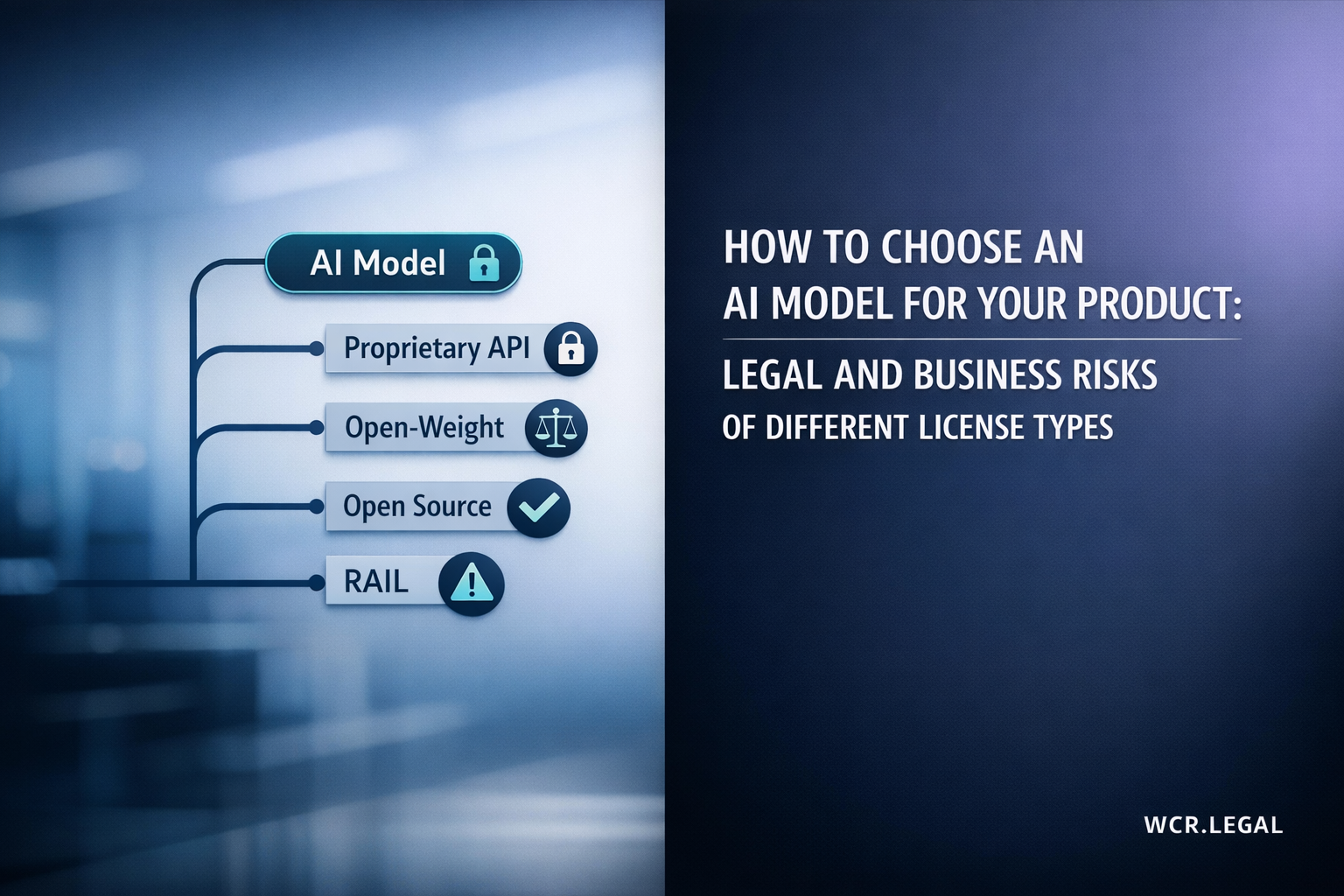
The main types of AI model licences — open weight, proprietary, and everything between
What each licence category actually permits — and the key distinctions that determine whether you can ship commercially
Key licence restrictions founders and PMs must understand
Use-case prohibitions, output ownership, fine-tuning rights, redistribution limits, and attribution obligations
Comparing major AI model licences — OpenAI, Anthropic, Meta, Mistral, Google, and others
A practical side-by-side of the licence terms that matter most for commercial product development
Building products on AI models — what to check before you commit to a model
The due diligence checklist every founder and PM should run through before basing a product on an AI model
Strategic conclusion — choosing the right model licence for your product stage
A decision framework matching product type, scale, and risk tolerance to the appropriate AI licensing approach
Introduction — why AI model licensing is a product and legal decision, not just a technical one
When a founder or product manager decides which AI model to build on, they are making a licensing decision with legal and commercial consequences that extend far beyond the initial technical integration. The model licence determines what the product can do, who can use it, whether the company can fine-tune and distribute modified versions, and — critically — who owns the outputs the product generates.
Most founders encounter this problem in the wrong order. They pick a model based on benchmark performance or API convenience, build their product, acquire users, and then discover — during a funding round, a legal review, or an enterprise sales cycle — that their chosen licence prohibits a use case central to their business, restricts commercial redistribution, or contains a clause that raises concerns for institutional investors or enterprise procurement teams.
AI model licences are not standardised. They range from fully permissive open-source licences that allow virtually any use, to tightly controlled proprietary API agreements that restrict competing products, require output attribution, and give the model provider rights to use customer data. Understanding the category your chosen model falls into — and the specific restrictions that apply — is a foundational product and legal task that should happen before the first line of integration code is written.
Common misconceptions about AI model licensing
- "Open source" means there are no restrictions on commercial use
- If a model is free to use, the outputs belong entirely to the builder
- Using a model via API means the licence doesn't apply to the product
- Fine-tuning a model means you own the fine-tuned version completely
- Enterprise customers don't care which model you use, only what it produces
- Switching models is easy — licence problems can always be fixed later
What AI model licensing actually determines
- Whether you can use the model in a specific product category or vertical
- Who legally owns the outputs — the model provider, the user, or nobody
- Whether you can fine-tune, host, and redistribute the model yourself
- Whether you can build a product that competes with the model provider
- What data the provider can use from your API calls for training or analysis
- Whether an enterprise customer's legal team will approve the model for their stack
An AI model licence is a contract between you and the model provider that governs everything your product does with that model. The fact that access is provided via an API — rather than as a downloadable file — does not reduce the legal force of the licence terms. Violating a model licence creates breach of contract liability, can trigger immediate service termination, and — in the case of open-weight models with use-case restrictions — may constitute copyright infringement if the licence conditions are not met.
Licence type
Is the model governed by a proprietary API agreement, a custom open-weight licence, an OSI-approved open-source licence, or a research-only licence?
Use-case restrictions
Does the licence prohibit specific verticals (healthcare, legal, weapons), competitive products, or high-risk applications as defined by the provider?
Output ownership
Does the licence assign ownership of generated outputs to the user, retain rights for the provider, or disclaim ownership entirely — leaving outputs in a legal grey zone?
Fine-tuning & redistribution
Can you fine-tune the model on proprietary data and host it yourself? Can you distribute fine-tuned versions to customers or release them publicly?
1. The main types of AI model licences — open weight, proprietary, and everything between
AI model licences do not map neatly onto traditional software licence categories. The industry has developed its own taxonomy — shaped by the technical distinction between models distributed as downloadable weights and models accessed exclusively via API — that founders and PMs need to understand before evaluating specific models.
Proprietary API licence
Access via API only · Model weights never distributed · Full provider control
The model is not distributed. The provider operates the model on its own infrastructure and you access it through an API. The licence is the Terms of Service governing that API — typically a commercial agreement that grants a limited, non-exclusive, non-sublicensable right to use the model's outputs for permitted purposes.
The provider retains full control over the model, can modify or withdraw it, and sets pricing unilaterally. Use-case restrictions, output ownership provisions, data usage rights, and competitive-use prohibitions are all set by the provider and cannot be negotiated except for enterprise tiers.
Weights accessible
No
Self-hosting
Not permitted
Fine-tuning
Via API only (where offered)
Commercial use
Permitted within ToS
Output ownership
Assigned to user (varies)
Provider data rights
API call data policies vary
Open-weight model with custom commercial licence
Weights available to download · Commercial use with restrictions · Not OSI open source
The model weights are publicly available to download, but the licence is not an OSI-approved open-source licence. Instead, the provider publishes a custom licence that permits many commercial uses while imposing specific restrictions — typically on use-case categories (weapons, surveillance, CSAM), on redistribution by very large companies, or on uses that compete directly with the provider's products.
This is the most common category for frontier open-weight models. "Open weight" is not the same as "open source" — the distinction matters legally because open-source licences have well-understood legal frameworks, while custom licences must be read carefully for their specific terms.
Weights accessible
Yes — downloadable
Self-hosting
Generally permitted
Fine-tuning
Generally permitted
Commercial use
Permitted with restrictions
Output ownership
Typically user's
Redistribution
Conditional on licence terms
True open-source licence (OSI-approved)
Weights + code freely available · No use-case restrictions · Legally well-understood
A small number of models are released under OSI-approved licences — most commonly Apache 2.0, MIT, or BSD — that impose no use-case restrictions and permit full commercial use, redistribution, and modification without restriction. These licences are legally well-understood: courts and legal teams know exactly what they permit and what they require.
Apache 2.0 is the most commercially friendly at scale — it requires preservation of licence and copyright notices but imposes no copyleft obligations. Models released under truly open licences are rare at the frontier level but more common for smaller, task-specific models and certain research releases.
Weights accessible
Yes
Self-hosting
Yes — unrestricted
Fine-tuning
Yes — unrestricted
Commercial use
Yes — unrestricted
Output ownership
User's
Redistribution
Yes (notice required)
Research / non-commercial licence
Weights available for research · Commercial use prohibited or gated · Unsuitable for product development without a separate agreement
Some model releases — particularly from academic institutions and research labs — are made under licences that explicitly prohibit commercial use. These models are available for research, academic study, and non-commercial experimentation, but using them in a commercial product is a licence violation regardless of whether the product generates revenue directly from the model's outputs.
Founders occasionally use research-licensed models in early prototypes without realising the commercial restriction. This is particularly common with older versions of models whose current commercial successors require a separate commercial agreement. Using a research-licensed model in a commercial product — even a pre-revenue startup — creates breach of licence exposure.
Weights accessible
Yes
Self-hosting
Research use only
Fine-tuning
Research use only
Commercial use
Prohibited
Output ownership
Unclear / restricted
Redistribution
Generally prohibited
| Licence type | Weights available | Commercial product use | Self-host & fine-tune | Redistribute modified | Founder suitability |
|---|---|---|---|---|---|
| Proprietary API | No | Yes — within ToS | No (API fine-tune only where offered) | No | High — fast to deploy |
| Open-weight custom licence | Yes | Yes — with restrictions | Yes — licence terms apply | Conditional | High — read licence carefully |
| OSI open source (Apache 2.0, MIT) | Yes | Yes — unrestricted | Yes — unrestricted | Yes (notice required) | Very high — maximum freedom |
| Research / non-commercial | Yes | No — prohibited | Research only | No | Not suitable for commercial product |
2. Key licence restrictions founders and PMs must understand
Across all AI model licence categories, five categories of restriction appear with sufficient frequency — and sufficient commercial consequence — that every founder and PM should understand them before committing to a model. These are: use-case prohibitions, output ownership provisions, fine-tuning and redistribution rights, data usage by the provider, and competitive-use clauses.
Use-case prohibitions — what your product cannot do
Almost every AI model licence — proprietary and open-weight alike — contains a list of prohibited use cases. These are uses the provider explicitly prohibits regardless of the commercial arrangement. The breadth and specificity of these lists varies considerably: some providers maintain broad category prohibitions, while others publish detailed acceptable use policies that enumerate specific prohibited activities.
The key point for founders is that use-case prohibitions apply to your product's use — not just your direct use. If your platform enables end users to engage in a prohibited activity, you are in breach of the licence even if you did not personally perform that activity. Platforms must implement controls that prevent users from violating the underlying model's acceptable use policy.
Product-level obligation End-user flow-through Reviewed at enterprise salesOutput ownership — who legally owns what the model generates
This is the most commercially significant and most legally uncertain dimension of AI model licensing. The question of who owns AI-generated outputs involves three layers: the model provider's licence terms, copyright law in the applicable jurisdiction (which in most countries currently does not protect AI-generated outputs without human authorship), and any specific contractual assignment in the provider's terms.
Most major proprietary API providers (OpenAI, Anthropic, Google) contractually assign ownership of outputs to the user — meaning you own what the model generates in response to your prompts. However, this contractual assignment cannot override copyright law: if a jurisdiction holds that AI-generated content is not copyrightable, the contractual assignment has limited practical value against third parties. Open-weight licences generally do not address output ownership at all.
Assignment in API ToS Copyright law uncertainty Check for IP indemnificationFine-tuning rights — and what you own after fine-tuning
Fine-tuning a model on your proprietary data does not give you ownership of the base model or full freedom to distribute the resulting fine-tuned version. The rights you acquire through fine-tuning depend entirely on the base model's licence.
Under a proprietary API licence, fine-tuning is offered as a paid service — you get a customised model endpoint but cannot download, host, or transfer the fine-tuned model. Under an open-weight custom licence (e.g., Llama 3), fine-tuning is generally permitted and you may distribute the fine-tuned model subject to the same licence conditions that apply to the base model. Under a true open-source licence, fine-tuning is unrestricted and redistribution is fully permitted subject only to attribution requirements.
API fine-tune: no portability Open-weight: licence passes through OSI licence: full redistribution rightsProvider data rights — what happens to your API call data
When you call a proprietary model API, you send data — prompts, context, user inputs — to the provider's infrastructure. The provider's terms of service determine what they can do with that data. The most critical question for commercial products is whether the provider can use your API call data to train or improve their models.
Most major providers have adjusted their default terms to not use API call data for training — but this is a default that may change, and enterprise customers routinely require contractual confirmation. For products handling personal data, the provider's data processing terms must also comply with GDPR, CCPA, or other applicable data protection law. A provider without a DPA (Data Processing Agreement) is a compliance problem for any product handling EU personal data.
Training data opt-out DPA requirement for personal data Enterprise procurement scrutinyCompetitive-use clauses — can you build a competing product?
Some proprietary API licences contain provisions that restrict the user from using the model's outputs to train or improve competing AI models. This restriction is most commonly found in OpenAI's terms and is designed to prevent the use of GPT outputs as training data for a competing language model.
For most application-layer founders, this restriction is not relevant — they are building on top of the model, not trying to replicate it. However, for AI infrastructure companies, model evaluation platforms, or companies that use LLM outputs as part of a training pipeline for their own models, this restriction creates a direct conflict that must be resolved before building on the provider's API.
Model training prohibition Application builders: generally unaffected AI infrastructure: high riskAttribution and disclosure obligations
Certain model licences — particularly open-weight licences and some research-origin releases — require attribution: a notice that the product is built on the specified base model. Some licences further require that end users be informed they are interacting with an AI system built on the licensed model.
Beyond contractual attribution requirements, the EU AI Act imposes independent disclosure obligations for certain AI-generated content (deepfakes, synthetic media) regardless of the underlying model licence. Founders building products that generate synthetic content in the EU must ensure their disclosure obligations are met at the product level, independently of what the model licence requires.
Model-level attribution requirements EU AI Act disclosure obligations Varies by deployment contextThe following use-case categories appear most frequently across major AI model acceptable use policies:
Weapons & military
Biological, chemical, nuclear or radiological weapons; military targeting systems
Mass surveillance
Unlawful facial recognition; individual tracking without consent; social scoring
CSAM
Child sexual abuse material — universal prohibition across all models
Disinformation
Influence operations; deceptive political content; impersonation of real persons
Unlicensed professional advice
Providing legal, medical, or financial advice as a substitute for licensed professionals without appropriate safeguards
Training competing models
Using outputs to train, fine-tune, or distil a competing AI model (provider-specific)
| Restriction type | Proprietary API | Open-weight custom | OSI open source | Founder action required |
|---|---|---|---|---|
| Use-case prohibition | Detailed AUP — review carefully | Use-case list in licence — often broad | Generally none beyond law | Mandatory AUP review before build |
| Output ownership | Typically assigned to user in ToS | Not addressed — defaults to user | Not addressed — defaults to user | Confirm in ToS; flag for copyright uncertainty |
| Fine-tuning rights | Via API only; model not portable | Permitted — licence passes through | Fully permitted | Check portability and redistribution terms |
| Provider data rights | API data policy — confirm opt-out | N/A — self-hosted | N/A — self-hosted | Obtain DPA; confirm no training use default |
| Competitive-use clause | Present in some providers (OpenAI) | Not common | Not applicable | Review if building AI infrastructure or training pipeline |
| Attribution obligation | Generally not required | Often required in redistributions | Copyright notice required | Low for API; check for open-weight redistribution |
3. Comparing major AI model licences — OpenAI, Anthropic, Meta, Mistral, Google, and others
The following profiles cover the most widely used AI models in commercial product development. Each profile summarises the licence type, the most commercially significant restrictions, and the key watchpoints that founders and PMs encounter in practice. Licence terms change — always read the current version before building.
OpenAI — GPT-4o, o-series, DALL-E, Whisper
Proprietary API · Commercial use permitted within usage policies · Enterprise agreements available
OpenAI's models are accessible exclusively via API (no weight download for frontier models). The Terms of Service assign ownership of outputs to the user, though OpenAI retains a licence to use outputs for service improvement subject to data usage settings. OpenAI publishes a detailed Usage Policy listing prohibited use categories.
The most product-relevant restriction is the prohibition on using outputs to train competing AI models. For application-layer products, this is generally not a constraint. For AI infrastructure companies or products that use GPT outputs in a training pipeline, it is a hard stop.
Weights available
No (frontier models)
Output ownership
Assigned to user
Fine-tuning
Via API (selected models)
IP indemnification
Available (paid plans)
Anthropic — Claude 3.x / 4.x family
Proprietary API · Commercial use permitted · Enterprise tier available · No open-weight releases
Anthropic's Claude models are proprietary API-only. The usage policy prohibits a standard set of harmful use cases (weapons, CSAM, mass deception) and includes a specific prohibition on using Claude to undermine AI oversight mechanisms. Commercial use is permitted and outputs are contractually assigned to the user.
Anthropic does not currently release open-weight versions of its frontier models. The enterprise tier offers a BAA (Business Associate Agreement) for HIPAA-adjacent deployments, which is significant for healthcare-adjacent products. Data is not used for training by default on the API.
Weights available
No
Output ownership
Assigned to user
Fine-tuning
Not currently offered
HIPAA BAA
Enterprise tier
Meta — Llama 3.x family
Open-weight · Custom LLAMA licence · Commercial use permitted with conditions · Large-scale restriction
Llama 3 models are distributed under Meta's custom LLAMA licence, which permits commercial use for most companies. The most important restriction: companies with more than 700 million monthly active users must obtain a separate licence from Meta — a provision designed to prevent the largest technology companies from leveraging Llama without a commercial arrangement.
Fine-tuning is permitted. Distribution of fine-tuned versions is permitted subject to the LLAMA licence being passed through to downstream users, and the "Llama" name cannot be used without Meta's permission. The weights can be self-hosted, which is a significant advantage for enterprise and regulated-sector deployments that cannot use third-party APIs for data residency reasons.
Weights available
Yes — download
Output ownership
User's
Fine-tuning
Permitted
700M MAU limit
Separate licence required
Mistral AI — Mistral, Mixtral, Codestral families
Mix of Apache 2.0 and custom licences · Some models fully open source · API also available
Mistral offers the most permissive licensing landscape among frontier model providers, with several models released under Apache 2.0 — a true OSI-approved open-source licence with no use-case restrictions and full redistribution rights. Mistral 7B and Mixtral 8x7B are available under Apache 2.0.
However, not all Mistral models carry the same licence. Codestral (their code-generation model) was originally released under a non-commercial licence before transitioning. The Mistral API has separate terms from the weight downloads. Founders should always check the specific licence for the specific model version they are evaluating — the licensing is not uniform across the Mistral portfolio.
Weights available
Yes (most models)
Apache 2.0 models
Mistral 7B, Mixtral
Fine-tuning
Fully permitted
Redistribution
Yes (Apache 2.0 models)
Google — Gemini API + Gemma open models
Two-track: Gemini (proprietary API) and Gemma (open-weight) · Separate licences
Google operates two distinct tracks. The Gemini API (Gemini 1.5 Pro, Ultra, Flash) is a proprietary API licence — commercial use permitted within Google's terms, outputs assigned to users. The Gemma family (Gemma 2, CodeGemma) are open-weight models released under Google's custom Gemma Terms of Use, which permits commercial use but prohibits certain high-risk applications.
Google's API terms include specific provisions on data use in Google Cloud context versus the free tier — enterprise users on Google Cloud get stronger data protection terms. Gemma's licence is not Apache 2.0 — it is a custom licence that must be read independently. Gemma fine-tuned models can be distributed subject to the same Gemma Terms passing through.
Gemini weights
No (API only)
Gemma weights
Yes — downloadable
Gemma fine-tuning
Permitted
Output ownership
Assigned to user
Stability AI — Stable Diffusion family
Open-weight · CreativeML OpenRAIL and successor licences · Use-case restrictions via RAIL
Stable Diffusion models introduced the RAIL (Responsible AI Licence) framework — a custom open-weight licence that distributes weights freely but attaches use-case restrictions that must be passed through to all downstream users. RAIL licences permit commercial use and fine-tuning but impose restrictions on harmful applications that are legally enforceable against the end user as conditions of the licence.
The CreativeML OpenRAIL-M licence used for earlier Stable Diffusion versions has been succeeded by different terms for later releases. SD3 and later versions have had more restrictive initial licence terms that were subsequently modified following community feedback. Output ownership for image models also intersects with copyright law uncertainties about AI-generated images, which are currently being resolved through litigation in multiple jurisdictions.
Weights available
Yes
Commercial use
Permitted with RAIL restrictions
Fine-tuning
Permitted
Output copyright
Legally uncertain
| Provider / Model | Licence type | Weights available | Commercial use | Fine-tune + self-host | Output ownership | Competing model prohibition |
|---|---|---|---|---|---|---|
| OpenAI GPT-4o / o-series | Proprietary API | No | Yes (within AUP) | API fine-tune only | Assigned to user | Yes — prohibited |
| Anthropic Claude 3/4 | Proprietary API | No | Yes (within AUP) | Not offered | Assigned to user | Not explicit — review AUP |
| Meta Llama 3.x | Custom LLAMA licence | Yes | Yes (<700M MAU) | Yes — licence passes through | User's | Not prohibited |
| Mistral 7B / Mixtral | Apache 2.0 | Yes | Yes — unrestricted | Yes — unrestricted | User's | Not prohibited |
| Google Gemini API | Proprietary API | No | Yes (within ToS) | API only | Assigned to user | Review ToS |
| Google Gemma 2 | Custom Gemma ToU | Yes | Yes (within ToU) | Yes — ToU passes through | User's | Not prohibited |
| Stable Diffusion (SDXL) | CreativeML OpenRAIL | Yes | Yes (RAIL restrictions) | Yes — RAIL passes through | Uncertain (copyright law) | Not prohibited |
4. Building products on AI models — what to check before you commit to a model
Model selection is a product architecture decision with a legal dimension. The right moment to evaluate a model's licence is before the first line of integration code is written — not when the product is ready to ship, a term sheet is on the table, or an enterprise customer's legal team is asking questions. The following checklist structures the pre-commitment licence review every founder and PM should complete.
Speed-to-market priority (MVP, pre-revenue)
For founders who need to validate a product concept quickly, a proprietary API provides the fastest path to a working prototype. The licence review is simpler (read the AUP, check output ownership), there is no infrastructure to manage, and frontier model performance is immediately accessible without fine-tuning.
The trade-off is dependency — on pricing, on availability, and on terms that can change. Plan the architecture so the API integration is abstracted behind a service layer that can be swapped without a full rebuild.
Recommended: OpenAI API, Anthropic Claude API, or Google Gemini APIEnterprise B2B product (data residency, compliance)
Enterprise procurement teams routinely require: data processing agreements, on-premises or VPC deployment options, assurance that customer data is not used for training, and in regulated sectors (healthcare, finance, government), specific certifications (HIPAA BAA, ISO 27001, SOC 2). Proprietary API-only models may satisfy the DPA requirement but cannot satisfy on-premises deployment.
For enterprise-critical products, an open-weight model that can be deployed on the customer's own infrastructure — or on a dedicated cloud instance — is often the only viable option for regulated buyer segments.
Recommended: Llama 3 (self-hosted), Mistral (self-hosted), or proprietary API with enterprise DPADifferentiation through fine-tuning
Products whose competitive advantage depends on fine-tuned model behaviour — domain-specific knowledge, stylistic consistency, task specialisation — need a licence that permits fine-tuning and portability of the fine-tuned model. Proprietary API fine-tuning (where available) produces a model endpoint tied to the provider. Open-weight fine-tuning produces a model the company controls and can deploy anywhere.
For products where the fine-tuned model is a core business asset — one that could be acquired as part of an exit — open-weight fine-tuning creates a more defensible and transferable IP position than API fine-tuning.
Recommended: Llama 3, Mistral (Apache 2.0), or Gemma — all permit fine-tuning with model portabilityCost management at scale
Proprietary API pricing is per-token — a model that is economically viable at prototype scale may become the largest cost line in the P&L at production scale. Founders should model the unit economics of their AI-layer costs at their anticipated scale before committing to an API-only architecture.
Self-hosting an open-weight model converts the variable per-token API cost into a fixed infrastructure cost — which may be significantly cheaper at sufficient volume. The break-even point varies by model size, inference hardware, and usage pattern. For high-volume, cost-sensitive products, building a dual-architecture that uses API at low volume and transitions to self-hosted at scale is a viable strategy — but requires the self-hosted model to be licenced for commercial use from the outset.
Recommended: Model the unit economics at 10x and 100x current volume; select open-weight if API costs are projected to exceed self-hosting at target scale5. Strategic conclusion — choosing the right model licence for your product stage
AI model licensing is not a one-time decision made at the start of product development. It is a living constraint that must be reviewed as the product scales, as the regulatory environment evolves, and as the provider's terms change. The six-step framework below gives founders and PMs a structured approach to making the initial licence decision — and keeping it current.
Map your product's use cases against every model you are evaluating — before you write integration code
For each model under evaluation, read the current acceptable use policy and map every planned feature against the prohibited use categories. Include features planned for the next 18 months, not just the MVP. Disqualify any model whose AUP conflicts with a planned feature that is central to the product thesis — not a feature you can remove without changing the product.
Determine your deployment requirements — API, self-hosted, or hybrid
Answer three questions before selecting a model: (a) Do any of your target customers require on-premises or VPC deployment? (b) Does your product handle personal data that cannot be sent to a third-party API under applicable data protection law? (c) Is the fine-tuned model a business asset you need to own and transfer independently of the provider? If any answer is yes, you need an open-weight model with a commercial licence — not a proprietary API.
Model the unit economics at scale — not just at prototype cost
Calculate the projected API cost per user, per transaction, or per unit of output at 10x and 100x your current usage. Compare that against the infrastructure and operational cost of self-hosting an open-weight alternative at the same scale. Build the model comparison into your financial model before committing to an architecture — the difference between the two options at scale can be material to unit economics and fundraising story.
Execute the required legal agreements before going live
For proprietary API models handling personal data: execute a DPA with the provider before processing any live user data. For enterprise products: confirm the provider's enterprise tier agreements satisfy your customers' procurement requirements. For open-weight models you plan to distribute: confirm you understand and can satisfy the licence pass-through obligations before shipping to end users.
Architect for model portability from day one
Regardless of which model you choose today, abstract the model integration behind a service interface that can be swapped without a full product rebuild. Treat the current model as an infrastructure dependency that may change — because the model landscape changes faster than most product timelines. A product that is tightly coupled to a single model's API is one provider decision away from an emergency re-architecture.
Set a licence review cadence — treat model licences like any other material contract
Proprietary model providers update their terms of service and acceptable use policies without notice. Open-weight model providers have changed licence terms between releases. Schedule a licence review each time you upgrade your model version, and at a minimum annually. Add model licence terms to the IP and legal risk register that you maintain for investor due diligence. A licence change that was missed six months ago is a diligence problem today.
The model licence is part of your product's legal architecture
Founders who choose their AI model primarily on benchmark performance, API convenience, or cost — without reading the licence — are building on a foundation they do not fully understand. The licence determines what your product can legally do, who owns what it produces, and whether the company that owns the model can change those rules unilaterally.
The AI model licensing landscape is still maturing. Licences that appear permissive today may be tightened as providers seek to monetise commercial use more aggressively. Models that are only available via API today may become open-weight in the future — or vice versa. Building with licence awareness, model portability, and a clear understanding of your deployment requirements is not legal over-engineering — it is product architecture.