How to Register a Company for a Cryptocurrency Project: Step‑by‑Step Legal Guide
How to Register a Company for a Cryptocurrency Project: Step‑by‑Step Legal Guide
Every successful cryptocurrency project begins with one foundational decision: where and how to register the legal entity that will hold the licences, enter contracts, open bank accounts, and carry regulatory responsibility. Getting the corporate structure wrong at the outset creates problems that compound at every subsequent stage — from licensing delays to banking refusals to investor due diligence failures. This guide walks through the full process, from entity type selection to post-registration compliance, covering the major crypto-friendly jurisdictions of 2025–2026.
Before writing a single line of smart-contract code or drafting a whitepaper, a crypto project needs an answer to one question: what legal vehicle will sit beneath the business? The entity you incorporate determines which licences you can apply for, which banks will open accounts for you, how investors will conduct due diligence, and ultimately who bears personal regulatory liability when things go wrong. Choosing the wrong structure at the outset rarely stays cheap — righting it later typically costs three to five times more than getting it right from the start.
- Simple and fast to incorporate
- Broad investor acceptance
- Flexible profit distributions
- Works well for DeFi/VASP operations
- Recognised globally by institutional investors
- Share classes enable complex cap tables
- Required for MiCA CASP licensing
- Compatible with convertible notes and SAFEs
- No shareholders — reduces securities risk on token
- Asset protection and perpetual existence
- Credible governance narrative for communities
- Pairs well with an operating company subsidiary
- Bridges on-chain governance with legal recognition
- Members protected from unlimited personal liability
- Enables DAO to sign contracts and open accounts
- Still evolving — regulatory treatment varies by jurisdiction
Jurisdiction selection is not simply about finding the lowest tax rate — it is a multi-factor decision that shapes every subsequent step of the business: which licences are available, which banks will work with you, how much substance is required on the ground, and how credible the entity appears to counterparties. The crypto-specific regulatory landscape has shifted dramatically since 2022; what was permissive two years ago may now impose full MiCA-style obligations, while previously overlooked jurisdictions have emerged as genuine leaders in crypto-friendly regulation.
- Is there a dedicated VASP or CASP regime?
- What is the typical licence processing time?
- How actively does the regulator supervise licence holders?
- How are token sales and staking income treated?
- Is there a tax treaty network with your key markets?
- Are there substance-over-form rules that could reclassify income?
- Which local banks service licensed VASPs?
- Are EMI or PSP alternatives available?
- Is correspondent banking available for USD/EUR flows?
- How many locally resident directors are required?
- Is a physical office mandatory or can a registered address suffice?
- Are there local staffing thresholds?
- Has the regulator publicly committed to supporting crypto innovation?
- How have courts treated crypto disputes historically?
- Is the political environment stable over a 5-year horizon?
| Jurisdiction | Crypto Licence | Tax Burden | Banking Access | Substance | Timeline |
|---|---|---|---|---|---|
| 🇪🇺 EU / MiCA | Clear (CASP) | Varies by state | Strong | Significant | 3–9 months |
| 🇦🇪 VARA Dubai | Comprehensive | 0% Corp tax* | Selective | Local office req. | 3–6 months |
| 🏝️ RAK DAO | DAO LLC frame. | 0% Corp tax | Limited options | Minimal | 1–4 weeks |
| 🇰🇿 AIFC Kazakhstan | CASP licence | 0% in AIFC zone | Developing | Local presence | 2–4 months |
| 🇸🇻 El Salvador | DASP licence | 0% on BTC gains | Challenging | Flexible | 1–3 months |
| 🇨🇭 Switzerland | FINMA DLT licence | Moderate | Good (crypto banks) | Significant | 6–18 months |
- FATF grey-listed or blacklisted — correspondent banks will refuse to process payments, making real-world operations impossible even with a valid licence.
- No track record of licensing crypto businesses — a brand-new crypto regime with no precedent approvals offers little predictability on timeline, cost, or regulatory stance.
- No accessible banking for licence holders — a licence without a bank account is not a functional business. Always verify which specific banks currently serve licensed VASPs in the jurisdiction.
- Rapidly changing political environment — jurisdictions that have reversed crypto-friendly laws in the past (or where a single political change could do so) add existential risk to long-term business plans.
- No mutual recognition or passporting — a licence that only allows you to serve local clients defeats the purpose of an international crypto business. Confirm the scope of permitted activity before committing.
Once jurisdiction and entity type are confirmed, the incorporation process itself follows a largely universal sequence — though the timelines, document requirements, and pain-points differ materially between jurisdictions. The steps below represent the standard workflow for a crypto operating company, from initial name reservation through to a functioning bank account. Missing or skipping any step typically creates complications downstream that are expensive to fix.
- Search the companies registry for name availability
- Conduct a trademark search (national + EU/WIPO if international)
- Avoid regulated terms without the corresponding licence (e.g. "bank", "insurance")
- Reserve the name formally if the registry allows a holding period
- Memorandum & Articles of Association (or LLC operating agreement)
- Shareholder / member register
- Founding resolutions (appointment of directors, registered address, share structure)
- Beneficial ownership declaration (mandatory in most jurisdictions post-2021)
- Certified passport copy and proof of address (less than 3 months old)
- Professional CV / résumé for all directors
- Criminal background check (apostilled, where applicable)
- Source-of-funds declaration for all UBOs holding ≥25%
- Regulator fit-and-proper questionnaire (for licensed entities)
- Registered office agreement with a local service provider or your own leased premises
- Proof of address: lease agreement or registered agent confirmation
- Local phone number and operational email
- Consider whether co-working space meets the regulator's "physical presence" threshold
- Submit via online registry portal or through a local notary / agent
- Pay registration and stamp duty fees
- Receive Certificate of Incorporation (CoI) and company number
- Request certified copies of CoI for bank account and licence applications
- Register for corporate income tax (TIN / EIN)
- Apply for VAT registration if turnover thresholds are exceeded
- In the EU: apply for EORI number if importing/exporting services
- Set up accounting and bookkeeping system from Day 1
- Business plan (3–5 year financial projections, service description, target markets)
- AML/CFT policy and procedures manual
- MLRO / Compliance Officer appointment and CV
- Minimum capital adequacy evidence (bank letter or audited accounts)
- Technology and cybersecurity assessment
- Response management for regulator queries
- Prepare a detailed bank presentation pack (business model, AML policy summary, projected volumes)
- Approach 3–5 banks and EMIs simultaneously to reduce timeline risk
- Include crypto-specialist banks where available (e.g. BCB Group, Sygnum, SEBA)
- Set up a backup EMI account while the main bank application is processed
- Expect enhanced due diligence: source of funds, customer profile, transaction flows
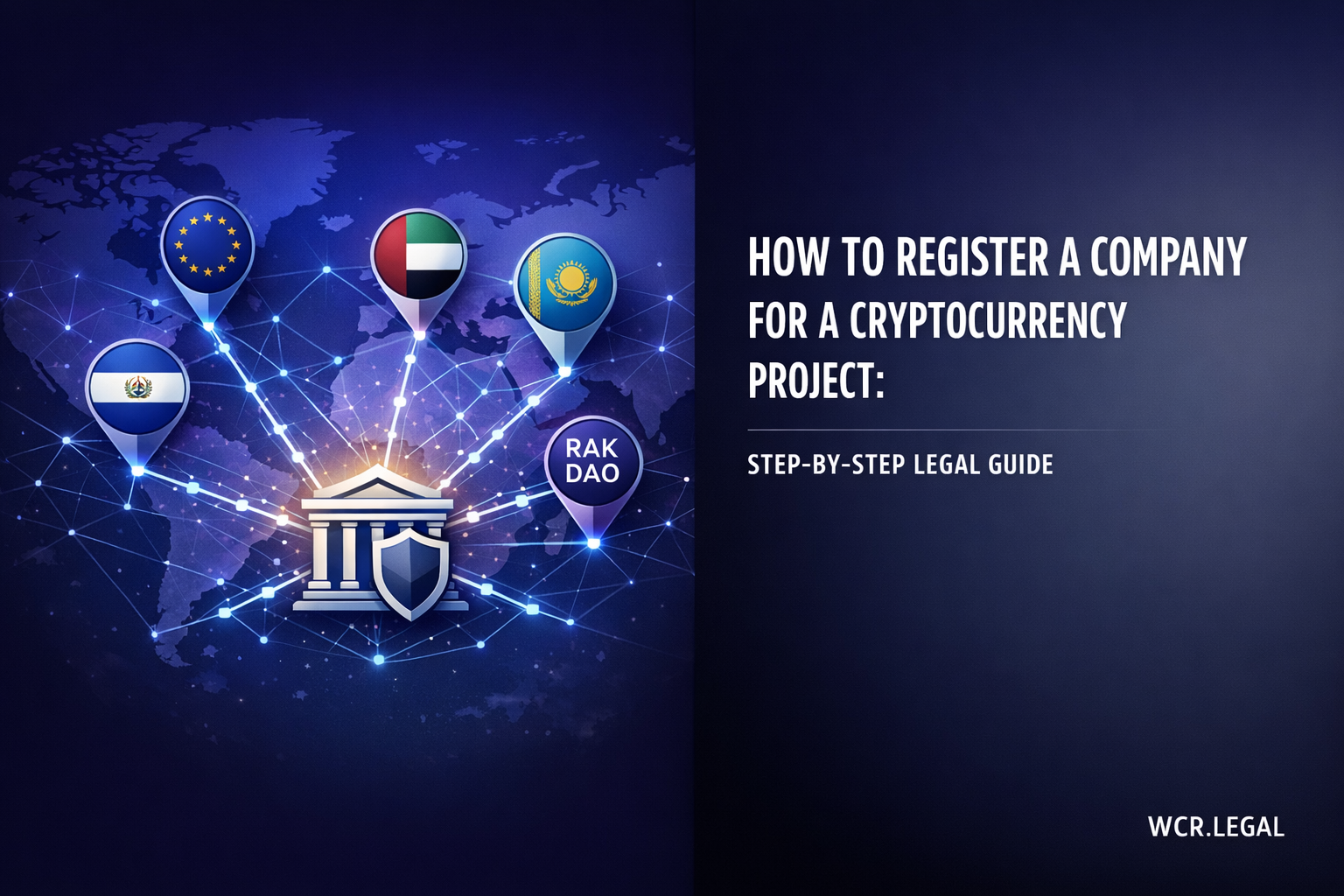
The following five jurisdictions represent the most practical and frequently chosen destinations for crypto company registration in 2025–2026. Each has a distinct regulatory framework, tax profile, and target business model. The right choice depends on your specific activity (exchange, wallet, fund, DeFi protocol, token issuer), your investor profile, and where your customers are located.
Incorporating a company is the beginning, not the end, of the compliance journey. Once the entity is registered and a licence is in hand, a new set of continuous obligations begins — obligations that require genuine operational infrastructure, not just paperwork. Regulators across all major crypto jurisdictions have significantly intensified their ongoing supervision of licensed entities since 2023, and failures in post-registration compliance are now the leading cause of licence suspensions and enforcement actions.
Even well-resourced teams make avoidable mistakes when structuring their crypto company. Many of these errors are not discovered until due diligence, bank onboarding, or regulatory review — at which point they are significantly more expensive to fix than they would have been at the outset. This final section addresses the eight most common structural errors, provides realistic cost ranges for different incorporation paths, and sets out a six-step action plan to get your project from concept to licensed, banked entity.
| Jurisdiction | Incorporation | Licence Fees | Legal / Advisory | Capital Required | Est. Total Year 1 |
|---|---|---|---|---|---|
| 🇪🇺 EU / MiCA (Lithuania) | €1,000–3,000 | €3,000–10,000 | €20,000–50,000 | €50,000–150,000 | €75,000–215,000 |
| 🇦🇪 VARA Dubai | AED 10,000–20,000 | AED 50,000–300,000 | $25,000–60,000 | AED 200,000–500,000 | $80,000–250,000 |
| 🏝️ RAK DAO | AED 5,000–15,000 | N/A (no VASP lic.) | $8,000–20,000 | None specified | $15,000–40,000 |
| 🇰🇿 AIFC Kazakhstan | $2,000–5,000 | $10,000–30,000 | $15,000–35,000 | $50,000–100,000 | $80,000–170,000 |
| 🇸🇻 El Salvador | $1,000–3,000 | $5,000–15,000 | $10,000–25,000 | $50,000 (BTC/USD) | $65,000–95,000 |
| Note: Figures are indicative ranges only. Actual costs vary by entity complexity, services scope, and market conditions. Ongoing operational costs (staff, office, banking, auditing) are excluded. | |||||