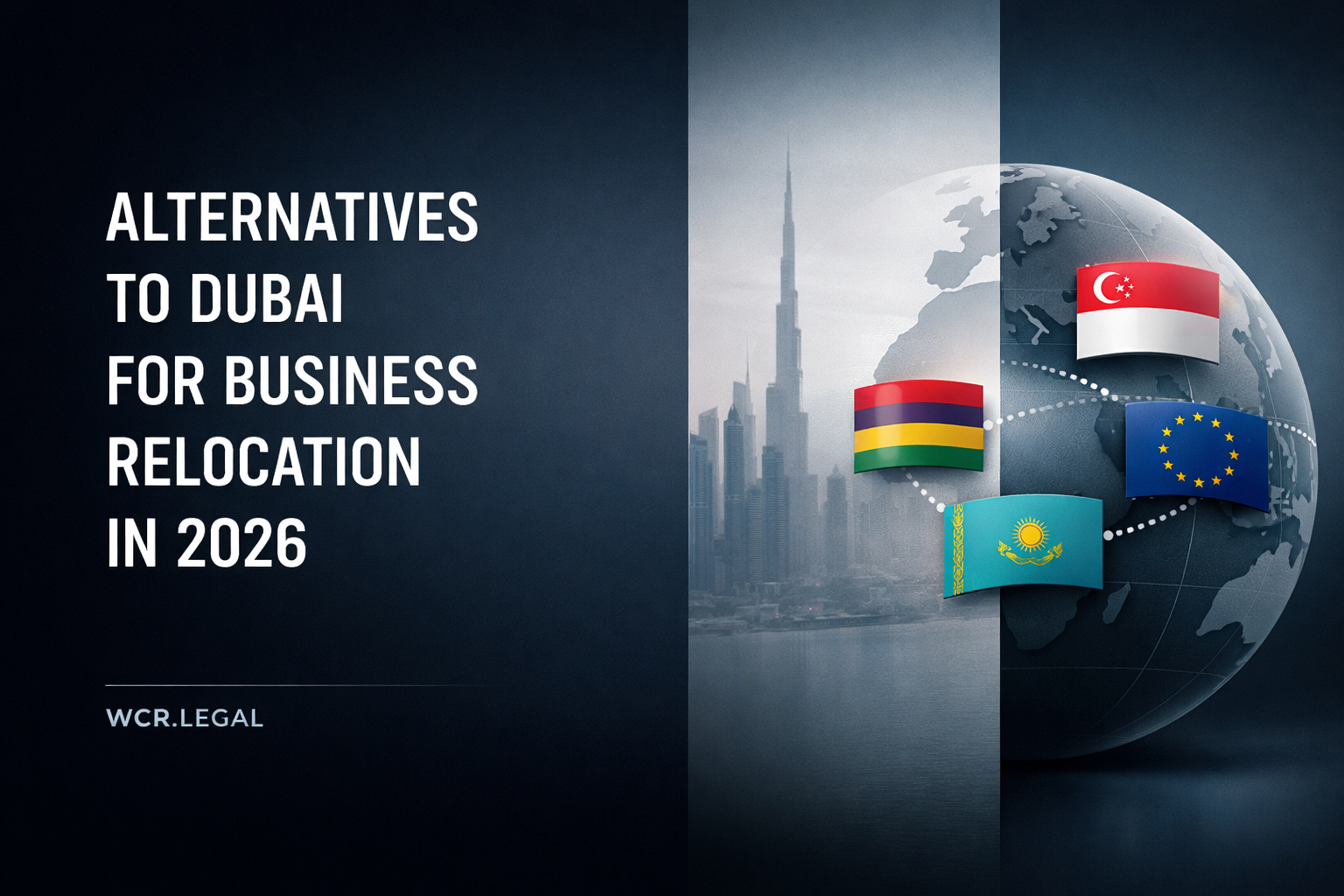
Alternatives to Dubai for Business Relocation in 2026
Alternatives to Dubai for Business Relocation in 2026
Six jurisdictions absorbing the outflow from Dubai — compared honestly. Costs, timelines, regulatory frameworks, and who each one actually suits.
Why Dubai is No Longer the Default Choice
For most of the 2020s, Dubai was the obvious answer for international founders looking to set up a regulated entity outside their home jurisdiction. The combination of zero corporate tax, a large expat business community, accessible Free Zone structures, and VARA's pioneering crypto framework made it genuinely competitive. That has not fundamentally changed — but the risk calculus has.
The post-March 2026 geopolitical environment has raised the operational cost of being based in Dubai for a specific category of business: regulated firms handling institutional capital, international payment flows, or technology with dual-use exposure. Banking due diligence timelines have lengthened significantly. Several correspondent banking relationships affecting UAE-incorporated businesses have been restructured. Regulatory expectations around beneficial ownership, AML, and substance — always present — have tightened in practice, not just on paper.
None of this means Dubai is a poor jurisdiction. For many businesses — regional trading, real estate, hospitality, domestic-facing services — it remains excellent. What has shifted is the default assumption that a DIFC or Free Zone structure gives you frictionless access to global banking, EU counterparties, and institutional investors. For regulated fintech, crypto, AI, and fund management businesses in particular, the friction is now material. That friction is driving a specific, deliberate outflow. The question is not whether to evaluate alternatives — it is which one fits your actual situation.
Singapore — The Premium Relocation Destination
Singapore is the closest equivalent to Dubai in terms of founder lifestyle, English common law, and international connectivity. It is also the most expensive and most demanding regulated jurisdiction on this list. See the Singapore jurisdiction overview for full licensing detail.
-
→MAS licensing is globally respected. A Singapore MAS licence is accepted without additional due diligence by most institutional counterparties, EU regulated entities, and US fund managers. It signals real regulated status in a way that few other jurisdictions can match.
-
→English common law. Contracts, dispute resolution, and corporate governance all operate on a familiar, well-tested legal framework. The Singapore International Commercial Court provides a credible forum for cross-border disputes.
-
→Asian capital access. Singapore positions you in the centre of one of the fastest-growing capital markets in the world. Family offices, sovereign wealth, and institutional fund managers are physically present in Raffles Place and Marina Bay.
-
→Banking is genuinely accessible. DBS, UOB, OCBC, and the major international banks maintain full correspondent relationships without the friction currently affecting some UAE corridors. Account opening for properly licensed entities is measured in weeks, not months.
-
!Cost is materially higher. Office space, staff salaries, and compliance infrastructure in Singapore are significantly more expensive than Dubai. A credible MAS-regulated operation — not a letterbox — requires a real team on the ground.
-
!MAS licensing takes 9–18 months. For the MAS Capital Markets Services or Payment Institution licence, expect a genuinely rigorous application process. Pre-application meetings, extensive documentation, and detailed financial projections are standard. There is no shortcut.
-
!Local presence is mandatory in practice. A Singaporean director alone is insufficient. MAS and institutional counterparties expect a functioning team with genuine decision-making authority in Singapore. A nominee director structure will not pass scrutiny.
-
!Not for early-stage businesses. If your annual revenue is below USD 500K and you are not yet generating consistent compliance infrastructure costs, Singapore will consume an outsized proportion of your operating budget. It is a destination for businesses ready to invest in institutional structure — not startups looking for a light-touch base.
Mauritius — The Underrated Option
Mauritius sits between offshore and onshore in a way that few jurisdictions manage. It is IOSCO-aligned, has a functioning VASP framework, real banking infrastructure, and a growing body of regulated fund and holding activity. It is consistently underestimated by founders who have not looked closely at it. See the full Mauritius jurisdiction guide for licensing detail and also the Mauritius VASP licence guide for 2026.
Mauritius was one of the earliest jurisdictions globally to implement a dedicated VASP (Virtual Asset Service Provider) licensing framework. The FSC's VASP licence covers exchange, custody, and brokerage activities and is FATF-aligned, meaning it is accepted by correspondent banks that would not touch an unlicensed structure.
The key differentiator from VARA (Dubai) and MAS (Singapore) is cost and speed. A Mauritius VASP licence can be obtained in 3–5 months at a fraction of the cost of either equivalent. For founders who need regulated status quickly and at a defensible standard — without the 12-month MAS process — this is a genuine alternative.
- →Regulator: FSC Mauritius (Financial Services Commission)
- →Timeline: 3–5 months from complete application to licence
- →Cost: Significantly lower than MAS or VARA equivalents
Mauritius's Global Business Company (GBC) structure remains one of the most tax-efficient holding vehicles available to international founders. The island has an extensive double tax treaty network — including treaties with India, South Africa, and several EU jurisdictions — that makes it structurally efficient for businesses with operations in Africa, South Asia, or the Gulf.
For founders relocating from Dubai who hold assets in Africa or South Asia, a Mauritius holding structure combined with holding structure planning can preserve much of the tax efficiency previously obtained through a UAE holding entity — with cleaner EU and institutional counterparty acceptance. See the Mauritius as a jurisdiction overview for treaty details.
- →Structure: Global Business Company (GBC1/GBC2) or Authorised Company
- →Treaties: 40+ double tax treaties including India, South Africa, UK, France
- →African market access: Preferred entry point for Eastern and Southern Africa
Mauritius offers a well-developed fund licensing regime that is increasingly relevant for tokenized fund structures and crypto-native asset managers. The Expert Fund (targeting sophisticated investors only) and the Collective Investment Scheme (CIS) structures both sit within a properly regulated FSC framework with genuine substance requirements.
For founders managing tokenized portfolios or digital asset funds who cannot access Singapore or EU fund structures at their current scale, Mauritius provides a regulated vehicle that major custodians and prime brokers will accept. The framework is explicitly designed to accommodate tokenized assets — not retrofitted from an analogue structure.
- →Structures: Expert Fund, CIS, Variable Capital Company (VCC)
- →Minimum: Expert Fund targets sophisticated/institutional investors only
- →Tokenized assets: FSC has issued explicit guidance on tokenized fund structures
EU Jurisdictions — Compliance-First Relocation
The EU is not one jurisdiction — it is a single market with 27 different entry points. The correct question is not 'should I go to the EU' but 'which EU jurisdiction suits my regulatory category and market target.' See the EU jurisdictions overview and the full MiCA vs VARA vs AIFC comparison for a detailed route map.
MiCA (Markets in Crypto-Assets Regulation) came fully into force across the EU in 2025. A CASP (Crypto-Asset Service Provider) licence obtained in any EU member state provides a passporting right to operate across all 27 EU countries without additional national licences. This is the single most valuable regulatory development for crypto businesses in the past decade.
For exchanges, custodians, brokers, and payment services with EU customers or EU institutional counterparties, a CASP licence is now effectively a requirement. The choice of member state affects application timeline, regulatory culture, and initial cost — but not the ultimate passporting scope.
- →Estonia / Lithuania: Established licensing infrastructure, experienced legal ecosystem, 4–6 month timelines for well-prepared applications
- →Netherlands: DNB supervision, higher substance expectations, stronger institutional credibility for larger businesses
- →Malta: Early-mover crypto regulation expertise; timelines of 6–9 months under the transitional MiCA period
- →Scope: CASP covers exchange, custody, brokerage, portfolio management, transfer, and advisory services for crypto-assets
For AI companies, SaaS businesses, and regulated technology providers targeting EU enterprise customers, the AI Act creates both an obligation and an opportunity. Operating from an EU member state with a proper legal entity removes the additional compliance layer of being treated as a non-EU provider under Article 70+ AI Act requirements. It also simplifies GDPR data processing agreements with EU clients.
The practical choice for English-speaking founders is Netherlands, Ireland, or Luxembourg. All three offer an English-language legal and regulatory environment, access to EU data centre infrastructure, and tax frameworks that work for IP-holding tech structures. Ireland and Luxembourg in particular have deep experience with international tech company structure.
- →Netherlands: Dutch Authority for Digital Infrastructure oversight, English legal environment, proximity to financial centres
- →Ireland: English common law, deep US tech ecosystem, experienced talent pool for compliance, AI, and data roles
- →Luxembourg: Fund management and fintech specialisation, CSSF supervision, strong EU financial institution relationships
- →Substance requirement: All three require genuine local operations — not just a registered address — to satisfy both regulatory and tax requirements
AIFC — Regulated, Affordable, and Underestimated
The Astana International Financial Centre in Kazakhstan is consistently overlooked by international founders who have not encountered it directly. That is a mistake worth correcting. See the AIFC jurisdiction guide and the AIFC overview for international founders for full detail.
The Astana International Financial Centre is a purpose-built financial free zone established under Kazakhstani law but operating under its own legal framework — English common law, modelled explicitly on DIFC and ADGM. It has an independent court system (AIFC Court) applying English common law, an independent arbitration centre (AIFC Arbitration Centre), and a dedicated financial regulator (AFSA — Astana Financial Services Authority).
AFSA is an IOSCO associate member and its regulatory framework was designed with direct input from DIFC and international bodies. It is not an offshore shell jurisdiction — it is a properly constructed international financial centre with real regulatory teeth, real court infrastructure, and real licensing substance requirements.
AFSA issues a Crypto-Asset Service Provider (CASP) licence covering exchange, custody, portfolio management, and advisory services for digital assets. The framework is explicitly FATF-aligned and has been updated for 2025-26 to incorporate the latest FATF travel rule requirements for virtual asset transfers.
- Timeline: 2–4 months from complete application to licence — significantly faster than MAS (9–18 months) or VARA (6–12 months)
- Cost: CASP licence at AIFC is 60–70% less expensive than comparable MAS or VARA licences, including application fees, capital requirements, and ongoing compliance infrastructure
- Substance: Real office and operational presence in Astana required — not a virtual office. AFSA conducts on-site reviews and expects functioning compliance infrastructure
- Banking: MCB Bank, subsidiary banking options, and AIFC partner banks provide corporate banking with international correspondent relationships
AIFC is particularly well-suited for founders relocating from the Gulf region who need a regulated, English common law framework but cannot justify the Singapore cost structure or the 12-month MAS timeline. The cultural and operational proximity to the Gulf is real — flight time from Dubai is under 4 hours, time zone overlap is significant, and the founder community has meaningful Gulf representation.
- Crypto and digital asset businesses needing regulated status quickly at lower cost than Singapore or EU alternatives
- Gulf-based founders who want English common law governance without moving to a Western jurisdiction
- Businesses accessing Central Asian and CIS markets where a local regulated presence provides commercial advantage
- Companies that need IOSCO-aligned regulatory status for institutional counterparty acceptance but are at an earlier stage of revenue growth
AIFC is not a substitute for Singapore if your primary market is Asia-Pacific and you need MAS-level institutional recognition. It is not an alternative to the EU if you need MiCA CASP passporting across EU member states for European retail or institutional clients. And it is not a light-touch base with minimal oversight — AFSA expects real substance and enforces its requirements.
The honest positioning: AIFC is the right answer for a specific, well-defined category of business. For everyone else, it is a secondary option worth understanding — not the primary recommendation. Do not choose it because it is cheap. Choose it because it fits your regulatory category, market, and operational model.
5 Questions That Determine Your Jurisdiction
No jurisdiction is universally correct. The right choice follows from your business model, regulatory category, market, and operational scale. Answer these five questions honestly and the shortlist narrows quickly. See also the jurisdictional diversification strategy guide for 2026.
Your jurisdiction should position you in — or as close as possible to — your primary revenue market. Regulatory recognition, banking relationships, and counterparty trust all follow from proximity to the market you serve.
Regulated businesses need a jurisdiction whose licensing framework covers their specific activity. An unlicensed business has more flexibility but less counterparty credibility. Be honest about which category you are in — and which you will need to be in within 12 months.
Compliance cost is not optional — it is the price of entry in every regulated jurisdiction. The question is not whether you will spend on compliance, but how much your operational model can absorb.
Banking requirements are often the deciding factor that eliminates jurisdictions from the shortlist entirely. Your regulatory licence is only as useful as your ability to actually move money. Be specific about which currencies you need, which corridors matter, and which banking relationships are non-negotiable for your counterparties.
These are two different decisions with different optimal answers. A full business relocation requires you to move real operational substance — team, decision-making, banking, regulatory presence. A holding structure relocation can be done more efficiently and does not require your whole team to physically relocate.
WCR Legal advises international founders on jurisdiction selection, regulatory licensing, and cross-border relocation structuring. We work across Singapore, Mauritius, AIFC, EU jurisdictions, and UAE — and give you honest advice on which option fits your specific situation, not the most expensive one.
