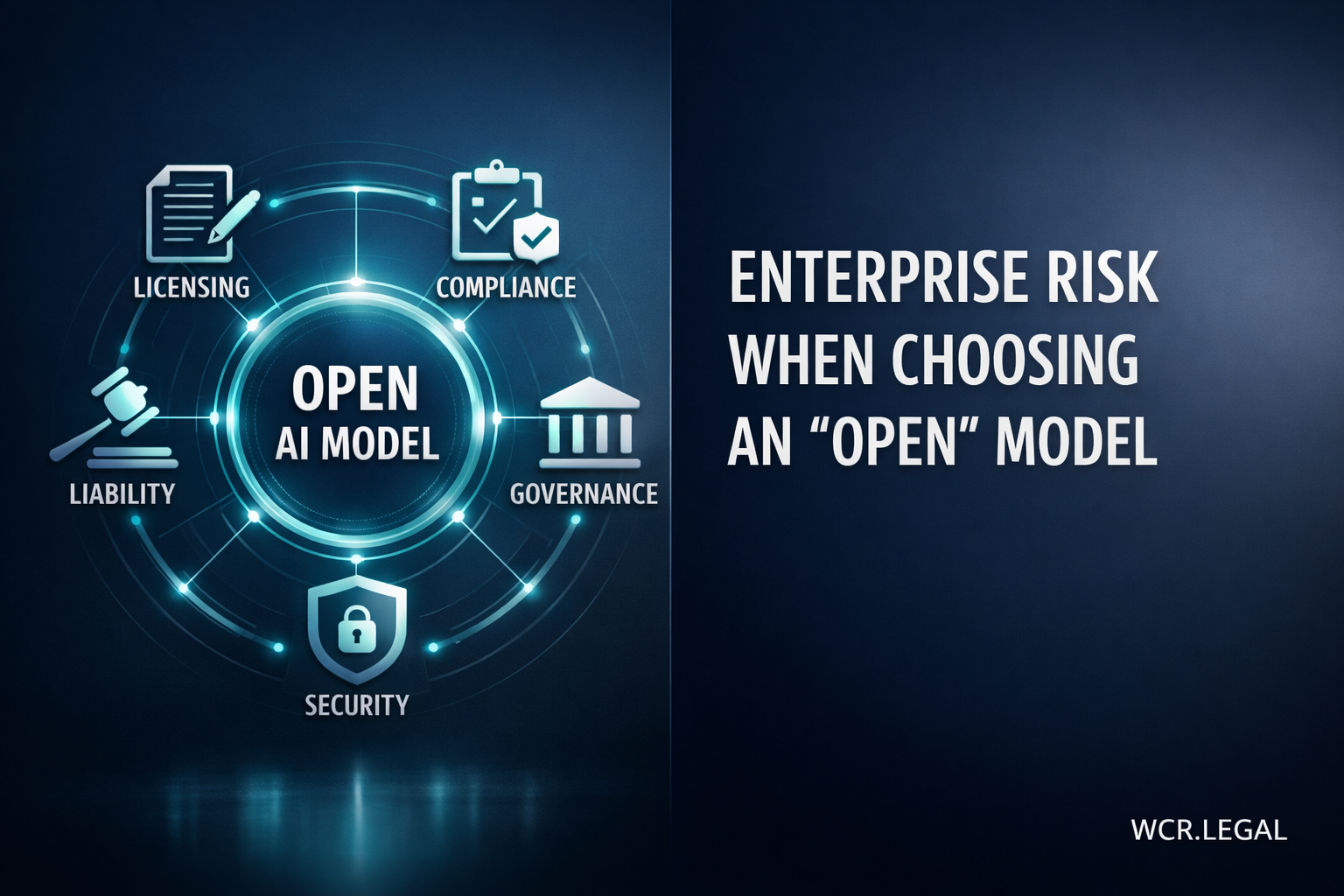
Enterprise Risk When Choosing an “Open” Model
Enterprise Risk When Choosing an "Open" Model
"Open" does not mean zero risk. Model licences from Llama, Gemma, NVIDIA, and Mistral each carry vendor lock-in vectors, unilateral change rights, and use-case restrictions that translate directly into enterprise procurement and contractual risk — risks that can be quantified, managed, and mitigated with the right strategy.
Introduction — "Open" Is a Technical Description, Not a Risk Assessment
The word "open" in AI model licensing carries significant marketing weight and limited legal precision. A model described as open may be fully open-source (Apache-2.0, like Mistral 7B), conditionally open (Llama 3 with use restrictions and a 700M MAU threshold), quasi-open (Gemma with a Prohibited Use Policy and termination rights), or open weights with proprietary training data and no source. None of these are equivalent in terms of enterprise risk — and all of them carry vendor dependencies that proprietary API relationships like OpenAI's also create, but in different forms.
For enterprise buyers evaluating AI products — and for AI product companies preparing for enterprise sales — the question is not "is this model open?" but "what risks does this model's licence create, how do those risks flow into our products and contracts, and what mitigations are in place?" The answers to those questions determine procurement approval, contract structure, and DPIA risk classification in ways that the "open" label does not.
Three Myths About Open Model Risk
"Open models eliminate vendor dependency"
Running model weights on your own infrastructure removes the API dependency — but not the licence dependency. If Meta changes the Llama 3 licence terms, or Gemma's Prohibited Use Policy is updated, continued use of existing weights may constitute acceptance of new terms. The vendor relationship is contractual, not just technical.
"Open weights mean I can do whatever I want"
Open weight availability is not the same as unrestricted use. All major commercial open-weight models — Llama 3, Gemma, NVIDIA Open Model License — contain use-case restrictions, competitor clauses, training bans, or flow-down obligations. The weights may be downloadable; the licence terms are still binding.
"Open models are automatically better for enterprise"
Enterprise procurement teams evaluate AI model dependencies on licence clarity, data processing terms, IP chain, and ongoing compliance obligations — not on whether weights are downloadable. A proprietary API with a strong DPA and clear IP indemnity may pass enterprise procurement faster than an open-weight model with a complex, updatable custom licence and no DPA. Risk profile determines approval, not openness.
Four Enterprise Risk Categories Across All Model Types
Vendor lock-in
Dependency on a single provider's model performance, availability, and licence terms
Licence change risk
Provider updates terms unilaterally; continued use constitutes acceptance of new obligations
Use-case restriction risk
Model AUP bans a category the product currently serves or plans to expand into
Enterprise contract friction
Model licence obligations create customer procurement objections, DPIA complexity, and MSA negotiation friction
Proprietary API vs Open Weight Models — Risk Profile Comparison
IP and investment context: Model licence choice creates ongoing obligations that affect the IP stack of AI products at every stage — from product development through fundraising and acquisition. For the broader framework on how model choice interacts with AI IP ownership and investment structuring, see AI IP Ownership — wcr.legal.
Section 1 — Vendor Lock-In and the Risk of Licence Changes
Vendor lock-in for open-weight AI models is not the same as lock-in for proprietary software. You can run the weights; you cannot negotiate the licence. The major commercial open-weight model licences — Llama 3, Gemma, NVIDIA Open Model License, and even Mistral's API terms — are all updatable by the provider without your consent, and in most cases continued use of the model or service after a term update constitutes acceptance of the new terms. That dynamic is the structural source of enterprise risk that the "open" label obscures.
Meta — Llama 3 Community License
Scale-conditional licence with unilateral update right and competitor restriction
The Llama 3 Community License grants broad commercial use rights — but those rights are conditioned on compliance with a set of terms that Meta can update. The most significant lock-in vector is not the current terms but the architecture of the licence: Meta can release a new version of the Llama Community License, and any future Llama model releases will operate under the new version. Companies that build product roadmaps around Llama model availability are implicitly accepting that Meta controls the terms of the underlying technology for the foreseeable future.
The 700M MAU clause creates a distinct form of vendor lock-in: it forces companies approaching that threshold to negotiate with Meta directly, on terms Meta sets, to continue operating. There is no market alternative for that negotiation — Meta is the sole counterparty. Any product that might approach scale faces a dependency on Meta's commercial discretion that has no equivalent in Apache-2.0 products.
Google — Gemma Terms of Use
Termination right, updatable PUP, and flow-down obligation create multi-layer dependency
Gemma's Terms of Use give Google three unilateral rights that constitute structural lock-in: the right to modify the terms (with continued use constituting acceptance), the right to update the Prohibited Use Policy, and the right to terminate a licensee's rights for breach — including breach by downstream users the licensee has not adequately controlled. The combination creates a situation where Google can expand the list of prohibited uses at any time, and your product must comply with the expanded list within whatever notice period (if any) Google provides.
The flow-down obligation creates a second layer of dependency: your enterprise customer contracts must be consistent with Gemma's Terms of Use. If Google updates the PUP and your customer agreements do not reflect the update, you face a potential breach — not of a contract with your customer, but of the Gemma Terms of Use — because your customers are using your product in ways that are no longer permitted under the updated PUP.
NVIDIA — Open Model License
More permissive than Llama/Gemma, but training restriction and absent patent grant remain
NVIDIA's Open Model License is the most permissive of the three major non-Apache custom model licences. It does not include the scale threshold or competitor restriction found in Llama 3, and permits deployment on non-NVIDIA hardware — a deliberate design choice to reduce hardware lock-in. However, the licence retains a training restriction (models trained from NVIDIA open models may not be used to compete with NVIDIA's foundation model offerings), an updatable Acceptable Use Policy, and no patent grant for model inference methods.
The absent patent grant is the most commercially significant long-term risk for enterprise products in hardware-adjacent or semiconductor-adjacent industries: NVIDIA holds a substantial patent portfolio covering inference hardware and techniques, and the absence of a patent licence for model methods leaves residual exposure for enterprise users in those sectors. For general software products, the training restriction and AUP update right are the primary lock-in concerns.
Mistral — Apache-2.0 (open weights) & Mistral API
Apache-2.0 eliminates licence lock-in; API terms create standard API dependency
Mistral's publicly released open-weight models (Mistral 7B, Mixtral 8x7B) under Apache-2.0 are the closest the commercial LLM ecosystem currently comes to a zero-licence-lock-in model. Apache-2.0 grants are irrevocable for the version you received, cannot be updated to impose new obligations, and permit any use including competitive products. A company that pins to a specific Mistral Apache-2.0 model version has a static, unconditional licence that will not change.
Mistral's commercial API is a different product — it carries standard API terms, sub-processor data processing obligations, and an AUP that can be updated. Enterprise products that use the Mistral API rather than self-hosting open weights face the same API dependency as OpenAI or Anthropic API products. The distinction matters for risk assessment: open-weight Apache-2.0 Mistral is the minimum-lock-in option; Mistral API is a standard API product with typical API risks.
Vendor Lock-In Dimension Matrix
A use case your product currently serves is added to the Prohibited Use Policy. Your product must either cease serving that use case or be in breach of the model licence — regardless of whether the use case was permitted when you launched the product.
A model version or capability previously available under the community licence is moved to a commercial licence tier. Continued use of that capability requires a commercial agreement on the provider's terms — or migration to a different model, with associated re-development costs.
As the EU AI Act, NIST AI RMF, and other regulatory frameworks mature, model providers will update their terms to comply — and those updates may impose new obligations on product licencees. Products that have not built licence-monitoring processes will discover changes reactively, often after the acceptance deadline.
A model version is deprecated without a compatible replacement. Products built on that specific version face re-training, re-evaluation, and potentially re-validation costs — a technical lock-in consequence that has direct commercial and legal implications for customer SLAs.
Section 2 — Risk Scenarios: Vendor Bans a Use Case, Changes Pricing, Adds New Restrictions
Abstract licence risk becomes concrete through scenarios. The four scenarios below represent the most commercially significant ways that open model vendor decisions have created — or could create — material business disruption for AI product companies. Each maps directly to clauses in Llama 3, Gemma, NVIDIA, or OpenAI's current terms, and each carries a risk register entry that should be part of any enterprise AI product's legal and operational risk management framework.
Scenario A — Vendor expands the prohibited use list to cover your core use case
Use-case ban: a category your product serves is added to the AUP/PUP
This is the highest-severity scenario for any product with a narrow vertical focus that touches a contentious AI application area. If your product serves legal, medical, financial, political, or media use cases, these are the categories most likely to attract expanded restriction — either due to regulatory pressure on the model provider, or due to public incidents involving similar applications.
Gemma's PUP already covers 18 categories. The Llama 3 AUP prohibits use in products that compete with Meta's social, messaging, and AI assistant businesses. NVIDIA's AUP covers broad "harmful" applications. All three can be expanded without your consent. A company with a healthcare AI assistant built on Gemma would face immediate non-compliance if Google added "medical diagnosis" to the PUP — a scenario that is not hypothetical given ongoing regulatory pressure on medical AI.
Forced product shutdown or redesign; customer contract breach
Immediate on PUP update — no grandfathering typical
Gemma (PUP), Llama 3 (AUP + competitor clause), NVIDIA (AUP)
Mitigation: Monitor model provider term updates quarterly. Maintain a model substitution plan identifying Apache-2.0 alternatives (Mistral) that could serve the same use case without AUP exposure. Include a force majeure / model licence change clause in enterprise customer contracts that permits service modification without breach.
Scenario B — Vendor moves current "free" capabilities to a paid commercial licence
Pricing change: community licence tier loses access to model capabilities or size
The history of developer-facing open-source and open-weight models includes multiple cases where community-accessible capabilities were later commercialised. OpenAI's GPT-3 began as a research model before becoming a paid API product. Llama 3's Community License already bifurcates — companies above 700M MAU must negotiate separately with Meta. A future version of the Llama licence could lower that threshold, add capability-level restrictions, or require payment for commercial use that currently falls within the community tier.
This risk is not symmetric across model families. Apache-2.0 Mistral weights — once released — cannot have pricing added retroactively for the released version. The irrevocable Apache-2.0 grant prevents that scenario for existing releases. For custom-licence models, the risk is structural: the licence architecture permits the provider to modify commercial terms for future access without affecting your rights to the version you already have — but if you need model improvements or new capabilities, you will be subject to the new terms.
Increased cost base; pricing model renegotiation with customers
New model versions or major releases; typically 6–18 months notice
All custom model licences; Apache-2.0 protected for current version
Mitigation: Pin to specific model versions where possible. Evaluate Apache-2.0 models as the baseline for cost stability. In enterprise customer agreements, avoid committing to specific model capabilities or performance benchmarks that could not be met with an alternative model if the primary model introduces cost restrictions.
Scenario C — Vendor terminates access for a downstream user's breach
Cascade termination: one customer's prohibited use triggers your licence termination
Gemma's Terms of Use give Google the right to terminate a licensee's rights for breach — and the flow-down obligation means that a breach by a downstream user of your platform could, in theory, constitute your breach of the Terms of Use if you have not implemented adequate contractual controls and monitoring. If a customer of your SaaS product uses a Gemma-powered feature for a prohibited purpose, and Google determines that you failed to adequately pass down and enforce the PUP, your product's licence could be at risk.
OpenAI's API Terms place developer responsibility for user compliance explicitly on the API developer: OpenAI can suspend or terminate API access for a developer whose platform enables policy violations by users. This creates a scenario where a single customer misusing your product triggers a platform-wide service disruption for all your customers — a risk with no equivalent in traditional software licensing.
Platform-wide service disruption; all customer contracts at risk
Immediate on provider detection; no notice period guaranteed
Gemma (termination right), OpenAI API (developer responsibility)
Mitigation: Implement technical AUP controls (content filtering, usage monitoring) with logs. Include immediate suspension rights in your customer ToS. Consider self-hosted open-weight models (Llama 3, Mistral) for use cases where API termination risk is highest — self-hosting removes the real-time termination vector while retaining the licence obligations.
Scenario D — Regulatory pressure forces provider to restrict previously permitted uses
Regulatory-driven restriction: EU AI Act, sector regulator, or government mandate forces AUP update
The EU AI Act classifies certain AI applications as high-risk or prohibited. As model providers operating in the EU market update their licences to comply, restrictions will be added that may affect use cases currently served by AI products. A product using Gemma for biometric identification, emotion recognition, or certain credit scoring applications may find those use cases restricted or prohibited by a Gemma PUP update driven by EU AI Act compliance requirements — even if the product's own regulatory status under the AI Act is unaffected.
This creates a two-layer regulatory risk: your product must comply with the AI Act directly, and it must also comply with any model-level restrictions your provider introduces in response to the AI Act, NIST AI RMF, or other frameworks. The two sets of obligations may not be perfectly aligned — a use case that is permitted under the AI Act may be restricted by your model provider's compliance-driven AUP update.
Use case retirement; product redesign; customer churn in affected verticals
EU AI Act enforcement begins 2025–2026; ongoing risk thereafter
All providers operating in EU market; Gemma PUP most specific to these categories
Mitigation: Conduct a joint AI Act + model licence use-case classification. Identify use cases that are both AI Act high-risk and near-AUP-boundary, and either migrate those to Apache-2.0 models with no AUP or build in the compliance infrastructure (human oversight, documentation, conformity assessment) that reduces the likelihood of a provider-driven restriction.
Risk Register — Open Model Licence Scenarios Summary
Section 3 — What Large Customers Want to See in Contracts and DPIAs
Enterprise procurement teams evaluating AI products built on third-party models do not take vendor assertions about model openness at face value. They review the underlying model licence obligations, trace how those obligations are reflected in the supplier's contract terms, and assess whether the data processing architecture creates GDPR or sector-specific compliance exposure. For AI product companies, this means the model licence choice is not just an internal technical decision — it is a material factor in enterprise sales cycle length, deal structure, and contract negotiation complexity.
The four areas where model licence choice most directly affects enterprise customer requirements are contractual risk allocation, DPIA documentation, sub-processor chain transparency, and IP ownership clarity. Each of these areas creates specific procurement objections that are predictable, repeatable, and — with the right preparation — addressable.
Four Areas Enterprise Procurement Teams Scrutinise
Typical Procurement Objections by Risk Level
Enterprise Contract Clause Requirements by Model Type
| Contract requirement | Proprietary API (OpenAI / Anthropic) | Llama 3 (open weight) | Gemma (open weight) | Apache-2.0 (Mistral 7B) |
|---|---|---|---|---|
| DPA with model provider | Available | None from Meta | Google Cloud DPA if via Vertex | None — self-hosted |
| Sub-processor chain completeness | Provider listed, DPA available | Hosting provider listed; Meta not a processor | Depends on deployment route | Self-hosted; no external processor |
| IP output indemnity availability | Limited indemnity in some tiers | Not available from Meta | Not available from Google | Not available — open licence |
| Training data use prohibition | API opt-out standard | Self-hosted; data does not leave | Self-hosted; data does not leave | Self-hosted; data does not leave |
| Cross-border transfer mechanism | SCCs / DPA varies by region | Depends on hosting provider | Depends on deployment route | Customer controls infrastructure |
| Licence change notification mechanism | API terms change with notice period | No formal notification process | No formal notification process | Apache-2.0 is irrevocable |
| Audit rights at model provider layer | SOC 2 / ISO 27001 reports available | Meta does not provide audit rights | Google Workspace audits; not model-specific | Self-hosted; customer can audit directly |
DPIA Information Requirements When Relying on Third-Party Models
Information the AI product must provide to customers
Gaps that model providers typically do not fill
What Procurement Teams Check Against the Sub-Processor Chain
📋 Named sub-processor list
Enterprise DPAs require a current named list of sub-processors, maintained and updated with prior notice of additions. The model provider — and any infrastructure provider hosting model weights — must appear on this list with their country of establishment and data processing role clearly described.
🔐 Back-to-back obligations
The supplier's DPA with each sub-processor must impose data protection obligations equivalent to those the customer imposes on the supplier. Enterprise procurement teams increasingly request copies of supplier-to-model-provider DPAs to verify this equivalence — a requirement that is difficult to satisfy for open-weight models with no formal provider relationship.
🌍 Transfer mechanism verification
Where model inference runs outside the EEA (common for US-based proprietary API providers and cloud-hosted open models), the transfer mechanism must be documented: SCCs executed with the sub-processor, Adequacy Decision coverage, or Binding Corporate Rules. The supplier must be able to produce these on request as part of enterprise due diligence.
IP structuring context: The contractual gaps at the model layer — particularly around IP indemnity and output ownership — interact directly with how AI product companies structure their IP for fundraising and M&A. For the framework on how model licence choice affects AI IP ownership and investment structuring, see AI IP Ownership — wcr.legal.
Section 4 — Multi-Model Strategy as a Way to Reduce Legal and Business Risk
The most effective structural mitigation against model licence risk is not better contract language — it is reducing the product's dependency on any single model provider. A multi-model architecture, designed deliberately rather than assembled by accident, reduces vendor lock-in risk, provides commercial leverage, creates fallback coverage for use-case restriction scenarios, and produces a substantially cleaner enterprise risk profile. The implementation cost is real, but so is the procurement and legal risk of single-model dependency.
Multi-model strategy is not about running multiple models simultaneously at all times. It is about designing the product so that the model layer is not a fixed dependency — model routing, version pinning, and architecture choices that preserve optionality are the structural foundation. The legal and commercial benefits then follow from that architectural flexibility.
Four Pillars of a Multi-Model Risk Strategy
Risk Reduction Impact by Multi-Model Strategy Element
Implementation Roadmap for Multi-Model Strategy
Map every model integration in the product, identify the licence type, document the AUP/PUP restrictions, and flag any use cases that approach restriction boundaries. This is the baseline required for all subsequent steps — and for any enterprise sales process or due diligence request.
If model provider calls are embedded directly in product logic, refactor them behind an internal routing interface. This is an engineering investment that pays dividends every time a model change is required — and it is the prerequisite for all other multi-model strategy elements.
For the product's most critical function — the one whose failure would breach an enterprise SLA — integrate, test, and maintain a secondary model. It does not need to be active in production, but it must be deployable within hours, not weeks. The secondary model's licence must be reviewed independently of the primary.
Where the product processes personal data that should not transit a third-party API, or where output IP clarity is material (e.g. legal, financial, creative content), deploy a self-hosted Apache-2.0 model for those specific tasks. The capability trade-off is often acceptable for bounded task categories.
Compile: model provider identities and roles, DPA references or self-hosting architecture diagrams, AUP mapping to product acceptable use policy, licence snapshot records, and sub-processor list. This pack answers the standard enterprise procurement questionnaire and reduces DPIA support burden to a documentation exchange rather than a negotiation.
Document the specific licence change events that trigger a mandatory model migration review. Then run a simulation: how long does a migration from the primary model to the secondary take, end to end, including legal review, testing, and deployment? The answer to that question determines the actual risk exposure the product carries — and informs what SLAs are commercially safe to offer enterprise customers.
Enterprise Risk Reduction Checklist — Multi-Model Strategy
The Risk Is Manageable — But Only If It Is Acknowledged
Model licence choice is not a one-time decision — it is an ongoing compliance and business strategy obligation that should be reviewed at every model version change, product expansion, fundraising round, and enterprise contract negotiation. The frameworks for managing it are available; the question is whether they are applied before a licence event creates urgency, or reactively under commercial and legal pressure. For guidance on how model licence choice interacts with AI IP ownership and investment structuring at the product level, see AI IP Ownership — wcr.legal.