How to Build an AI Governance Framework Step by Step
How to Build an AI Governance Framework Step by Step
AI governance is no longer a policy exercise. It is a board-level control system that determines how AI is approved, monitored, and legally defended inside your company. Below is a practical implementation roadmap — not theory, but a working structure you can deploy.
Introduction — Why AI Governance Is Now a Board-Level Issue
AI governance is no longer “an IT policy”. AI is a strategic business asset — and, at the same time, a direct source of legal exposure. That combination is why boards and executives are now expected to oversee how AI is approved, monitored, and controlled.
AI scaled value — and scaled responsibility
Regulators are moving fast. Vendor AI is everywhere. Automated decisions affect customers, employees, and eligibility outcomes. Governance is the mechanism that keeps AI adoption defensible, not just “innovative”.
What companies used to assume
old model- “AI is just another tool owned by IT.”
- “A short AI policy covers the risk.”
- “If a vendor provides the model, the vendor owns the outcome.”
- “We’ll fix governance when we scale.”
- “If there’s no explicit AI law, there’s no real compliance risk.”
What reality requires in 2026
defensibility- AI touches decisions that create legal consequences (fairness, privacy, consumer rights, sector rules).
- Governance must be operational: approvals, controls, monitoring, evidence.
- Vendor AI still leaves you accountable unless contracts + oversight allocate risk properly.
- Boards and executives need a reporting line, not “we use AI”.
- Compliance is about systems and controls, not just legal summaries.
Working definition (practical perspective)
Fast trigger test: is AI governance board-level in your company?
quick scan- 1 AI influences eligibility, pricing, ranking, or access If AI affects outcomes for people or customers, accountability becomes a governance issue.
- 2 Multiple teams deploy AI independently Shadow AI is not a “usage” problem — it is a control and ownership problem.
- 3 Vendor models / SaaS / APIs are used in production You need procurement rules, contract protections, and monitoring responsibilities.
- 4 Personal data or automated decision logic is involved Privacy, transparency, contestability, and logging become non-negotiable controls.
- 5 Leadership cannot explain “who approved what, and why” If you can’t explain it, you can’t defend it — governance fills that gap.
1. What an AI Governance Framework Actually Includes
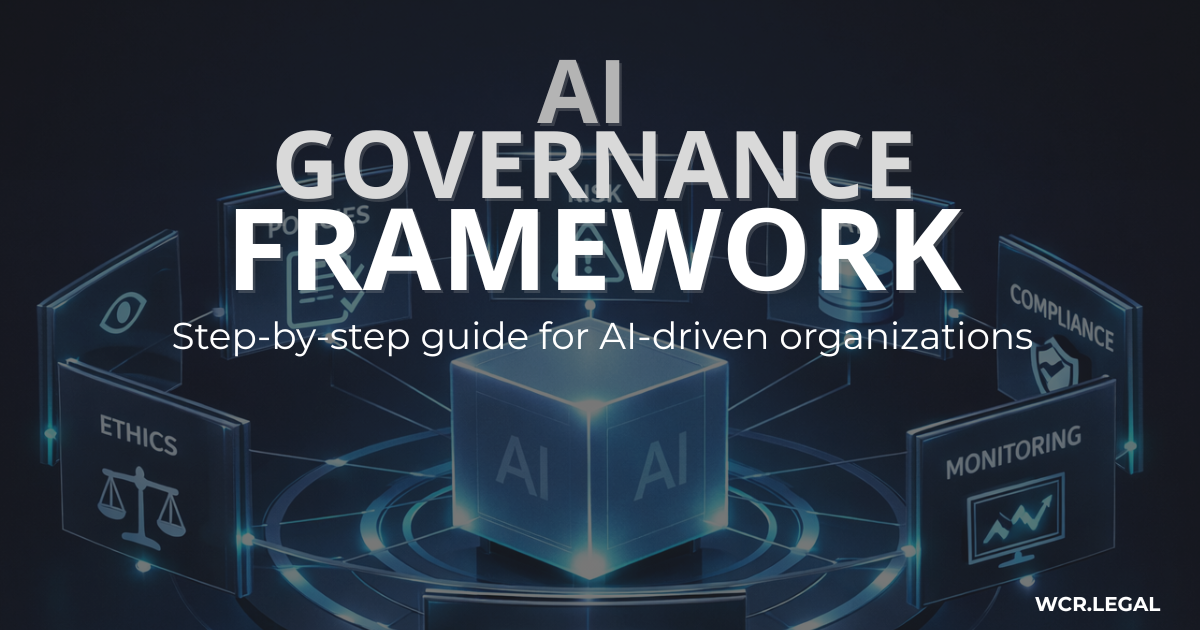
Most companies treat “AI governance” as a single policy. In practice, a governance framework is a layered control system: oversight, risk, enforceable rules, operational controls, and continuous monitoring — tied to owners and evidence.
If your framework does not produce owners, workflows, and audit evidence — it is not governance. It is paperwork.
Practical definition (what “framework” means operationally)
1) Governance layer (oversight)
Establishes decision authority, board/executive reporting, and “who owns what” across AI use cases.
Output: Charter + accountability map2) Risk layer (classification)
Classifies AI use cases by impact and exposure, documents risk decisions, and defines when escalation is mandatory.
Output: Risk Register + classification model3) Policy layer (rules)
Translates legal/regulatory expectations into enforceable rules: usage boundaries, transparency, human oversight, data handling, vendor requirements.
Output: Policy pack + approvals4) Control layer (workflows)
Makes governance real: pre-deployment approvals, testing gates, documentation requirements, post-deployment monitoring, and change control.
Output: Approval workflow + control checklists5) Monitoring layer (evidence)
Ensures continuous oversight: periodic audits, incident reporting, KPI-based monitoring, revalidation, and governance reporting to leadership.
Output: Audit reports + monitoring logs| Layer | Purpose | Output |
|---|---|---|
| Governance | Strategic oversight and decision authority | Charter |
| Risk | Risk identification and classification logic | Risk Register |
| Policy | Formal, enforceable rules and boundaries | Policy pack |
| Control | Operational enforcement through workflows | Approval workflow |
| Monitoring | Ongoing review, evidence, and improvement | Audit & reports |
2. Step 1 — Map Your AI Landscape
You cannot govern what you have not identified. The first practical step in building an AI governance framework is creating a complete, documented AI inventory across all departments, vendors, and integrations.
Objective: Create a defensible AI inventory
visibility → ownership → risk awareness2.1 Identify AI Systems
- Internal models and decision-support tools
- SaaS platforms with embedded AI functionality
- External APIs and LLM integrations
- Experimental or pilot-stage AI systems
- Shadow AI used informally by teams
2.2 Assign Clear Ownership
- Business owner for each AI use case
- Technical owner responsible for lifecycle management
- Compliance or risk reviewer
- Escalation authority for high-risk systems
| AI System | Purpose | Owner | Risk Level | Vendor | Status |
|---|---|---|---|---|---|
| Customer Scoring Model | Eligibility assessment | Head of Risk | High | Internal | Production |
| Marketing AI Tool | Content generation | CMO | Medium | SaaS Provider | Active |
- Completed AI Inventory Register
- Assigned system owners
- Initial risk visibility across business units
3. Step 2 — Define Roles & Accountability
Governance fails not because of missing policies — but because of unclear responsibility. Every AI use case must have defined decision-makers, reviewers, and escalation paths.
Objective: Ensure every AI system has a named owner, approval authority, and reporting line.
3.1 Board & Executive Oversight
- Approve AI governance charter
- Define risk appetite
- Receive periodic AI risk reporting
- Escalation for high-impact systems
3.2 Operational Responsibility
- AI Officer / responsible executive
- Business owner per use case
- Technical lead for model lifecycle
- Change management oversight
3.3 Compliance & Legal Control
- Risk classification validation
- Regulatory mapping
- Contractual risk allocation
- Incident escalation protocol
| Function | Board | AI Officer | Legal | IT | Business |
|---|---|---|---|---|---|
| AI Policy Approval | A | R | C | I | I |
| Risk Classification | I | R | A | C | C |
| Deployment Approval | I | A | C | R | R |
| Incident Escalation | I | R | A | C | C |
- AI Governance Charter
- Formal appointment of AI Officer
- Defined reporting and escalation structure
4. Step 3 — Conduct AI Risk Assessment
Once AI systems are identified and ownership is defined, the next step is to evaluate how risky each use case actually is. Risk assessment determines control intensity, escalation requirements, and board visibility.
Objective: Classify AI systems based on impact and exposure
4.1 Key Risk Factors
- Impact on individual rights or access
- Automated decision-making without human review
- Use of personal or sensitive data
- Potential bias or discriminatory impact
- Sector-specific regulatory exposure (finance, health, telecom, etc.)
- Cross-border data processing or deployment
4.2 Risk Classification Model
- Define impact scale (Low / Medium / High / Critical)
- Define likelihood scale
- Assign risk score using matrix logic
- Define mandatory controls per risk tier
| Risk Type | Impact | Likelihood | Score | Mitigation |
|---|---|---|---|---|
| Automated eligibility decision | High | Medium | High | Human oversight + documented appeal process |
| AI-generated marketing content | Low | Medium | Low | Content review workflow + brand guidelines |
- Formal AI Risk Register
- High-risk classification list
- Escalation and approval triggers
- Documented mitigation measures
5. Step 4 — Develop the Policy Layer
Policies are the bridge between legal expectations and daily operations. A strong policy layer breaks governance into a practical document pack — defining rules, responsibilities, and controls that teams must follow.
Objective: Build a “policy pack” that can be approved and enforced
The policy layer is not one PDF. It is a set of documents that define standards, procedures, and escalation. Each document should have a purpose, an owner, and an approval route.
AI Governance Policy
The core policy defining scope, roles, oversight, accountability principles, and governance boundaries.
Scope + roles + governance boundariesRisk Management Procedure
Defines risk assessment methodology, classification tiers, control intensity, and escalation triggers.
Risk tiers + controls + escalationHuman Oversight Rules
Sets when human review is mandatory, how override decisions are recorded, and what evidence is retained.
Human review + overrides + evidenceAI Incident Policy
Establishes reporting channels, internal escalation, investigation steps, and external disclosure decision logic.
Incident intake + escalation + disclosureVendor AI Requirements
Defines procurement requirements, vendor due diligence scope, contractual protections, and monitoring duties.
Due diligence + contracts + monitoring| Document | Mandatory? | Purpose | Approved by |
|---|---|---|---|
| AI Governance Policy | Yes | Sets governance scope, roles, and accountability rules | Board / Executive |
| Risk Management Procedure | Yes | Defines risk assessment and classification logic | AI Officer + Legal |
| Human Oversight Rules | Yes (for high-risk) | Defines human review and override documentation | Compliance / Legal |
| AI Incident Policy | Yes | Establishes escalation and incident response workflow | Executive / Legal |
| Vendor AI Requirements | Yes (if vendors used) | Sets vendor controls and contractual standards | Procurement + Legal |
- Approved AI policy pack (core governance documents)
- Clear owners and approval routes for each document
- Rules that can be enforced through workflows and controls
6. Step 5 — Build Control & Approval Mechanisms
Governance becomes real only when it is operationalized. Controls and approval workflows ensure that no AI system is deployed, modified, or scaled without documented review and authorization.
Objective: Implement enforceable approval and monitoring workflows
proposal → review → approval → monitoringBusiness Proposal
A department proposes an AI use case and documents purpose, data, and expected impact.
Risk & Legal Review
Risk tier is assigned, regulatory exposure assessed, and mitigation controls defined.
Approval Decision
Authorized decision-maker approves, escalates, or rejects deployment based on risk tier.
Deployment with Controls
System goes live with required documentation, human oversight, and monitoring parameters.
Ongoing Monitoring
Performance, incidents, and risk indicators are reviewed periodically and revalidated.
Pre-Deployment Controls
- Formal risk classification sign-off
- Legal and compliance validation
- Testing and documentation requirements
- Defined human oversight conditions
Post-Deployment Controls
- Continuous monitoring and logging
- Incident detection and reporting
- Periodic model revalidation
- Governance reporting to management
- Documented AI approval workflow
- Control checklists for each risk tier
- Monitoring and review schedule
- Evidence repository for audits and incidents
7. Step 6 — Vendor & Contract Governance
Most organizations do not “build AI” — they buy AI: SaaS products, APIs, embedded AI features, outsourced model development, and third-party datasets. That makes vendor governance a core part of AI governance: if you cannot control the vendor, you cannot control the risk.
Objective: Prevent “outsourced liability” through vendor due diligence and contract controls
due diligence → contract protections → monitoring7.1 AI Vendor Due Diligence (what you must check)
- What the system does, and which decisions it influences (decision pathway)
- Data flows: personal data, sensitive data, cross-border transfers, sub-processors
- Model update cadence and change control (retraining, prompt changes, new features)
- Security posture, incident history, and notification timelines
- Auditability: logs, explanations, evidence, and vendor cooperation
- Marketing claims vs enforceable commitments (avoid “trust us” AI)
7.2 Contractual Protections (what must be in writing)
- Liability allocation aligned with operational control
- Indemnities for IP infringement and third-party claims
- Training data and rights warranties (lawful sources, no restricted data)
- Security and confidentiality obligations + sub-processor control
- Incident notification, cooperation, and remediation duties
- Audit rights and compliance evidence access (where realistic)
| Clause / Control | Required | Why it matters | Typical evidence |
|---|---|---|---|
| Liability caps aligned to risk | Yes (risk-based) | Prevents “paper protection” where caps are too low for real exposure. | Contract schedule + risk tier mapping |
| IP infringement indemnity | Yes | AI outputs and training data can trigger third-party IP claims. | Indemnity clause + claim handling process |
| Training data warranties | Yes | Reduces risk of unlawful datasets and licensing violations. | Warranty + vendor documentation (where available) |
| Audit / evidence access | Preferable | Needed for investigations, regulators, and internal defensibility. | Audit rights, reporting pack, SOC/ISO reports |
| Incident notification SLA | Yes | Late notice breaks your ability to respond and meet legal timelines. | SLA + notification channel + escalation contacts |
| Sub-processor controls | Yes (if data) | Hidden subcontractors create privacy and security exposure. | Sub-processor list + change notification |
- AI vendor due diligence checklist + completed assessments for key vendors
- Contract clause baseline aligned with risk tiers
- Vendor monitoring and re-assessment triggers (updates, incidents, scope change)
8. Step 7 — Incident Response & Liability Planning
Even with strong governance controls, AI failures will occur: incorrect decisions, biased outputs, hallucinations, data leaks, or regulatory complaints. Governance maturity is measured not by avoiding incidents — but by how quickly and defensibly you respond to them.
Objective: Build a structured AI incident response system
detect → escalate → assess → remediate → document7.1 Internal Escalation Structure
- Clear reporting channel for employees and users
- Defined escalation threshold (based on risk tier)
- Incident owner assigned immediately
- Time-bound internal review and documentation
7.2 External & Regulatory Exposure
- Assessment of reporting obligations (data protection, sector regulators)
- Contractual notification duties to vendors or clients
- Communication protocol (public statements, user notices)
- Board notification for high-impact incidents
| Incident ID | Date | AI System | Risk Tier | Impact | Mitigation | Status |
|---|---|---|---|---|---|---|
| AI-2026-01 | 12.02.2026 | Customer Scoring Model | High | Incorrect automated rejection | Manual review + override + retraining | Closed |
| AI-2026-02 | 18.02.2026 | Marketing AI Tool | Medium | Misleading output | Content correction + workflow update | Under review |
- AI Incident Response Procedure
- Escalation and notification matrix
- Incident Register template
- Defined regulatory reporting assessment process
9. Step 8 — Monitoring & Continuous Improvement
AI governance is not a one-time implementation project. Models evolve, vendors update systems, regulators issue new guidance, and risk exposure changes. Continuous monitoring ensures that governance remains aligned with reality.
Objective: Maintain governance effectiveness over time
audit → review → adjust → report8.1 Periodic Review & Audit
- Scheduled review of AI Inventory Register
- Re-assessment of risk tiers for active systems
- Audit of control adherence and documentation
- Verification of human oversight effectiveness
8.2 Model & Vendor Revalidation
- Review of model updates and retraining cycles
- Vendor reassessment upon feature expansion
- Security and data processing updates
- Re-approval trigger for significant changes
8.3 Policy & Control Updates
- Update governance documents when regulations evolve
- Adjust internal controls based on incidents
- Refine approval workflow thresholds
- Incorporate lessons learned from audits
8.4 Governance Reporting
- Periodic AI risk report to executive management
- High-risk system summary for board visibility
- Incident statistics and trend analysis
- Control effectiveness indicators (KPIs)
- AI governance review schedule
- Audit and revalidation procedure
- Executive AI risk reporting template
- Defined triggers for policy and control updates
10. 30-Day AI Governance Launch Plan
If your organization does not yet have a structured AI governance framework, the following 30-day roadmap provides a realistic starting point. The goal is not perfection — but operational control.
Objective: Move from zero structure to minimum viable governance in 4 weeks
inventory → risk → policy → controlsWeek 1 — AI Inventory & Ownership
- Identify all AI systems (internal + vendor-based)
- Create AI Inventory Register
- Assign system owners
- Map decision-impact exposure
Week 2 — Risk Assessment
- Define risk classification model
- Assess all active AI systems
- Identify high-risk use cases
- Define escalation thresholds
Week 3 — Policy Pack
- Draft AI Governance Policy
- Approve Risk Management Procedure
- Define Incident Response rules
- Formalize vendor requirements
Week 4 — Controls & Training
- Implement approval workflow
- Launch incident reporting channel
- Conduct internal training session
- Report status to executive management
Minimum Viable AI Governance Checklist
fast implementation baseline