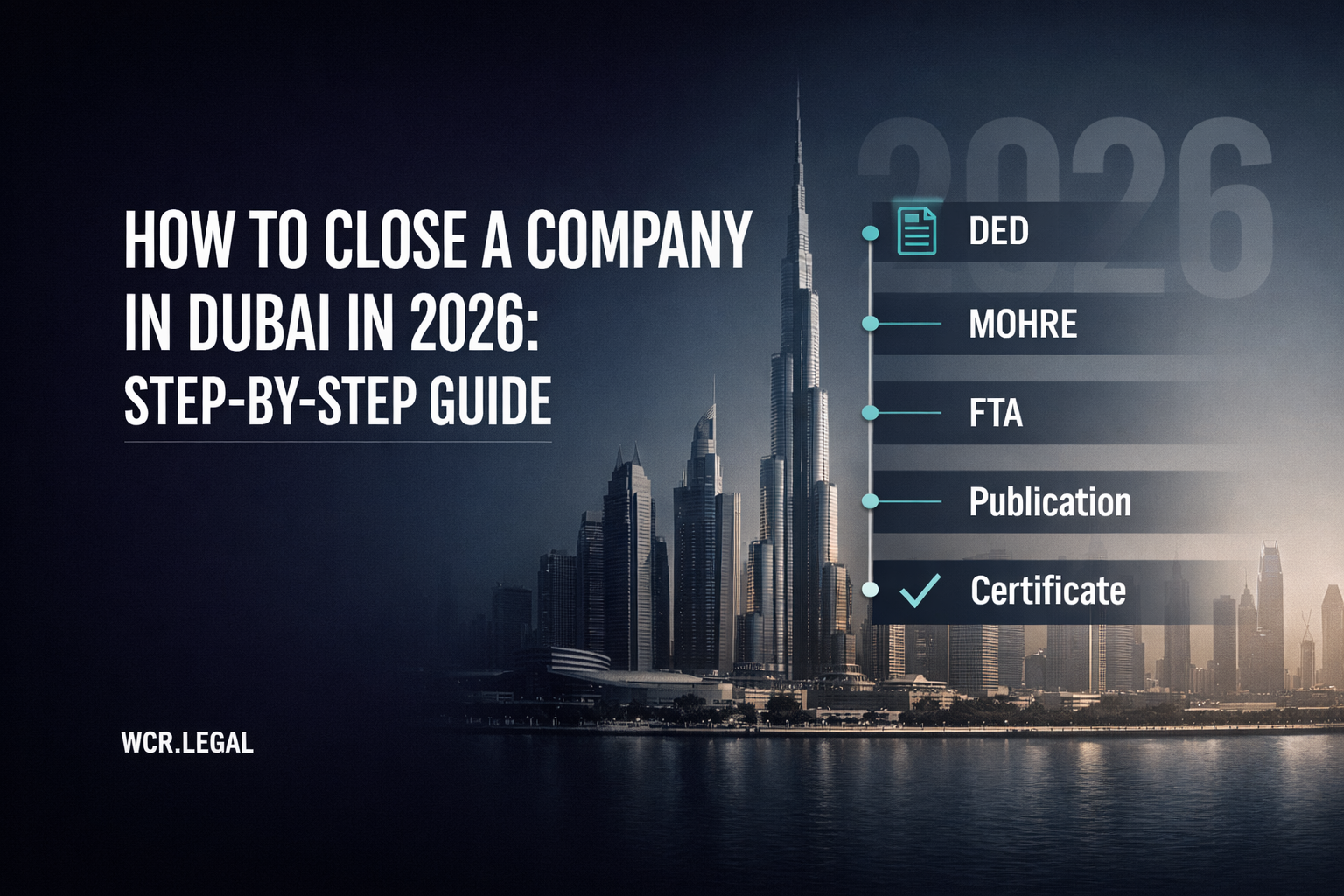
How to Close a Company in Dubai in 2026: Step-by-Step Guide

How to Close a Company in Dubai in 2026: Step-by-Step Guide

How to Close a Company in Dubai in 2026: Step-by-Step Guide

🇦🇪 UAE Corporate · Company Closure

How to Close a Company in Dubai in 2026: Step-by-Step Guide

Mainland, Free Zone, DIFC, and ADGM — the complete administrative guide to closing a UAE company in 2026. Staff visas, bank accounts, tax clearance, the 45-day newspaper rule, and what to do before you file anything.

7 sections · ~8 min read
Mainland & Free Zone
DIFC / ADGM
Staff & Visas
Bank Account
📋 In This Guide
7 sections · ~8 min read
1
Why founders are closing Dubai companies in 2026
The geopolitical context — banking friction, regulatory shifts, and the decision to leave
2
Mainland company closure: the process
DED, MOHRE, FTA clearance, the 45-day newspaper rule, and final deregistration
3
Free Zone company closure
Standard Free Zones vs DIFC/ADGM — two different processes, different timelines
4
What happens to your staff and UAE visas
30-day cancellation rule, AED 500/day fines, and statutory gratuity obligations
5
Closing your UAE bank account
30–90 day notice, clearing facilities, obtaining the bank NOC
6
What to do before you close: checklist
Contracts, IP transfer, VAT deregistration, litigation checks, and data compliance
7
Alternatives to full closure
Dormancy, holding restructure, and parallel registration — when full wind-down isn't the right move
🌍 Section 1

Why Founders Are Closing Dubai Companies in 2026

The decision to close is rarely just about process — it is about context. Understanding what has changed in 2026 helps frame what you are navigating and why the administrative process has become more scrutinised than it was two years ago.

The 2026 context
Geopolitical shift
1
Banking friction and financial compliance pressure

The first quarter of 2026 has brought significantly increased scrutiny on cross-border financial flows through the UAE. Correspondent banking relationships have tightened, and UAE banks — responding to pressure from international compliance frameworks — have applied more aggressive due diligence requirements on business accounts, particularly those with international transaction patterns or clients in jurisdictions currently under geopolitical pressure.

For many founders, the practical impact has been account restrictions, delayed transfers, requests for documentation that are difficult to satisfy at scale, and in some cases account closures initiated by the bank rather than the business owner. The AML/KYC compliance environment has become a material operational cost, not just a one-time onboarding exercise.

2
Regulatory framework uncertainty — VARA, ADGM, and licensing

The VARA regulatory framework continues to evolve with new guidance, and ADGM's position on certain cross-border business models and product types has created uncertainty for founders who set up specifically to benefit from UAE regulatory frameworks. What was a clear regulatory path in 2023 or 2024 has, for some business models, become a moving target.

For businesses in regulated activities — financial services, digital assets, AI products — the cost of staying ahead of regulatory change has become a factor in the decision to exit. The alternative for many is a jurisdiction with a more settled regulatory framework and clearer rules of engagement.

Note: This applies across Mainland, Free Zone, and financial centre structures. The regulatory pressure is not specific to one licence type — it reflects broader international developments in how Gulf financial hubs are being treated by correspondent banking networks.
3
Different founders, different reasons — same process

There is no single profile of a founder closing a Dubai company in 2026. Some are relocating operations to EU-regulated jurisdictions to access counterparties who require MiCA or comparable regulatory status. Others are restructuring around a holding entity in a neutral jurisdiction while maintaining UAE client relationships. A smaller group are winding down entirely — exiting the market without a successor structure.

All of these situations involve the same administrative process. The reason for leaving affects the strategy — not the paperwork.

Whatever your reason for leaving — here is exactly what the process looks like.
🏛 Section 2

Mainland Company Closure: The Process

Mainland companies are registered with the Department of Economic Development (DED). The closure process involves five sequential steps and typically takes 3–5 months. The 45-day creditor window — which most founders do not anticipate — is the main driver of that timeline. See our overview of Mainland and Free Zone structures for context on how licence type affects the process.

Mainland closure — DED process step by step
DED · MOHRE · FTA
1
Cancel the trade licence with DED Start here

Submit a cancellation application to the Department of Economic Development. All shareholders must formally consent and sign. Any outstanding DED fees, renewal charges, or fines must be cleared before the application is accepted. DED will not begin processing until the account is clean.

Timeline: 1–2 weeks once submitted. Responsible: You or your PRO — DED does not initiate this automatically.
2
Clear all MOHRE obligations — staff and WPS Run in parallel

All employee contracts must be formally terminated through the Ministry of Human Resources and Emiratisation (MOHRE). Wage Protection System (WPS) records must reflect zero outstanding salary obligations. End-of-service gratuity must be calculated and settled for every eligible employee. You cannot obtain MOHRE clearance while any employment obligation remains open — and without MOHRE clearance, deregistration cannot proceed.

Timeline: 2–4 weeks depending on headcount. Responsible: MOHRE — through their online portal or service centre.
3
Obtain a tax clearance certificate from the FTA Allow extra time

File a final VAT return with the Federal Tax Authority and apply for VAT deregistration. If your business is subject to UAE corporate tax, all outstanding filings and liabilities must be settled. The FTA issues a tax clearance certificate once all obligations are confirmed as discharged — this document is required for final DED deregistration and often takes longer than expected to arrive.

Timeline: 2–6 weeks. File VAT deregistration as early as you are eligible — do not wait until the final stages. Responsible: Federal Tax Authority (FTA).
4
Publish a liquidation notice in an Arabic newspaper 45-day window

UAE law requires publication of a formal liquidation notice in a DED-approved Arabic-language newspaper. A 45-day creditor claims window runs from the date of publication — not from the date you decide to close, and not from the date you apply to DED. Any creditor may submit a claim against the company during this window. All submitted claims must be resolved before you can proceed to final deregistration.

Timeline: 45 days minimum from publication date — this is non-negotiable. Responsible: You arrange publication through a DED-approved Arabic newspaper.
5
Final deregistration and certificate of cancellation Final step

Once the 45-day creditor window has closed with no unresolved claims, collect all remaining NOCs — from your bank, landlord, and utilities provider. Submit the final deregistration package to DED along with your FTA clearance certificate and MOHRE clearance. Upon approval, DED issues a Certificate of Cancellation confirming the company has been legally dissolved.

Timeline: 1–2 weeks once all NOCs and clearances are assembled. Responsible: DED — this is the only step they control end-to-end.
⚠️
The step that catches everyone
The 45-day newspaper publication catches most founders off guard. It adds 6–8 weeks to what feels like a simple closure — and the clock only starts on the publication date, not when you submit your DED application. Budget for it from day one.
🏢 Section 3

Free Zone Company Closure: Standard Zones vs DIFC/ADGM

Free Zone closure does not go through DED. Each Free Zone Authority runs its own deregistration process. The process for DIFC and ADGM entities is more formal and more document-intensive than a standard Free Zone — and operates under different legal principles. See our comparison of DIFC, ADGM, and Mainland UAE exit routes.

🏭
Standard Free Zones
JAFZA · DMCC · RAKEZ · IFZA and others
2–4 months
1
Submit closure application to the Authority. Each Free Zone has its own deregistration form and online portal. All shareholders must sign. Outstanding licence fees and any fines must be cleared before the application proceeds.
2
Collect NOCs from bank, landlord, and utilities. The Authority will not process closure until all three NOCs are submitted. Start collecting them before you file — each one takes time independently.
3
Submit audited accounts for the final financial year. A signed audit report from an approved auditor is required. If your company is behind on audits, this is a common blocker — resolve it before filing.
4
Authority reviews and issues cancellation certificate. Once all documents clear, the Authority processes the closure and issues formal confirmation of deregistration.
⚖️
DIFC / ADGM
Financial centre entities — stricter process
3–6 months
1
Pass a members' resolution to commence voluntary winding up. A formal board or shareholders' resolution is required. This must be filed with the DIFC Registrar of Companies or the ADGM Registration Authority to formally open the winding-up procedure.
2
Apply to the relevant Registrar. Both DIFC and ADGM operate under their own company regulations with specific forms, filing fees, and timelines. ADGM's process follows English common law winding-up procedure closely.
3
More comprehensive audit and financial statements required. DIFC and ADGM expect detailed final accounts and may require appointment of a licensed liquidator for larger entities or those with outstanding third-party obligations.
4
Final dissolution order and striking off. Once all obligations are discharged and creditors satisfied, the Authority issues a formal dissolution order and the entity is struck from the register.
Documents needed regardless of zone
Prepare in advance
📄
Trade licence copy
Valid or expired — the Authority needs this on file to confirm the entity being closed.
🪪
Passport copies of all shareholders and directors
All individuals listed in the company register must be verified. Certified copies may be required for DIFC/ADGM submissions.
🏢
NOC from landlord
Confirming no outstanding lease obligations or early termination liability. The Free Zone Authority will not proceed without this.
🏦
NOC from bank
Confirming zero account balance, all credit facilities cleared, and account ready to close. One of the most common delays — start early.
NOC from utilities provider (DEWA or equivalent)
Required to confirm no outstanding utility balances associated with the business premises.
📋
Board resolution to dissolve
Notarised where required by the Authority. For DIFC/ADGM, this must follow specific procedural requirements under their company regulations.
🧮
Audited accounts for the final financial year
Signed by an approved auditor. If the company is behind on annual audits, this is the most common blocker — and cannot be fast-tracked.
👥
Labour authority clearance
Confirming no outstanding employee obligations, salary arrears, or unresolved labour disputes. Required regardless of Free Zone or Mainland structure.
⚖️
ADGM — different rules apply
ADGM uses English common law. If your entity has outstanding disputes, unresolved contractual claims, or active regulatory matters, the winding-up process follows different rules than a standard Free Zone exit. Disputes do not pause during winding up — they run in parallel and can significantly extend the timeline. Take legal advice before filing if any claims are active or threatened. See our guide on DIFC, ADGM, and Mainland UAE exit routes.
👥 Section 4

What Happens to Your Staff and UAE Visas

Licence cancellation does not automatically cancel employee visas. You remain the legal sponsor until each visa is formally processed through the correct channels. For a detailed step-by-step guide covering MOHRE, ICP, gratuity, and the 30-day rule, see our dedicated guide: What Happens to Staff on UAE Visas When You Close Your Business.

👥
Employed Staff on Your Visa
Company-sponsored work and residence visas
30-day rule

All employees on company-sponsored visas must have their visas formally cancelled through the ICP (Federal Authority for Identity, Citizenship, Customs and Ports Security) within 30 days of licence cancellation. This is not automatic — you must file for each employee separately.

You remain legally liable as sponsor until each visa cancellation is confirmed. A lapsed licence does not terminate sponsorship obligations. Fines accrue from day 31.

AED 500 / day
Per employee — fine accrues from day 31 after licence cancellation for every unprocessed visa
🪪
Investor and Partner Visas
Visas tied to the company licence
Grace period applies

Investor and partner visas tied to the company licence are automatically invalidated when the licence is cancelled — but formal cancellation through the ICP must still be filed. Invalidation and cancellation are not the same. The visa record remains open until you act.

A 60-day grace period applies from the date of licence cancellation. Use this window to transfer visa status to a new sponsor, exit the country, or process formal cancellation without overstay penalty.

60 days
Grace period for investor/partner visa holders to exit, transfer, or formally cancel
💰
End-of-Service Gratuity
Statutory obligation — not optional
Before deregistration

UAE law requires all employees with 1 or more years of service to receive statutory end-of-service gratuity when their employment is terminated due to company closure. This is treated as employer-initiated termination regardless of how the closure is framed. Gratuity must be settled in full before MOHRE will issue clearance.

Year 1–5
21 days' basic salary per year of service
Year 6+
30 days' basic salary per year of service
Cap
Total gratuity capped at 2 full years of basic salary
  • Calculation base: Basic salary only — housing, transport, and allowances excluded unless contract states otherwise
  • Part years: Accrued pro-rata for service beyond one full year
Timeline reality
If you have more than 3 employees on UAE visas, factor an extra 4–8 weeks into your closure timeline. MOHRE clearance, visa cancellations, and gratuity settlement must all complete before deregistration can proceed — and they run sequentially, not simultaneously. For the complete visa cancellation process, see: What Happens to Staff on UAE Visas When You Close Your Business.
🏦 Section 5

Closing Your UAE Bank Account

Bank account closure is the step most often left too late — and the one most likely to delay final deregistration. Run this process in parallel with company deregistration, not after it. For a detailed guide covering bank-by-bank differences and common blockers, see: How to Close a UAE Bank Account as a Foreign Business.

UAE bank account closure — four steps
Run in parallel with deregistration
1
Notify the bank of your intention to close Start immediately

Submit formal written notification to your relationship manager or business banking team. Most UAE banks require 30–90 days notice for business account closure. Notify them at the same time as you begin the company deregistration process — not after. Late notification is the single most common reason a closure stalls at the final stage.

Practical note: Notify in writing via email and request confirmation. Do not rely on a phone call or verbal conversation as proof of notification.
2
Clear all credit facilities and outstanding guarantees Complete in full

All loans, credit lines, overdraft facilities, and bank guarantees must be fully repaid, cancelled, or formally transferred before the bank will begin closure proceedings. This includes guarantees issued on behalf of the company to landlords, suppliers, or government authorities — not just direct banking credit. The bank will not issue an NOC until every facility shows a zero balance.

Common oversight: Bank guarantees issued to Free Zone authorities or landlords are often overlooked. Check with the bank for a complete list of all active facilities and guarantees before assuming the account is clear.
3
Obtain the bank NOC (No Objection Certificate)

Once all facilities are cleared and the account balance is ready for transfer, the bank issues a formal No Objection Certificate confirming no outstanding financial obligations against the company. This document is required by DED, your Free Zone Authority, and in some cases the FTA as part of the deregistration package.

Keep the original — certified copies are not always accepted. The NOC is time-limited at some banks, so coordinate timing with your deregistration submission.

4
Transfer remaining funds and close the account Retain records

Transfer the remaining balance to a personal account or your new corporate entity in the successor jurisdiction. Request written confirmation from the bank that the account has been formally closed — this is separate from the NOC. Retain all bank statements, transaction records, and the closure confirmation letter for a minimum of 5 years. UAE regulatory requirements may apply post-dissolution.

⚠️
The most common timing mistake
Most UAE banks require 30–90 days notice. Founders who wait until deregistration is nearly complete before contacting the bank often face a 2–3 month additional delay waiting for the bank NOC. Run bank closure in parallel — not after.
📖
Detailed guide available
For a full walkthrough including bank-by-bank differences, the document checklist, and how to handle accounts at banks that have become difficult to deal with, see: How to Close a UAE Bank Account as a Foreign Business.
✅ Section 6

What to Do Before You Close: Pre-Closure Checklist

These are the items that get missed or left too late. Work through this list before you file anything with DED or your Free Zone Authority — most of these actions cannot be completed after the process has started.

✅ Do this first
Pre-Closure Checklist
Before you file anything
📄
Review all active contracts and notice obligations
Identify contracts with notice periods, auto-renewal clauses, or early termination penalties. Client agreements, supplier contracts, software subscriptions, and office leases all have different exit mechanics. Breaching a contract during closure can generate claims that outlast the company.
Do first
📢
Notify key clients and counterparties
Give clients adequate notice before the closure process becomes visible. Sudden disappearance creates reputational and legal exposure. Agree on transition arrangements, final deliverables, or referrals to a successor entity where applicable. Do not let clients find out through a lapsed bank transfer or an unreachable account.
Do first
💳
Settle all outstanding supplier and creditor invoices
Unpaid creditors can submit claims during the 45-day Mainland publication window or during the Free Zone NOC process. Unresolved debts can delay — or in some cases block — deregistration entirely. Settle everything before you file.
Do first
🔐
Transfer all IP assets to the successor entity
Trademarks, domain names, software registrations, and copyrights do not automatically transfer when a company closes. They must be formally assigned before dissolution. Once the company is struck off, recovery is extremely difficult — and in some jurisdictions, impossible without court involvement. See our guide on IP transfer before company closure.
Do first
🏛
Deregister for VAT with the FTA
File a VAT deregistration application with the Federal Tax Authority. FTA deregistration runs on a separate track from DED or Free Zone deregistration and has its own clearance timeline. Outstanding VAT returns or unpaid liabilities will block your tax clearance certificate — which in turn blocks final deregistration.
Run in parallel
⚖️
Check for active or pending litigation
A court case, arbitration claim, or regulatory investigation does not automatically pause when a company enters closure. Proceeding with dissolution while a claim is active can expose shareholders to personal liability. If any disputes are unresolved or threatened, take legal advice before filing your deregistration application.
🌍
Confirm your successor jurisdiction is fully operational
If relocating, the new entity must be able to receive clients, sign contracts, and operate a bank account before the UAE entity closes. Gaps in legal capacity create risk — particularly for regulated activities. See our company registration services for cross-border setup support.
Run in parallel
💾
Back up and archive all corporate records
Export and store incorporation documents, board resolutions, shareholder agreements, audited financial statements, tax filings, WPS records, and correspondence. UAE regulations require retention for at least 5 years post-dissolution. Store both in the cloud and on a physical drive — do not rely on a single source.
Do first
Collect all third-party NOCs in advance
NOCs from your landlord, utilities provider, and bank can each take several weeks to obtain. Chasing them at the final stage is the most common cause of delays that founders describe as the Authority "going slow." Start the NOC collection process before you submit your deregistration application.
Run in parallel
🔒
Handle personal data per PDPL and GDPR
If you hold personal data of UAE or EU residents, data must be transferred to the successor entity, deleted, or archived in compliance with the UAE Personal Data Protection Law and/or GDPR before dissolution. Failure creates post-dissolution regulatory exposure for the individuals responsible for data handling at the time of closure.
🔐
IP — the most overlooked item
Trademarks, domain names, and software registrations cannot be retroactively recovered from a dissolved entity. The process of re-registering in your own name or a new company is expensive, slow, and sometimes impossible if a third party has registered in the interim. Complete the IP transfer before you file anything with the deregistration authority.
🔄 Section 7

Alternatives to Full Closure

Before committing to a full wind-down, consider whether one of these options better fits your situation. Full closure is irreversible — dormancy, restructuring, and parallel registration are all reversible, or at least give you more optionality.

💤
Dormancy / Suspension
Pause operations — keep the entity
Lowest friction

Most UAE Free Zones allow companies to enter a formally dormant or suspended status for 1–2 years rather than closing. The company retains its registration, corporate history, and UAE banking relationships but ceases active trading. Annual fees are reduced and compliance requirements during dormancy are minimal.

This is the lowest-friction option if you plan to return, reactivate, or sell the entity within 24 months. It preserves your UAE corporate footprint without the administrative and financial cost of a full closure and re-registration if you change your mind.

Best for
Founders pausing UAE operations temporarily or exploring options before committing to a full exit
🏗️
Restructure as a Holding Entity
Shift operations, keep the structure
Preserves UAE presence

Rather than closing, restructure the UAE entity as a passive holding company with no active trading in the UAE. Operational activity shifts to the new jurisdiction while the UAE entity continues to hold IP, real estate, or equity stakes in subsidiaries. This preserves the UAE banking relationship, corporate history, and any treaty-based or jurisdictional benefits.

This approach works well when the UAE entity holds assets or relationships that are difficult to transfer. See our guide on holding restructuring for how this typically works in practice.

Best for
Founders with UAE-held IP, real estate, or equity stakes who want to shift operations without liquidating assets
🌐
Parallel Registration
Build the new entity before closing the old one
Migration path

Register in the target jurisdiction before closing the UAE entity. Run both in parallel for 6–12 months. This allows you to migrate contracts, bank accounts, client relationships, and staff without gaps in legal capacity or periods where the business cannot contract or receive payments.

Parallel registration is the most common approach for founders relocating regulated operations. It also provides a fallback if the new jurisdiction presents unexpected licensing delays. For a comparison of where to go, see the Dubai business relocation alternatives guide.

Best for
Founders actively relocating who need continuity of operations and client relationships during the transition
💡
Before you file for closure
Full closure is rarely the only option. If you are relocating rather than winding down, parallel registration while keeping the UAE entity dormant often makes more sense than an immediate wind-down. The cost of maintaining a dormant entity for 12 months is far lower than re-registering in the UAE if you need to return. See our UAE jurisdiction overview for context on how different UAE structures affect your exit options.
Closing Your Dubai Company — or Weighing Your Options?

WCR Legal advises founders on UAE company closure, dormancy strategy, holding restructuring, and cross-border relocation. We work across Mainland, Free Zone, DIFC, and ADGM structures — and across the jurisdictions you're moving to.

No commitment required · Confidential initial consultation · Response within 1 business day

Oleg Prosin is the Managing Partner at WCR Legal, focusing on international business structuring, regulatory frameworks for FinTech companies, digital assets, and licensing regimes across various jurisdictions. Works with founders and investment firms on compliance, operating models, and cross-border expansion strategies.