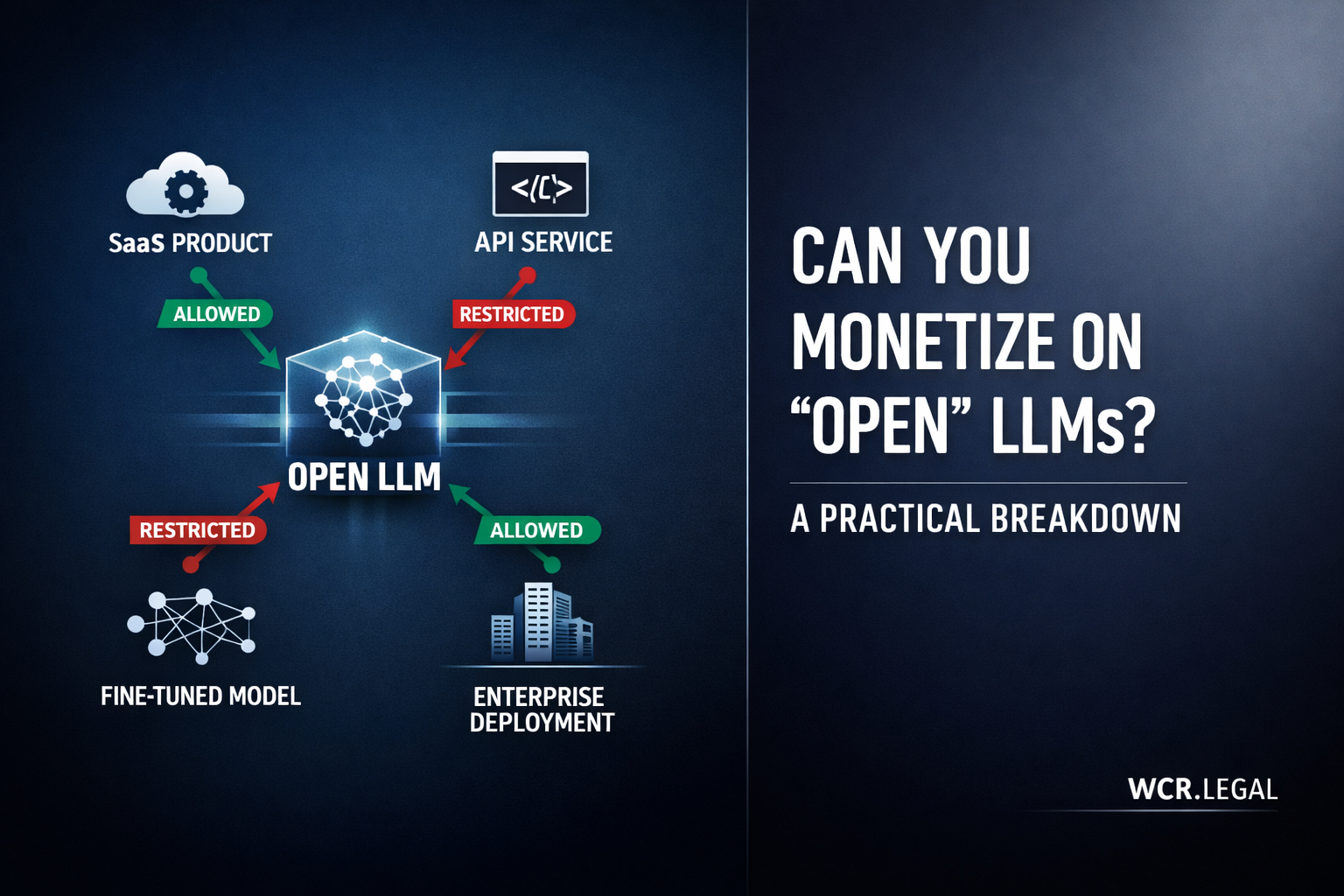
Can You Monetize on “Open” LLMs? A Practical Breakdown
Can You Monetize on "Open" LLMs? A Practical Breakdown
Gemma, Llama 3, and Mistral are described as "open" — but open does not mean commercially unrestricted. The gap between what the licence permits and what a business wants to do is where legal exposure begins. This post maps the restrictions, clarifies the feature-vs-reselling line, and identifies the business models that work and those that do not.
Introduction — The Permission Gap in "Open" LLMs
The word "open" in open-source AI carries a specific technical meaning — the model weights are publicly available. It does not mean the model is free to commercialise in any way you choose. Every major open LLM — Llama 3, Gemma, Mistral's commercial releases, and NVIDIA's OML-licensed models — comes with a licence that defines what commercial use is permitted, what is restricted, and what is outright prohibited. The gap between what founders assume they can do and what the licence actually permits is where legal exposure silently accumulates.
This is not a theoretical concern. Licence restrictions on open LLMs have already produced measurable commercial consequences: products redesigned at scale after legal review, enterprise deals stalled over procurement questions about the underlying model, and startup valuations impacted by IP chain uncertainty at fundraising. Understanding the licence before building the revenue model — not after the product is in production — is the commercially rational approach.
Three Assumptions That Get Founders Into Trouble
Open weights grant access to the model — they do not grant unlimited commercial rights. Llama 3 prohibits certain use cases entirely, applies MAU thresholds above which a commercial licence is required, and restricts using the model to build products that compete with Meta. Gemma's licence similarly bans specific harm categories and usage types regardless of whether the weights are publicly available.
SaaS deployment does not insulate you from model licence restrictions — it changes how the restrictions apply. The question is not whether you are a SaaS product, but what your SaaS product does: whether it builds on the model to create distinct value, or whether the model itself is the product being sold. The licence restrictions run to the use case, not the delivery mechanism.
Pricing that is directly proportional to model API calls — with no meaningful value-added layer between the model and the customer — can constitute API reselling regardless of what you call it in your terms of service. Several model licences prohibit "selling access to" the model as a distinct commercial act. Whether your pricing structure crosses that line depends on whether there is genuine product value added, not on the pricing label you use.
How Licence Restrictions Flow Through the Product Stack
Sets the outer boundary: what use cases are permitted, what scale triggers additional obligations, what downstream uses are prohibited, and what the product layer must flow down to customers
Must stay within the model licence boundary on use cases and must flow down required restrictions to customers in the product's own terms of service — the product cannot grant customers rights the model provider has not granted the product
Bound by both the product's ToS and — through flow-down clauses — by the underlying model's acceptable use policy; customer activities that violate the model licence create upstream liability for the product layer even when the product's own terms do not explicitly address the behaviour
Four Variables That Determine Your Licence Exposure
Which model you are using
The licence type — Llama 3 Community Licence, Gemma ToU, Apache-2.0, NVIDIA OML, Mistral Research Licence vs commercial — determines the baseline restrictions. Apache-2.0 models carry the fewest restrictions; custom model licences carry the most. This is the single most important variable in the commercial risk assessment.
How you deploy it
Self-hosted open-weight models used internally create different obligations than models accessed via API or redistributed as part of a product. Deployment method affects sub-processor obligations, data processing agreements, and whether distribution-specific licence clauses are triggered.
What your revenue model is
Revenue models that monetise the model directly — per-token billing, inference API reselling, model-as-a-service — face higher licence scrutiny than revenue models that monetise a product outcome the model enables. The closer the pricing unit is to the model's own output unit, the more carefully the licence must be reviewed.
Who your customers are
Certain model licences restrict use in competitive contexts — serving customers who compete with the model provider, or enabling applications in sectors the model provider has identified as prohibited. Enterprise customers in regulated sectors also trigger additional obligations around data processing and model governance that affect the commercial relationship.
Structuring context: Model licence choice affects not just product compliance but the IP structure of the company itself — including what is defensible at fundraising and how AI assets are valued in M&A. For the framework on how open model licence obligations interact with AI IP ownership and investment structuring, see AI IP Ownership — wcr.legal.
Section 1 — Monetization Restrictions Across Open LLMs
Every major open LLM applies commercial restrictions that fall into three categories: scale-based thresholds that trigger additional obligations above certain user counts, competitor bans that prohibit using the model to build products that compete with the model provider, and reselling prohibitions that restrict monetising the model or its weights directly. These restrictions are not identical across models — the specific terms, thresholds, and prohibitions vary materially between Llama 3, Gemma, NVIDIA's OML, and Apache-2.0 licensed models like Mistral 7B.
The Three Restriction Categories That Matter for Monetization
Licence Profile by Model — Commercial Restriction Overview
Restriction Comparison — Key Monetization Variables
Section 2 — Selling Your Feature vs Reselling the Model
The single most important commercial distinction in open LLM licensing is the difference between building a product that uses a model and reselling the model itself. Licence restrictions on API reselling and model redistribution do not apply to every business that makes money using an open LLM — they apply to a specific type of monetization where the model, rather than the value the model enables, is the thing being sold. Understanding where the line falls is not a legal technicality. It is the difference between a product that is freely commercialisable and one that requires a separate agreement with the model provider.
The line is not always obvious in practice. A document summarisation tool that charges per document is clearly selling a product feature — the model is the engine, not the product. An inference API that exposes raw model completions and charges per token is clearly reselling model access. Between these two extremes sits a large grey zone: usage-based SaaS products, AI platform tooling, embedded AI APIs sold to developers, and multi-model routing services where the underlying model is material to the customer proposition.
Permitted vs Prohibited: The Core Commercial Distinction
You add value on top of the model
The model itself is what customers pay for
The Five-Question Test — Which Side of the Line Are You On?
Usage-Based Pricing — When It Is Fine and When It Is Not
Section 3 — Business Models That Work Well on Open LLMs
The commercial success of the Gemma, Llama 3, and Mistral licence families for software businesses is not theoretical — there are well-established archetypes of products that fit cleanly within the licence boundaries while generating defensible revenue. The pattern that runs through every commercially viable open-LLM business model is the same: the model is infrastructure, and the product is built on top. The revenue is derived from what the product does, not from access to the model itself.
The models best suited for commercial products without licence complications are Apache-2.0 licensed models — specifically Mistral 7B and its derivatives — because Apache-2.0 places no commercial restrictions on use, redistribution, or monetization. For products that need higher capability and can work within their licence restrictions, Llama 3 and Gemma are viable for most SaaS and vertical application use cases below the specific restriction thresholds. The key is matching the business model archetype to the model licence's actual constraints.
What Each Model Is Suited For Commercially
Four Business Model Archetypes That Work
Vertical SaaS with AI-powered workflow
Fine-tuned specialist model as a product
AI-augmented internal tooling sold externally
Consumer or SMB applications with embedded AI
Why Apache-2.0 Models Are the Default Choice for Maximum Commercial Freedom
What Apache-2.0 permits that custom licences restrict
Where Apache-2.0 models may require trade-offs
Section 4 — Business Models That Hit Licence Walls
Not every business model that involves an open LLM is within the licence boundaries. Several commercially attractive models — inference-as-a-service, raw API reselling, usage-based pass-through pricing, and competitor-facing tooling — run directly into the restrictions that Gemma, Llama 3, and NVIDIA's OML apply to commercial use. Understanding which models hit these walls, and what the structural alternatives are, is commercially necessary before committing to a product and revenue architecture.
Four Scenarios Where Licence Walls Appear
Licence Wall Severity by Business Model and Model
Usage policy governs; no explicit prohibition but material risk
ToU explicitly bans providing model as API to third parties
Apache-2.0 allows redistribution; inference API is fine
Approaches reselling line; product value-add must be clear
Token pricing on Gemma API constitutes providing model as service
No pricing restriction under Apache-2.0
Training competing LLMs on Llama 3 explicitly banned
Use that negatively affects Google is prohibited
Apache-2.0 cannot restrict any field of endeavour
Fine-tune distribution permitted; must preserve community licence
Fine-tune distribution permitted; inherits Gemma ToU restrictions
Derivative weight distribution fully permitted under Apache-2.0
Pre-Launch Monetization Compliance Checklist
Open LLMs Are Commercially Viable — With the Right Architecture
The choice of which open LLM to build on is not just a technical decision — it is an IP structuring decision that affects the product's commercial architecture, enterprise sales posture, and investor-facing risk profile. Products that treat the model licence as infrastructure — as fundamental as their choice of cloud provider or database — avoid the compliance surprises that follow founders who treat it as a legal formality. For guidance on how model licence choice intersects with AI IP ownership and investment readiness, see AI IP Ownership — wcr.legal.