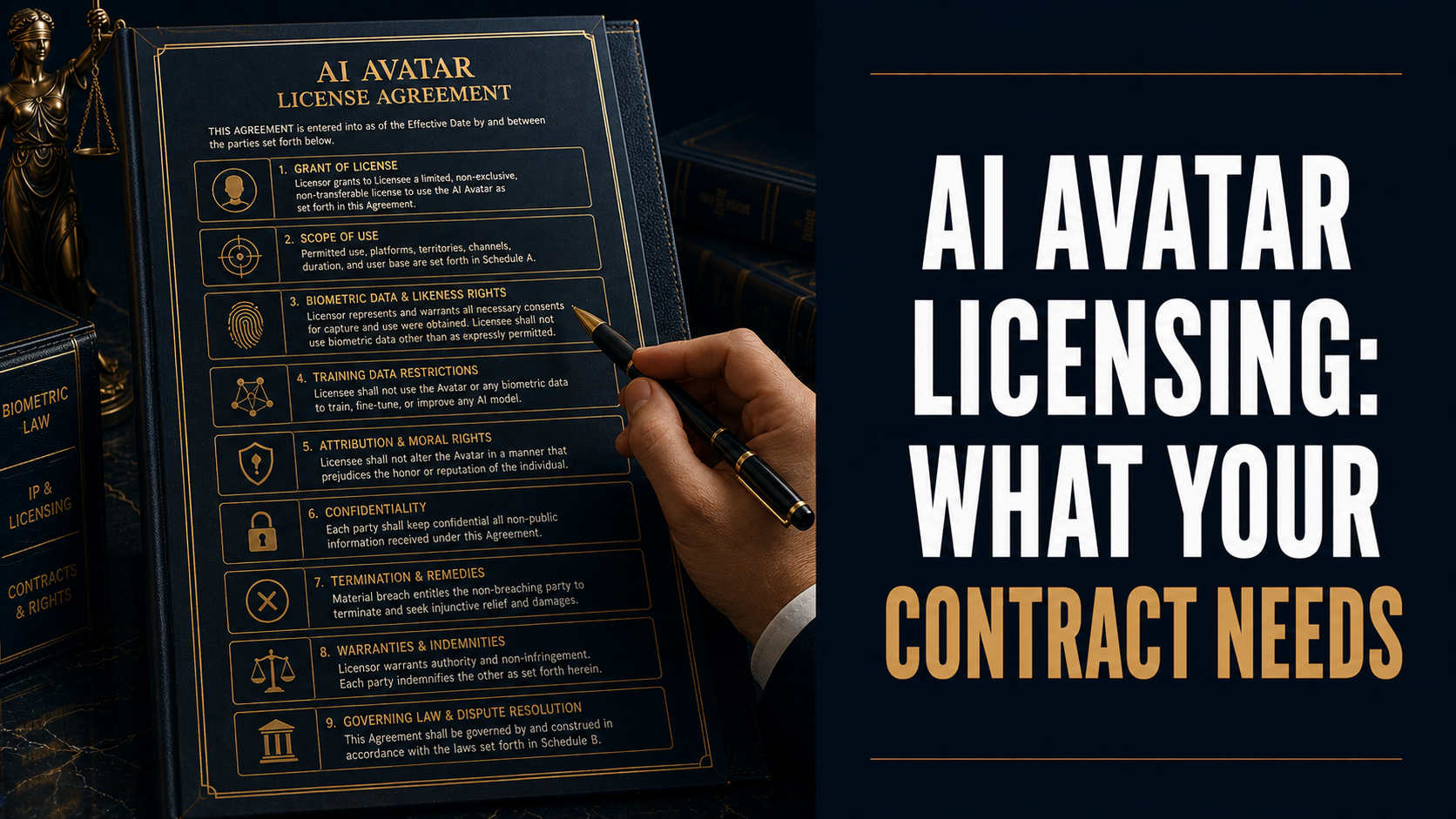
What Must an AI Avatar Licensing Agreement Contain? A Practical Checklist
What Must an AI Avatar Licensing Agreement Contain?
A Practical Checklist
Standard IP templates cannot handle biometric special-category data, GDPR withdrawal rights, or EU AI Act disclosure obligations. Here is what every agreement needs before it is signed.
Standard IP licensing templates were not designed for AI-generated likeness. When a brand deploys an AI avatar licensing arrangement, it is simultaneously processing biometric special-category data under GDPR Article 9, potentially triggering US state biometric privacy statutes, and generating synthetic content that will carry mandatory disclosure obligations under EU AI Act Article 50 from August 2026.
A generic talent release or IP assignment covers none of those requirements. Brands, agencies, and platforms that rely on standard templates face consent withdrawal exposure, regulatory fines, and — in the worst case — no contractual mechanism to halt AI-generated content once a talent relationship breaks down.
Why Avatar Licensing Needs More Than a Standard IP Agreement
Three structural differences between AI avatar deals and conventional talent agreements create exposure that standard contracts cannot cure.
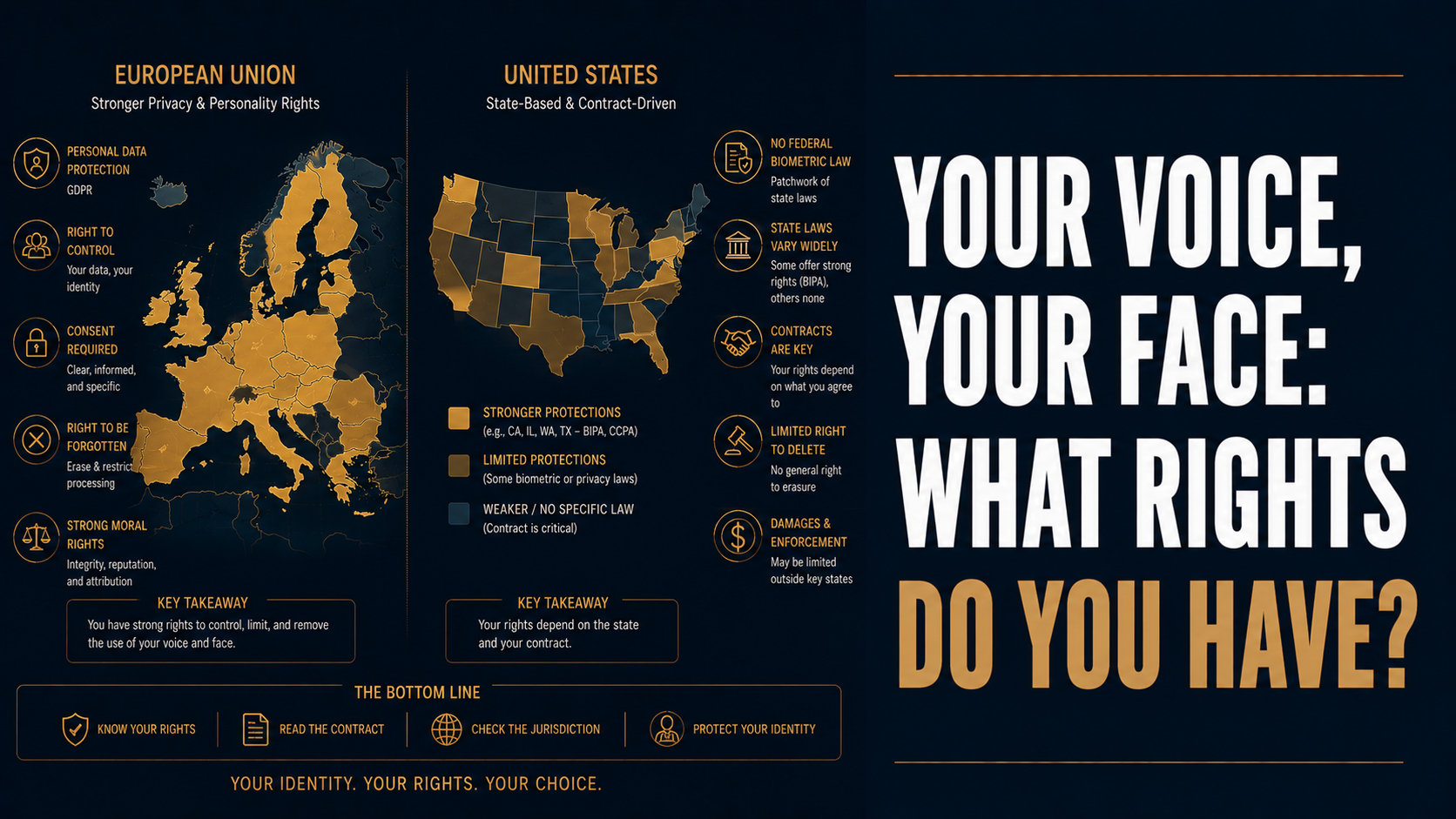
Face geometry, voiceprints, and facial expression models are special-category data under GDPR Article 4(14) and Article 9. Standard IP assignment clauses transfer rights over a creative asset — they do not constitute explicit consent to process biometric data. A rights grant is not a lawful basis. Without a standalone Article 9(2)(a) consent mechanism, every downstream use of the avatar is unlawful from the moment of capture. The same logic applies under BIPA, where an irrevocable IP license from a gig contract satisfies copyright law but does not constitute the written consent required under 740 ILCS 14/15(b).
Article 7(3) GDPR establishes consent withdrawal as an absolute right that cannot be waived, conditioned on payment, or tied to outstanding campaign obligations. A standard talent agreement that purports to grant “irrevocable” rights to likeness data is void to the extent it conflicts with this right. The only compliant approach is a defined withdrawal procedure with technical kill-switch implementation timelines built into the contract from day one — not added as a post-signing amendment after a dispute arises.
From 2 August 2026, Article 50 of the EU AI Act mandates that providers deploying AI systems that generate synthetic audio, image, or video content embed machine-readable watermarks and make clear disclosure to end users. Agreements entered today that are silent on Art. 50 compliance will require mid-campaign renegotiation or expose the brand to regulatory action. The obligation typically falls on the brand or agency deploying the content — not the AI model vendor.
10 Clauses Every AI Avatar Agreement Must Include
Each clause addresses a specific regulatory requirement or practical exposure. Click “Sample Wording” on any card to see a compliant drafting baseline.
Generic IP agreements refer to “likeness” without specifying what is captured. Regulators require precision: face geometry, voiceprint, gait, and motion data each trigger different statutory definitions. An undefined scope creates consent gaps at every processing step downstream.
A blanket IP license does not constitute valid consent to process biometric special-category data. GDPR requires specific, informed, freely given, unambiguous written consent. BIPA requires written consent disclosing purpose and duration before collection. Consent embedded in broad Terms of Service is non-compliant under both regimes.
The clause most commonly absent from standard templates — and the one generating the highest post-withdrawal liability. Without defined kill-switch timelines, a brand facing mid-campaign withdrawal has no contractual framework for orderly cessation and no remedy for costs incurred.
Without an enumerated platform list and category restrictions, AI avatar content can be deployed across any platform — including adult content, political advertising, or markets where the brand has no regulatory approval. GDPR’s purpose limitation principle also requires that processing not extend beyond the originally consented purpose.
Open-ended or automatically renewing licenses conflict with GDPR’s storage limitation principle. An undefined term also prevents enforcement of post-termination obligations. Automatic renewal clauses that purport to extend biometric data processing without fresh consent are void under GDPR.
Overly broad exclusivity can prevent talent from working in adjacent industries entirely — which courts may treat as an unreasonable restraint of trade. Exclusivity must be precisely scoped, and must not extend to talent’s use of their own natural likeness or markets outside the Territory.
From 2 August 2026, Art. 50 requires machine-readable watermarks and clear end-user disclosure on all AI-generated synthetic content. Agreements silent on this obligation create ambiguity over which party bears implementation cost and regulatory liability — particularly where content is generated by a vendor but distributed by the brand.
AI avatars can be deployed simultaneously across multiple platforms at minimal marginal cost. Without platform-specific rate cards and audit rights, brands have both the incentive and the technical capability to underreport usage. Royalty terms must be granular enough to capture this scalability.
AI generation enables rapid deployment in contexts talent has not reviewed. Without a defined approval process, avatar content may appear in reputationally damaging scenarios. Unlike traditional advertising, AI allows retroactive generation at scale once the model exists — making pre-deployment approval essential.
Deleting raw biometric data does not cure liability if the trained model retains the capability to reproduce biometric patterns. GDPR Art. 17 extends to derived data and trained models where technically feasible. Post-termination obligations must address three layers: raw data, trained models, and distributed cached content.
Contract Completeness Checker
Check which of the 10 clauses your current AI avatar agreement contains. Tick each item present to see your coverage score and risk level.
FAQ: AI Avatar Licensing Agreements
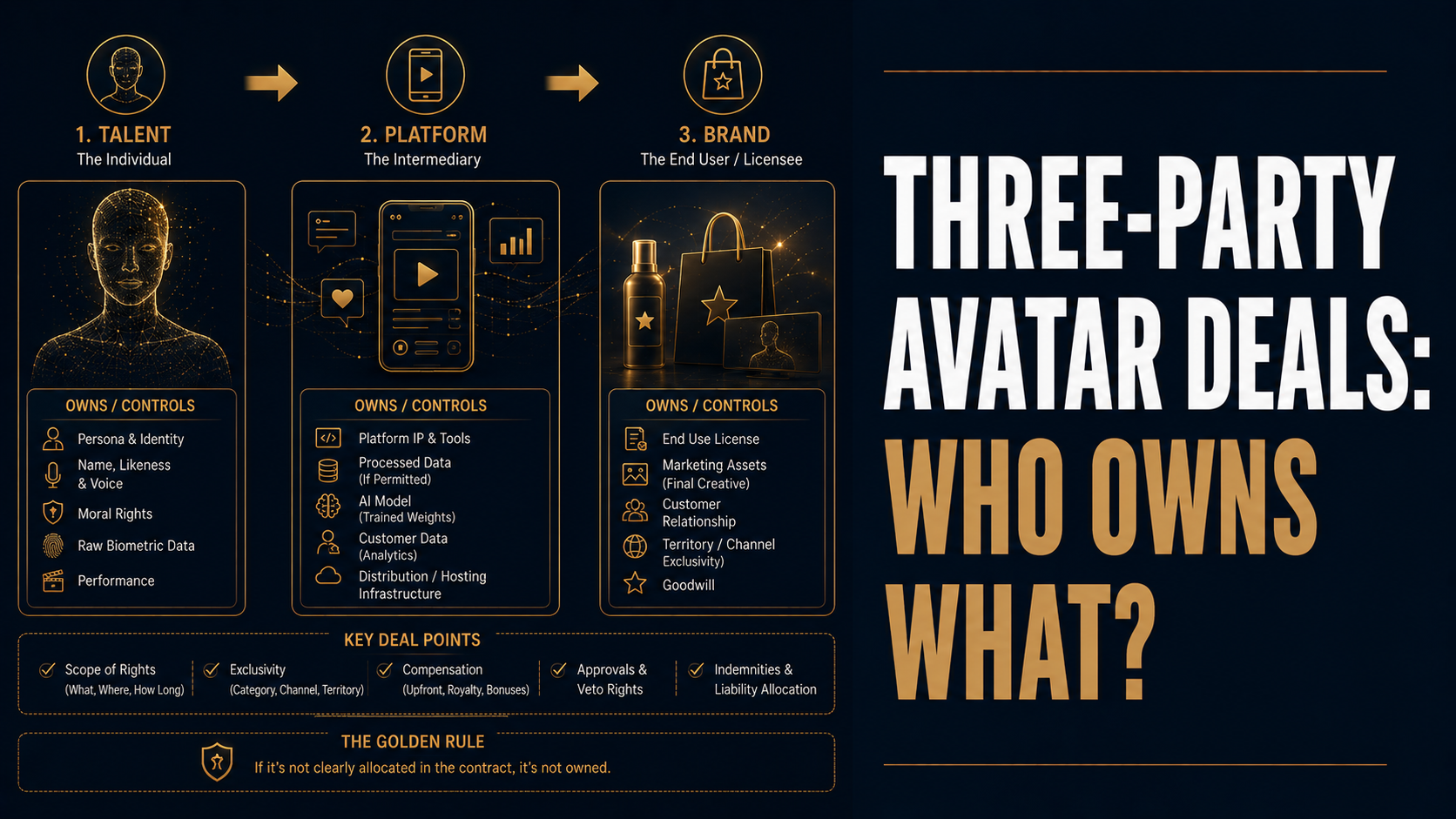
A standard talent agreement licenses a finite creative output — a recorded performance. An AI avatar license authorises the creation of unlimited new synthetic outputs from a biometric template, which is special-category data under GDPR Article 9. This distinction has two critical consequences: (1) the subject matter requires explicit consent under a separate legal regime from IP law; and (2) deployment scale is structurally unlimited once the model exists. Standard IP frameworks assume a defined creative output; avatar agreements must govern an engine that produces outputs that have not yet been created. See also our guide to three-party avatar licensing structures.
No. Article 7(3) GDPR establishes consent withdrawal as an absolute right that cannot be waived, excluded, or conditioned by contract. A clause that makes withdrawal conditional on paying a break fee, satisfying campaign obligations, or completing an exclusivity period is void under GDPR to that extent. What is negotiable: the notice period and technical implementation timelines. What is not negotiable: the right itself. The GDPR withdrawal mechanism in avatar agreements is a structural feature, not an optional commercial term.
Article 50 of Regulation (EU) 2024/1689 imposes disclosure obligations on providers of AI systems generating synthetic image, audio, or video content. From 2 August 2026, the requirements are: (i) machine-readable watermarks or technical provenance markers embedded in AI-generated content; and (ii) clear disclosure to end users that content is AI-generated, perceptible under normal usage conditions. The obligation falls on the entity deploying the AI system — typically the brand or agency, not only the AI model vendor. See our analysis of the EU AI Act August 2026 deadline for full implementation requirements.
A kill-switch clause defines three sequential steps following a consent withdrawal notice. First, the generation layer: the AI system is disabled from creating new content using the talent’s biometric template — typically achievable within 24 hours. Second, the distribution layer: all live deployments across approved platforms are taken down and downstream platforms notified — standard window is 72 hours. Third, the model layer: the underlying AI model must be retrained or retired to remove the talent’s identifiable biometric patterns — typically 30 days. Contracts lacking defined timelines for each layer create GDPR Art. 17 erasure violations and potential damages exposure if content continues circulating post-withdrawal.
This is one of the most underestimated post-termination issues in avatar deals. Deleting raw biometric data does not cure GDPR Article 17 obligations if the trained model retains the capability to reproduce the talent’s identifiable biometric patterns — a property confirmed by model inversion research. Post-termination obligations must cover three layers: (1) raw data deletion from all systems including backups; (2) model retraining or retirement to excise the talent’s patterns; and (3) removal of all distributed Avatar Content from active channels. A certified destruction report from a responsible officer provides evidence of compliance and limits regulatory exposure. See our analysis of using voice and face data without consent for the underlying liability framework.
WCR Legal advises brands, agencies, and platforms on GDPR-compliant AI avatar licensing — from first draft to kill-switch mechanics and Art. 50 implementation.

Post Comment