UAE Free Zone vs Mainland: What Changes for Foreign Businesses in 2026
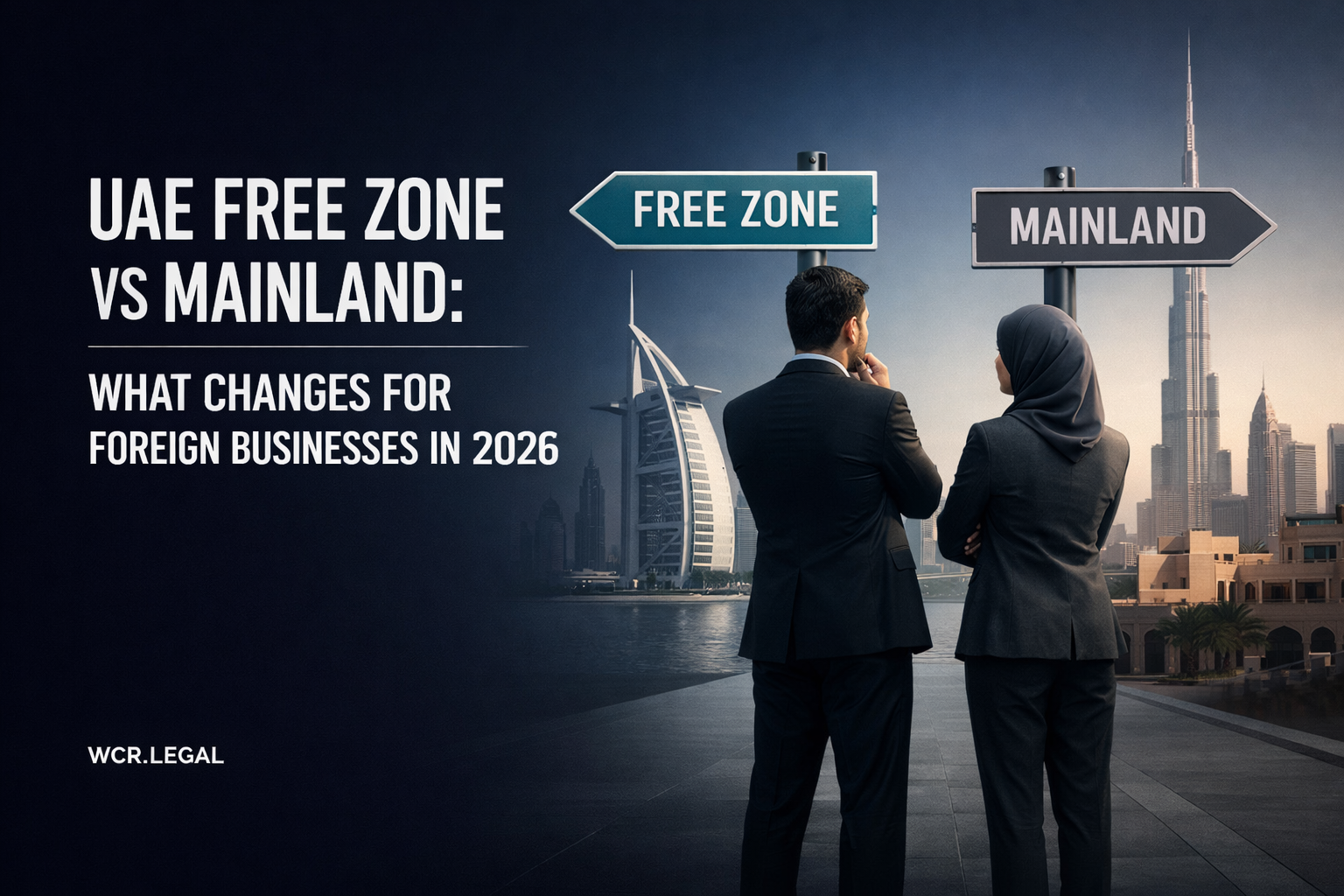
UAE Free Zone vs Mainland:
What Changes for Foreign Businesses in 2026
Three years of rule changes have quietly repositioned the Free Zone vs Mainland choice. If you haven't reviewed your structure since 2022, you're likely operating on assumptions that no longer hold.
The Three Things That Changed Everything in 2024–2026
The UAE business environment changed significantly in the three years following the FATF grey-listing and corporate tax introduction. Most founders know the headline — 9% corporate tax exists now — but the full picture involves three separate shifts that interact with each other. Understand all three before deciding whether your current structure still fits. For background on UAE Mainland and Free Zone structures, see our jurisdiction guide.
The UAE introduced a 9% corporate tax in June 2023, applicable to profits above AED 375,000. For Mainland businesses, the position is straightforward: profits above the threshold are taxed at 9%. For Free Zone businesses, the headline rate remains 0% — but only on qualifying income. This is where most founders have a problem.
The Qualifying Free Zone Person (QFZP) regime allows a Free Zone entity to maintain a 0% effective rate, but only if it meets three cumulative conditions: it earns qualifying income, it has adequate substance in the Free Zone, and it does not elect out of the regime. The definition of qualifying income excludes several categories of activity that are common in Free Zone companies — most critically, services provided to UAE Mainland clients.
The Virtual Assets Regulatory Authority (VARA) launched its full licensing regime and continued to refine requirements through 2024–2025. Minimum capital requirements were clarified, compliance obligations increased, and several provisional approvals lapsed. For businesses operating in crypto and digital assets, the practical result is a higher compliance baseline and a longer, more expensive licensing process than founders anticipated when VARA launched. See our VARA in the UAE guide for the current requirements.
The banking friction issue is separate from VARA itself but directly linked. UAE banks — applying enhanced due diligence following the FATF grey-listing period and post-removal scrutiny — have applied significantly tighter criteria to crypto-adjacent accounts. Businesses that provide services to crypto clients, hold digital asset balances, or have transaction patterns flagged as crypto-related are finding account reviews, restrictions, and closures regardless of their VARA status. The structural issue is that UAE banking risk appetite for this sector has not recovered to pre-2022 levels.
The increased counterparty scrutiny from EU and US institutional investors in 2025–2026 is not a regulatory change — but it is having regulatory consequences. Businesses that use UAE Free Zone structures as their primary operational entity are reporting increased due diligence requests from European and American institutional counterparties, fund administrators, and payment processors. Some are requesting additional documentation; others are declining the relationship.
This is a perception issue that has become a real-world problem. The UAE's removal from the FATF grey list in February 2024 was a positive signal, but the enhanced due diligence habit formed during 2022–2024 has not fully unwound at the counterparty level. For businesses that depend on institutional relationships with EU or US entities, the UAE structure choice now carries a reputational as well as a regulatory dimension. See also our article on geopolitical risk and business structure in 2026.
Free Zone in 2026: What Still Works
The Free Zone model is not broken — the headline advantages are still real. What changed is the conditions under which you access them. The three core advantages that made Free Zones attractive for internationally oriented businesses remain intact in 2026, provided your income structure qualifies.
The 0% corporate tax rate for Qualifying Free Zone Persons (QFZP) is real and available in 2026. It was not eliminated by the corporate tax regime — it was codified into it. A Free Zone entity that earns primarily qualifying income (services to non-UAE clients, certain holding income, re-exported goods) can maintain a 0% effective rate on that income.
The condition is qualification, not location. A Free Zone entity with 100% qualifying income has a better tax position than a Mainland entity. A Free Zone entity with 60% qualifying income needs to understand what rate applies to the non-qualifying 40% — and whether the QFZP status has been lost entirely for that period.
- 0% on qualifying income — no change to the rate itself
- QFZP regime requires adequate substance in the Free Zone
- Annual self-assessment of income mix required — not automatic
- QFZP status lost for entire tax period if de minimis threshold breached
100% foreign ownership in Free Zones remains fully intact — this was never changed and is a constitutional feature of the Free Zone framework, not a tax concession. Foreign founders retain full ownership, full profit repatriation rights, and no requirement for a local partner or sponsor in any Free Zone in the UAE.
It is worth noting that 100% foreign ownership is now also available in most Mainland business activities following the 2021 Commercial Companies Law reforms — so the ownership advantage of Free Zones is less distinctive than it was in 2019. But it remains relevant for activities where Mainland ownership structures are more complex or where the Free Zone framework is preferred for other reasons.
- 100% foreign ownership — no local sponsor required
- Full profit and capital repatriation with no restrictions
- No foreign exchange controls on outbound transfers
- No requirement for UAE-domiciled director or shareholder
For founders who are not physically based in the UAE full-time, Free Zones remain the most operationally flexible structure. Flexi-desk arrangements satisfy office requirements for most licence categories. Visa allocations are available without the physical space requirements that Mainland entities face. Company management can be conducted remotely from outside the UAE for most business activities.
The substance requirements introduced by the corporate tax regime do add a new dimension: if you are claiming QFZP status, you need to be able to demonstrate that core income-generating activities are conducted within the Free Zone, not just that you hold a Free Zone licence. A flexi-desk with no staff and no management activity in the UAE will struggle to satisfy this — but for businesses with genuine UAE operations, the substance requirement is achievable without a full office fit-out.
- Flexi-desk and shared office arrangements accepted for most licences
- Visa allocation available from first year — typically 2–6 visas on flexi-desk
- Remote directorship and management permitted for most activities
- Substance documentation required if QFZP status is claimed
Mainland in 2026: What Improved and What Got Harder
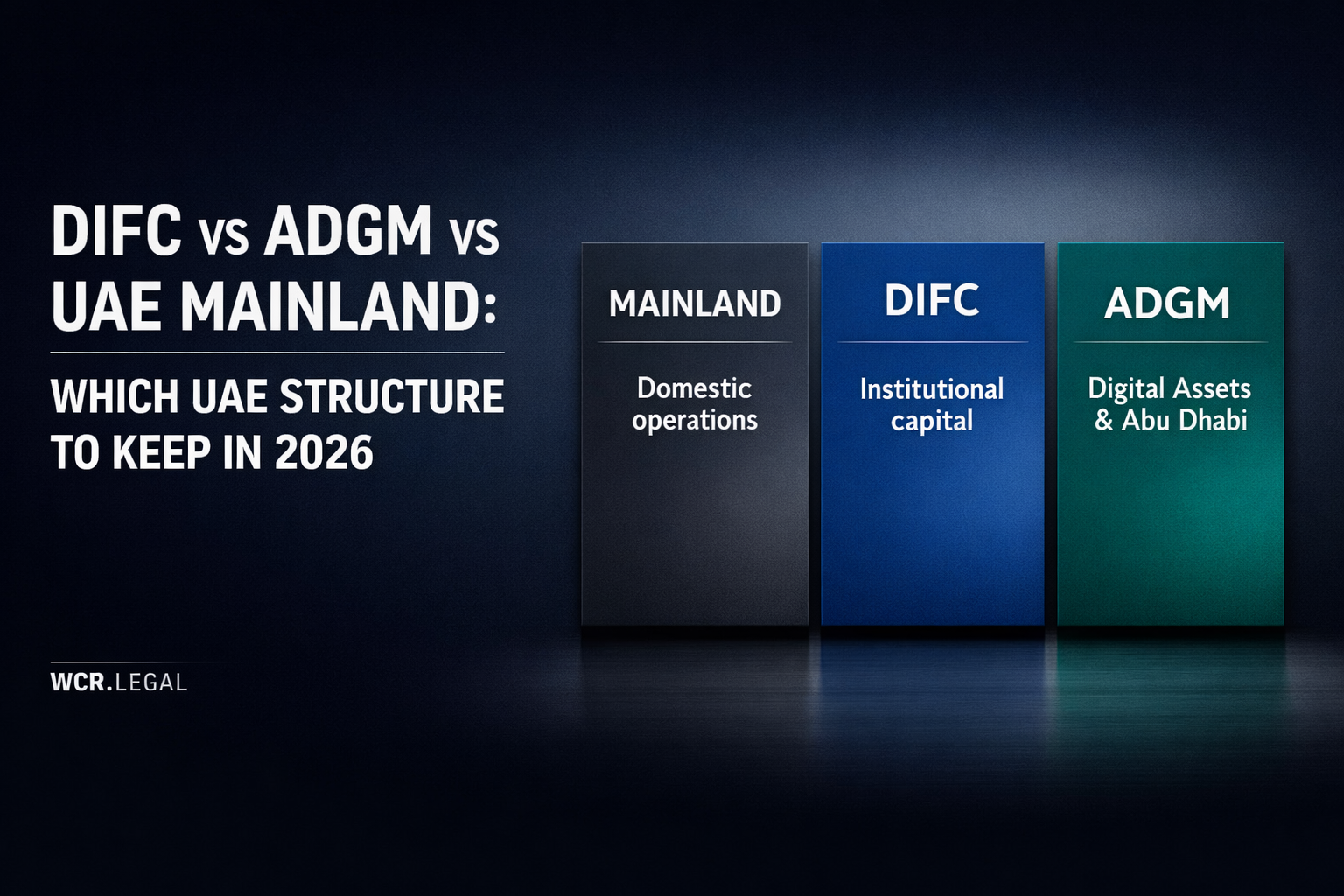
The UAE Mainland story in 2026 is genuinely mixed. The 2021 Commercial Companies Law reforms improved the ownership and market access position significantly. The corporate tax introduction and ongoing banking compliance requirements made operating costs and complexity materially higher. If you are evaluating whether to move from Free Zone to Mainland — or add a Mainland entity — the picture is more nuanced than either "Mainland is now great" or "stay in your Free Zone." See our full overview of UAE Mainland and Free Zone structures. For a broader structure comparison including DIFC and ADGM, see our DIFC vs ADGM vs UAE Mainland guide.
The Free Zone Trap: When 0% Is Not Actually 0%
The most common misconception in UAE corporate structuring in 2026 is that a Free Zone company automatically pays 0% tax on everything it earns. It does not. The 0% rate applies to qualifying income only — and the qualifying income definition is narrower than most founders realise. If your Free Zone company regularly earns income from the categories on the right below, you are already in a 9% position and may not know it. Our holding and tax structuring service can assess your current position.
What to Do Now: Review, Restructure, or Exit
The worst outcome is doing nothing because the decision feels complicated. Four concrete steps will tell you where you actually stand — and what action, if any, is required. Each step can be done independently; start with Step 1 before making any decisions about the rest.
Pull your last 12 months of invoices and categorise each by client location: UAE Mainland, other UAE Free Zone, or outside UAE. Then categorise by income type: services, goods, dividends/holding, property. Cross-reference against the QFZP qualifying income list for your Free Zone.
The output you need: what percentage of your revenue is qualifying income? If it is above 95% (with non-qualifying below AED 5M or 5% of total, whichever is lower), your QFZP status is intact. If you are below that threshold, you may have already lost QFZP status for the relevant tax period and need to understand the tax liability.
If your income audit shows a significant proportion of UAE Mainland revenue, the structural answer is usually not to abandon the Free Zone — it is to add a Mainland entity for the Mainland-facing business and keep the Free Zone entity for the qualifying international business. A dual structure (Free Zone holding + Mainland operating entity) is a common and legitimate approach for businesses that genuinely serve both markets.
The dual structure creates its own compliance overhead — two entities, two sets of accounts, intercompany arrangements that must be at arm's length — but for a business with, say, 40% UAE Mainland revenue and 60% international revenue, keeping both structures is usually cheaper than paying 9% on everything through a single Mainland entity. The DIFC vs ADGM vs UAE Mainland guide covers the structure options in more detail.
Banking friction in the UAE is a structural problem, not a relationship problem. If your current bank is restricting your account, requiring enhanced due diligence, or declining transaction categories, changing relationship managers at the same bank will not solve it. The issue is how your entity is categorised in the bank's risk framework — which is driven by your Free Zone, your activity type, your transaction patterns, and your client profile.
Assess your banking position independently of your structure decision. If your banking problem is activity-based (crypto-adjacent, high-risk sectors), the solution may be a structure change — DIFC or ADGM entities have better banking access for certain activity types. If it is jurisdiction-based (certain Free Zones receive more scrutiny than others), switching to a better-regarded Free Zone may help. If you are considering relocating out of the UAE entirely, see our guide to alternatives to Dubai for business relocation.
With the information from Steps 1–3, the decision framework is straightforward: if your Free Zone entity is QFZP-qualifying and banking adequately, you stay and document your compliance position properly. If your income mix is wrong, you restructure — either a dual structure or a Free Zone entity with a redirected client mix. If your UAE presence has become more administrative than commercial and the compliance overhead exceeds the benefit, you exit.
Exiting a UAE entity is not free or fast — see our guide on how to close a company in Dubai in 2026 for the full process, including the Free Zone deregistration requirements and the bank account closure sequence. If the decision is to relocate, our relocation alternatives guide covers Singapore, Mauritius, EU, and AIFC as alternatives. The worst outcome — inaction because the decision is uncomfortable — leaves you in a 9% tax position you may not have budgeted for, with a banking relationship that is deteriorating, and a compliance exposure that grows with every filing.
WCR Legal works with foreign founders on UAE structure reviews — qualifying income assessments, dual structure design, and exit coordination. We tell you what you actually need to do, not what the options theoretically are.