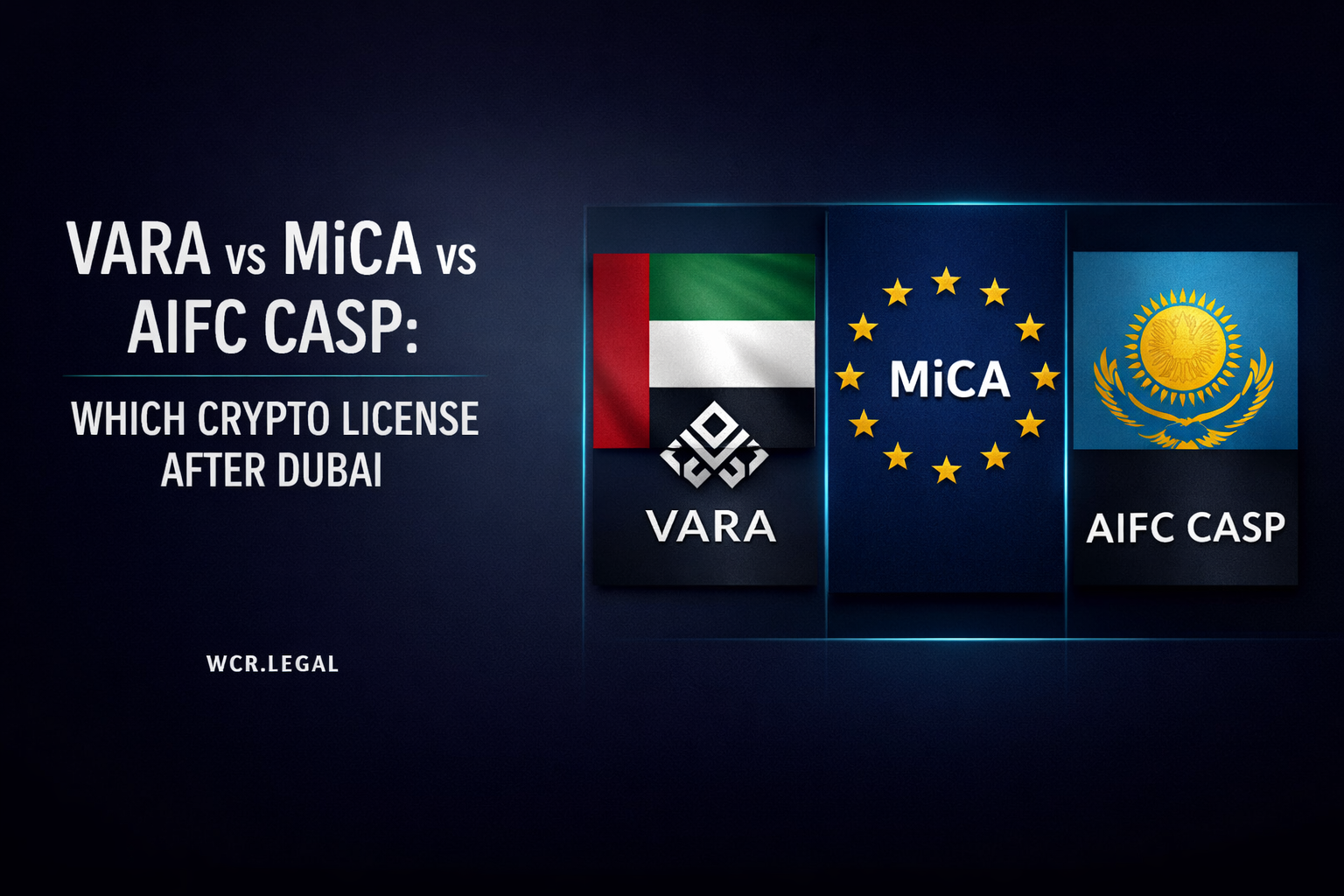
VARA vs MiCA vs AIFC CASP: Which Crypto License After Dubai
VARA vs MiCA vs AIFC CASP: Which Crypto Licence After Dubai?
March 2026 changed the calculus for VARA-licensed founders. If your banking access is tightening or your EU counterparties are asking questions, here is the regulated path forward — compared honestly.
Why VARA Alone Is No Longer Enough
This is not about VARA failing. The VARA regulatory framework is still one of the most comprehensive crypto licensing regimes in the world. The problem is what has shifted around it — and what your VARA licence can no longer do for you in 2026. See also our overview of Dubai alternatives for business relocation for the broader picture.
If you are VARA-licensed, you already know this. Since Q4 2025, UAE banks have been applying significantly more rigorous due diligence to crypto-related accounts — including those held by entities with active VARA licences. The situation is not that VARA-licensed businesses are being refused banking. It is that the process is slower, the documentation requirements are heavier, and the onboarding timelines have extended to a point where operational liquidity is affected.
The underlying driver is not regulatory — it is geopolitical. UAE correspondent banking relationships with US and EU institutions now carry elevated scrutiny, and UAE banks are absorbing that scrutiny by passing it downstream to their crypto clients. VARA has not changed. The macroeconomic context around it has.
Since MiCA came into full effect, EU-regulated exchanges, custodians, and institutional investors have been aligning their counterparty frameworks around CASP status. The practical consequence: if you approach an EU-regulated exchange about listing or liquidity, or an EU family office about raising capital, the first question in their compliance checklist is increasingly "are you MiCA-registered or in the process?" VARA does not answer that question, because MiCA is a distinct regime with no mutual recognition agreement with UAE.
This is not yet a hard block in every case — many EU counterparties still accept well-regulated non-EU licences alongside enhanced due diligence. But the trajectory is clear. By end of 2026, MiCA status is likely to become a default requirement for substantive EU institutional relationships rather than a nice-to-have.
The broader shift is this: the era of running a global crypto business from a single regulated jurisdiction is ending. The businesses that built on a single VARA licence and assumed that was sufficient are now finding that their operational dependencies — banking, counterparties, investor onboarding, stablecoin rails — each map to a different jurisdictional standard. Managing those dependencies from a single entity is becoming structurally difficult.
Multi-jurisdictional licensing used to be an enterprise-scale concern. In 2026, it is becoming the baseline expectation for any crypto business with international exposure. The question is no longer whether to add a second regulated jurisdiction — it is which one to add first, and in what sequence.
VARA: What Still Works in 2026
The answer is: quite a lot. The case for adding a second jurisdiction is not a case against VARA. It is a case for understanding precisely where your VARA licence is genuinely strong — and where it has reached its geographic and counterparty limits. See also how VARA compares to RAK DAO in 2026 for the UAE-internal picture.
VARA remains the most comprehensive and operationally detailed crypto licensing regime in the MENA region. The rulebooks — covering exchange, brokerage, investment management, lending, custody, and advisory — are more granular than most equivalent frameworks globally. That granularity is operationally useful: it gives you clear compliance parameters rather than the interpretive ambiguity that plagues lighter-touch regimes.
VARA-licensed entities are recognised by UAE financial institutions, including CBUAE-regulated banks, without the secondary DD burden that unlicensed entities face. Within the Gulf market specifically, your VARA licence carries weight that no other crypto regulatory badge currently matches.
- Recognised across all seven Emirates
- Accepted by UAE banks and financial counterparties
- Most detailed crypto rulebooks in MENA
- FSRA (ADGM) parallel track also available for offshore structures
VARA-licensed entities are not being frozen out of UAE banking. That framing overstates the problem. But the onboarding process has materially lengthened since Q4 2025, and the documentation requirements are more extensive. Businesses that opened accounts smoothly in 2023–2024 are finding that renewal reviews and new account requests are considerably slower.
The underlying issue is correspondent banking. UAE banks that maintain USD correspondent relationships with US institutions are applying the compliance standards those correspondent banks demand — which include elevated scrutiny of crypto-related flows, regardless of VARA status.
The VARA Dubai licensing service page has current guidance on the most crypto-friendly banking options within the UAE ecosystem.
VARA's licensing framework has not been materially revised in 2026. The timeline from initial application to full licence remains 6–12 months for standard cases, with more complex structures — particularly those involving proprietary exchange infrastructure or novel product types — extending to 18 months or beyond.
Costs remain substantial. Application fees, compliance officer appointments, AML programme build-out, and the ongoing supervisory levy make VARA one of the more expensive crypto licensing processes globally. This is by design — VARA is explicitly a premium-tier licence, not a gateway for early-stage or budget-constrained operators.
- Application fees: AED 30,000–120,000 depending on category
- Ongoing annual supervisory fee: significant for most licence types
- Minimum capital: varies by activity — up to AED 200M for certain exchange licences
- No material framework changes announced for 2026
MiCA: The EU Option
If your business has European clients, European investors, or European banking relationships, MiCA is not optional — it is the regulatory standard your counterparties are aligning toward. See the full EU regulatory environment overview and the VASP-to-CASP MiCA deadline guide for the transition timeline.
AIFC CASP: The Fastest Regulated Path
If you need a regulated crypto licence in under six months, at a fraction of MiCA or VARA cost, the AIFC jurisdiction is the only credible option currently available. The AIFC CASP licence is not a lite-touch registration — it is a full VASP-equivalent authorisation under an IOSCO-aligned framework, enforced by English common law.
The AFSA (Astana Financial Services Authority) CASP framework covers the full spectrum of VASP-equivalent activities: exchange, OTC brokerage, custody, investment management of digital assets, and digital asset advisory. The scope is comparable to what VARA covers for UAE, or what a MiCA CASP authorisation covers for the EU — it is not a restricted-activity registration.
AIFC operates under its own legal framework based on English common law, administered by the AIFC Court — a permanent international court with judges drawn from English, Singaporean, and common law jurisdictions. Contracts governed by AIFC law are enforceable internationally under the New York Convention. This is not a soft offshore framework — it is a properly functioning legal system designed for international commercial relationships.
AIFC CASP applications submitted with complete documentation are processed by AFSA in 2–4 months. This is not an aspirational timeline — it is the consistent experience for well-prepared applications. Applications that are submitted incomplete or that require supplementary rounds will take longer, but 6 months is a realistic worst case rather than the norm.
The cost advantage is substantial. AFSA application fees are in the range of USD 5,000–15,000 depending on activity category. Minimum capital requirements are lower than equivalent VARA or MiCA thresholds. No physical presence in Astana is required at the application stage, which eliminates the office setup and local hire costs that add significantly to MiCA first-year expenditure. All-in first-year costs for a standard AIFC CASP are typically USD 25,000–50,000 — versus USD 80,000–200,000 for MiCA or USD 150,000+ for VARA.
AIFC-licensed entities can access Kazakhstani banking through Halyk Bank, Kaspi, and Forte Bank — all of which maintain correspondent relationships covering USD, EUR, and RUB operations. This is functional and operationally usable. It is not at the level of Singapore or EU banking in terms of correspondent network depth, but it is materially better than the situation facing VARA-licensed entities trying to open new accounts in 2026.
International correspondent access for AIFC entities is improving. Some tier-2 European banks and several Asian correspondent banks now accept AFSA-licensed entities for account opening. The trajectory is positive — AIFC's inclusion in international financial centre dialogues is translating into improved banking access over time.
AIFC CASP is the right first move for founders who need a regulated licence fast while building toward MiCA or MAS — the AIFC licence demonstrates regulatory credibility and regulatory track record, which strengthens a subsequent MiCA or MAS application. It is also the right permanent licence for businesses whose primary client base is in Central Asia, South Asia, or the CIS, where AFSA authorisation carries significant counterparty weight.
It is also appropriate for VARA-licensed businesses that need a second regulated entity to solve banking — an AIFC entity provides an alternative banking access point and a parallel compliance structure while the VARA entity continues to serve Gulf-facing operations.
Side-by-Side: VARA vs MiCA vs AIFC CASP
Seven dimensions that matter operationally. No marketing spin — just the practical picture as of March 2026. For the deeper regulatory analysis of how these frameworks actually differ in structure, see VARA vs MiCA vs AIFC CASP: how the regulatory routes actually differ.
Which One to Choose: Decision Framework
Four scenarios — mapped to the right licence. Find your situation, read the logic, and if you need guidance on the AML/KYC compliance implications of a jurisdiction switch, that guide covers the compliance transition in detail.
WCR Legal advises VARA-licensed businesses on second-jurisdiction strategy, MiCA CASP applications, and AIFC CASP licensing. We handle the process end-to-end — from jurisdiction selection to application submission and NCA liaison — while your VARA entity continues to operate.