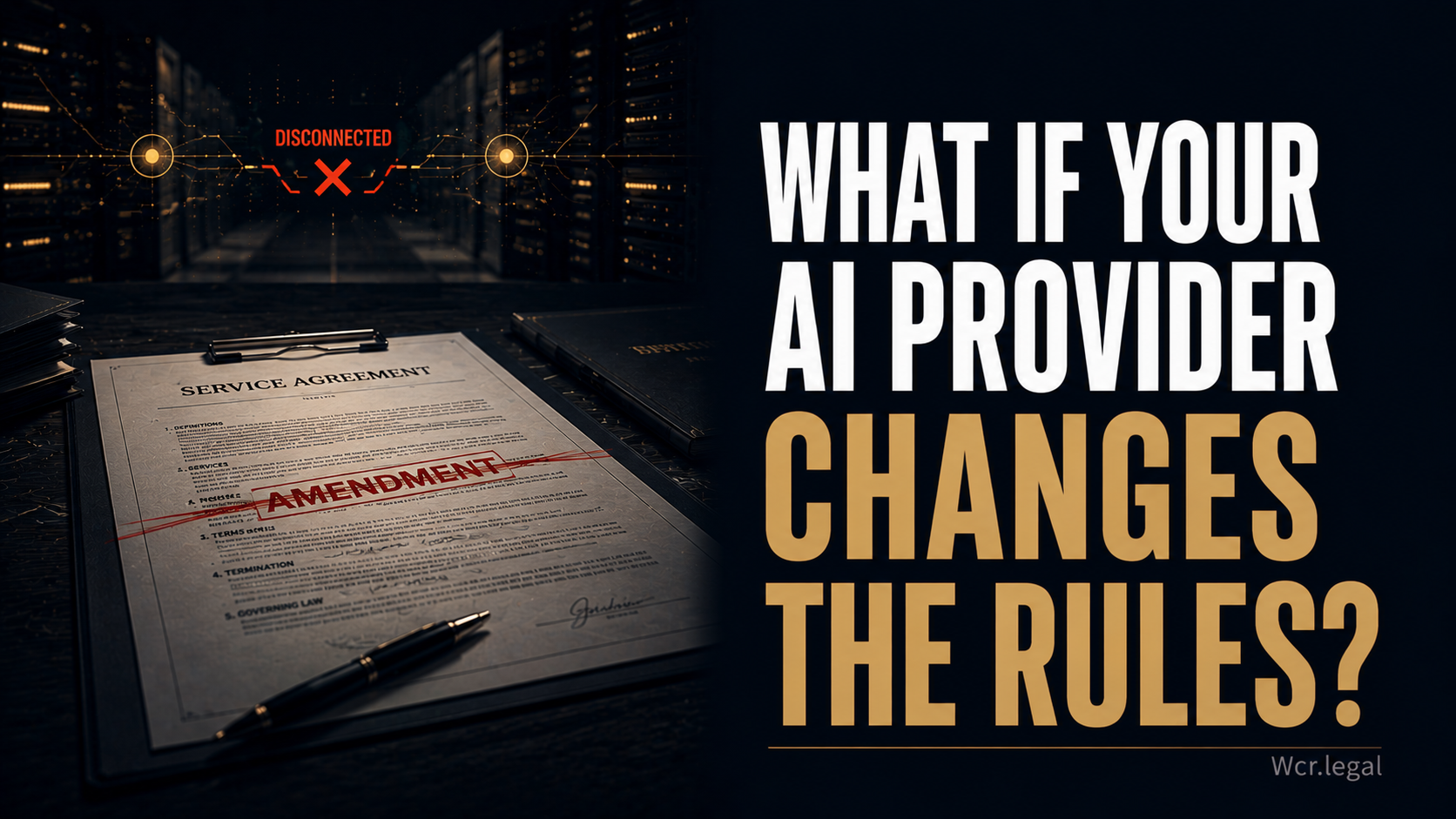
What Happens to Your AI Product If Your Model Provider Changes Terms?
AI Law · Founder Guide
What Happens to Your AI Product If Your Provider Changes Terms?
OpenAI changed its ToS 4 times in 2023–2024. GPT-4 is deprecated. Here’s what that means — and how to protect your product.
1
What has actually changed
OpenAI ToS timeline 2022–2026
2
Four scenarios that break your product
Deprecation · Terms · Price · Geo
3
How each provider handles this
OpenAI · Anthropic · Mistral
4
What to put in your contract now
5 protective clauses
5
How exposed is your product?
3-question self-assessment
6
Common questions
ToS, deprecation, investor DD
Section 1
What Has Actually Changed
It started with an email. GPT-4 deprecated. Migration deadline in 30 days. The product that took eight months to build, fine-tuned on proprietary data, no longer works as designed. No contractual remedy. No refund. No recourse. This is not hypothetical — it has already happened to hundreds of B2B products. Our AI Model Licensing practice helps founders build contractual protection against exactly this risk before the next change arrives.
OpenAI ToS & model changes: 2022–2026
Average: one material change per year, without contractual notice
Timeline
2022
Plugin and application registration requirements removed
Access policy change
OpenAI eliminated the waitlist and registration process, opening API access broadly. Products built around specific approval structures needed to adapt. No contractual notice period was provided to existing customers.
Feb 23
Usage policies consolidated — prohibited use cases expanded
Terms of Service change
OpenAI merged its content policy and usage policies into a single document. Several use cases previously permitted were reclassified as requiring explicit approval. Products operating in grey-area verticals — legal, medical, financial — faced sudden compliance questions mid-product-development.
2024
GPT-3.5 and GPT-4 deprecated; pricing restructured across tiers
Model deprecation + price change
The models that most production AI products were built on became inaccessible. Fine-tuned model weights built on GPT-4 required migration to GPT-4o. Pricing restructured across API tiers simultaneously. Products with fixed-price client contracts absorbed the margin compression with no contractual protection.
The deprecation notice window: 30 days for most customers. For enterprise agreements with version lock provisions, this was manageable. For standard API customers, it was not.
Jan 26
Service Terms updated — liability caps and dispute resolution revised
Most recent material change
OpenAI updated its Service Terms in January 2026. Changes included revisions to the aggregate liability cap structure and dispute resolution procedures. Standard API customers received notice via website update. The aggregate liability cap under standard terms remains the greater of amounts paid in the prior 12 months or $100.
The pattern
Four material changes in three years, without contractual advance notice to standard API customers. Each change required product adaptation. None triggered any contractual remedy under standard terms. This is the environment your product operates in.
Section 2
Four Scenarios That Break Your Product
These are not edge cases. They are the documented failure modes of AI products built on standard API terms without contractual protection. Investors conducting AI-aware due diligence look for each of these specifically.
DEP
Model deprecation
Your fine-tuned model becomes inaccessible
The most operationally damaging scenario
What happens: The base model your fine-tuned version was built on is deprecated. Your custom model behaviour — the differentiation you spent months building — disappears. The replacement model behaves differently.
Business impact: Emergency migration, regression testing, customer-facing behaviour changes, potential SLA breaches with enterprise clients. Timeline: 30 days under standard terms.
Contractual protection: Version lock clause — guarantees access to a specific model version for a defined period, typically 12–24 months. Only available via negotiated enterprise agreements.
ToS
Terms change
Your use case becomes prohibited overnight
No grandfathering in standard terms
What happens: OpenAI revises its usage policies. Your product’s vertical — legal document automation, medical decision support, financial analysis — is reclassified from permitted to requiring explicit approval, or prohibited outright.
Business impact: Immediate compliance obligation. No grandfathering clause in standard terms. If your use case is now prohibited, continued operation is a breach. You cannot bill customers for a product you can no longer lawfully run.
Contractual protection: Change-of-terms termination right — the right to exit the agreement without penalty if the provider makes a material change to permitted use cases that affects your product.
$
Price hike
API costs rise, client contracts don’t
Margin compression with no contractual exit
What happens: OpenAI restructures its pricing tier. Your per-call cost increases materially. Your client contracts are fixed-fee or have annual rate locks. You absorb the difference.
Business impact: Margin erosion that scales with usage. At high volume, a 20% API price increase can eliminate product-level profitability without a single client churning. Under standard terms, OpenAI can change pricing with reasonable notice — no minimum notice period is specified.
Contractual protection: Price stability clause with defined notice period and exit right. Requires enterprise-level negotiation. Also: pass-through provisions in your own client contracts.
EU
Geo-restriction
EU clients lose access — your SLA breaks
Regulatory compliance shifts the risk to you
What happens: A provider restricts service in certain jurisdictions in response to regulatory pressure — as has already occurred with AI services in Italy and other EU markets. Your enterprise clients in those markets lose access. Your SLA is breached.
Business impact: Enterprise clients trigger service credit provisions or termination rights under their own agreements with you. You bear the liability for a restriction you did not cause and could not prevent.
Contractual protection: Force majeure and regulatory change carveouts in your client agreements, plus multi-provider architecture that allows regional failover without service interruption.
Liability cap — read this before your next DD meeting
OpenAI’s aggregate liability under standard API terms is capped at the greater of what you paid in the last 12 months or $100. If your product breaks because of a model deprecation or terms change, you have no contractual remedy beyond that. You are entirely on your own.
Section 3
How Each Provider Handles This
A comparison of the three main providers on the four parameters that determine your exposure. Standard terms only — enterprise agreements can materially improve each of these positions.
OAI
OpenAI API
GPT-4o · GPT-4 · GPT-3.5
ToS change notice
Informal
Notice via website or email. No contractually defined minimum period in standard terms.
Model deprecation notice
~30 days
Typically 30 days in practice. Not a guaranteed contractual minimum under standard terms.
Termination right if terms change
Limited
Standard terms give OpenAI broad right to change; customer termination rights are narrow.
Price change notice
Reasonable notice
“Reasonable notice” required but no minimum period specified. No exit right on price change.
ANT
Anthropic API
Claude 3.7 · Claude 3.5 · Claude 3
ToS change notice
30 days
Anthropic provides notice of material changes. Enterprise agreements can specify a contractual minimum.
Model deprecation notice
Varies
No guaranteed period under standard terms. Enterprise agreements can include version commitments.
Termination right if terms change
Enterprise only
Standard terms: limited. Enterprise: material change termination rights are negotiable.
Price change notice
Reasonable notice
Price stability over defined periods is negotiable at enterprise level.
MIS
Mistral / Open-weight
API · Self-hosted · Apache 2.0
ToS change notice
N/A (self-hosted)
Self-hosted open-weight models have no upstream ToS. Your infrastructure, your rules.
Model deprecation notice
Full control
Self-hosted: no deprecation risk. You control the model version indefinitely.
Termination right if terms change
Full control
Self-hosting eliminates upstream ToS risk entirely. Compliance burden shifts to you.
Price change notice
Infrastructure only
No API pricing exposure. Cost is compute infrastructure. No per-call risk.
Built your product on a single provider with no contractual exit? A 30-minute review identifies exactly what you need to negotiate before your next enterprise deal or investor meeting.
Book a 30-min review →
Section 4
What to Put in Your Provider Contract Now
Five clauses that convert a standard click-through agreement into a defensible contractual position. None of these are available on standard API terms — each requires negotiation at enterprise level. For investors’ DD expectations, see our AI due diligence service.
Provider contract protection checklist
5 clauses — none available on standard API terms without negotiation
Negotiate now
Advance notice — 30+ days before any material ToS change
Define “material” explicitly: changes to permitted use cases, pricing, model availability, data handling, or liability cap. Standard terms give OpenAI the right to change with informal notice. Enterprise agreements can specify a contractual minimum advance notice period and define your rights if that period is not met.
Target: 30-day contractual minimum · Define “material change” in writing
Termination for convenience if terms change materially
The right to exit the agreement without penalty if the provider makes a material change that adversely affects your product or business. Without this, you are locked in even if the terms become commercially untenable. This is the single most important protective clause for product-dependent companies.
Target: 30-day exit window after material change notice
Version lock for fine-tuned models
A contractual commitment that the base model version your fine-tuned model runs on will remain accessible for a defined period — typically 12 or 24 months. Without this, a deprecation notice can render your fine-tuning investment worthless in 30 days. Version lock provisions exist in OpenAI enterprise agreements and are actively negotiated.
Target: 12–24 month version availability commitment
Price stability clause
A cap on pricing changes within a defined period, or a right to exit if prices increase beyond a defined threshold. Critical if your own client contracts are fixed-fee or have annual rate locks. Without price stability, an API cost increase directly compresses your margin with no contractual remedy.
Target: price freeze period or >X% increase triggers exit right
Data portability and model export rights
The right to export your fine-tuned model weights and training data on termination — regardless of the reason for termination. Without this, walking away from the provider also means walking away from the IP embedded in your fine-tuned model. This clause must be explicit; it is not implied by contractual ownership of outputs.
Target: model weights export · training data return · 30-day transition period
Parallel protection in your client contracts
These clauses protect you upstream. You also need corresponding provisions downstream: pass-through pricing adjustment rights in your MSAs, force majeure and regulatory change carveouts covering upstream provider actions, and SLA definitions that exclude provider-caused outages from your service credit calculations.
Section 5
How Exposed Is Your Product?
Answer three questions to get an immediate read on your vendor lock-in exposure ahead of your next fundraise or enterprise deal.
3-question provider dependency assessment
Takes under 60 seconds — results are immediate
Self-assessment
Question 1 of 3
Is your product built on a single AI provider?
Yes — single provider, no fallback
Primarily one provider with a fallback
Multi-provider architecture
Question 2 of 3
Do you have a fine-tuned model with that provider?
Yes — we have fine-tuned models in production
No — inference only
Planning to fine-tune
Question 3 of 3
Does your provider contract include termination rights if the provider changes terms materially?
Yes — we have a negotiated enterprise agreement
No — standard API terms only
Not sure what our agreement says
Assess my exposure →
Ready to build contractual protection into your AI provider relationships?
WCR Legal reviews AI model licensing agreements for B2B founders preparing for investment or enterprise deals. We identify your exposure, advise on what to negotiate, and prepare you for the questions investors ask about vendor dependency.
Section 6
Common Questions from Founders and Investors
Frequently asked questions
5 questions — ToS changes, deprecation, investor DD
5 questions
1
Does OpenAI give notice before changing its ToS?
+
Yes, but the standard terms do not specify a fixed notice period. In practice, “notice” has meant an email update or a website post. For some changes it has been days; for others, weeks. This is legally sufficient under standard click-through terms. If you need a contractually guaranteed notice period — which you do if your product has enterprise SLAs — you must negotiate a specific minimum into your enterprise agreement. A 30-day advance notice of material changes is a standard ask at enterprise level and is routinely granted.
2
What happens to my fine-tuned model if OpenAI deprecates the base model?
+
It becomes inaccessible. OpenAI does not guarantee version availability under standard API terms — and the deprecation of GPT-3.5 and GPT-4 demonstrated this concretely. Your fine-tuned model weights may be yours contractually, but they run on OpenAI infrastructure. If the base model is deprecated, that infrastructure is no longer available. The two available responses: negotiate a version lock provision into your enterprise agreement (available, and negotiated regularly), or plan a migration path to an open-weight alternative where you control the infrastructure and the model version indefinitely.
3
Can I terminate my agreement if OpenAI raises prices?
+
Not under standard API terms. OpenAI has broad rights to adjust pricing with reasonable notice, and no termination right is triggered by a price increase under standard terms. Enterprise agreements can include price stability clauses — a defined period of price certainty, or a right to exit if prices increase beyond a specified threshold. These must be explicitly negotiated. They are not standard. The parallel issue: if your own client contracts are fixed-fee, an API price increase directly compresses your margin. See our AI risk and liability practice for how to structure pass-through protections in your client MSAs.
4
Is using open-weight Mistral models a solution to vendor lock-in?
+
Partially — and it is a genuine solution to the upstream ToS risk. Self-hosting an open-weight model eliminates deprecation risk, ToS change exposure, and per-call pricing risk entirely. You control the infrastructure and the model version. The trade-off: the compliance burden shifts to you. Data security, model governance, GDPR processor obligations — all become your direct responsibility rather than the provider’s. This is manageable, but it must be planned for. See our article on using customer data to train AI models for the data governance implications of self-hosted fine-tuning.
5
What do investors look for on this topic at Series A?
+
Series A investors with AI-aware DD processes look for four things: single-provider dependency and what happens if that provider changes its terms; data portability and whether the company can migrate its fine-tuned models and training data; a documented migration or fallback plan; and contractual protections in the provider agreement. A company with standard API terms, a single fine-tuned model in production, and no migration plan is a concentration risk. This is routinely flagged in investment committee memos. See our article on who owns AI outputs for the IP ownership side of the same DD questions.


Post Comment