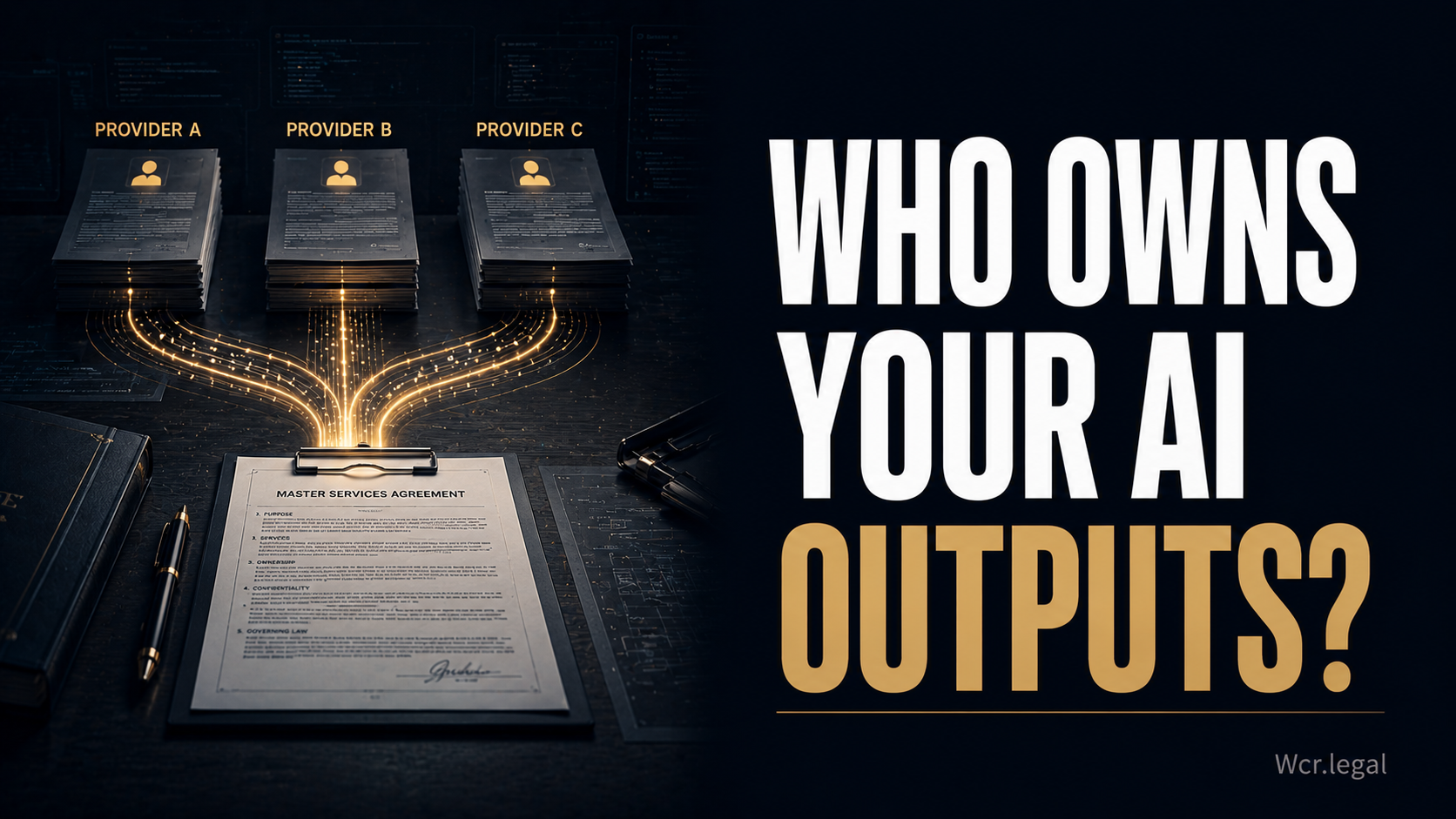
OpenAI vs Anthropic vs Mistral: Who Owns Your AI Outputs?
AI Law · Founder Guide
OpenAI vs Anthropic vs Mistral: Who Owns Your AI Outputs?
Three providers, three different answers — and only one that matters when your investor asks.
1
Three layers of AI output ownership
Contractual · Copyright · Indemnity
2
What each provider actually offers
OpenAI · Anthropic · Mistral compared
3
What this means for your product
SaaS · Marketplace · Enterprise
4
Pre-DD checklist
8 questions investors will ask
5
What’s your exposure level?
3-question IP self-assessment
6
Common questions
What investors ask on Series A DD
Section 1
Three Layers of AI Output Ownership
Your investor is three slides into due diligence. They look up and ask: “If a competitor copies your AI-generated outputs — your reports, your content, your product descriptions — can you stop them?” You say: “Yes, we own the outputs.” The room goes quiet. That answer is not enough. For a full review of your AI provider agreements, our AI Model Licensing practice covers this in detail. Also relevant: Can I use customer data to train my AI model?
Three distinct legal concepts — most founders only have the first
Investors ask about all three. Know where you stand.
IP Framework
1
Contractual Ownership — can you use it and sell it?
All three providers give you this
The provider assigns you rights to the AI output through their Terms of Service. OpenAI, Anthropic and Mistral all do this for API customers. It means you can use outputs commercially and pass rights downstream to your clients. What it does not mean: you can prevent someone else from generating an identical output using the same prompt.
Contractual assignment answers “can we sell this to our customers?” It does not answer “can we stop a competitor copying it?”
2
Copyright Protection — can you stop copying?
Depends on human authorship, not on ToS
Copyright does not follow from the provider’s ToS — it follows from human authorship. The US Copyright Office (2023–2024 guidance) and the EU’s emerging position both require meaningful human creative input for copyright to attach. An automated AI pipeline with minimal human direction may produce outputs that receive no copyright protection at all, regardless of what the ToS says.
The practical solution: document human involvement in your AI workflows. Prompting strategy, editorial selection, and substantive editing all strengthen a copyright claim. Zero human involvement means zero copyright.
3
IP Indemnity — who pays if it infringes?
Most standard API customers have none
If your AI output turns out to infringe someone else’s copyright — an author, a photographer, a software company — who covers the liability? Anthropic (enterprise tier) offers IP indemnity to qualifying customers. Standard OpenAI API terms do not. Mistral offers none at any tier. Most founders building on standard API access are carrying unhedged exposure they have never audited.
Quick reference
Contractual = can you use it. Copyright = can you stop copying. Indemnity = are you covered if it infringes. Most founders have only the first. Investors ask about all three.
Section 2
What Each Provider Actually Offers
ToS language looks similar across all three providers. The practical IP positions are not. A plain-language comparison as of 2025–2026. See also: how AI models are actually licensed for the upstream licensing picture.
OAI
OpenAI API
GPT-4o · GPT-4 · GPT-3.5
Contractual assignment
Yes
Outputs assigned to user in ToS. Sublicensing to downstream clients permitted.
Copyright position
Neutral
Does not claim copyright. User bears the risk of whether copyright attaches to outputs.
IP indemnity
Enterprise only
Copyright Shield for ChatGPT Enterprise only. Standard API: no indemnity provided.
ANT
Anthropic API
Claude 3.7 · Claude 3.5 · Claude 3
Contractual assignment
Yes
Assigns output rights to customers under business agreements. Commercial use permitted.
Copyright position
User bears risk
Anthropic disclaims all warranties. Copyright determination is entirely the user’s responsibility.
IP indemnity
Enterprise available
IP indemnity available under enterprise agreements. Not included in standard API access.
MIS
Mistral API
Mistral Large · Small · Open weights
Contractual assignment
Yes (API)
API outputs assigned to user. Open-weight models: each has a separate licence that governs instead.
Copyright position
User bears risk
No copyright warranties. Open-weight terms add further complexity for self-hosted deployments.
IP indemnity
None
No IP indemnity available at any tier. Full exposure sits with the API customer.
Mistral open-weight models
Mistral Small and earlier Mixtral releases operate under Apache 2.0 or the Mistral Research License — not the API ToS. If you self-host, your IP position is governed by the specific model’s licence. Apache 2.0 is permissive for commercial use. The Mistral Research License is not. Always check the specific model page before self-hosting at scale.
Section 3
What This Means for Your Product
Three product models. Three different IP gaps to audit before your next fundraise or enterprise deal.
SaaS
Output resale
You pass AI outputs to your customers
The most common B2B AI product model
The gap: Your provider assigns outputs to you. But does your plan explicitly permit sublicensing those outputs to your downstream customers? Not all plans do.
What investors check: Does your customer ToS accurately represent the rights you can actually pass on? Are you making IP representations your provider hasn’t backed?
Action: Confirm sublicensing is permitted in your plan. Align your customer ToS with what you actually own — not what you assume you own.
MKT
User-generated
Users generate content on your platform
Platform ownership is doubled
The gap: Your platform provides AI tools; users generate outputs. The ownership question now runs provider → platform → user. Ambiguity at either layer is a DD problem.
What investors check: Does your platform ToS explicitly define who owns AI-generated outputs — the user, the platform, or a shared arrangement?
Action: Define ownership clearly in your platform ToS. Ambiguity here is not a technicality — it is a valuation risk that sophisticated investors will flag.
ENT
IP warranty
Enterprise clients require IP warranties
The gap most founders discover too late
The gap: Your enterprise customer wants an IP warranty in the MSA — a commitment that your outputs do not infringe. You can only give this if your provider gives it upstream. On standard API, they do not.
What investors check: Does your MSA include IP warranties your provider doesn’t back? That is unhedged liability on your balance sheet. See our AI due diligence service.
Action: Either exclude AI outputs from IP warranties, negotiate enterprise terms with a provider that offers indemnity, or structure human involvement to support a copyright position.
Not sure your provider agreement covers your product use case? A 30-minute review surfaces the gaps before your next investor meeting or enterprise deal.
Book a 30-min review →
Section 4
Pre-DD Checklist: AI Output Ownership
Eight questions investors will ask. Work through these before you accept an LOI or term sheet. For deeper coverage, see our AI risk and liability services.
AI output IP checklist
8 items — minimum for any investment-ready AI product
DD-ready
Does your provider ToS include explicit contractual assignment of outputs to you?
Confirm the specific clause — do not rely on the general impression that “you own the outputs.” Assignment language must be present and unambiguous.
Does your plan explicitly permit sublicensing outputs to your customers?
Check the specific tier you are on. Enterprise plans typically permit this explicitly; some standard plans do not address it, which creates ambiguity you do not want in a DD process.
Is there sufficient human authorship in your AI workflows to support a copyright claim?
Document how humans direct, review, select and edit AI outputs. The more substantive the human input, the stronger the copyright position. Fully automated pipelines may produce unprotectable output.
Document: prompting strategy · editorial review · substantive editing
Do you offer IP warranties to enterprise clients in your MSA?
If yes: is your upstream provider covering that exposure through indemnity? If not, you are offering a warranty you cannot honour. This is one of the first things a sophisticated enterprise legal team will find.
Have you documented human involvement in your AI generation process?
Written records of prompting decisions, editorial choices, and quality review processes. This documentation supports both copyright claims and investor DD narratives.
If using Mistral open-weight models: have you checked the specific licence of that model version?
Apache 2.0 and Mistral Research License have materially different commercial terms. The model name alone does not tell you which licence applies — you must check the specific release.
Check: mistral.ai model cards · Hugging Face licence tab
Do your customer contracts include a clause defining who owns AI-generated outputs?
Silence in your customer MSA is not in your favour. Define ownership explicitly: what rights you are passing on, what you are not, and what the customer can do with AI outputs downstream.
Can you answer the investor question: “If a competitor copies your AI output, what is your position?”
Write a one-paragraph answer now. If you struggle to write it, you are not ready for the question in a DD meeting. The answer should address contractual ownership, copyright basis, and what remedies you would have. See our AI Model Licensing Guide for Founders.
Section 5
What Is Your Exposure Level?
Answer three questions to get an immediate read on your IP position ahead of fundraising or a major enterprise deal.
3-question IP exposure assessment
Takes under 60 seconds — results are immediate
Self-assessment
Question 1 of 3
How do you use AI outputs in your product?
Internal only — we do not pass outputs to clients
We pass outputs to end users or clients
Users generate content on our platform
Multiple of the above
Question 2 of 3
Do your enterprise clients require IP warranties in your agreements?
Yes — we have IP warranties in our MSAs
No — we do not offer IP warranties
Not yet, but enterprise deals are coming
Not sure what our MSA says
Question 3 of 3
Which provider powers your product?
OpenAI API
Anthropic API
Mistral API
Open-weight model (LLaMA, Mistral self-hosted, etc.)
Multiple providers
Assess my exposure →
Need clarity on your AI output ownership before fundraising or a major client deal?
WCR Legal reviews AI model licensing agreements for B2B founders preparing for investment. We identify gaps, align your customer contracts with your provider terms, and prepare you for the questions investors ask.
Section 6
Common Questions from Founders and Investors
Frequently asked questions
5 questions — what comes up most in Series A DD
5 questions
1
If OpenAI assigns me ownership of outputs, why can’t I copyright them?
+
Because copyright and contractual ownership are separate legal concepts that operate independently of each other. OpenAI’s ToS assigns you contractual rights to use and commercialise outputs. But copyright protection — the right to prevent others from copying — requires human authorship under US, EU and UK law. If your team meaningfully directed, selected and shaped the output, copyright may apply. If an automated pipeline generated it with minimal human input, it may not qualify for protection at all. The practical solution: document human involvement in your AI workflows at every stage.
2
Does Anthropic offer IP indemnity for API customers?
+
Anthropic offers IP indemnity only under enterprise agreements, not standard API access. Under standard API terms, Anthropic disclaims liability for IP infringement in outputs. If you have enterprise clients requiring IP warranties in your MSA, you need to either negotiate enterprise terms with Anthropic or structure your contracts carefully to avoid passing down warranties your provider has not covered. Offering IP warranties without upstream coverage is unhedged liability.
3
What does “Mistral open-weight” mean for my IP position?
+
Mistral releases some models under open licences such as Apache 2.0 or the Mistral Research License. These are entirely separate from the API Terms of Service. If you self-host a Mistral open-weight model, your IP position is governed by that specific model’s licence — not by Mistral’s API terms. Apache 2.0 is permissive for commercial use. The Mistral Research License restricts commercial applications. The model name alone does not tell you which licence applies: always check the specific model release page before self-hosting at scale.
4
Can I include an IP warranty in my MSA if my provider doesn’t offer indemnity?
+
You can include it contractually, but doing so creates unhedged liability — you are warranting something your upstream provider has not covered. The three practical options are: (a) exclude AI-generated content explicitly from IP warranties in your MSA, (b) negotiate enterprise terms with a provider that offers indemnity before signing MSAs that require it, or (c) invest in sufficient human involvement in your outputs to support a legitimate copyright position. See our AI risk and liability practice for structuring advice.
5
What will investors ask about AI output ownership on Series A DD?
+
Expect questions across four areas: who owns the outputs your product generates and on what legal basis; whether you can pass those rights to clients and whether your plan permits it; whether you have IP exposure if a client claims infringement; and whether your provider agreement actually supports the warranties in your client MSAs. Investors conducting AI-aware DD have seen these gaps before — and they know exactly what to look for. Our earlier article on using customer data to train AI covers the training data side of the same DD questions.

Post Comment