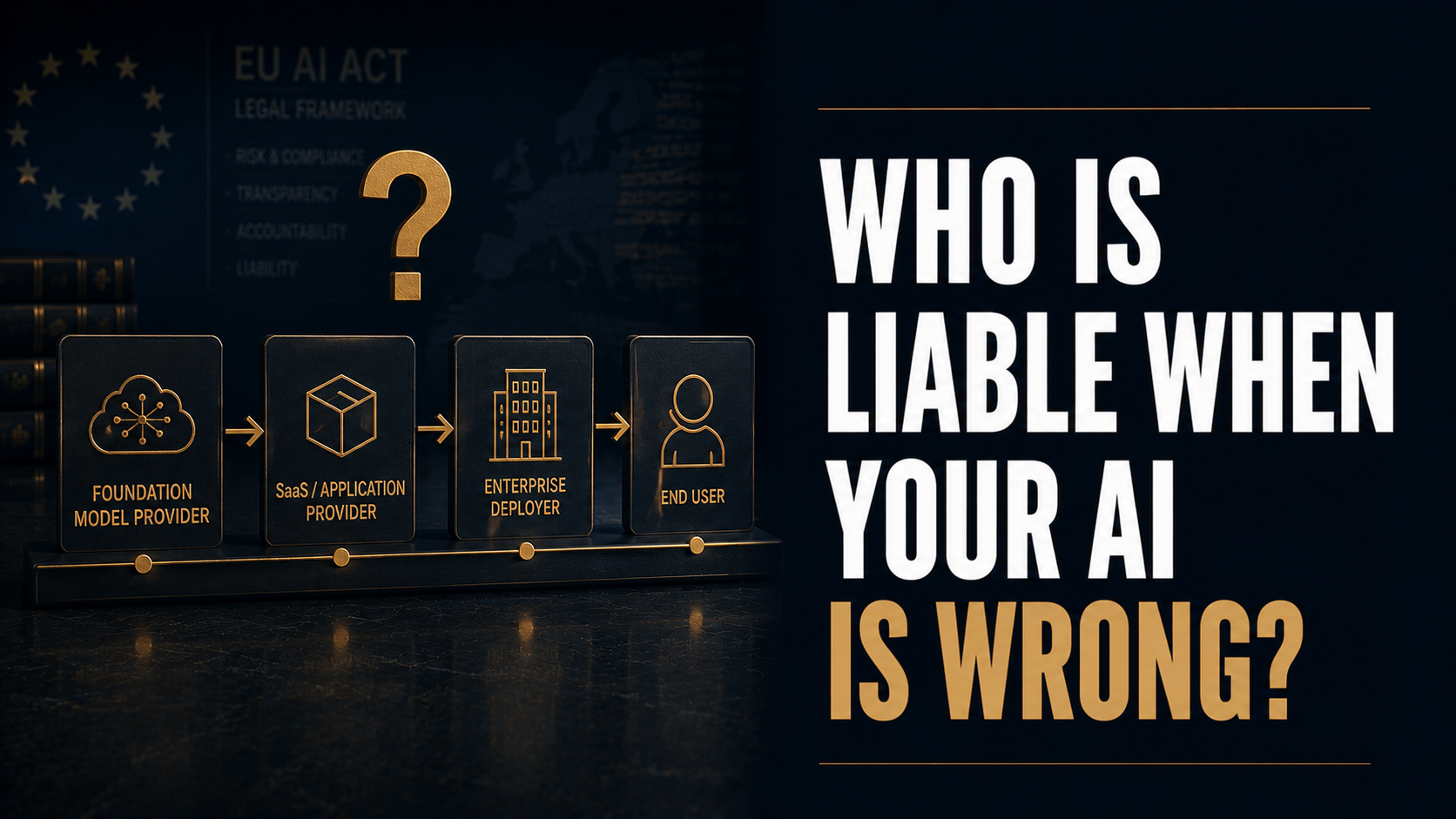
Who Is Liable When Your AI Makes a Wrong Decision? Mapping Responsibility Across the Supply Chain
Who Is Liable When Your AI Makes a Wrong Decision?
The AI Supply Chain: Four Roles, Four Liability Positions
What Is Your Role? Select to See Your Exposure
Three Scenarios: Who Pays?
How to Protect Your Position
Common Questions
Yes — as an enterprise deployer, you face direct obligations under EU AI Act Article 26: you must implement human oversight, ensure use within intended purpose, and monitor outputs. Separately, employment law, GDPR Article 22, and financial services regulation create liability frameworks that operate entirely independently of who owns the AI. “It was my vendor’s system” is a factor in apportioning liability between you and the vendor — it is not a complete defence against the person harmed.
The EU AI Act is a regulatory framework: it sets obligations and creates enforcement powers (fines up to €30M or 6% of global turnover, market withdrawal) but does not itself create private rights of action for individuals harmed by AI. The revised Product Liability Directive (applying from December 2026) creates strict civil liability: individuals can sue for damages caused by defective AI software without proving fault. In practice, an AI failure will typically trigger both: regulatory investigation under EU AI Act and civil litigation under PLD. Non-compliance with EU AI Act obligations will be used as evidence of a product defect in PLD proceedings.
Contractual liability caps work between contracting parties — they can limit what your enterprise customer can recover from you in a breach of contract claim. They do not protect you against: (1) regulatory fines under EU AI Act; (2) third-party tort claims from individuals harmed by the AI — they are not party to your contract; (3) PLD strict liability claims, which cannot be contractually excluded against consumers or in cases of personal injury. A well-drafted AI liability cap in your MSA is essential — but it addresses only a portion of your total exposure.
Potentially, yes. Article 25 provides that a deployer who substantially modifies a high-risk AI system is reclassified as provider and must comply with Articles 9–17. Fine-tuning on client data that changes the system’s risk profile, performance characteristics, or intended use case is the clearest example of substantial modification. The test is not technical complexity — it is whether the modification meaningfully changes how the system behaves in ways that affect the risk level. See our provider vs deployer analysis for the full Article 25 test.
The timeline has multiple layers. EU AI Act prohibited practices applied from February 2025. GPAI obligations (foundation model providers) applied from August 2025. High-risk AI system obligations under Annex III apply from August 2026 — the most significant deadline for enterprise SaaS. The revised Product Liability Directive applies to AI software placed on the market from December 2026. National laws (employment discrimination, GDPR Article 22, financial services regulation) already apply now — AI does not create an exemption from existing legal frameworks.

Post Comment