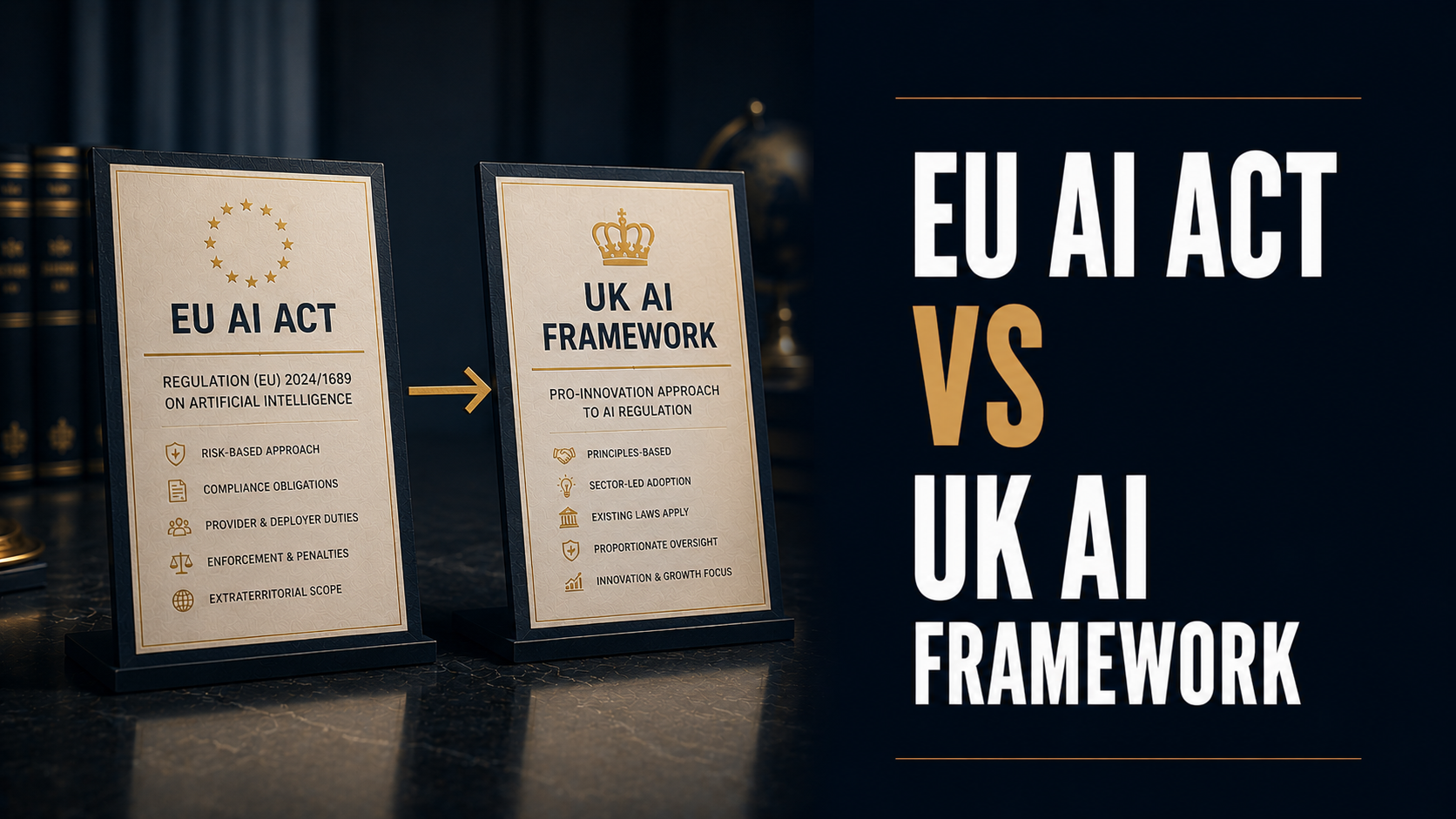
EU AI Act vs UK AI Framework: What’s Different and Why It Matters for Your Product
EU AI Act vs UK AI Framework: What’s Different and Why It Matters for Your Product
Post-Brexit, the EU and UK took divergent paths on AI regulation. EU AI Act compliance does not mean UK compliance. If your SaaS serves both markets, you need to understand both frameworks — and where they conflict.
Since Brexit, the EU and UK have been quietly building divergent AI governance regimes. The EU chose a single, horizontal, risk-based regulation — the EU AI Act — that is now binding law with a phased compliance timeline running through 2026 and 2027. The UK chose a different path: no dedicated AI statute, but instead a framework of sector-specific guidance issued by existing regulators, underpinned by retained EU law and new cross-border AI compliance considerations as the two regimes diverge further over time.
For SaaS companies with users in both markets, this creates a structurally different compliance problem than most teams anticipate. The obligations do not simply overlap — they reflect different legal philosophies, different enforcement mechanisms, and in some areas directly conflicting requirements. This guide maps the seven most important divergences and gives you a practical tool to assess what dual-market compliance actually requires for your product.
Key Differences: EU AI Act vs UK AI Framework
Seven parameters that determine your compliance obligations across both markets. Where the frameworks conflict or require parallel work, the practical impact on your product team is substantial.
How Divergent Are Your Obligations?
Answer three questions to see whether you need one framework, both with overlap, or full parallel compliance programmes.
What EU Compliance Misses for the UK
EU AI Act compliance addresses none of the following UK-specific obligations. If you serve UK users, each of these must be assessed and addressed independently of your EU programme.
Frequently Asked Questions
No. EU AI Act compliance does not satisfy UK obligations. The frameworks are based on different legal instruments, administered by different authorities, and cover different obligations. EU AI Act conformity assessment documents will not be accepted by the ICO, FCA, or CMA as evidence of UK compliance. Your EU technical documentation, risk assessment, and human oversight implementation must be reviewed separately against UK GDPR, sector-specific FCA or ICO guidance, and the Equality Act. The two programmes will share some common elements — data governance, audit trails, documentation culture — but they cannot be treated as one.
UK GDPR began as a direct copy of EU GDPR, retained in domestic law after Brexit. However, it has been diverging. The ICO has issued guidance on automated decision-making and AI that interprets Article 22 (automated decisions) differently from EDPB guidance in some respects. UK data transfer mechanisms — including the UK’s own adequacy decisions and the International Data Transfer Agreement (IDTA) — are distinct from EU Standard Contractual Clauses. The UK Government has also proposed reforms to UK GDPR under the Data Protection and Digital Information framework. For AI processing, particularly profiling and automated decisions, the two regimes must be checked separately against current guidance from their respective authorities.
As of May 2026, no dedicated UK AI Act has been introduced. The current government has indicated it is monitoring the EU AI Act’s implementation before committing to a statutory approach. The most likely scenario for binding UK AI legislation is a targeted bill covering high-risk sectors — similar to the Online Safety Act model — rather than a comprehensive horizontal regulation. Companies should not wait for UK AI legislation before addressing UK compliance obligations. The existing ICO, FCA, CMA, and Equality Act frameworks are already enforceable and regulators are actively applying them to AI systems now. The absence of an AI-specific statute does not mean the absence of legal risk.
A single legal entity can operate in both markets, but it will need to satisfy both compliance frameworks without the benefit of EU AI Act mutual recognition in the UK, or vice versa. The practical implications depend on your product. For EU AI Act purposes, non-EU providers must appoint an EU-authorised representative if they place AI systems on the EU market without a local entity (Article 22). For UK purposes, there is no equivalent EU-representative requirement, but ICO registration, FCA authorisation, and other sector licences may require a UK legal presence. Jurisdiction structuring decisions should be reviewed against the compliance cost implications of each structure. See our guide on AI jurisdiction structuring.
The UK AI Safety Institute (AISI) was established to evaluate the safety of advanced AI systems, particularly frontier models. It does not have regulatory enforcement powers and participation in its evaluations is voluntary. AISI is not an AI regulator in the same sense as the ICO or FCA — it conducts research, issues reports, and coordinates with international counterparts on AI safety. If your company builds or deploys foundation models, engagement with AISI may be commercially relevant (some major developers have voluntarily agreed to submit models for evaluation) but it is not legally required. For compliance purposes, your relevant UK authorities remain the ICO, FCA, CMA, and sector-specific regulators depending on your product’s use case.
EU compliance is a starting point. UK compliance is a separate programme.
Post-Brexit SaaS companies serving both markets face two enforcement regimes, two documentation standards, and two sets of regulators. Our cross-border AI practice builds compliance architectures that work across both — without duplicating effort where genuine overlap exists.

Post Comment