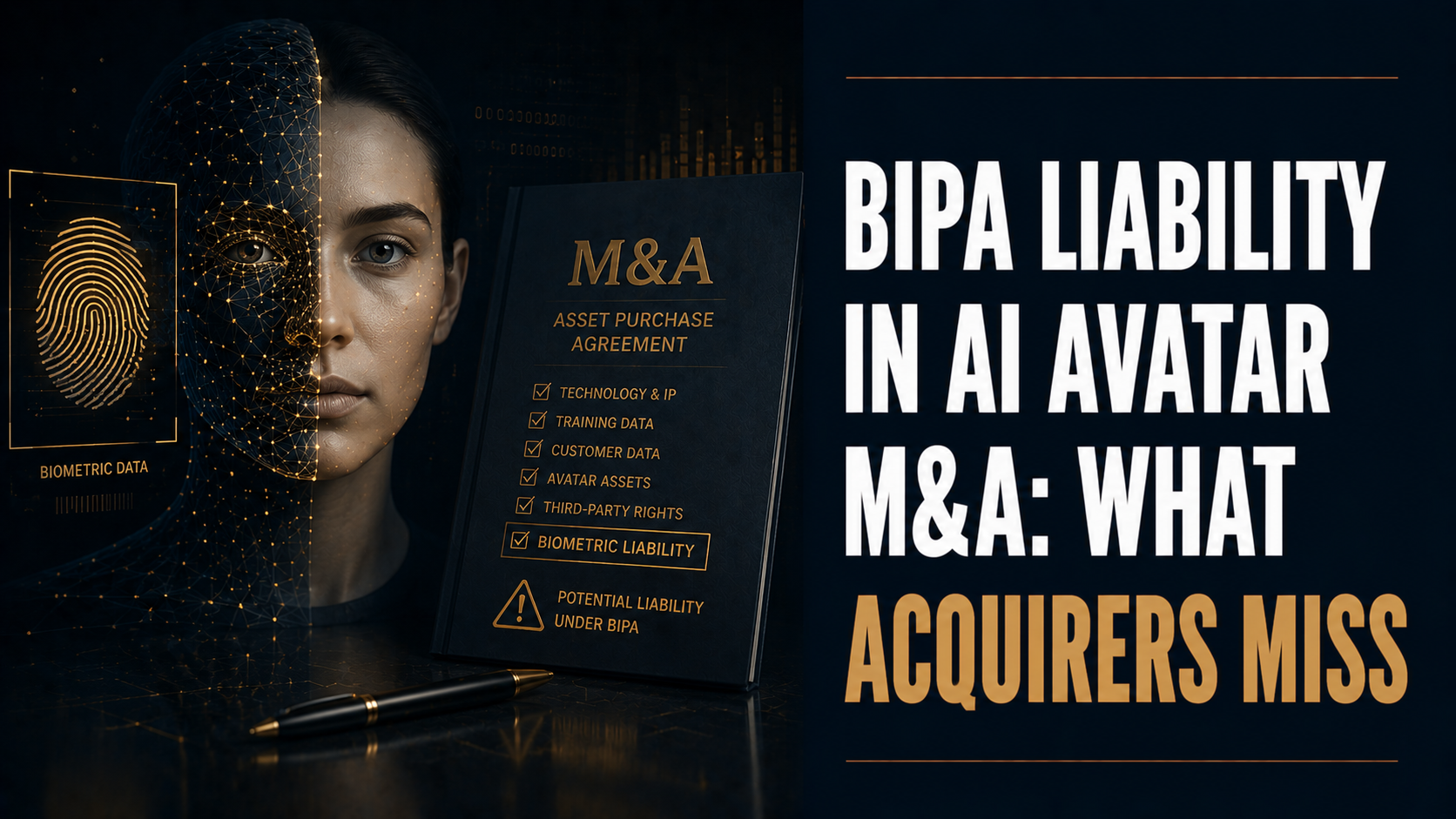
BIPA Liability in AI Avatar M&A: What Acquirers Miss
BIPA Liability in AI Avatar M&A:
What Acquirers Miss
AI avatar platforms collect face geometry and voiceprints at scale. Standard M&A due diligence misses the Illinois BIPA exposure. By the time a class action is filed, the deal has closed.
AI avatar platforms — tools that synthesize realistic face and voice replicas for video generation, deepfake detection, or digital twin creation — are among the hottest M&A targets in the current AI cycle. They are also among the most legally exposed under the Illinois Biometric Information Privacy Act (BIPA). Yet standard acquisition due diligence rarely surfaces this exposure before closing. The result: class actions filed post-closing against the combined entity, with liability that accrues on a per-scan basis across the entire Illinois user base.
WCR Legal’s AI Avatar Due Diligence practice has developed a BIPA-specific DD protocol because standard legal and tech DD checklists are not built for platforms that collect biometric identifiers at scale. This article explains the mechanics, the precedents, and the deal structure implications.
Why Avatar Platforms Are BIPA Magnets
Three technical characteristics of AI avatar platforms — present in virtually every product in this category — independently satisfy BIPA’s definition of biometric identifier collection, triggering the statute’s written consent, retention, and destruction requirements.
Avatar platforms extract facial landmark coordinates — eye spacing, nose bridge geometry, jaw angle — to generate photorealistic digital likenesses. Under BIPA Section 10, a “scan of face geometry” is explicitly enumerated as a biometric identifier. Collection without a publicly available written retention policy and individual written consent is a strict-liability violation. One Illinois-resident user upload = one potential violation.
AI voice cloning requires voiceprint extraction — the acoustic signature unique to an individual’s speech pattern. BIPA Section 10 includes “voiceprint” as an enumerated biometric identifier. Courts applying BIPA to AI note-taking tools (2025–2026) have confirmed that automated voiceprint extraction for synthesis purposes, not only for identification, satisfies the statutory definition. Avatar platforms combining face + voice synthesis face compounding exposure on two independent biometric tracks.
In Cothron v. White Castle System (Ill. 2023), the Illinois Supreme Court held that a separate BIPA violation accrues each time a biometric is collected or transmitted without consent — not once per individual. An avatar platform that re-scans a user’s face geometry on each upload or login, or re-processes a voiceprint on each session, generates a separate violation per scan. For a 50,000-user platform with 10 sessions per user, unconsented face geometry scans alone may represent 500,000 violations at $1,000–$5,000 per violation. This is the exposure that closes deals or triggers indemnification clawbacks.
Precedents Every Avatar Acquirer Should Know
Three enforcement actions define the outer bounds of BIPA exposure for AI platforms. Each carries a distinct M&A lesson about legacy data liability, consent chain gaps, and the emerging voiceprint frontier.
What Is Your BIPA Exposure?
Answer three questions about the target platform to receive a preliminary BIPA exposure classification. This tool is for orientation only — not a substitute for formal legal DD. Use it to prioritize the depth of your biometric review.
Clean vs Exposed — Deal Structure Implications
BIPA exposure does not automatically kill a deal. It changes the deal structure. The comparison below shows how each parameter shifts when counsel identifies material biometric liability during DD.
BIPA Pre-Acquisition Checklist
Six DD steps that should run in parallel with standard legal and technical due diligence for any AI avatar platform with an Illinois user base.
Yes. BIPA applies to the collection of biometric identifiers from Illinois residents, regardless of where the collecting company is incorporated or headquartered. A Delaware-incorporated AI avatar platform with a San Francisco office still violates BIPA if it collects face geometry or voiceprints from Illinois residents without compliant written consent. The Seventh Circuit has confirmed territorial reach based on the location of the data subject, not the data collector.
No. SB 2909 (effective August 2024) limited recovery to one violation per plaintiff per course of conduct, which reduces aggregate exposure compared to the per-scan model in Cothron v. White Castle. However, the Seventh Circuit has not yet decided whether SB 2909 applies retroactively to claims filed before the amendment’s effective date. Cases filed before August 2025 may still be litigated under the pre-amendment per-scan rule. For M&A purposes, any BIPA exposure analysis should model both the pre-amendment and post-amendment damage scenarios as a range.
Rarely in full. R&W insurance carriers have become increasingly aware of BIPA exposure and many policies now contain specific biometric data exclusions or require enhanced underwriting for platforms with material Illinois user bases. Known BIPA violations or pending claims are typically excluded entirely. Even where coverage exists, BIPA-specific escrows negotiated in the SPA often provide more reliable protection for the acquirer than R&W policy coverage, which may be subject to contestation at the claims stage.
BIPA requires: (1) a written, publicly available data retention and destruction policy specific to biometrics, established before collection; (2) a written consent obtained from each individual before any biometric collection, separate from the general Terms of Service, stating the specific purpose and duration of collection; and (3) a prohibition on profit-generating disclosure of biometric data. A ToS clause that references “use of your likeness” does not satisfy these requirements. Pre-acquisition remediation often involves issuing retroactive re-consent notices to the Illinois user cohort, which has its own class action risk if improperly handled.
Frame it as a calculable contingent liability, not an abstract regulatory risk. Quantify the Illinois user base, multiply by scan frequency, apply both per-scan ($1,000–$5,000 per violation) and aggregate models, and present a low-high range in dollar terms. Treat it the same as tax exposure or environmental liability — it is a number that should appear in the financial model and inform escrow sizing, price, and indemnification carve-outs. The mistake is treating BIPA as a compliance checkbox rather than a valuation variable. The Clearview ($51.75M) and Meta ($650M) settlements demonstrate that biometric liability can be material relative to any AI avatar company’s enterprise value.
Is a Deal You Already Paid For
WCR Legal provides pre-acquisition BIPA due diligence for M&A counsel and PE/VC acquirers targeting AI avatar platforms. Consent chain audit, exposure modeling, and deal structure recommendations delivered in 7–14 days.

Post Comment