Three-Party Avatar Licensing: How to Structure Rights Between Platform, Talent and Brand
Three-Party Avatar Licensing:
How to Structure Rights Between Platform, Talent and Brand
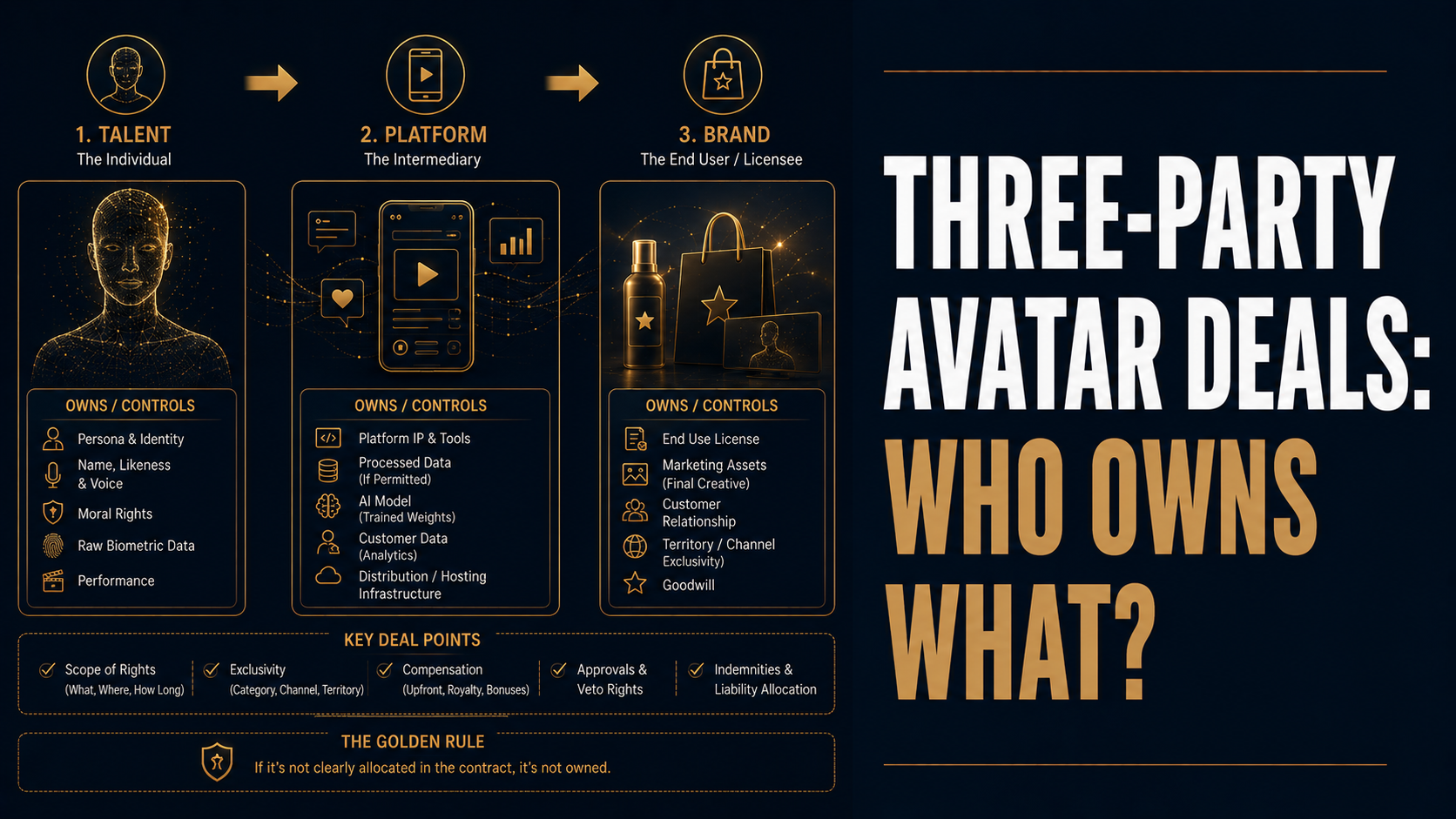
In AI avatar deals, three parties hold overlapping rights — and none of them can act without the others. Understanding who grants permission to whom is the starting point for any compliant structure.
Most parties entering an AI avatar deal assume there is one agreement to negotiate. In practice, a compliant structure requires two: one between Talent and Platform (governing biometric data collection and the creation of the avatar model), and one between Platform and Brand (governing the sublicensed right to deploy that model in campaigns). If either agreement is missing, incomplete, or inconsistent with the other, the chain breaks — and all three parties face exposure simultaneously.
WCR Legal’s AI avatar licensing practice works with all three parties to structure agreements that align rights, allocate regulatory obligations, and build in the withdrawal and kill-switch mechanics that GDPR makes non-negotiable.
The Three-Party Rights Chain
Rights in an AI avatar deal flow in one direction and break in all directions. Each link in the chain is a separate legal instrument with separate regulatory requirements.
The first agreement is the foundation of the entire structure. Talent grants the Platform: (a) an IP license over their likeness for the purpose of creating an AI model; and (b) explicit GDPR Article 9(2)(a) written consent to collect, process, and retain the biometric data required to build that model. This agreement also establishes the revenue share for downstream deployments and defines the Permitted Purposes that constrain everything the Platform can sublicense downstream.
The second agreement sublicenses to Brand the right to deploy Avatar Content within the scope Talent originally consented to. The Platform cannot grant more rights than it holds — a sublicense cannot exceed the upstream consent. This agreement must also flow down the withdrawal mechanism: if Talent withdraws consent from Platform, Brand must receive notice and must cease deployment on its own channels within the contractually defined window, independently of any instruction from Platform.
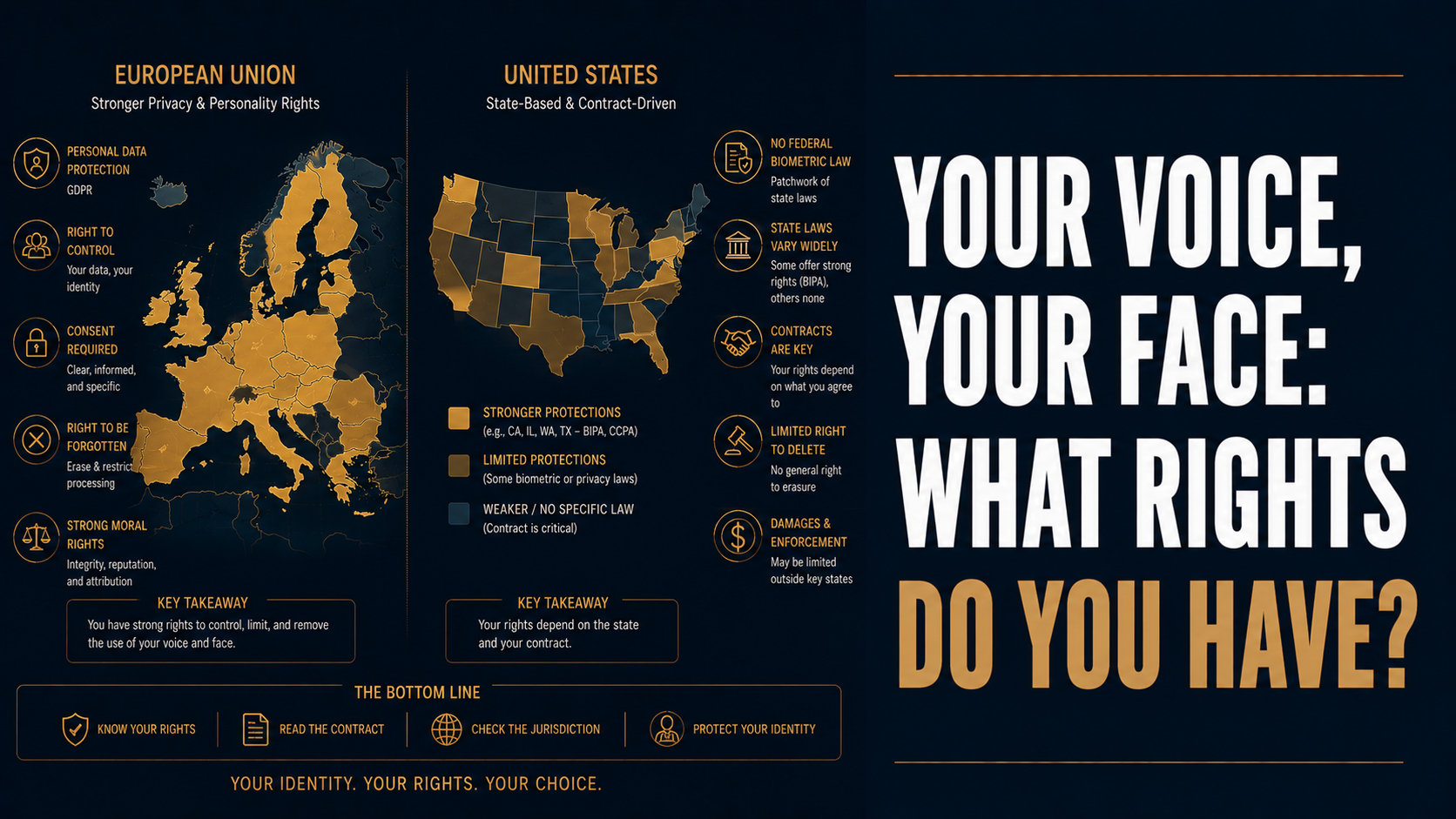
No matter what Agreement 1 says, Talent cannot assign, waive, or contract out of the GDPR right to withdraw consent under Article 7(3). This right is personal to Talent and operates independently of any commercial arrangement. A clause purporting to make withdrawal irrevocable, conditional on completion of campaign obligations, or transferable to the Platform’s discretion is void. The practical consequence: the entire rights chain is permanently subject to Talent’s unilateral termination right. Platform and Brand must design their infrastructure and contract terms around this structural feature — not against it.
Rights Chain Diagram: Click Each Party to See Their Obligations
Select a party to view their specific rights, obligations, and what they cannot waive or transfer in the three-party structure.
What Breaks the Chain
Each scenario represents a structural break that exposes all three parties simultaneously — even those not directly responsible for the break.
Platform’s Agreement 1 with Talent covers use for beauty campaigns in the EU only. Agreement 2 with Brand permits use globally and in automotive advertising. Brand deploys Avatar Content in automotive campaigns in the US — a use Talent never consented to and a market Talent excluded.
Agreement 2 lists three approved platforms. Brand’s media team independently deploys Avatar Content on a fourth platform not in Schedule B — without seeking approval. The deployment includes a social media channel that Talent has publicly stated conflicts with their values (Schedule F approval rights).
Talent sends withdrawal notice to Platform’s DPO. Platform’s internal process delays forwarding the notice to Brand by 5 days. Brand continues distributing live Avatar Content campaigns during those 5 days without knowledge of the withdrawal — including new impressions on platforms listed in Agreement 2.
Agreement 2 is silent on Art. 50 EU AI Act compliance. Post-August 2026, Brand deploys Avatar Content in EU-accessible campaigns without machine-readable watermarks or end-user disclosure. Platform claims it is the “provider” and its system watermarks content. Brand claims Platform is responsible. Neither party has confirmed technical implementation or contractual allocation.
Pre-Signing Checklist for Each Party
Tick each item your party has confirmed before signing into the three-party structure.
FAQ: Three-Party Avatar Licensing
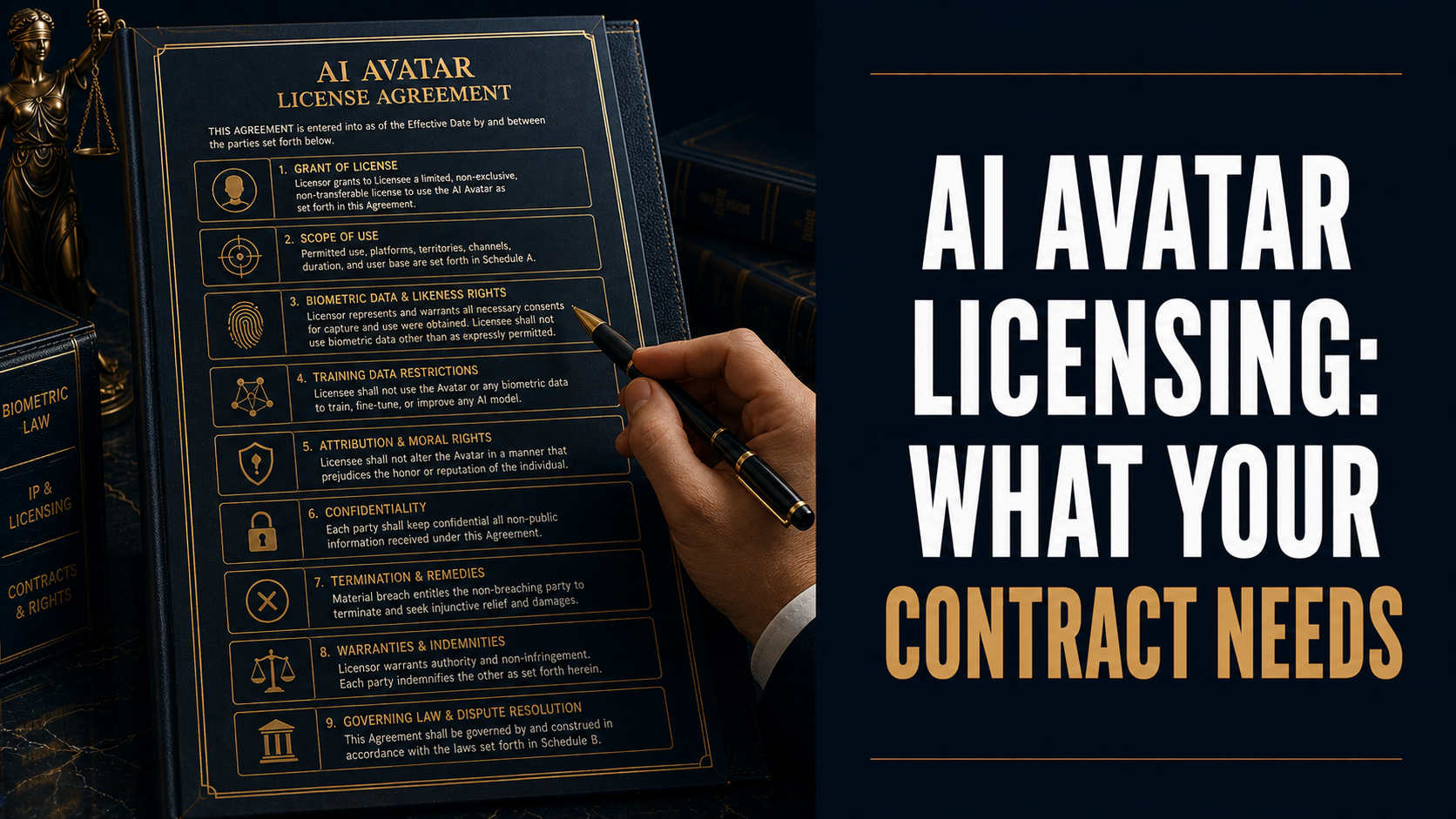
A tripartite contract can work if structured carefully. The critical constraint is that the GDPR Art. 9(2)(a) consent mechanism must function as a standalone consent instrument — specific, informed, freely given, and unambiguous — not as a clause embedded in a commercial agreement where it is obscured by commercial terms. If using a single tripartite document, the consent provisions must be clearly severable: if the commercial terms are disputed or the agreement is terminated, the consent should not automatically fail with it. In practice, most compliant structures use two agreements because the Talent-Platform relationship (governing biometric data processing) has fundamentally different regulatory requirements from the Platform-Brand relationship (governing commercial sublicensing). See our full guide on the AI avatar licensing agreement checklist for the 10 clauses both documents need.
No. GDPR Article 7(3) makes the withdrawal right personal to the data subject — in this structure, Talent. It cannot be assigned to any third party, including the Platform. The Platform can act as Talent’s agent for the purpose of receiving and forwarding withdrawal notices, but it cannot hold the right on Talent’s behalf or make withdrawal decisions for Talent. Any contractual provision purporting to transfer the withdrawal decision to Platform is void. What Talent can agree to is a defined notice procedure — who receives the notice, in what form, and what technical sequence is triggered. This is procedural structuring, not waiver or assignment. See our detailed analysis of GDPR withdrawal in avatar agreements.
The EU AI Act distinguishes between “providers” (who develop or place the AI system on the market) and “deployers” (who put the AI system into use in a professional context). In a typical three-party avatar structure, Platform is the provider — it developed the avatar model and the system generating Avatar Content. Brand is the deployer — it takes the AI-generated Avatar Content and distributes it to end users as part of a commercial campaign. Under Art. 50, the deployer (Brand) bears the obligation to ensure end users are clearly informed that the content is AI-generated. Platform, as provider, must ensure the system supports the technical watermarking capability required by Art. 50. Both obligations must be explicitly allocated in Agreement 2 — silence creates joint regulatory exposure. Full analysis is in our EU AI Act August 2026 deadline guide.
Brand’s remedies depend entirely on what Agreement 2 says. A well-structured Agreement 2 should include: (a) Platform’s representation that Talent’s consent is valid and in force as of execution; (b) Platform’s obligation to indemnify Brand for costs directly resulting from withdrawal that Platform failed to prevent through its own Agreement 1 obligations; and (c) a contractual mechanism for refund or credit of unused campaign spend if withdrawal occurs before campaign completion. What Agreement 2 cannot do is shift Brand’s own GDPR regulatory obligations onto Platform — Brand’s duty to halt distribution upon withdrawal is assigned by regulation, not by contract. Even with a strong indemnity, Brand faces independent regulatory liability if it continues distributing after withdrawal notice. For influencer-specific structures, see our guide on influencer AI avatar contracts.
No. The sublicense Platform grants to Brand in Agreement 2 is limited by what Talent consented to in Agreement 1 — this is the nemo dat principle applied to both IP and data processing law. If Brand wants to deploy on additional platforms, in additional territories, for additional product categories, or after the original term expires, Platform must first return to Talent and obtain an amendment to Agreement 1 with fresh, specific consent covering the new scope. Only once that upstream consent is secured can Platform execute a corresponding amendment to Agreement 2. Platforms that shortcut this process — expanding Agreement 2 scope on the assumption Talent will agree retroactively — expose Brand to retroactive GDPR consent violations and expose themselves to breach of Agreement 1. The integrity of the two-agreement structure depends on maintaining this sequence.
WCR Legal advises Talent, Platforms, and Brands on compliant three-party avatar licensing — from consent mechanics to withdrawal flow-down and EU AI Act allocation.

Post Comment