Biometric Training Data as M&A Liability: How to Price the Risk in Avatar Acquisitions | WCR Legal

Biometric Training Data as M&A Liability: How to Price the Risk in Avatar Company Acquisitions

AI Law • Biometric Privacy • M&A Due Diligence

Biometric Training Data as M&A Liability:
How to Price the Risk in Avatar Company Acquisitions

The AI avatar model you are acquiring was trained on biometric data. Whether that data was lawfully collected, from whom, and under what consent framework determines whether the model is an asset or a contingent liability.

$50B+ Identity Fraud Market 2025 Deepfake Fraud +58% YoY Gig Biometric Markets = New Liability Vector 5 Training Data Risk Profiles BIPA + GDPR + Copyright Simultaneously
Contents 6 Sections
1
Why Biometric Training Data Is an M&A Issue
3 mechanics of inherited liability
2
Risk by Training Data Source
5 source profiles · interactive selector
3
How to Structure the Deal
4 deal mechanism options
4
Biometric Data DD Checklist
6-point pre-close protocol
5
FAQ
5 questions PE/VC counsel ask
6
Related Resources
Avatar DD · BIPA · Training data

When a PE fund or strategic acquirer targets an AI avatar company, the core asset is the generative model — the system that synthesizes photorealistic faces, voice clones, and digital likenesses. What the model can do determines the valuation. But how the model was trained determines the liability.

Avatar models require vast quantities of biometric training data: face images, voice recordings, geometric landmark sequences, and body motion data. The sourcing of that data — from gig marketplaces, public internet scraping, proprietary collection, or synthetic generation — creates legal exposure that persists inside the trained model long after the original data is deleted. WCR Legal’s AI Avatar Due Diligence practice treats training data provenance as a primary DD workstream, not a compliance footnote.

The Gig Biometric Market Problem
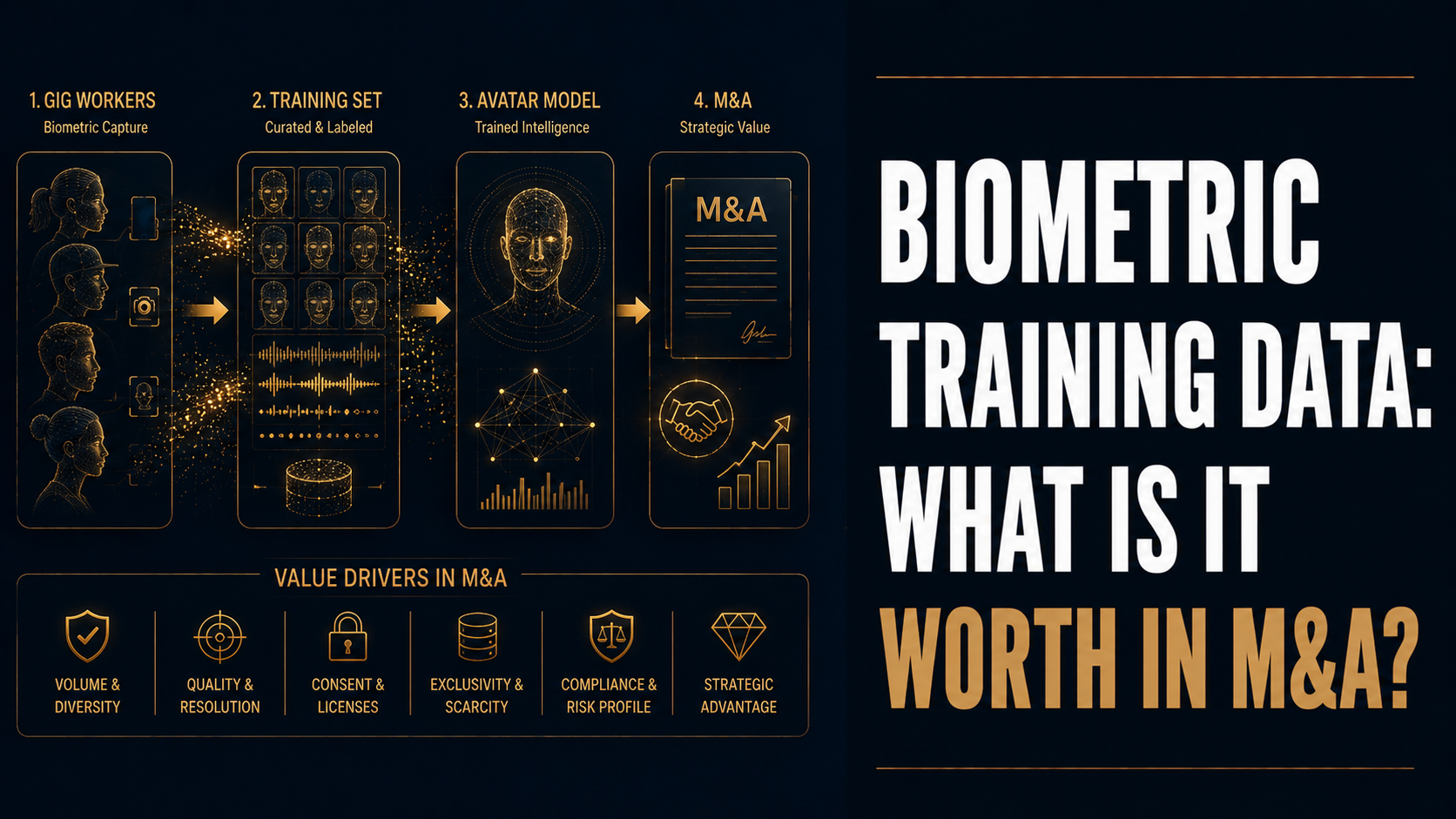
Platforms like Amazon Mechanical Turk, Scale AI, Appen, and Prolific allow avatar companies to rapidly acquire large volumes of face scans and voice recordings from paid gig workers. The typical gig contract grants the platform a broad, irrevocable license to the biometric data. What most gig contracts do not include: BIPA-compliant written notice, a stated retention period, a public destruction policy, or GDPR Art. 9 explicit consent for special category data. An avatar model trained entirely on gig marketplace biometric data may have a clean IP chain and a legally defective consent chain — simultaneously.
Section 01

Why Biometric Training Data Is Now an M&A Issue

Three legal mechanics transform biometric training data from a historical data governance question into an active deal liability. Each operates independently and can affect deal price even when the others are managed.

Three Liability Mechanics
Each independently affects deal structure and valuation
3 Vectors
1
Gig Worker Biometric Markets Sell Identity Under Irrevocable Licenses
Primary Vector

Gig marketplace contracts typically grant the commissioning platform a perpetual, irrevocable, worldwide license to use the contributor’s biometric data for “any purpose.” This IP-law mechanism resolves copyright and intellectual property questions about the training data. It does not resolve BIPA. A gig worker who consented via a marketplace contract to the irrevocable commercial use of their face geometry did not, by that consent, provide BIPA-compliant written notice and release under 740 ILCS 14/15(b) if the contract lacks the required BIPA elements. The platform holds an IP license to data it collected without biometric privacy law compliance — a structurally contradictory position that many acquirers only discover post-close.

IP license from gig worker ≠ BIPA consent. Two different legal instruments, two different requirements
If gig worker was an Illinois resident at time of collection: BIPA exposure applies regardless of marketplace platform’s location
Marketplace’s own consent mechanism may or may not satisfy BIPA — must be reviewed on a contract-by-contract basis
2
Biometric Data Is Practically Impossible to Anonymize From a Trained Model
Structural Risk

Unlike text training data, biometric data used to train a generative avatar model cannot be meaningfully anonymized post-training. The model’s generative capability is derived from the statistical encoding of real face geometries and voice patterns. Research in model inversion and membership inference attacks has demonstrated that biometric attributes of training data contributors can be extracted from trained models with varying degrees of fidelity. This means: deleting the training dataset does not delete the legal exposure. An acquirer who requests pre-close deletion of biometric training data as a remediation measure may reduce ongoing storage violations but retains a model that encodes the biometric attributes of unconsented contributors.

Model inversion attacks can partially reconstruct training data biometrics from generative models
“Delete the training data” as a pre-close condition addresses storage liability only, not the trained model itself
If the model is the primary asset, the acquirer must price the model’s training data provenance into the valuation — there is no structural cure that preserves the model intact
3
Acquirers Inherit Liability for the Predecessor’s Biometric Collection
Successor Liability

In an asset acquisition, the general rule is that buyers do not inherit seller liabilities. Biometric data liability is a significant exception. Courts applying BIPA have found that an acquirer who continues to use a trained model built on unlawfully collected biometric data is an active participant in the ongoing violation, not merely a passive successor. Under GDPR, the acquirer steps into the role of data controller for any biometric data that transfers with the asset — including the encoded attributes in the model. Structuring a transaction as an asset deal does not insulate the acquirer from biometric claims arising from the training dataset.

Asset deal structure does not break the chain of BIPA liability if the trained model transfers
Under GDPR, the acquiring entity becomes data controller for all biometric data that transfers — including model-encoded attributes
Indemnification from seller may cover pre-close claims but does not prevent the class action from naming the acquirer
Section 02

Risk by Training Data Source

Select the training data source that best describes the target platform’s model. Each profile carries a distinct risk classification and DD protocol. Most avatar platforms use multiple sources — apply the highest applicable risk profile.

Training Data Source Risk Profile
Select a source to view risk classification, DD checklist, and deal structure guidance
Interactive
Proprietary
CollectedLow Risk
Gig
MarketplaceMed–High
Internet
ScrapingHigh Risk
Synthetic
GeneratedLow Risk
Licensed
Third-PartyMedium
Low Risk
Proprietary Collected — Consent-Based User Data

The platform collected biometric training data directly from its own users through a product feature (e.g., users uploading their own face photos or voice recordings to create personal avatars). If proper BIPA and GDPR consent was obtained at the time of collection, and that consent covers training use, this is the lowest-risk sourcing profile. The primary DD question is whether the consent documentation is verifiable and whether it actually covers training as a stated purpose — not just avatar generation.

DD Checklist
Confirm consent instrument is separate from ToS and predates first biometric capture
Verify consent explicitly names model training as a collection purpose
Confirm historical consent records are retrievable for the Illinois user cohort
Check GDPR ROPA includes biometric data with Art. 9 lawful basis
Deal Structure
Standard reps & warranties covering biometric compliance
Consent records to be delivered as a closing deliverable
Standard indemnification basket and survival period applicable
If consent records are incomplete: treat as Gig Marketplace profile
Medium–High Risk
Gig Marketplace — Mechanical Turk, Scale AI, Appen, Prolific

The platform sourced biometric training data from gig workers via a data labeling marketplace. Workers provided face images, voice recordings, or motion capture data under a marketplace contract. The marketplace granted the platform a commercial license to the data. The critical DD question: did the marketplace contract, or the platform’s own supplemental consent, satisfy BIPA Section 15(b) requirements for written notice and release for every Illinois-resident contributor? Most marketplace contracts from before 2023 did not. GDPR compliance depends on whether EU contributors were provided with explicit Art. 9 consent for special category data processing.

DD Checklist
Obtain and review gig marketplace contracts for BIPA-compliant consent language
Confirm whether Illinois-resident contributors were identified and consent was state-specific
Quantify Illinois gig worker exposure — number of IL-resident contributors × per-scan potential
Check if marketplace indemnified the platform for biometric consent deficiencies
Deal Structure
Dedicated biometric training data escrow sized to quantified Illinois exposure
Seller BIPA indemnification for pre-closing gig data violations
Specific rep: seller warrants gig contracts satisfy applicable biometric privacy law
R&W insurance: confirm whether gig biometric exposure is excluded or covered
High Risk
Public Internet Scraping — Images, Videos, Social Media

The platform trained its biometric model on publicly available images and videos scraped from the internet without individual consent. This is the training data methodology that generated the Clearview AI ($51.75M) and Meta ($650M) BIPA settlements. Public availability of a biometric image does not constitute consent under BIPA, GDPR, or copyright law. A scraping-sourced model carries simultaneous BIPA class action exposure, GDPR enforcement risk, and copyright infringement exposure under recent US and EU AI copyright rulings. This is the highest-risk profile and may constitute a deal-level issue for many acquirers.

DD Checklist
Determine what percentage of training data was scraped vs consent-based
Identify sources: social media platforms, public image databases, video platforms
Assess Illinois-resident exposure: estimate based on source platform demographics
Check for existing demand letters, litigation, or regulator inquiries
Deal Structure
Material valuation reduction or potential deal-killer depending on scraping volume
Uncapped or super-cap BIPA indemnification from seller
Consider pre-close model retraining on clean dataset as condition to close
R&W insurance will not cover known scraping-based BIPA exposure
Low Risk
Synthetic Generated — AI-Generated Training Data

The platform used synthetically generated biometric data (AI-generated faces and voices, not real people) to train or fine-tune its model. This is the lowest-risk sourcing profile from a biometric privacy perspective: no real individuals’ biometric identifiers were collected, so BIPA and GDPR biometric consent requirements do not directly apply. The primary DD questions shift to: (1) what model was used to generate the synthetic data, and was that model trained on real biometric data; (2) does the synthetic data generation method introduce copyright issues from the generative model used; and (3) are any real biometric samples in the training mix alongside the synthetic data.

DD Checklist
Confirm the generative model used to create synthetic training data is itself clean
Verify no real biometric samples are mixed into the synthetic training set
Check IP licensing terms of the generative model used for synthesis
Confirm no synthetic data is derived from specific real individuals’ likenesses
Deal Structure
Standard biometric reps and warranties with no enhanced BIPA escrow required
Rep confirming 100% synthetic sourcing and no real biometric mixing
IP chain review for the synthetic data generation tool remains applicable
If source model is unknown: treat as mixed profile pending investigation
Medium Risk
Licensed Third-Party — Commercial Biometric Data Providers

The platform licensed biometric training data from a commercial data provider or research institution. The license agreement grants rights to use the dataset for training purposes. The risk profile depends on: (1) whether the original data provider collected biometrics with BIPA-compliant consent from all contributors; (2) whether the license survives a change of control; and (3) whether the data was collected before the provider implemented biometric compliance frameworks. Established academic datasets (e.g., LFW, VGGFace2) are particularly high-risk, as their original collection predates modern biometric privacy law and lacked adequate consent for commercial use.

DD Checklist
Review license agreement: confirm it covers training use and survives change of control
Request data provider’s consent documentation and collection methodology
Flag any academic or pre-2020 datasets: most lack BIPA-compliant consent
Confirm whether the license agreement contains provider indemnification for consent deficiencies
Deal Structure
Change-of-control review required: confirm license transfers to acquirer without consent
Seller rep: data provider’s consent framework satisfies applicable biometric privacy law
Pass-through indemnification from provider to acquirer, if negotiable
Academic dataset exposure: treat as Scraping profile for valuation purposes
Section 03

How to Structure the Deal Around Biometric Liability

Biometric training data liability is quantifiable, and quantifiable liabilities can be priced. Four deal mechanisms address the exposure depending on its character, scale, and certainty. They are not mutually exclusive — most transactions with material exposure use two or three in combination.

1
Purchase Price Reduction
For Measurable Risk
Where the biometric training data exposure is quantifiable — known Illinois user base, identifiable unconsented scan events, determinable per-violation exposure range — the cleanest solution is a direct purchase price reduction reflecting the net present value of the maximum exposure. The acquirer pays less for a model with tainted training data. The seller absorbs the discount as the party best positioned to have avoided the liability.
When to Use
Scraping-sourced or gig-sourced models with a calculable Illinois user base and a definable exposure range. Works best where the parties agree on the exposure quantum and do not need to preserve deal price optically.
Limitation
Does not protect the acquirer from class actions filed post-close. The liability still attaches to the combined entity — the price reduction compensates for it but does not eliminate it.
2
Biometric-Specific Escrow
For Contingent Claims
A dedicated escrow, separate from the general indemnification holdback, sized against the quantified biometric exposure range. The escrow is released to the acquirer upon settlement or final judgment of any biometric class action filed within the survival period, or released to the seller if no claim is filed by the escrow release date. The escrow amount is calibrated using both the per-scan (Cothron) and aggregate (SB 2909) models as a range.
When to Use
Where the exposure is material but uncertain — possible but not certain class action exposure, active demand letters, or litigation that has not yet been filed. The escrow allows the deal to close while protecting the acquirer against the contingent liability materializing.
Limitation
Escrow must be sized conservatively (maximum exposure, not expected outcome) to function as adequate protection. Sellers typically resist escrow amounts that reflect full per-scan Cothron exposure — the negotiation range becomes the SPA’s most contested element.
3
BIPA Indemnification from Seller
For Pre-Closing Violations
A specific indemnification provision covering BIPA and biometric privacy law claims arising from training data collected before the closing date. Unlike the general indemnification basket, the biometric indemnification: (1) is carved out from the general cap; (2) has an extended survival period matching the Illinois statute of limitations (5 years); (3) covers both direct claims and third-party class actions; and (4) applies regardless of whether the acquirer knew of the exposure at closing.
When to Use
When the parties cannot agree on a price reduction or escrow quantum, or when the exposure is difficult to quantify pre-close. The indemnification shifts risk to the seller without requiring a specific dollar adjustment to the purchase price at signing.
Limitation
Only as good as the seller’s financial ability to honor it. For transactions involving a founder-led target being fully acquired, seller indemnification may be the primary post-close protection — but the seller will have limited resources post-close if a large class action materializes.
4
Reps & Warranties Insurance
For Strategic Transactions
R&W insurance backstops the seller’s representations and warranties, allowing the acquirer to make claims against an insurer rather than the seller post-close. For biometric training data exposure, R&W insurance is available but subject to significant underwriting scrutiny. Carriers have become increasingly sophisticated about biometric data exclusions. Known BIPA exposure — exposure identified during DD — will be excluded. R&W insurance is most useful for residual unknown exposure, not for quantified training data risk identified in the data room.
When to Use
Strategic acquisitions where the deal price is too high for a material escrow holdback to be practical, or where the seller insists on a clean exit. Works best combined with Option 3 for known exposure and insuring against unknown biometric violations not surfaced in DD.
Limitation
Known biometric violations identified in DD are excluded from coverage. Do not rely on R&W insurance as a substitute for biometric DD — if the data room reveals training data issues and you close anyway, those issues are excluded from the policy.
Section 04

Biometric Data DD Checklist

Six pre-close steps for M&A counsel reviewing an AI avatar company’s biometric training data. Run in parallel with general legal and technical DD during the data room phase.

Biometric Training Data Due Diligence
Click to mark complete · 6 steps
0 / 6
Training Data Provenance
Map Every Training Data Source — Proprietary / Gig / Scraped / Synthetic / Licensed
Request a complete inventory of biometric training data sources used to build or fine-tune the target’s generative model. For each source: identify data type (face geometry, voiceprint, motion capture), collection period, volume, and geographic distribution of contributors. Assign each source to a risk profile before proceeding to consent review.
Critical
Review Gig Marketplace Contracts for BIPA-Compliant Consent Language
Obtain and review every gig platform contract under which biometric data was collected. Confirm: (a) consent was obtained before first biometric capture; (b) consent is separate from general ToS; (c) consent states the specific purpose and retention period; (d) consent was obtained from Illinois-resident contributors under BIPA Section 15(b) standards. Contracts from pre-2023 vintage are presumptively deficient until proven otherwise.
Critical
Model Training Consent
Confirm Training-Specific Consent Covers Every Data Source Used in Model Training
Verify that each biometric data source in the training pipeline is covered by consent that explicitly authorizes model training use, not only avatar generation or service delivery. A consent instrument that covers “creating your digital avatar” does not automatically cover using the contributor’s biometric data to train a commercial generative model. See the consent chain audit framework for Link 3 analysis.
Critical
Quantify Illinois Exposure — Model Both Per-Scan and Aggregate Scenarios
Estimate the number of Illinois-resident biometric data contributors whose data was used in training. Multiply by estimated scan frequency where applicable. Calculate maximum exposure under Cothron (per-scan, $1,000–$5,000 per violation) and SB 2909 aggregate (one recovery per plaintiff) models. Present as a low-high range. This number should appear in the financial model and inform escrow sizing and purchase price adjustment discussions.
High Priority
Change of Control & Litigation
Review All Third-Party Data Licenses for Change-of-Control Provisions
For every licensed biometric dataset, confirm that the license: (a) survives the acquisition without requiring licensor consent; (b) permits use by the acquirer entity post-close; and (c) grants rights to continue using the trained model built on the licensed data. A license that terminates upon change of control can invalidate the acquirer’s right to operate the core model post-close — a value-destroying post-close discovery.
High Priority
Search for Pending and Threatened Biometric Claims Related to Training Data
Search PACER and relevant state court dockets for any BIPA or biometric privacy claims naming the target or related entities. Request seller disclosure of all demand letters, regulatory inquiries, or threatened litigation relating to biometric data collection or model training. Confirm R&W insurance availability and whether known training data exposure is excluded from coverage.
Required
Know what the model was trained on before you price the deal. WCR Legal’s biometric training data audit maps every sourcing decision against BIPA and GDPR requirements, quantifies the exposure, and recommends deal structure adjustments — in 7–14 days.
Request Training Data Audit ›
Frequently Asked Questions
Biometric Training Data in Avatar Company M&A
1
Can the acquirer avoid BIPA liability by structuring the transaction as an asset purchase rather than a stock deal?
+

Not reliably. The general asset purchase rule — that buyers do not assume seller liabilities — has been significantly eroded for biometric data claims. Courts applying BIPA have found that an acquirer who continues to deploy a trained model built on unlawfully collected biometric data is actively participating in the ongoing violation, not passively inheriting a past one. Under GDPR, the acquirer becomes the data controller for any biometric data that transfers with the asset. Additionally, plaintiffs’ counsel routinely name successor entities in class actions, and courts have shown willingness to allow those claims to proceed even in asset deals. An asset purchase structure reduces exposure at the margins but does not provide a complete liability shield.

2
If the target deletes all biometric training data before closing, does that resolve the liability?
+

No. Deletion of the raw training dataset addresses ongoing storage violations under BIPA Section 15(a) and GDPR Art. 5(1)(e) storage limitation. It does not eliminate claims for the historical period of unlawful collection or transmission. More importantly, the trained model encodes statistical representations of the biometric attributes of the training contributors. Research in model inversion demonstrates that these representations can be partially reconstructed. The model itself is, in a meaningful technical sense, derived from the biometric data of real individuals. Deploying the model post-close means deploying a product built on the contributors’ encoded biometric attributes — a fact that persists regardless of whether the underlying dataset is deleted.

3
How should an acquirer handle academic datasets (e.g., LFW, VGGFace2, MS-Celeb-1M) in the training pipeline?
+

Treat academic biometric datasets as equivalent to scraped internet data for M&A risk purposes. Datasets like LFW (Labeled Faces in the Wild), VGGFace2, and MS-Celeb-1M were assembled from public internet sources without individual consent, predate modern biometric privacy law, and have been the subject of removal requests and litigation by data subjects. MS-Celeb-1M was formally withdrawn by Microsoft following privacy concerns. Using any of these datasets in a commercial model’s training pipeline creates BIPA exposure for any Illinois-resident individuals whose images were included, and GDPR exposure for any EU-resident individuals. The commercial value of “pre-trained on a large public dataset” must be discounted against the inherited biometric liability from that dataset.

4
Does a gig worker’s execution of a marketplace contract constitute valid BIPA consent?
+

It depends entirely on the content of the specific contract and the jurisdiction of the gig worker. A marketplace contract that: (a) separately identifies biometric collection (distinct from general intellectual property assignment); (b) specifies the purpose of biometric use; (c) states a retention period; and (d) was signed before the first biometric capture event — may constitute a valid BIPA written release. Most marketplace contracts written before 2022 do not satisfy these requirements. The burden of proof in BIPA litigation is on the defendant to demonstrate that a compliant written consent was obtained. For M&A purposes, assume that gig marketplace contracts are deficient until a contract-by-contract review confirms otherwise.

5
What is the realistic exposure range for an avatar company with 50,000 gig-collected face scans from unverified Illinois residents?
+

Using a conservative Illinois demographic estimate (approximately 4% of US population is Illinois-resident), 50,000 total gig contributors yields approximately 2,000 potential Illinois-resident contributors. Under the SB 2909 aggregate model (one recovery per plaintiff): 2,000 claimants × $1,000–$5,000 = $2M–$10M exposure. Under the pre-amendment Cothron per-scan model (applicable to cases filed before the retroactivity question is resolved): if each contributor’s face geometry was scanned an average of 5 times during onboarding and data collection: 2,000 × 5 scans × $1,000–$5,000 = $10M–$50M exposure. For a $30M–$50M avatar company acquisition, this exposure range is material and should drive escrow sizing, price adjustment, and indemnification structure.

WCR Legal — Biometric Training Data Audit
The Model Is the Asset.
The Training Data Is the Liability.

WCR Legal audits biometric training data provenance, maps consent gaps across all sourcing channels, quantifies exposure under BIPA and GDPR, and recommends deal structure adjustments before you sign. Available for active M&A and investment transactions.

Oleg Prosin is the Managing Partner at WCR Legal, focusing on international business structuring, regulatory frameworks for FinTech companies, digital assets, and licensing regimes across various jurisdictions. Works with founders and investment firms on compliance, operating models, and cross-border expansion strategies.

Post Comment