Three-Party Avatar Licensing: How to Structure Rights Between Platform, Talent and Brand | WCR Legal

Three-Party Avatar Licensing: How to Structure Rights Between Platform, Talent and Brand

AI Law • Digital Likeness • Avatar Licensing

Three-Party Avatar Licensing:
How to Structure Rights Between Platform, Talent and Brand

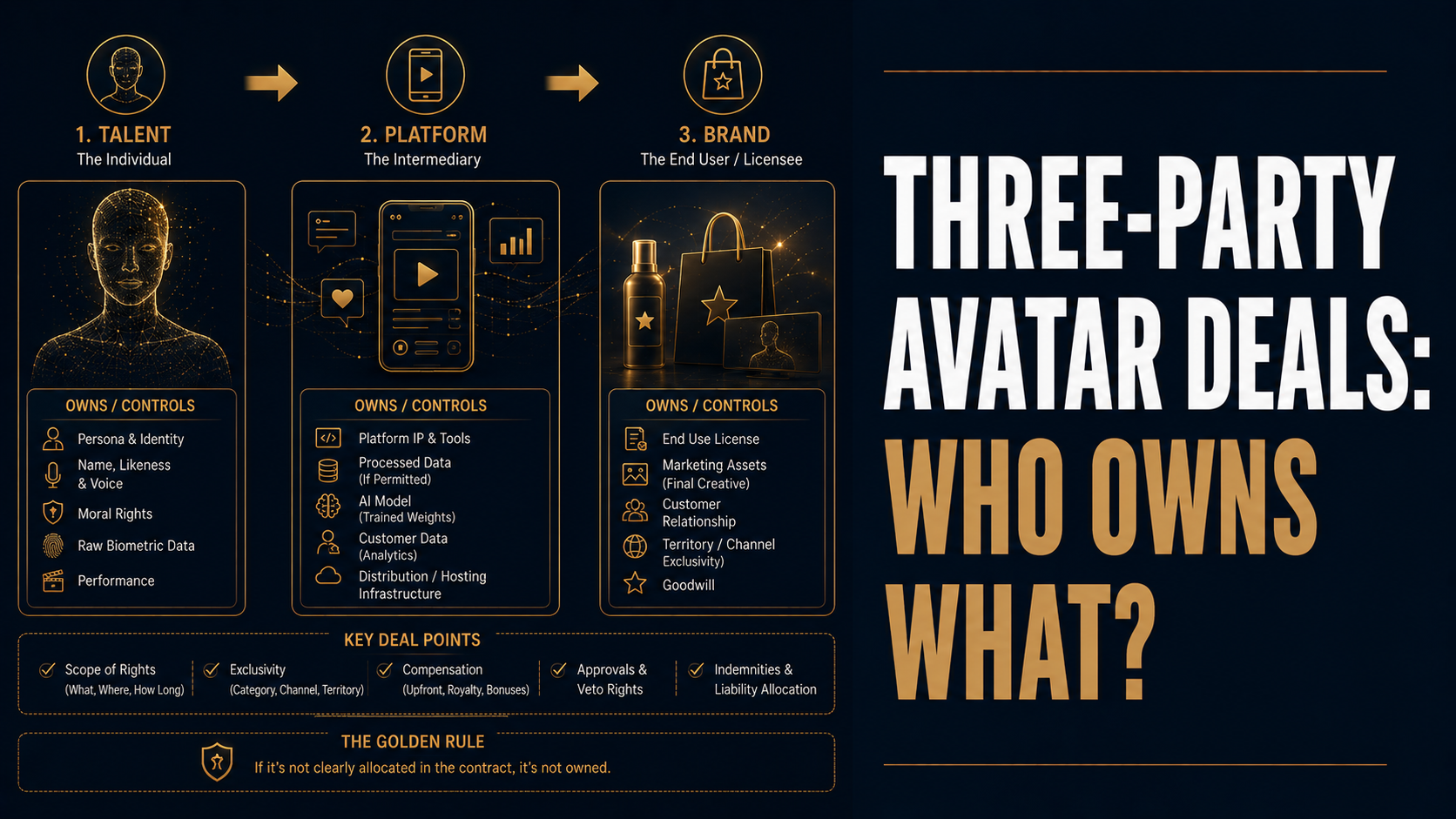
In AI avatar deals, three parties hold overlapping rights — and none of them can act without the others. Understanding who grants permission to whom is the starting point for any compliant structure.

3 Parties 2 Separate Agreements 1 Break = All Exposed GDPR Non-Waivable Rights EU AI Act Deployer Status
Contents 6 Sections
1
The Three-Party Rights Chain
How rights flow · what never transfers
2
Rights Chain Diagram
Interactive · click each party
3
What Breaks the Chain
4 chain-break scenarios
4
Checklist per Party
Talent · Platform · Brand
5
FAQ
5 structuring questions
6
Related Resources
Licensing · GDPR · Agreements

Most parties entering an AI avatar deal assume there is one agreement to negotiate. In practice, a compliant structure requires two: one between Talent and Platform (governing biometric data collection and the creation of the avatar model), and one between Platform and Brand (governing the sublicensed right to deploy that model in campaigns). If either agreement is missing, incomplete, or inconsistent with the other, the chain breaks — and all three parties face exposure simultaneously.

WCR Legal’s AI avatar licensing practice works with all three parties to structure agreements that align rights, allocate regulatory obligations, and build in the withdrawal and kill-switch mechanics that GDPR makes non-negotiable.

The Core Misunderstanding
Brands frequently assume that if the Platform says “we have all necessary rights,” their own exposure is covered. It is not. The Brand’s EU AI Act deployer obligations and GDPR withdrawal obligations are independent of the Platform’s representations. If Talent withdraws consent and the Brand continues distributing Avatar Content, the Brand is liable — regardless of what the Platform’s contract says.
Section 01

The Three-Party Rights Chain

Rights in an AI avatar deal flow in one direction and break in all directions. Each link in the chain is a separate legal instrument with separate regulatory requirements.

Two Agreements — Three Parties — One Chain
Talent → Platform Agreement / Platform → Brand Agreement
Rights Flow
1
Talent → Platform: Consent to Create + Biometric Data Processing
Agreement 1 • Foundation

The first agreement is the foundation of the entire structure. Talent grants the Platform: (a) an IP license over their likeness for the purpose of creating an AI model; and (b) explicit GDPR Article 9(2)(a) written consent to collect, process, and retain the biometric data required to build that model. This agreement also establishes the revenue share for downstream deployments and defines the Permitted Purposes that constrain everything the Platform can sublicense downstream.

IP license to use likeness to build the avatar model — defined purpose, defined platforms, defined duration
GDPR Art. 9(2)(a) explicit consent for biometric data collection — cannot be bundled in general T&Cs
Revenue share mechanism for downstream brand licensing — typically percentage of sublicense fee per deployment
BIPA §15(b) written release if any Illinois-resident biometric collection is involved
2
Platform → Brand: Sublicense + Scope Restrictions + Withdrawal Flow-Down
Agreement 2 • Downstream Use

The second agreement sublicenses to Brand the right to deploy Avatar Content within the scope Talent originally consented to. The Platform cannot grant more rights than it holds — a sublicense cannot exceed the upstream consent. This agreement must also flow down the withdrawal mechanism: if Talent withdraws consent from Platform, Brand must receive notice and must cease deployment on its own channels within the contractually defined window, independently of any instruction from Platform.

Sublicense scope is capped at Talent’s consented Permitted Purposes — Brand cannot use Avatar Content for purposes Talent never authorised
Withdrawal mechanism must flow down: Brand receives notice from Platform and independently halts deployment within agreed timeline
Platform assigns EU AI Act Art. 50 deployer responsibility to Brand — Brand bears watermarking and end-user disclosure obligations from August 2026
Brand must verify consent chain before first deployment — Platform’s representations do not substitute for Brand’s own due diligence obligation
3
What Talent Never Assigns: The Non-Transferable GDPR Withdrawal Right
Absolute Right • GDPR Art. 7(3)

No matter what Agreement 1 says, Talent cannot assign, waive, or contract out of the GDPR right to withdraw consent under Article 7(3). This right is personal to Talent and operates independently of any commercial arrangement. A clause purporting to make withdrawal irrevocable, conditional on completion of campaign obligations, or transferable to the Platform’s discretion is void. The practical consequence: the entire rights chain is permanently subject to Talent’s unilateral termination right. Platform and Brand must design their infrastructure and contract terms around this structural feature — not against it.

GDPR Art. 7(3): withdrawal right is absolute and personal — cannot be waived, assigned, or conditioned
EU personality rights (France, Germany) and US right of publicity (CA, TN, IL) add independent non-waivable protections on top of GDPR
The notice procedure and implementation timelines are negotiable; the underlying right is not
Structural Note
Some platforms attempt to replace the two-agreement structure with a single tripartite agreement signed by all three parties. This can work, but requires care: the consent mechanism must still satisfy GDPR Art. 9(2)(a) as a standalone instrument, not a clause buried in a commercial contract. If the tripartite agreement is the consent vehicle, it must be structured so the consent provisions survive any termination of the commercial terms — otherwise, a commercial dispute can inadvertently void the consent that underpins the avatar model’s lawful existence.
Section 02

Rights Chain Diagram: Click Each Party to See Their Obligations

Select a party to view their specific rights, obligations, and what they cannot waive or transfer in the three-party structure.

Three-Party Rights Chain
Click a party to expand their obligations
Interactive
T
Talent
Biometric Source • Consent Owner
License & Consent
P
Platform
Data Controller • Model Operator
Sublicense
B
Brand
Deployer • End-User Publisher
Talent
Biometric Source — Consent Owner — Right of Withdrawal
Consent Scope
Specific biometric identifiers listed in Schedule A (face geometry, voiceprint, motion)
Purpose-limited to Permitted Uses — Platform cannot use model for purposes beyond this scope
Territory and duration defined — consent does not extend to additional markets without re-confirmation
All third-party recipients and processor categories disclosed at point of consent
GDPR Rights (Personal, Non-Transferable)
Art. 15 — Right of access: full record of biometric data held by Platform
Art. 17 — Right to erasure: raw data + trained model + cached Avatar Content
Art. 20 — Data portability: biometric data in machine-readable format on request
Art. 7(3) — Withdrawal: absolute, at any time, without condition or penalty
Personality Rights
EU moral rights (France Art. L121-1, Germany UrhG §12): inalienable right to object to distortion or damage to reputation
California Civil Code §3344: right of publicity for use of name/likeness in commercial contexts
Tennessee ELVIS Act (2024): protects AI-generated voice and likeness against unauthorised use
Revenue & Withdrawal Procedure
Entitled to revenue share on all downstream Brand deployments per Schedule E
Withdrawal notice: written to Platform DPO — initiates 24h / 72h / 30-day sequence
Entitled to certified destruction report within 30 days of withdrawal confirming model retirement
What Talent Never Assigns
The GDPR Art. 7(3) withdrawal right is personal and non-waivable. No contractual clause — in Agreement 1 or Agreement 2 — can transfer, condition, or extinguish this right. Any purported waiver is void. Personality rights under EU and US law are similarly non-transferable: Talent can license the commercial use of their likeness but cannot permanently alienate the underlying right.
Platform
Data Controller — Kill-Switch Operator — Sublicensor
Data Controller Obligations (GDPR)
Lawful basis under Art. 9(2)(a): must maintain and document Talent’s explicit consent
Data Processing Agreements (Art. 28) with every vendor in the processing chain
BIPA §15(a): publicly available written data retention and destruction policy
Data minimisation and purpose limitation — biometric data used only for Permitted Uses
Sublicensing Constraints
Cannot sublicense beyond Talent’s consented scope — nemo dat quod non habet
Must flow-down withdrawal mechanism to Brand in Agreement 2
Must notify Brand within 24 hours of receiving Talent’s withdrawal notice
Cannot expand sublicense scope in Agreement 2 without first obtaining fresh Talent consent in Agreement 1
Kill-Switch Operator
Technical infrastructure: must be able to halt Avatar Content generation within 24h of withdrawal
Distribution halt + downstream notification within 72h
Model retraining or retirement within 30 days to remove Talent’s biometric patterns
Certified destruction report to Talent within 30 days
EU AI Act Art. 50
Platform is typically the “provider” of the AI system under EU AI Act — must ensure the system supports watermarking capability
Must confirm to Brand which Art. 50 obligations are assigned to Platform vs Brand in Agreement 2
Implementation required from 2 August 2026 — must be operational before first Brand deployment after that date
What Platform Cannot Do
Platform cannot sublicense rights it does not hold. If Talent’s consent covers Platform A but Brand wants to deploy on Platform B, Platform must first obtain an amendment to Agreement 1 with fresh Talent consent before executing Agreement 2. Platform also cannot waive Talent’s withdrawal right on Talent’s behalf or prevent Talent from communicating a withdrawal notice directly to Brand.
Brand
Sublicensee — EU AI Act Deployer — End-User Publisher
Sublicense Verification
Must confirm Platform holds valid Talent consent covering Brand’s intended use, platforms, territory, and duration
Cannot deploy Avatar Content for purposes not in Talent’s original consented scope — Platform’s representation does not cure this
Should request consent audit trail from Platform before first deployment as due diligence
Must verify exclusivity terms — competing brands on same platform may create exclusivity breach
Withdrawal Response Obligations
Upon Platform notification of withdrawal: remove all Avatar Content from Brand-controlled channels within 72h
Obligation is independent — Brand cannot await Platform instruction to begin removal
Must notify own downstream distributors, media buying partners, and platforms within 72h
Delete all cached copies of Avatar Content from Brand’s own systems and CDN
EU AI Act Deployer Status
Brand is typically the “deployer” under EU AI Act — entity that puts AI-generated content into use for end users
Responsible for end-user disclosure that content is AI-generated (Art. 50) from August 2026
Must ensure watermarks are preserved and not stripped in distribution workflow
Cannot claim Platform’s Art. 50 compliance covers Brand’s own publishing obligations
Post-Campaign Obligations
Upon campaign end: remove all Avatar Content from active distribution within agreed window
Delete cached Avatar Content from Brand systems — not storage obligation but deployer obligation
Confirm removal to Platform in writing to trigger Platform’s certified destruction obligations to Talent
What Brand Cannot Assume
Brand cannot assume that Platform’s contractual representations fully insulate Brand from GDPR and EU AI Act exposure. Brand’s deployer and downstream publisher obligations are assigned by regulation, not by Agreement 2. A Brand that continues distributing Avatar Content after receiving a withdrawal notice — even briefly — is independently liable under GDPR Art. 17, regardless of the Platform’s indemnity provisions.
Section 03

What Breaks the Chain

Each scenario represents a structural break that exposes all three parties simultaneously — even those not directly responsible for the break.

1
Platform Sublicenses Beyond Talent’s Consent Scope
Consent Overflow

Platform’s Agreement 1 with Talent covers use for beauty campaigns in the EU only. Agreement 2 with Brand permits use globally and in automotive advertising. Brand deploys Avatar Content in automotive campaigns in the US — a use Talent never consented to and a market Talent excluded.

Exposure
Platform: breach of Agreement 1 + GDPR purpose limitation violation. Brand: tortious use of biometric data without valid consent basis + potential right of publicity claim. Talent: immediate right to withdraw from all uses and seek damages for unconsented deployment.
Structural Fix
Agreement 2 scope must be expressly capped at Agreement 1 scope. Any expansion requires Platform to first amend Agreement 1 with fresh Talent consent before executing an expanded Agreement 2.
2
Brand Deploys on Unapproved Platform or in Excluded Context
Platform Breach

Agreement 2 lists three approved platforms. Brand’s media team independently deploys Avatar Content on a fourth platform not in Schedule B — without seeking approval. The deployment includes a social media channel that Talent has publicly stated conflicts with their values (Schedule F approval rights).

Exposure
Brand: material breach of Agreement 2 + independent GDPR violation (processing for purpose beyond consented scope) + personality rights claim if deployment is reputationally damaging. Platform: potential liability to Talent for failing to enforce platform restrictions on Brand.
Structural Fix
Agreement 2 must include explicit prohibition on off-schedule deployment and a Brand obligation to obtain pre-approval for any new platform. Platform audit rights over Brand deployment are standard in compliant structures.
3
Talent Withdraws — Platform Fails to Notify Brand in Time
Kill-Switch Failure

Talent sends withdrawal notice to Platform’s DPO. Platform’s internal process delays forwarding the notice to Brand by 5 days. Brand continues distributing live Avatar Content campaigns during those 5 days without knowledge of the withdrawal — including new impressions on platforms listed in Agreement 2.

Exposure
Platform: breach of kill-switch notification obligation + GDPR Art. 17 violation for failing to initiate erasure chain. Brand: independent GDPR Art. 17 liability for continuing to distribute post-withdrawal, even absent Platform notice — Brand’s obligation to halt begins when it receives notice, not when it should have received it. Talent: full suite of remedies against both parties.
Structural Fix
Agreement 2 must give Talent a direct notification right to Brand as well as Platform. Talent should be able to notify Brand directly upon withdrawal, bypassing any Platform delay. Brand must treat direct Talent notice as equally valid to Platform notice.
4
EU AI Act Art. 50 Deployer Obligation Left Unassigned
Regulatory Gap

Agreement 2 is silent on Art. 50 EU AI Act compliance. Post-August 2026, Brand deploys Avatar Content in EU-accessible campaigns without machine-readable watermarks or end-user disclosure. Platform claims it is the “provider” and its system watermarks content. Brand claims Platform is responsible. Neither party has confirmed technical implementation or contractual allocation.

Exposure
Brand: Art. 50 violation as deployer — regulatory fines under EU AI Act enforcement regime. Platform: potential provider liability if the AI system does not support watermarking capability. Both: joint regulatory exposure where roles overlap. Talent: reputational exposure from non-disclosed AI content associated with their likeness.
Structural Fix
Agreement 2 must explicitly assign Art. 50 provider obligations to Platform (watermarking technical capability) and Art. 50 deployer obligations to Brand (end-user disclosure, watermark preservation in distribution). Both parties confirm implementation readiness before August 2026 campaigns.
Section 04

Pre-Signing Checklist for Each Party

Tick each item your party has confirmed before signing into the three-party structure.

Three-Party Readiness Checklist
Talent • Platform • Brand
0 / 12
Talent — Before Signing Agreement 1
Consent instrument is standalone — not buried in commercial terms — and lists specific biometric identifiers, purpose, duration, and all processor categories
GDPR Art. 9(2)(a) • BIPA §15(b)
Talent
GDPR withdrawal procedure confirmed in writing — including DPO contact, kill-switch timelines, and direct notification right to Brand
GDPR Art. 7(3) • Kill-switch: 24h / 72h / 30d
Critical
Revenue share mechanism covers all downstream Brand deployments — with audit rights over Platform’s sublicensing records
Schedule E • 3-year recordkeeping
Talent
Approval rights (Schedule F values statement) flow down to Brand through Agreement 2 — Brand cannot deploy in excluded contexts without Talent sign-off
Personality rights • Reputation protection
Talent
Platform — Before Signing Agreement 2
Agreement 2 scope is expressly capped at Agreement 1 scope — no downstream rights exceed what Talent consented to in Agreement 1
Nemo dat • Purpose limitation • GDPR Art. 5(1)(b)
Platform
Withdrawal flow-down confirmed in Agreement 2: Brand receives notification within 24h of Talent withdrawal and has independent obligation to halt deployment
Kill-switch • Art. 17 erasure chain
Critical
GDPR Art. 28 Data Processing Agreements signed with all vendors in the model training and deployment chain
Data controller obligations • BIPA §15(a) public policy
Platform
EU AI Act Art. 50 obligations allocated in Agreement 2: Platform confirms watermarking technical capability; Brand confirms end-user disclosure implementation
Art. 50 • August 2026 deadline
Platform
Brand — Before First Deployment
Consent audit trail requested from Platform: confirm Talent’s consent covers Brand’s intended platforms, territory, duration, and use category
Due diligence • Sublicense verification
Critical
Withdrawal response procedure established internally: Brand team knows who receives Platform notification, confirms 72h removal timeline, and notifies own distributors
GDPR Art. 17 • Independent Brand obligation
Critical
EU AI Act Art. 50 deployer obligations confirmed: Brand’s distribution workflow preserves watermarks and includes end-user AI disclosure from August 2026
Deployer status • Art. 50 implementation
Brand
Campaign scope confirmed against Schedule B (approved platforms) and Schedule F (talent values) — any new platform requires Platform pre-approval before deployment
Scope restriction • Platform approval gate
Brand
Structuring a three-party avatar deal? WCR Legal drafts and reviews all three layers — Agreement 1, Agreement 2, and the withdrawal mechanics that connect them.
Book a Structuring Consultation →
Section 05

FAQ: Three-Party Avatar Licensing

Frequently Asked Questions
Agencies, platforms, and brands on structuring avatar rights
1
Why are two separate agreements needed — can a single tripartite contract cover everything?

A tripartite contract can work if structured carefully. The critical constraint is that the GDPR Art. 9(2)(a) consent mechanism must function as a standalone consent instrument — specific, informed, freely given, and unambiguous — not as a clause embedded in a commercial agreement where it is obscured by commercial terms. If using a single tripartite document, the consent provisions must be clearly severable: if the commercial terms are disputed or the agreement is terminated, the consent should not automatically fail with it. In practice, most compliant structures use two agreements because the Talent-Platform relationship (governing biometric data processing) has fundamentally different regulatory requirements from the Platform-Brand relationship (governing commercial sublicensing). See our full guide on the AI avatar licensing agreement checklist for the 10 clauses both documents need.

2
Can Talent assign GDPR withdrawal rights to the Platform, so the Platform manages all consent decisions?

No. GDPR Article 7(3) makes the withdrawal right personal to the data subject — in this structure, Talent. It cannot be assigned to any third party, including the Platform. The Platform can act as Talent’s agent for the purpose of receiving and forwarding withdrawal notices, but it cannot hold the right on Talent’s behalf or make withdrawal decisions for Talent. Any contractual provision purporting to transfer the withdrawal decision to Platform is void. What Talent can agree to is a defined notice procedure — who receives the notice, in what form, and what technical sequence is triggered. This is procedural structuring, not waiver or assignment. See our detailed analysis of GDPR withdrawal in avatar agreements.

3
Who is the EU AI Act Art. 50 deployer in a three-party structure — Platform or Brand?

The EU AI Act distinguishes between “providers” (who develop or place the AI system on the market) and “deployers” (who put the AI system into use in a professional context). In a typical three-party avatar structure, Platform is the provider — it developed the avatar model and the system generating Avatar Content. Brand is the deployer — it takes the AI-generated Avatar Content and distributes it to end users as part of a commercial campaign. Under Art. 50, the deployer (Brand) bears the obligation to ensure end users are clearly informed that the content is AI-generated. Platform, as provider, must ensure the system supports the technical watermarking capability required by Art. 50. Both obligations must be explicitly allocated in Agreement 2 — silence creates joint regulatory exposure. Full analysis is in our EU AI Act August 2026 deadline guide.

4
What happens if Talent withdraws consent mid-campaign — does Brand have any remedy against Platform?

Brand’s remedies depend entirely on what Agreement 2 says. A well-structured Agreement 2 should include: (a) Platform’s representation that Talent’s consent is valid and in force as of execution; (b) Platform’s obligation to indemnify Brand for costs directly resulting from withdrawal that Platform failed to prevent through its own Agreement 1 obligations; and (c) a contractual mechanism for refund or credit of unused campaign spend if withdrawal occurs before campaign completion. What Agreement 2 cannot do is shift Brand’s own GDPR regulatory obligations onto Platform — Brand’s duty to halt distribution upon withdrawal is assigned by regulation, not by contract. Even with a strong indemnity, Brand faces independent regulatory liability if it continues distributing after withdrawal notice. For influencer-specific structures, see our guide on influencer AI avatar contracts.

5
Can Platform expand the sublicense to Brand without going back to Talent for fresh consent?

No. The sublicense Platform grants to Brand in Agreement 2 is limited by what Talent consented to in Agreement 1 — this is the nemo dat principle applied to both IP and data processing law. If Brand wants to deploy on additional platforms, in additional territories, for additional product categories, or after the original term expires, Platform must first return to Talent and obtain an amendment to Agreement 1 with fresh, specific consent covering the new scope. Only once that upstream consent is secured can Platform execute a corresponding amendment to Agreement 2. Platforms that shortcut this process — expanding Agreement 2 scope on the assumption Talent will agree retroactively — expose Brand to retroactive GDPR consent violations and expose themselves to breach of Agreement 1. The integrity of the two-agreement structure depends on maintaining this sequence.

WCR Legal • AI Law
Structure the Rights Chain Before the Deal Closes

WCR Legal advises Talent, Platforms, and Brands on compliant three-party avatar licensing — from consent mechanics to withdrawal flow-down and EU AI Act allocation.

Oleg Prosin is the Managing Partner at WCR Legal, focusing on international business structuring, regulatory frameworks for FinTech companies, digital assets, and licensing regimes across various jurisdictions. Works with founders and investment firms on compliance, operating models, and cross-border expansion strategies.

Post Comment