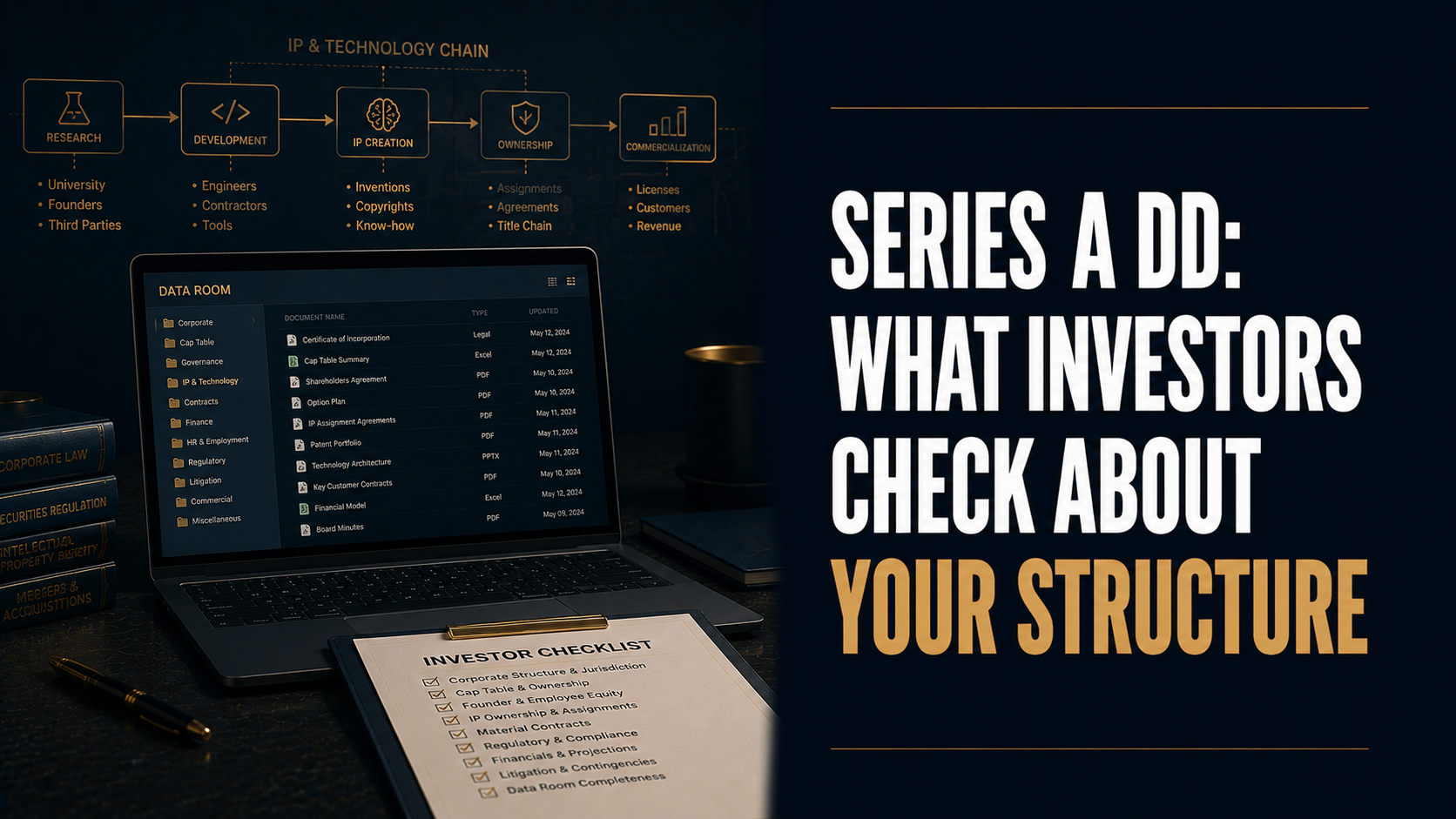
Series A Due Diligence: What Investors Check in AI Startups

What Do Investors Check About Your Corporate Structure at Series A?

AI Law · Investment Structuring

What Do Investors Check About Your Corporate Structure at Series A?

IP problems torpedo AI deals at the finish line. If you have a term sheet, legal DD has already started. This is what investors are looking for — and what kills deals after signing.

70–80% of AI company value = intangible assets IP problems = deal killers 10 DD checkpoints 4 investor review blocks 5 most common deal-breakers
In This Guide 6 Sections
1
Four Blocks Investors Review
Corporate · IP chain · AI licences · EU AI Act
2
Five Problems That Kill AI Deals
The most common deal-breakers after term sheet
3
Series A DD Readiness Checklist
10-item interactive assessment
4
FAQ
5 questions founders ask before DD
5
Related Guides
IP assignment · AI structuring · training data
6
Pre-DD Legal Review
Fix issues before investors find them

Seventy to eighty percent of the value in an AI company sits in intangible assets: the model weights, the training pipeline, the proprietary data, the brand, and the IP that makes the technology defensible. At Series A, sophisticated investors run legal due diligence specifically to verify that the company actually owns what it is selling. For AI startups, that inquiry has become deeper and more technically demanding than it was three years ago. Investors and their counsel now review AI structuring, IP chain integrity, training data provenance, and regulatory readiness as a single integrated exercise — not as separate boxes to tick.

The good news: every problem investors find in DD is a problem you could have fixed before they started looking. This guide maps what the legal review covers, identifies the five issues that most reliably kill AI deals after term sheet, and gives you a 10-item checklist to assess your own readiness before the data room opens.

Deal-Killer Warning
IP problems torpedo AI deals at the finish line. Unlicensed training data, missing founder IP assignments, and open-source licence violations are the three most common reasons investors kill a deal — or reprice it dramatically — after term sheet. These issues are fixable before DD. They are almost never fixable during it.
Section 1

Four Blocks Investors Review in Legal DD

Series A legal due diligence on an AI startup is not a standard corporate review. Investors’ counsel — and increasingly, dedicated AI legal specialists — work through four distinct blocks in a structured sequence.

Series A Legal DD Framework
What investor counsel reviews — in order of priority
4 Blocks
1
Corporate Structure
Block 1 — Corporate Housekeeping: Entity, Cap Table, and Organogram

Before reviewing any IP, investors verify that the corporate structure is clean and the company is organised to receive investment. Unexpected shareholders, undocumented share issuances, or unclear voting arrangements can make closing impossible regardless of how strong the technology is.

Incorporation: correct jurisdiction (typically Delaware or England & Wales for international investors), no dormant subsidiaries or phantom entities from earlier pivots
Cap table: fully diluted share register reconciled against all issue resolutions, SAFE notes, convertibles, and option pools — no “missing” shareholders
Organogram: group structure showing all entities, their jurisdictions, and the flow of IP ownership and licensing between them
Red flag: IP held by an entity that is not the investment target, or by a founder personally through a side entity
2
Highest Priority
Block 2 — IP Chain: Assignments from Founders, Employees, and Contractors

The IP chain review is the most important block for AI companies. Investors are confirming one thing: that the company legally owns the IP it is built on. Every contribution to the codebase, model, and dataset that was made by a person must be traced to a written assignment from that person to the company.

Founder IP assignment agreements: signed by every founder, covering all work done before and after incorporation. Pre-incorporation code is a specific risk area — see Founder IP Assignment for AI Startups.
Employee IP assignment clauses: present in every employment contract for technical staff — past and present. Employment-law default rules vary by jurisdiction and do not always vest IP in the employer automatically.
Contractor IP assignment agreements: every external developer, data annotator, or ML engineer who touched the core product must have signed a written assignment. Contractor work is almost never automatically owned by the commissioning company.
IP in the right entity: all assignments must run to the investment target company, not to a parent, sister entity, or individual shareholder.
3
AI-Specific
Block 3 — AI Licences: Training Data, Model Weights, and API Provider ToS

This block is unique to AI companies and is where most traditional legal teams — and most founders — underestimate their exposure. Three separate licence categories must be reviewed.

Training data provenance: every dataset used to train or fine-tune the model must have a documented licence permitting commercial use in AI training. Scraping public websites without checking the robots.txt and terms of service is a specific risk. See our guide on using customer data to train AI models.
Upstream model licences: the licence terms of any foundation model used (fine-tuned or via API) must permit the use case. LLaMA variants, Mistral models, and others carry licence restrictions that may prohibit commercial deployment or require specific attribution.
API provider ToS and change-of-control clauses: OpenAI, Anthropic, Google, and other API providers include terms that may restrict commercial use, limit resale, or include change-of-control provisions that could affect the licence upon acquisition.
4
If EU Exposure
Block 4 — EU AI Act Readiness: Classification, Roadmap, and Internal Policy

For any AI startup with EU users, EU customers, or EU market ambitions, investors now expect a credible EU AI Act readiness posture. This is not optional for investors with EU LPs, portfolio ESG requirements, or regulatory exposure themselves.

Risk classification: has the company assessed whether its AI system falls into Annex III high-risk categories? See the August 2026 high-risk deadline guide for current timing.
Compliance roadmap: even if full compliance is not yet achieved, a documented roadmap with milestones and budget is sufficient. Investors are checking for awareness and planning, not perfection.
Internal AI usage policy (Article 4 EU AI Act): required for all deployers using AI systems. A written policy covering permitted uses, training obligations, and oversight is a basic expectation. Absence is a flag.
Section 2

Five Problems That Kill AI Deals

These are not theoretical risks. Each of the following has caused a Series A to be restructured, repriced, or killed after term sheet in the last 24 months. Most are preventable with six weeks of pre-DD legal work.

1
IP Chain
Missing Founder IP Assignment
Founders wrote code, trained models, or built datasets before the company was incorporated — or before they signed an IP assignment agreement. The IP was never formally transferred to the company. From a legal perspective, a person who wrote code before assigning IP still owns that code, even if they are the CEO and a major shareholder.
Deal Impact
Investors cannot close on a company that does not own its core IP. This issue forces a restructuring, a price holdback, or an escrow — if it does not kill the deal entirely.
2
Training Data
Training Data Without Commercial Rights
The model was trained on data scraped from the open internet — Stack Overflow, Reddit, news archives, GitHub — without verifying that the source terms of service permit AI training for commercial products. Multiple high-profile copyright cases (The New York Times v. OpenAI, Getty Images v. Stability AI) have made investors acutely aware that training data without a defensible licence creates litigation tail risk that cannot be easily quantified or priced.
Deal Impact
Unquantifiable litigation exposure. Investors building a financial model cannot assign a probability to a copyright class action. The deal either gets killed or requires a full data remediation plan as a condition precedent to closing.
3
Open Source
Viral Open-Source Model Licence on a Commercial Product
The product is built on a foundation model released under a licence that restricts commercial use, requires open-sourcing of derivative works, or prohibits specific use cases. LLaMA 2 had a non-commercial clause that many early builders missed. LLaMA 3 and other models have “Acceptable Use Policies” that prohibit specific sectors. GPL-style viral licences in base models can propagate to the entire product stack if not isolated correctly.
Deal Impact
If the core product infringes an open-source licence, the company may be required to open-source its own proprietary code or cease using the model entirely. Both outcomes are catastrophic for a growth-stage AI company.
4
Contractors
Contractor-Built Core IP Without Assignment Agreement
Early-stage AI startups commonly use freelancers, outsourced ML teams, or offshore development studios to build core product components — often without a written IP assignment agreement. In most jurisdictions, IP created by an independent contractor belongs to the contractor by default, not the commissioning company. A “work for hire” clause is not sufficient in all jurisdictions and is not implied by payment alone.
Deal Impact
Investors’ counsel will identify every external contributor to the codebase in the DD request list. Missing assignments become conditions to closing — and if the contractor is unreachable or uncooperative, the deal can stall indefinitely.
5
Contracts
Change-of-Control Clauses That Can Revoke Key Licences
API provider agreements, data licences, and enterprise software agreements often include change-of-control provisions that allow the counterparty to terminate or suspend the licence upon a change in ownership or control — which a Series A investment can trigger if structured as a majority investment. If the company’s product depends on a single API provider with a termination-on-CoC clause, that clause must be identified, assessed, and either waived or renegotiated before closing.
Deal Impact
A change-of-control clause in a critical infrastructure contract can make the investment uninsurable, require pre-closing consent from the counterparty, or fundamentally alter the deal structure. Identifying this in DD rather than pre-DD costs weeks of renegotiation at the worst possible moment.
Section 3

Series A DD Readiness Checklist

Ten items. These are the questions investor counsel will ask. Check each one off as you confirm it is in order — before the data room opens.

Click each item to mark as confirmed in your data room
IP & Corporate (5 items) · AI-Specific & Regulatory (5 items)
0 / 10
IP & Corporate Foundation
Founder IP assignment agreements signed by all founders, covering pre- and post-incorporation work
Critical
Employee IP assignment clauses present in all current and past technical staff employment contracts
Critical
Contractor IP assignment agreements signed by every external developer, ML engineer, and data contributor
Critical
IP confirmed as legally owned by the investment target entity — not by a founder personally or a parent entity
Critical
Cap table is clean: fully diluted register reconciled, no undocumented shareholders or surprise convertibles
Corporate
AI-Specific & Regulatory
Training data sources documented with licence status confirmed as permitting commercial AI training
AI-Specific
Open-source model licences reviewed for commercial-use restrictions, viral provisions, and AUP compliance
AI-Specific
API provider ToS reviewed for change-of-control clauses, commercial-use limits, and resale restrictions
Contracts
EU AI Act compliance roadmap documented (if EU market exposure) — classification, timeline, and budget
EU AI Act
Data room assembled: all IP documents, assignments, licences, and contracts accessible in a single organised location
Data Room
Term sheet signed? Investor DD typically begins within 2–4 weeks. The problems listed above take 4–8 weeks to fix properly. Pre-DD legal review is the only way to protect your valuation.
Book a Pre-DD Review →
Section 4

Frequently Asked Questions

Series A Due Diligence — Founder FAQ
5 questions — click to expand
1
When should I start pre-DD legal preparation?
+

Ideally, six to twelve months before you expect to raise. In practice, most founders begin when they receive a term sheet or when investor conversations become serious. At that point, you typically have four to six weeks before a data room request arrives. That is enough time to fix clean documentary issues — missing signatures, absent assignment agreements, basic cap table errors — but not enough time to remediate a fundamentally compromised training dataset or renegotiate a contractual structure that embeds IP in the wrong entity. The earlier you start, the more options you have.

2
What is a founder IP assignment and why does it matter at Series A?
+

A founder IP assignment is a written agreement in which each founder transfers ownership of any IP they created — code, models, datasets, inventions, designs — to the company. It matters at Series A because investors are buying equity in the company, and the value of that equity depends on the company owning the technology. If a founder retains personal ownership of the core IP — even unintentionally, through an unsigned or inadequate agreement — the investment is buying equity in a shell. Courts and investor counsel look at the date the IP was created, the date of incorporation, and the date of assignment. Pre-incorporation work is a specific risk area that requires explicit treatment in the assignment agreement. See our detailed guide on Founder IP Assignment for AI Startups.

3
Can I use open-source models like LLaMA commercially in my product?
+

It depends on the specific licence version and your use case. LLaMA 2 required Meta’s written approval for commercial use above a threshold number of monthly active users. LLaMA 3 and later versions have different licence terms but include an Acceptable Use Policy that prohibits specific applications. Mistral models are generally permissively licensed but some variants carry restrictions. The general principle is: never assume an open-source model permits commercial deployment without reading the full licence, Acceptable Use Policy, and any supplementary terms. Investor counsel will pull these licences during DD and map them against your actual product use case. A mismatch after term sheet is one of the hardest problems to fix quickly.

4
What should my data room contain for the IP section?
+

The IP section of a Series A data room for an AI company should contain: (1) all founder IP assignment agreements, signed and dated; (2) a schedule of all employees and contractors who contributed to the product, with copies of their relevant contracts and assignment clauses; (3) a training data register listing each dataset used, its source, and the licence or rights basis for commercial use in AI training; (4) copies of all model licences and API provider agreements with the relevant terms highlighted; (5) a change-of-control analysis flagging any agreements with CoC provisions; and (6) if EU exposure is present, the EU AI Act risk classification memo and compliance roadmap. Presenting a well-organised IP section is itself a signal to investors — it demonstrates operational maturity and reduces the perceived risk of investing.

5
How does EU AI Act readiness affect Series A valuation?
+

Directly, EU AI Act compliance status does not have a standard valuation formula at Series A. Indirectly, it affects valuation in two ways. First, EU investors and investors with EU LPs increasingly treat regulatory readiness as a de-risking factor — a company with a documented compliance roadmap for its EU market is priced as lower-risk than one with no awareness of its obligations. Second, for companies building high-risk AI systems (as defined by EU AI Act Annex III — HR tools, credit scoring, healthcare AI), a credible compliance programme is becoming a prerequisite for enterprise sales in the EU. Enterprise customers increasingly require EU AI Act compliance documentation as part of procurement. A company that cannot demonstrate a path to compliance cannot win the enterprise contracts that justify its Series A valuation. See the August 2026 high-risk deadline for current timing context.

WCR Legal — AI Investment Structuring

The best time to fix IP problems is before investors find them.

A pre-DD legal review takes four to six weeks. It identifies and remediates the issues that would otherwise surface at the worst possible moment — during DD, when your leverage is lowest and the cost of delay is highest.

Oleg Prosin is the Managing Partner at WCR Legal, focusing on international business structuring, regulatory frameworks for FinTech companies, digital assets, and licensing regimes across various jurisdictions. Works with founders and investment firms on compliance, operating models, and cross-border expansion strategies.

Post Comment