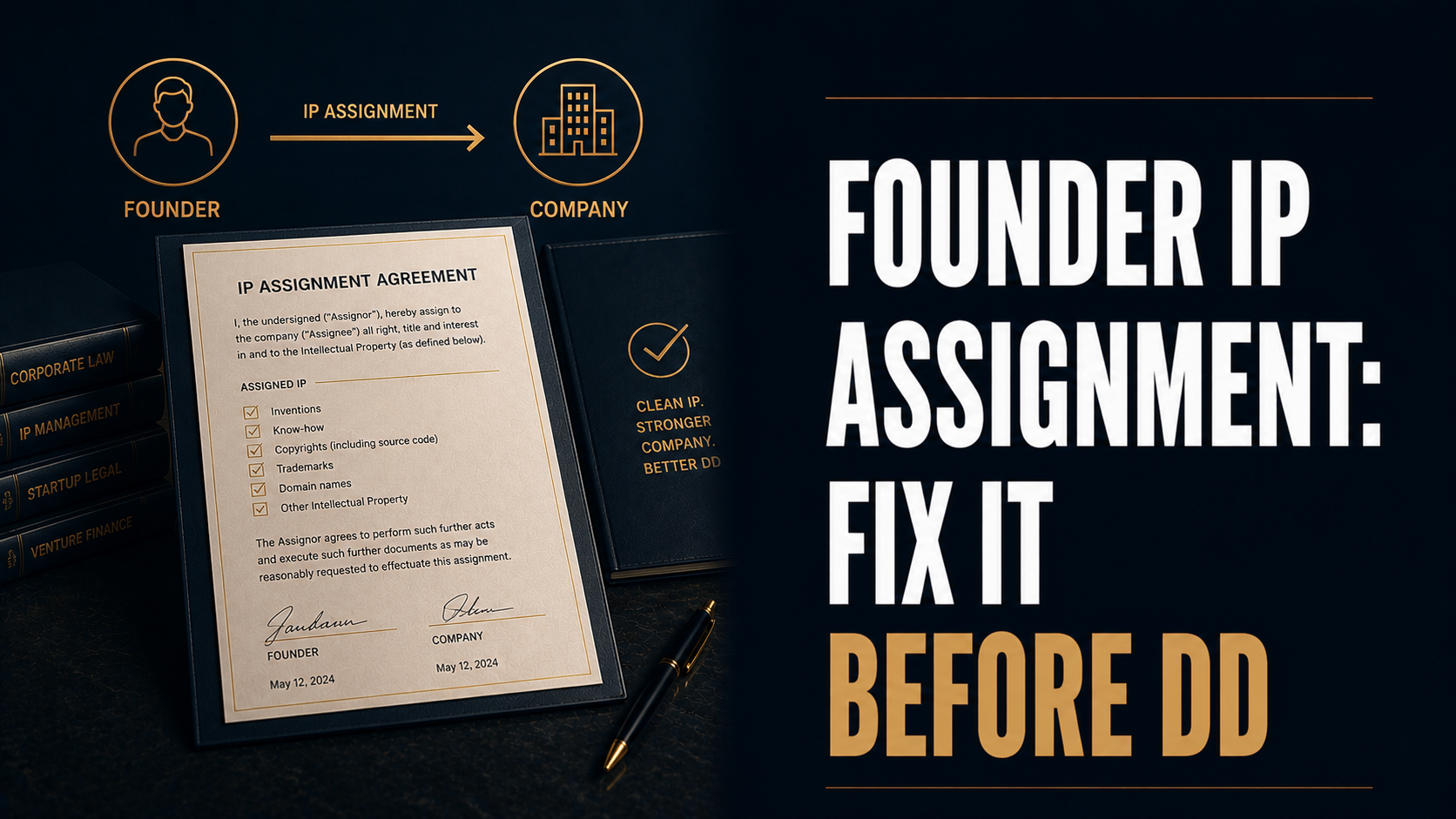
Founder IP Assignment: Why It’s the First Thing Investors Check — and How to Fix It
Founder IP Assignment: Why It’s the First Thing Investors Check — and How to Fix It
Pre-incorporation work doesn’t automatically belong to your company. For AI startups this means code, training data, model weights and research may sit outside your cap table — invisible until due diligence reveals the gap.
Why Founder IP Assignment Is the First Thing Investors Check
At Series A, investors run a full IP chain review before closing. Their first question is always the same: does your company actually own what it’s built? For most AI startups that were founded before formal incorporation, the honest answer is: partly. The rest sits with the founders personally. This is a fixable problem — but only if it is addressed before due diligence starts. Learn more about the full structuring picture in our guide to AI Structuring.
The default position under most common-law jurisdictions — including England & Wales, UAE (DIFC/ADGM) and most US states — is that copyright in a work vests in the author at the moment of creation. An employment agreement with the company can transfer future IP automatically. But work that pre-dates the company or any employment contract is a different matter entirely: it stays with the individual unless a separate, explicit assignment is executed.
For traditional software companies this is an inconvenience. For AI startups it is a structural problem. The most valuable assets in an AI business — the trained model, the curated dataset, the fine-tuned weights — are almost always created before the company exists. Investors know this. Their lawyers know this. And the gap will surface in due diligence whether founders are prepared for it or not.
What AI-Specific IP Assignment Must Cover
A generic IP assignment clause that says “all intellectual property” is often insufficient. For AI startups, the agreement must itemise each category explicitly — because courts and investors apply different standards to each one.
How to Fix It: 4-Step IP Assignment Process
An IP assignment gap is fixable in most cases. The key is to do it before a term sheet is signed, because post-term-sheet corrections trigger re-disclosure obligations and can reset valuation negotiations. Here is the standard remediation process.
How Complex Is Your Fix?
Answer four questions to understand whether your IP assignment situation is a straightforward paperwork task or a multi-party audit. The result guides how urgently you need specialist help.
No. Incorporation creates a legal entity but does not transfer any IP to it. In all major common-law jurisdictions — England & Wales, DIFC, ADGM, most US states, Singapore — IP vests at creation in the individual author or inventor. The only way to transfer that IP to the company is through an explicit, written assignment agreement signed by the individual assignor. Simply being a shareholder or director of the company is not sufficient.
Technically yes, but it creates significant complications. Post-term-sheet corrections must be disclosed to the investor, who may re-evaluate the valuation or impose conditions on the assignment. Some investors treat a post-signing IP gap as a material misrepresentation if it was not flagged in the data room. The practical advice is to execute all IP assignments before any investor engagement begins — certainly before providing access to a data room — so that the chain of title is clean when DD starts.
This is one of the more difficult situations in AI IP remediation. If the contractor cannot be located to sign a retroactive assignment, the company may need to re-create the affected work from scratch, obtain a legal opinion on the de minimis nature of the contribution, or disclose the gap to investors with a risk assessment. In some cases, a contractual indemnity from the founders can provide partial protection. The right approach depends on how significant the unassigned contribution is relative to the total IP. Specialist legal advice is required before deciding how to proceed.
Going forward, every contractor engagement — however short — should include an IP assignment clause as a baseline requirement. See our analysis of AI output ownership for related considerations.
Not automatically. The dataset and the trained model are separate IP assets. Assigning the dataset transfers ownership of the data compilation and any copyright in the curated selection and arrangement. But the model weights — the numerical parameters resulting from the training run — are a separate work. They must be assigned independently. For fine-tuned models, the base model’s licence terms may also affect what can be assigned and to whom. Always address datasets and model weights as separate line items in the assignment schedule. You can learn more about data usage and ownership in our guide to using customer data to train AI models.
Yes. Both DIFC and ADGM apply English common law principles to IP, which means the same default rule applies: IP vests in the individual creator. An explicit written assignment is required. DIFC and ADGM-incorporated companies often have international investor syndicates who apply the same DD standards as London or New York investors. In practice, the assignment documentation needs to be bilingual or dual-jurisdiction compliant if founders are UAE residents but the company is a DIFC/ADGM entity. A deed of assignment may be preferable over a simple contract in these jurisdictions as it is valid without consideration.
Fix Your IP Chain Before Investors Find the Gap
An IP assignment gap found in due diligence gives investors leverage. The same fix done proactively costs a fraction of the time — and protects your valuation. WCR Legal handles founder IP assignments, contractor retroactive assignments and full pre-round IP audits for AI startups.


Post Comment