IP Holding Company for AI Startups: What It Is and When You Need One

IP Holding Company for AI Startups: What It Is and When You Need One

AI Law · Investment Structuring

IP Holding Company for AI Startups: What It Is and When You Need One

IP holding is one of the most discussed — and least understood — structuring tools for AI founders. Here is what it actually does, when it makes legal and commercial sense, and when it is premature complexity you do not need yet.

Protects IP from operational risk Enables cross-border licensing Not always necessary — use the decision tree 3-step mechanism explained
In This Guide 6 Sections
1
What an IP Holding Company Does
Ownership · licensing · ring-fencing
2
When It Makes Legal Sense
Needed vs. not needed
3
Do You Need One? Decision Tree
3-question interactive tool
4
What the Structure Looks Like
Practical implementation checklist
5
FAQ
5 questions founders ask
6
Get Structuring Advice
AI IP structuring review

Most AI founders encounter the concept of an IP holding company at one of three moments: when a lawyer mentions it during pre-raise structuring advice, when an investor says they want the IP “clean” in a specific entity, or when they read about how large technology companies organise their group structures. The term is used to cover a range of different arrangements — and whether it makes sense for a specific company depends on its stage, jurisdictional footprint, and investor requirements, not on whether it sounds sophisticated.

This guide explains what an IP holding structure actually does in legal terms, identifies the specific circumstances where it adds genuine value for an AI startup, and gives you a decision tool to assess whether it applies to your situation now. For broader context on AI structuring across jurisdictions, see our practice overview.

Before You Read Further
IP holding structures involve real legal and tax complexity. This guide explains the legal mechanics and the factors that inform the decision — it is not a substitute for jurisdiction-specific legal and tax advice. The right structure for your company depends on where it operates, where investors are located, and what your exit scenarios look like.
Section 1

What an IP Holding Company Actually Does

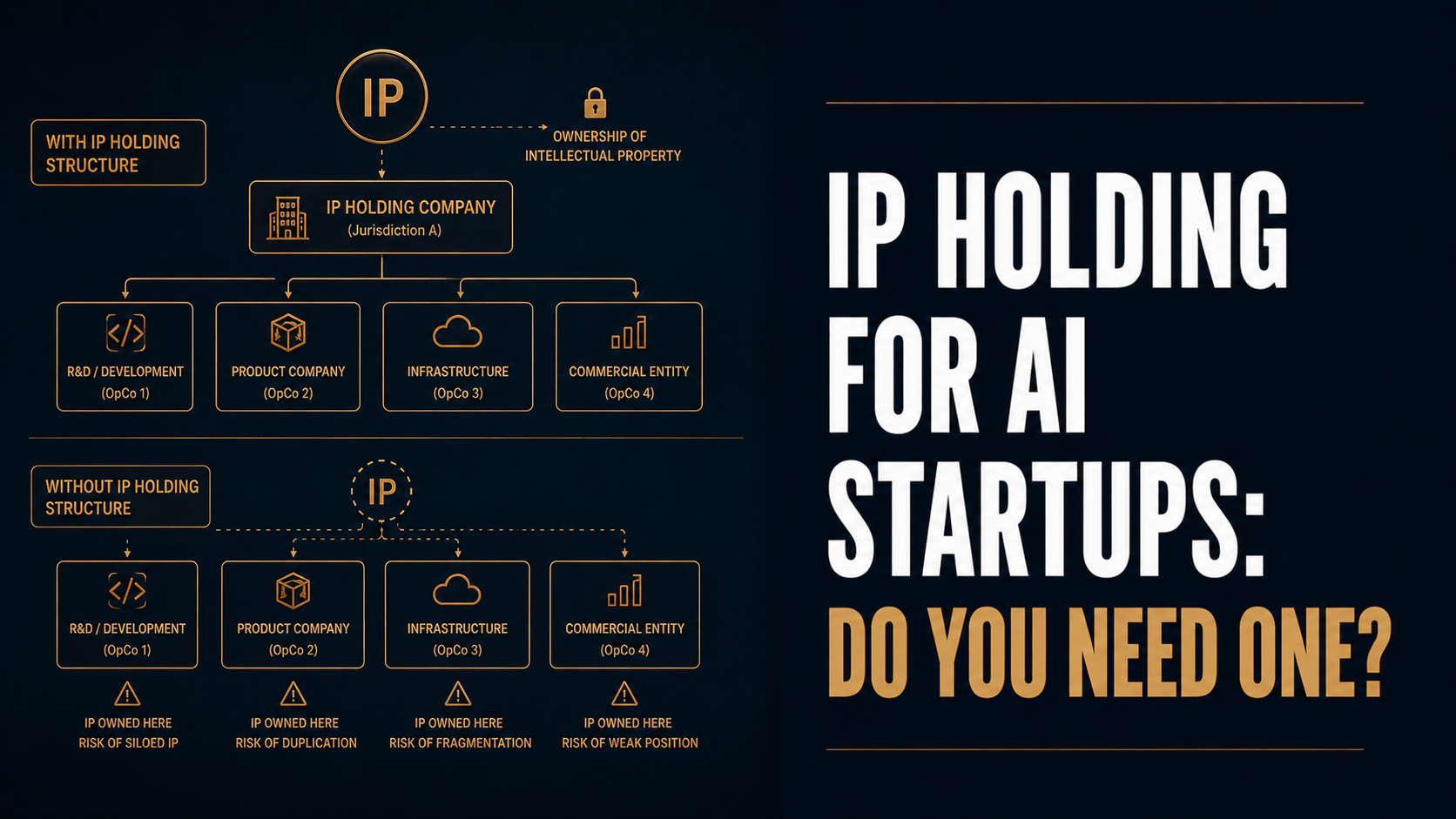
An IP holding company is a legal entity whose primary purpose is to own intellectual property — patents, copyright in software and model weights, trademarks, trade secrets — and licence that IP to one or more operating companies in the group. The mechanism works in three steps.

How the IP Holding Structure Works
Legal mechanics in three steps
3 Steps
1
Ownership
Step 1 — IP Belongs to the Holding Entity, Not the Operating Company

All intellectual property — model weights, training pipeline code, proprietary datasets, software, brand — is legally owned by the IP holding company. The operating company (the entity that sells to customers, employs engineers, and takes on commercial risk) does not hold the IP. It receives a licence to use it.

IP is assigned or transferred into the holding entity — either at formation or through a formal IP transfer agreement
All future IP created by employees and contractors is assigned to the holding entity, not the operating company
The holding entity is typically incorporated in a jurisdiction with favourable IP tax treatment, strong IP law, or investor familiarity (Delaware, Netherlands, Luxembourg, Ireland, UK, Cayman Islands depending on the structure)
2
Licensing Flow
Step 2 — The Operating Company Gets a Licence and Pays Royalties

The operating company (OpCo) licences the IP from the holding company (HoldCo) under a written intra-group licence agreement. This licence covers the specific rights OpCo needs to run the business: the right to use, modify, sub-licence to customers, and deploy the AI system commercially.

Intra-group licence agreement: governs the scope of the licence, the royalty rate, term, territory, and sublicensing rights. This must be a genuine arm’s-length agreement at a commercially reasonable royalty rate — not a formality
Royalty payments: OpCo pays royalties to HoldCo. In multi-jurisdiction structures, this creates an intercompany cash flow that must be documented correctly and comply with transfer pricing rules in each jurisdiction
See our guide on intra-group AI licensing for the documentation requirements in detail
3
Protection
Step 3 — IP Is Ring-Fenced from Operational Risk

Because the IP sits in a separate legal entity, it is legally insulated from the operational risks of the operating company. If OpCo faces a lawsuit, enters into a dispute with a customer, or becomes insolvent, the IP held in HoldCo is not automatically exposed to those creditors or claimants — subject to proper structuring and compliance with insolvency and fraudulent transfer rules.

Creditor protection: operational creditors of OpCo generally cannot reach assets held in HoldCo — they can only pursue the assets OpCo itself owns, which is the licence, not the underlying IP
Litigation ring-fencing: IP infringement claims or customer disputes that arise from OpCo’s commercial activities are isolated from the HoldCo’s balance sheet
Investment structuring: investors in the operating entity do not automatically acquire rights in the IP if the deal is structured around the OpCo. This gives founders control over how IP is valued and monetised separately from operational performance
Section 2

When IP Holding Makes Legal Sense

IP holding structures are not universally appropriate. The complexity they introduce — intra-group agreements, transfer pricing, separate entity maintenance — must be justified by genuine legal or commercial benefit. Below are the conditions that typically make the structure worthwhile, and those where it is premature.

When You Likely Need It
Structural or commercial triggers
Consider Structuring
When It Is Probably Premature
Complexity without proportionate benefit
Monitor & Revisit
Multi-jurisdiction operational entities
You have (or plan) subsidiaries or branches in more than one country. A central HoldCo simplifies licensing and consolidates IP ownership across the group.
Investor requires specific IP jurisdiction
Series A or B investor terms specify that IP must be held in Delaware, England & Wales, the Netherlands, or another jurisdiction — often driven by their own fund structure or portfolio standards.
Significant intra-group licensing revenue
Your business model generates material royalty flows between group entities — for example, a US operating entity licensing AI models from an EU-based holding entity to serve European customers.
High operational litigation exposure
Your product operates in a sector with elevated litigation risk — healthcare AI, financial services AI, or any use case involving consequential automated decisions. IP ring-fencing protects core assets from adverse judgments.
Dual-track exit strategy
You are positioning for a trade sale of the operating business while retaining the IP for a separate licensing revenue stream or future venture. A pre-existing HoldCo structure makes this separation significantly cleaner.
Single-entity startup at pre-seed or seed
One entity, one jurisdiction, no subsidiaries. The IP holding structure adds legal maintenance cost and transfer-pricing complexity without providing proportionate protection at this stage.
No cross-border operational activity
All revenue, employees, and operations are in one jurisdiction. The primary benefit of a HoldCo — cross-border licensing and multi-jurisdiction IP consolidation — does not apply.
No investor requirement for the structure
Your investors have not asked for a specific IP holding arrangement. Building one speculatively before a term sheet adds complexity to your cap table and corporate structure for no immediate benefit.
Insufficient transfer-pricing capacity
You do not yet have the accounting infrastructure to maintain arm’s-length royalty rates, document intercompany transactions, and file transfer-pricing documentation in each jurisdiction. A poorly maintained structure creates more legal risk than no structure.
IP chain not yet clean
Founder IP assignments are missing, contractor agreements are unsigned, or the company does not yet own its IP unambiguously. Fix the IP chain first — see our Founder IP Assignment guide. There is no point building a holding structure around IP you do not definitively own.
Section 3

Do You Need an IP Holding Company?

Answer three questions to get a directional assessment for your company’s current stage and structure.

IP Holding Company Decision Tool
3 questions — directional guidance only
1
Do you have — or are you actively building — subsidiary or operational entities in more than one jurisdiction?
Y
Yes — we operate or plan to operate across multiple jurisdictions
Subsidiaries, branches, or entities in more than one country
N
No — single entity, single jurisdiction
All operations in one country for now
2
Does a current or prospective investor require the IP to be held in a specific jurisdiction or entity?
Y
Yes — investor has specified an IP holding requirement
Term sheet, side letter, or pre-investment condition
N
No — no investor-driven IP holding requirement
Not raised in investment discussions
3
Do you have or expect material intra-group royalty or licensing flows between your group entities?
Y
Yes — significant cross-entity royalty or licensing revenue
One entity licences IP to another for commercial deployment
N
No — no material intra-group licensing flows yet
All revenue from external customers, not from licences between group entities
Likely Not Needed Yet
You are operating as a single entity in one jurisdiction.
At this stage, an IP holding structure would add legal maintenance, transfer-pricing complexity, and annual filing obligations without providing proportionate protection or commercial benefit. The most important task right now is ensuring your founder IP assignments are signed and your IP chain is clean. Revisit this decision when you establish your first foreign subsidiary, when an investor asks for a specific structure, or when you begin planning a Series A with international investors.
Consider Now
An investor is requiring an IP holding structure — this needs legal attention before closing.
When an investor specifies that IP must be held in a particular entity or jurisdiction, that requirement typically becomes a condition precedent to closing. The structure must be set up, IP transferred in, intra-group licence agreements documented, and transfer-pricing positions established before the investment completes. This is a legal project requiring four to eight weeks of focused work. Acting on it early — ideally before term sheet — avoids it becoming a deal-timing pressure point. See our AI structuring services for how we approach this.
Worth Structuring
Multi-jurisdiction operations with intra-group licensing flows justify the structure.
You have the two primary conditions that make an IP holding structure commercially rational: separate legal entities in different jurisdictions, and royalty flows between them. A properly documented HoldCo structure will simplify your intercompany IP licensing, provide a credible arm’s-length basis for royalty pricing, and ring-fence your core IP from the operational risk of each OpCo. The next step is jurisdiction selection for HoldCo and preparing an intra-group licence agreement. See our guide on intra-group AI licensing for the documentation framework, and the double company structure guide for how this fits into broader group architecture.
Monitor as You Grow
Multi-jurisdiction, no investor requirement, no material royalty flows yet.
You have the jurisdictional complexity that could justify a HoldCo, but the commercial triggers — investor requirement or significant intra-group licensing revenue — are not present yet. The structure is premature. The correct action is to ensure your existing entities each have clean IP ownership documentation and clear intercompany agreements for any shared services or development work. Revisit the HoldCo question when you begin fundraising conversations with international investors, or when your cross-entity licensing flows become material enough to warrant transfer-pricing documentation. See the Series A DD guide for what investors check in the interim.
Section 4

What Holding Structure Looks Like in Practice

If you have decided a HoldCo structure is appropriate, the following items constitute the legal implementation. Each represents a discrete workstream, not just a document.

IP Holding Implementation Checklist
Click each item to mark as complete in your setup process
0 / 8
Entity & IP Transfer
Holding entity incorporated in the chosen jurisdiction with correct share structure and ownership
Jurisdiction selection should account for investor preferences, IP tax regimes (patent box), treaty networks, and substance requirements. Delaware, Netherlands, and Ireland are common choices for AI companies with EU exposure.
Foundation
IP transfer agreement executed: all existing IP assigned from founders and operating company to HoldCo
This is a formal legal assignment — not just a board resolution. The agreement must identify each asset being transferred, include consideration (even nominal), and be properly executed in each relevant jurisdiction.
Critical
All future IP assignment clauses in employee and contractor agreements updated to assign to HoldCo
Every new hire and contractor agreement must assign IP to the holding entity going forward. Existing agreements that assign to OpCo must be reviewed and, where necessary, novated or supplemented.
Critical
Intra-Group Licensing
Intra-group IP licence agreement signed between HoldCo and each OpCo
A genuine, arm’s-length licence specifying scope (which IP, which use cases), territory, term, sublicensing rights, and the royalty rate. This document is what investors and tax authorities will review — it must reflect commercial reality, not a formality.
Licensing
Royalty rate documented with a transfer-pricing analysis or benchmarking study
Tax authorities in most jurisdictions require that intra-group royalty rates reflect arm’s-length pricing. A transfer-pricing study or comparable transaction analysis is needed to defend the rate. The complexity and cost of this depends on the jurisdictions involved.
Tax
Intercompany royalty payment flows set up with compliant invoicing and accounting treatment
Royalty payments must be reflected correctly in each entity’s accounts, with compliant invoicing between group entities, correct VAT or withholding tax treatment depending on the jurisdictions, and reconciliation of intercompany balances.
Accounting
Group Governance
HoldCo has genuine substance in its jurisdiction: board, registered office, and economic activity
Many jurisdictions — and investors — require that HoldCo is not a pure shell. Substance requirements vary but commonly include local directors, a registered office, and actual decision-making activity. Without genuine substance, the structure may not withstand regulatory or investor scrutiny.
Substance
Group organogram updated and investor data room reflects the holding structure accurately
The group structure chart must show HoldCo at the correct position, with ownership percentages and the flow of IP licensing between entities. This is one of the first documents investors request in DD — an inaccurate or missing organogram signals poor corporate governance.
Data Room
Investor asking for an IP holding structure? Setting it up correctly — with a defensible transfer-pricing position and genuine substance — takes six to eight weeks. Starting after term sheet is too late.
Book a Structuring Review →
Section 5

Frequently Asked Questions

IP Holding Company — Founder FAQ
5 questions — click to expand
1
Which jurisdiction is best for an AI startup IP holding company?
+

There is no single correct answer — the right jurisdiction depends on where your operating entities are, where your investors are based, and your exit scenarios. Delaware (or Wyoming) is the default choice for US-centric structures. The Netherlands and Ireland are common for European IP holding because of their established IP tax regimes (the Dutch Innovation Box and Irish Knowledge Development Box), extensive treaty networks, and familiarity to EU and US investors. The UK (England and Wales) is used where common law certainty and London-based investor preference are priorities. Cayman Islands or BVI structures are used in certain fund-backed or dual-structure arrangements. Each jurisdiction has specific substance requirements, annual maintenance costs, and treaty implications that must be assessed against your company’s specific facts. Generic advice to “use the Netherlands” without assessing your specific treaty position is insufficient.

2
How does intra-group licensing work in practice for an AI company?
+

The operating company (OpCo) signs a licence agreement with the IP holding company (HoldCo) that grants OpCo the right to use the AI system — including the model, training pipeline, software, and related IP — for commercial purposes in its territory. OpCo pays a royalty to HoldCo, typically calculated as a percentage of revenue or a fixed per-use fee, as agreed in the licence. That royalty flows from OpCo to HoldCo as a recurring intercompany payment. The royalty rate must be set at arm’s length — meaning it must reflect what an unrelated third party would charge for a comparable licence. Tax authorities in most jurisdictions will scrutinise this rate in a transfer-pricing audit. The rate and its basis must be documented in a transfer-pricing policy or benchmarking study. For the documentation framework, see our guide on intra-group AI licensing.

3
Can I set up an IP holding company after my Series A, or does it need to be done before?
+

It can be done post-Series A, but the cost and complexity increase significantly once external investors are on the cap table. Before an investment, the company’s founders control the structure and can reorganise without requiring investor consent. After an investment, any material corporate restructuring — including IP transfers between entities — typically requires investor approval under standard Series A protective provisions. Additionally, transferring IP after a round at a significant valuation creates a higher tax cost (the IP is now worth more, so the transfer triggers a larger gain). The structuring work is cheapest and most flexible at early stage, before institutional capital is in. If a Series A investor will require a specific IP holding structure, that requirement should ideally be identified in the term sheet and implemented as a condition to closing rather than as a post-closing reorganisation.

4
Does an IP holding company help with EU AI Act compliance?
+

Indirectly, yes. The EU AI Act distinguishes between providers (who place AI systems on the market) and deployers (who use them in their own operations). If your HoldCo is registered in the EU and owns the AI system that is licensed to OpCos, HoldCo may be considered the provider under the Act — which concentrates the provider obligations (technical documentation, conformity assessment, registration) in a single entity with a clear EU presence. This can simplify compliance compared to a structure where the provider is a non-EU entity that must appoint an EU authorised representative under Article 22. However, the EU AI Act compliance implications of a proposed holding structure should be assessed alongside the tax and legal structuring analysis — they are not separate considerations. See our guide on double company structure for AI startups for how these considerations interact.

5
What is the difference between an IP holding company and a double company structure?
+

The terms overlap but describe different emphases. A “double company structure” (sometimes “dual entity structure”) typically refers to splitting the business between a US entity (usually a Delaware C-corp) for US investors and market, and a non-US entity for the rest of the world — with IP sitting in one and OpCo activity in the other, or with licensing flowing between them. An “IP holding company” specifically refers to the entity whose primary role is to hold and licence IP, regardless of where the operating companies are. In practice, a double company structure often uses an IP holding arrangement as one of its components. The distinctions matter less than the specifics of which entity holds the IP, which entity takes on the commercial and regulatory risk, and how the licence and royalty flows are documented. See our double company structure guide for a detailed comparison.

WCR Legal — AI Investment Structuring

The right structure is the one that fits your stage, your investors, and your exit.

IP holding is not a default. It is a tool that works when the conditions are right — and adds cost and complexity when they are not. We help AI founders make this decision correctly, and implement it when the time comes.

Oleg Prosin is the Managing Partner at WCR Legal, focusing on international business structuring, regulatory frameworks for FinTech companies, digital assets, and licensing regimes across various jurisdictions. Works with founders and investment firms on compliance, operating models, and cross-border expansion strategies.

Post Comment