IP Holding Company for AI Startups: What It Is and When You Need One
IP Holding Company for AI Startups: What It Is and When You Need One
IP holding is one of the most discussed — and least understood — structuring tools for AI founders. Here is what it actually does, when it makes legal and commercial sense, and when it is premature complexity you do not need yet.
Most AI founders encounter the concept of an IP holding company at one of three moments: when a lawyer mentions it during pre-raise structuring advice, when an investor says they want the IP “clean” in a specific entity, or when they read about how large technology companies organise their group structures. The term is used to cover a range of different arrangements — and whether it makes sense for a specific company depends on its stage, jurisdictional footprint, and investor requirements, not on whether it sounds sophisticated.
This guide explains what an IP holding structure actually does in legal terms, identifies the specific circumstances where it adds genuine value for an AI startup, and gives you a decision tool to assess whether it applies to your situation now. For broader context on AI structuring across jurisdictions, see our practice overview.
What an IP Holding Company Actually Does
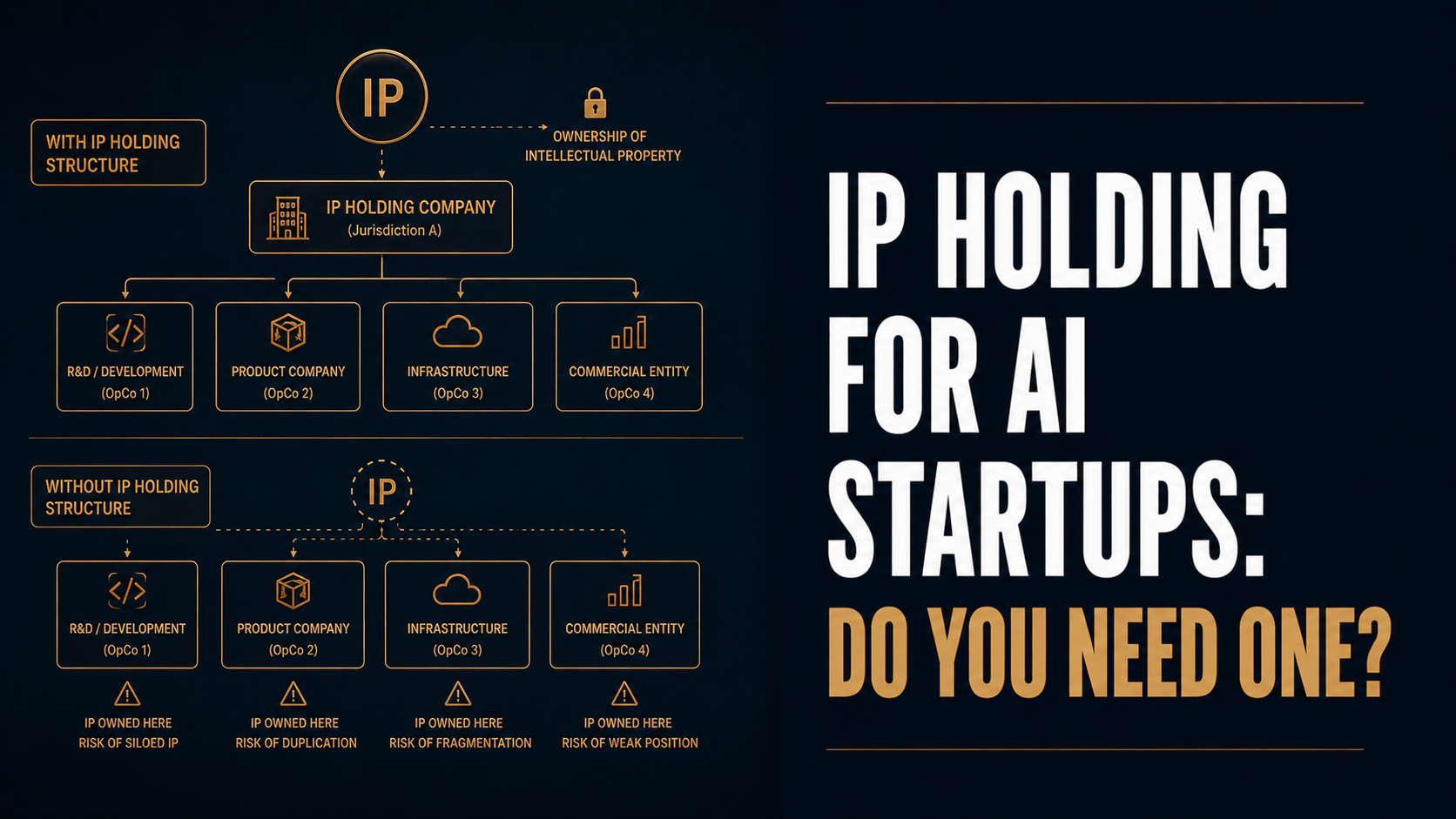
An IP holding company is a legal entity whose primary purpose is to own intellectual property — patents, copyright in software and model weights, trademarks, trade secrets — and licence that IP to one or more operating companies in the group. The mechanism works in three steps.
All intellectual property — model weights, training pipeline code, proprietary datasets, software, brand — is legally owned by the IP holding company. The operating company (the entity that sells to customers, employs engineers, and takes on commercial risk) does not hold the IP. It receives a licence to use it.
The operating company (OpCo) licences the IP from the holding company (HoldCo) under a written intra-group licence agreement. This licence covers the specific rights OpCo needs to run the business: the right to use, modify, sub-licence to customers, and deploy the AI system commercially.
Because the IP sits in a separate legal entity, it is legally insulated from the operational risks of the operating company. If OpCo faces a lawsuit, enters into a dispute with a customer, or becomes insolvent, the IP held in HoldCo is not automatically exposed to those creditors or claimants — subject to proper structuring and compliance with insolvency and fraudulent transfer rules.
When IP Holding Makes Legal Sense
IP holding structures are not universally appropriate. The complexity they introduce — intra-group agreements, transfer pricing, separate entity maintenance — must be justified by genuine legal or commercial benefit. Below are the conditions that typically make the structure worthwhile, and those where it is premature.
Do You Need an IP Holding Company?
Answer three questions to get a directional assessment for your company’s current stage and structure.
What Holding Structure Looks Like in Practice
If you have decided a HoldCo structure is appropriate, the following items constitute the legal implementation. Each represents a discrete workstream, not just a document.
Frequently Asked Questions
There is no single correct answer — the right jurisdiction depends on where your operating entities are, where your investors are based, and your exit scenarios. Delaware (or Wyoming) is the default choice for US-centric structures. The Netherlands and Ireland are common for European IP holding because of their established IP tax regimes (the Dutch Innovation Box and Irish Knowledge Development Box), extensive treaty networks, and familiarity to EU and US investors. The UK (England and Wales) is used where common law certainty and London-based investor preference are priorities. Cayman Islands or BVI structures are used in certain fund-backed or dual-structure arrangements. Each jurisdiction has specific substance requirements, annual maintenance costs, and treaty implications that must be assessed against your company’s specific facts. Generic advice to “use the Netherlands” without assessing your specific treaty position is insufficient.
The operating company (OpCo) signs a licence agreement with the IP holding company (HoldCo) that grants OpCo the right to use the AI system — including the model, training pipeline, software, and related IP — for commercial purposes in its territory. OpCo pays a royalty to HoldCo, typically calculated as a percentage of revenue or a fixed per-use fee, as agreed in the licence. That royalty flows from OpCo to HoldCo as a recurring intercompany payment. The royalty rate must be set at arm’s length — meaning it must reflect what an unrelated third party would charge for a comparable licence. Tax authorities in most jurisdictions will scrutinise this rate in a transfer-pricing audit. The rate and its basis must be documented in a transfer-pricing policy or benchmarking study. For the documentation framework, see our guide on intra-group AI licensing.
It can be done post-Series A, but the cost and complexity increase significantly once external investors are on the cap table. Before an investment, the company’s founders control the structure and can reorganise without requiring investor consent. After an investment, any material corporate restructuring — including IP transfers between entities — typically requires investor approval under standard Series A protective provisions. Additionally, transferring IP after a round at a significant valuation creates a higher tax cost (the IP is now worth more, so the transfer triggers a larger gain). The structuring work is cheapest and most flexible at early stage, before institutional capital is in. If a Series A investor will require a specific IP holding structure, that requirement should ideally be identified in the term sheet and implemented as a condition to closing rather than as a post-closing reorganisation.
Indirectly, yes. The EU AI Act distinguishes between providers (who place AI systems on the market) and deployers (who use them in their own operations). If your HoldCo is registered in the EU and owns the AI system that is licensed to OpCos, HoldCo may be considered the provider under the Act — which concentrates the provider obligations (technical documentation, conformity assessment, registration) in a single entity with a clear EU presence. This can simplify compliance compared to a structure where the provider is a non-EU entity that must appoint an EU authorised representative under Article 22. However, the EU AI Act compliance implications of a proposed holding structure should be assessed alongside the tax and legal structuring analysis — they are not separate considerations. See our guide on double company structure for AI startups for how these considerations interact.
The terms overlap but describe different emphases. A “double company structure” (sometimes “dual entity structure”) typically refers to splitting the business between a US entity (usually a Delaware C-corp) for US investors and market, and a non-US entity for the rest of the world — with IP sitting in one and OpCo activity in the other, or with licensing flowing between them. An “IP holding company” specifically refers to the entity whose primary role is to hold and licence IP, regardless of where the operating companies are. In practice, a double company structure often uses an IP holding arrangement as one of its components. The distinctions matter less than the specifics of which entity holds the IP, which entity takes on the commercial and regulatory risk, and how the licence and royalty flows are documented. See our double company structure guide for a detailed comparison.
The right structure is the one that fits your stage, your investors, and your exit.
IP holding is not a default. It is a tool that works when the conditions are right — and adds cost and complexity when they are not. We help AI founders make this decision correctly, and implement it when the time comes.


Post Comment