Consent Chain Audit in Avatar Platform Investments: What Breaks and Why
Consent Chain Audit in Avatar Platform Investments:
What Breaks and Why
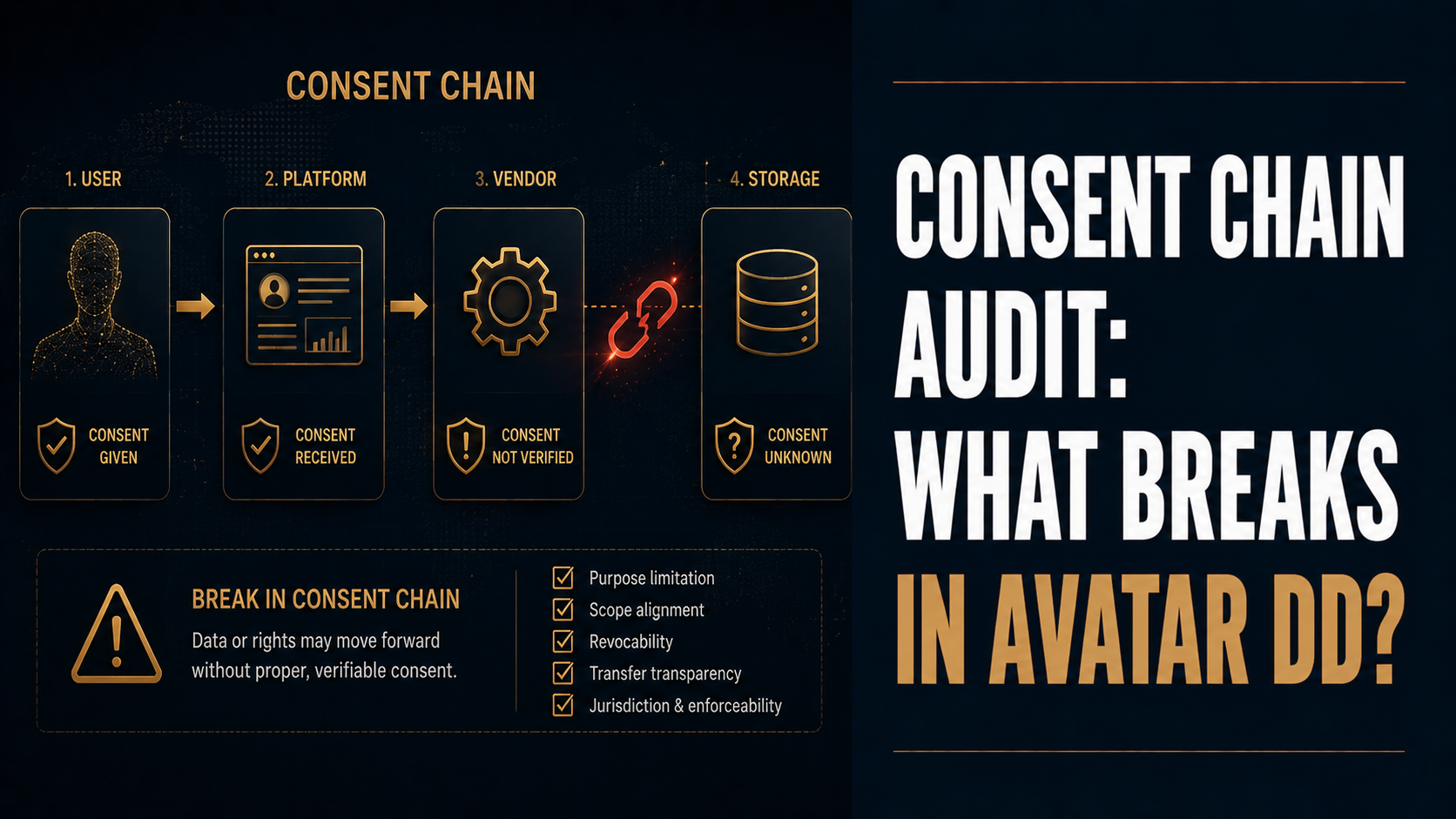
An avatar platform’s consent chain has four links. A single break creates class-action exposure under BIPA and GDPR simultaneously. Investors and M&A counsel who do not audit the full chain before closing inherit the liability.
Most AI avatar platforms fail a consent chain audit before the first data room document is opened. Not because their legal teams were negligent, but because consent frameworks were built for product lawyers, not for the biometric privacy regimes that govern platforms collecting face geometry and voiceprints at scale. The result is a chain that looks complete in the ToS but breaks at Link 2, 3, or 4 — precisely the links that BIPA and GDPR independently require.
WCR Legal’s AI Avatar Due Diligence practice audits the full consent chain as a standalone DD workstream. This article maps each link, explains the most common failure patterns, and provides an 8-point checklist for investors and M&A counsel conducting pre-close review.
The Avatar Platform Consent Chain
A compliant consent chain for an AI avatar platform consists of four sequential links. Compliance at Link 1 does not validate Links 2–4. Each link must independently satisfy the applicable legal standard.
Before collecting any biometric identifier from an Illinois resident, BIPA Section 15(b) requires a platform to: (1) inform the user in writing that biometric data is being collected; (2) state the specific purpose of collection; (3) state the retention period; and (4) obtain a written release. This must occur before the first biometric capture event — not at account creation, not via a retroactive ToS update, and not through a general privacy policy. The consent instrument must be separate from Terms of Service.
Avatar platforms routinely pass biometric data to third-party vendors — face recognition APIs (AWS Rekognition, Azure Face, third-party SDKs), voice synthesis providers, cloud storage with biometric processing features. Each transmission to a third-party processor must be covered by a Data Processing Agreement (DPA) that: restricts the processor to the consented purpose, prohibits onward transfer, and imposes equivalent security obligations. BIPA Section 15(d) prohibits disclosure of biometrics without consent. An absence of DPA coverage is a disclosure violation independent of Link 1.
AI avatar platforms train generative models on user-contributed biometric data. A consent instrument that authorizes collection for “creating your digital avatar” does not automatically cover the transfer of that biometric data into a training dataset. BIPA Section 15(c) prohibits profiting from biometric data. Courts applying BIPA and GDPR have found that using biometric data to train a commercial model — which increases the model’s commercial value — can constitute profit-making from biometric data. If user consent covers only the service feature, not the training use, Link 3 is broken for every training instance.
BIPA Section 15(a) requires a covered entity to have a written, publicly available policy establishing a retention schedule and guidelines for permanent destruction of biometric data. This policy must be in place before collection begins. The deletion requirement is absolute: biometrics must be destroyed when the purpose for which they were collected is fulfilled, or within 3 years, whichever is earlier. An avatar platform without a published retention policy violates BIPA Section 15(a) for every Illinois user, regardless of whether individual consent was obtained under Section 15(b).
What Typically Breaks
Four failure patterns appear in the vast majority of avatar platform consent chain audits. Each maps to a specific BIPA or GDPR violation and carries independent class-action or enforcement exposure.
Consent Chain Audit Checklist — Check Each Link
Eight items mapped across the four consent chain links. Mark each item confirmed as you review the data room. The checklist evaluates chain integrity and surfaces any links requiring remediation before close.
GDPR + BIPA: Two Independent Regimes
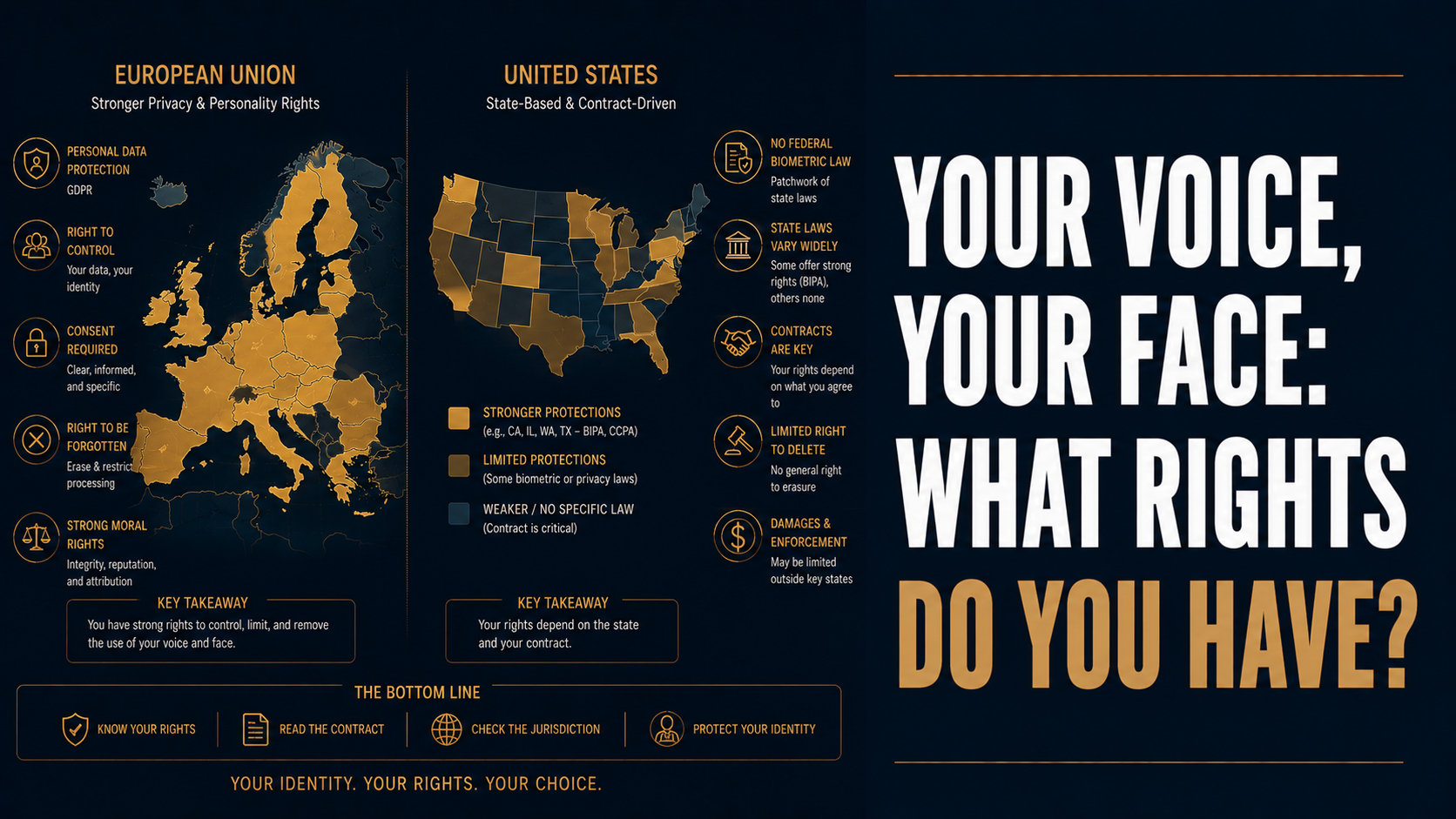
The consent chain must satisfy both legal frameworks for any user who falls under both. This is not theoretical — it applies to every EU-resident user who accesses the platform from Illinois, and to any Illinois resident who is also an EU data subject. The compliance obligations are additive, not alternative.
Remediation Before Closing — What a Consent Cure Looks Like
Not all consent chain breaks are deal-killers. Some can be remediated pre-close. Understanding which breaks are curable, and at what cost, is essential to pricing and structuring the transaction correctly.
Link 4 failures (absent public retention policy) can be remediated pre-close by publishing a BIPA-compliant biometric retention and destruction policy and implementing documented deletion procedures. This cures ongoing Section 15(a) exposure for all users going forward. Similarly, missing DPAs with third-party vendors can be executed pre-close to cover future biometric transmissions. These are the items to address in the pre-close remediation plan.
If the platform lacks a separate biometric consent instrument (Link 1 failure), issuing a re-consent notice to the existing user base before close can stop the accrual of new violations. The re-consent notice must be: separate from any existing ToS, affirmatively accepted before the next biometric capture, and served with BIPA-compliant content. It does not cure pre-notice violations but creates a documented consent date from which future liability is limited.
If the generative model was trained on biometric data collected without training-specific consent, the taint cannot be remediated through contract language or a re-consent campaign. The acquirer faces three options: (1) accept the exposure and price it into the deal; (2) require pre-close retraining on a clean dataset as a condition to close; or (3) decline the acquisition. In most transactions, option 1 with a dedicated escrow and representations covering training data consent status is the most practical path.
No. BIPA Section 15(b) requires a written release specifically for biometric data collection, separate from any general Terms of Service. Courts in the Seventh Circuit have consistently held that a ToS checkbox or a privacy policy clause mentioning biometric data does not satisfy the written release requirement. The consent must be a standalone instrument, affirmatively accepted by the user before the first biometric capture, identifying the specific data type being collected, its purpose, and its retention period. Platforms that rely on ToS consent alone have a clean-sheet Link 1 failure.
No. BIPA violations accrue at the time of unconsented collection or unauthorized disclosure, not at the time of a lawsuit. Deleting biometric data before close removes the ongoing storage violation but does not eliminate claims for the historical collection period. A class action can still be filed by any Illinois resident who was a user of the platform during the period of unconsented biometric collection, seeking damages for the violation that accrued when their data was collected. Pre-close deletion is useful for stopping the accrual of new violations but does not function as a retroactive cure.
A GDPR-compliant Data Processing Agreement under Art. 28 addresses controller-processor relationships and must include specific mandatory clauses: processing only on documented instructions, confidentiality, security measures, sub-processor authorization, data subject rights assistance, deletion or return of data, audit rights, and provision of all necessary information to demonstrate compliance. BIPA does not have a formal DPA requirement, but Section 15(d) requires that any disclosure of biometric data to a third party be: (a) authorized by the data subject, or (b) required by law. A BIPA-compatible vendor agreement must restrict the vendor to the consented purpose and prohibit onward use. A GDPR-compliant DPA with appropriate biometric processing restrictions usually satisfies BIPA’s vendor agreement requirements — but only if it contains explicit Art. 9 special category data provisions.
Three SPA mechanisms address residual consent chain exposure: (1) a specific biometric indemnification with an escrow sized against the quantified exposure range (Illinois users × unconsented captures × applicable per-violation amount); (2) a survival period extended to the full Illinois statute of limitations (5 years) for biometric-specific reps and warranties; and (3) a post-close remediation covenant requiring the seller-side team to cooperate with a consent re-architecture program during the specified period. Where R&W insurance excludes known biometric exposure, the SPA escrow is the primary risk-allocation mechanism. Do not rely on generic indemnification baskets for biometric liability — the exposure range can exceed standard caps.
Yes, materially. A standard GDPR data audit reviews the platform’s Record of Processing Activities, lawful bases, data subject rights procedures, and DPA coverage broadly across all personal data categories. A consent chain audit for a biometric AI platform is a narrower, deeper review of a single data category (biometrics) across all four chain links: collection consent, third-party transmission coverage, model training consent, and retention and deletion procedures. It maps every biometric data flow — including SDK calls and training pipelines — against the consent instruments actually on file and computes exposure under both BIPA (per-scan and aggregate models) and GDPR (enforcement fine range). It is biometric-specific, litigation-oriented, and built around the specific failure patterns that create class action exposure in avatar platform transactions.
to Open a Class Action
WCR Legal’s consent chain audit maps all four links across BIPA and GDPR, identifies curable and structural breaks, and delivers a pre-close remediation plan. Available for M&A transactions and investment rounds in AI avatar platforms.

Post Comment