How to Document Your Digital Identity Wishes Before Death: A Legal Guide for Public Figures and Creators
How to Document Your Digital Identity Wishes Before Death: A Legal Guide for Public Figures and Creators
AI can clone your voice from three minutes of audio. It can animate your face from photographs taken before you were born. Most estates have no legal instrument to govern what happens next. This guide changes that.
Estate planning has always lagged technology. By the time lawyers drafted cryptocurrency inheritance clauses, Bitcoin was already a decade old. We are now at the same inflection point with generative AI — except the stakes are higher, the timelines are shorter, and the legal frameworks are more fragmented than anything that came before.
A creator who dies today without documented digital identity wishes leaves behind a legal vacuum. Their general executor — typically a family member or accountant — will receive AI licensing requests for voice synthesis, deepfake authorization, avatar creation, and training data use. That executor has no legal obligation to ask what the deceased would have wanted, and often has no framework to evaluate what any reasonable answer would look like.
Who decides without a document? Without a designated digital persona trustee, AI licensing decisions pass to your general executor — who may have no legal authority over your right of publicity in the relevant jurisdiction, no knowledge of your brand values, and no technical expertise to evaluate what “AI voice synthesis” actually means in practice. Courts apply the law at the time of death, not the law of 2030.
This guide gives you the legal instruments, jurisdiction-specific rules, and a practical 12-point documentation checklist to close that gap. It is structured for creators, public figures, entertainers, and their legal advisors.
Why AI Makes Posthumous Identity Risk Urgent
Three technical realities that existing estate law was not designed to address.
The implication for estate planning: Unlike a house, a bank account, or a copyright, your AI likeness rights are not automatically governed by inheritance law. They require affirmative, specific, technically-informed documentation to be enforceable.
What Counts as “Digital Identity” Legally
Six asset categories — their legal nature, transferability, and governing law.
Note: “Transferable” refers to whether the right can pass to an estate or be managed by a trustee. Personal rights (biometric, personality) generally cannot be transferred as property but can be exercised by authorized representatives in some jurisdictions.
Five Legal Instruments You Can Use
From the minimum viable floor to comprehensive posthumous governance.
What it covers: Explicit instructions about AI permissions, digital identity management, account disposition, and trustee designation. The will clause is legally binding (subject to probate) and gives executors clear authority to act.
Limitations: Subject to probate (public record); may conflict with existing contracts; GDPR data rights do not pass to estates in most EU member states; ineffective against platforms that do not recognize estate rights; does not survive beyond the probate jurisdiction.
When to use: Every creator and public figure. This is the absolute minimum viable instrument. Draft it now, even if you revisit it annually.
What it covers: A dedicated trust holding rights related to your digital identity — right of publicity license rights, AI authorization agreements, digital asset wallets, and revenue streams from posthumous licensing. A trustee manages these rights independently from the general estate. Can be structured as irrevocable to ensure long-term management beyond the will’s terms.
Limitations: Requires significant upfront legal drafting; right of publicity rights vary by state in transferability; not yet recognized in all jurisdictions as a valid standalone trust purpose; complex to administer across multiple jurisdictions.
When to use: Public figures, entertainers, and creators with commercial value in their identity. Essential where posthumous AI licensing revenue is expected.
What it covers: A standalone document — analogous to a healthcare advance directive — that specifies in plain language what AI uses of your voice and face you authorize, what you prohibit, who holds authority to decide edge cases, and the values or brand guidelines your digital persona must respect. Not a substitute for legal instruments, but provides guidance for trustees and licensees that goes beyond what a will or trust can capture.
Limitations: Not independently binding on third parties; must be incorporated by reference into a will or trust to become enforceable; requires updating every 2–3 years as AI capabilities evolve.
When to use: All creators and public figures, as a companion to legal instruments. The Directive Builder in §7 generates a draft starting point.
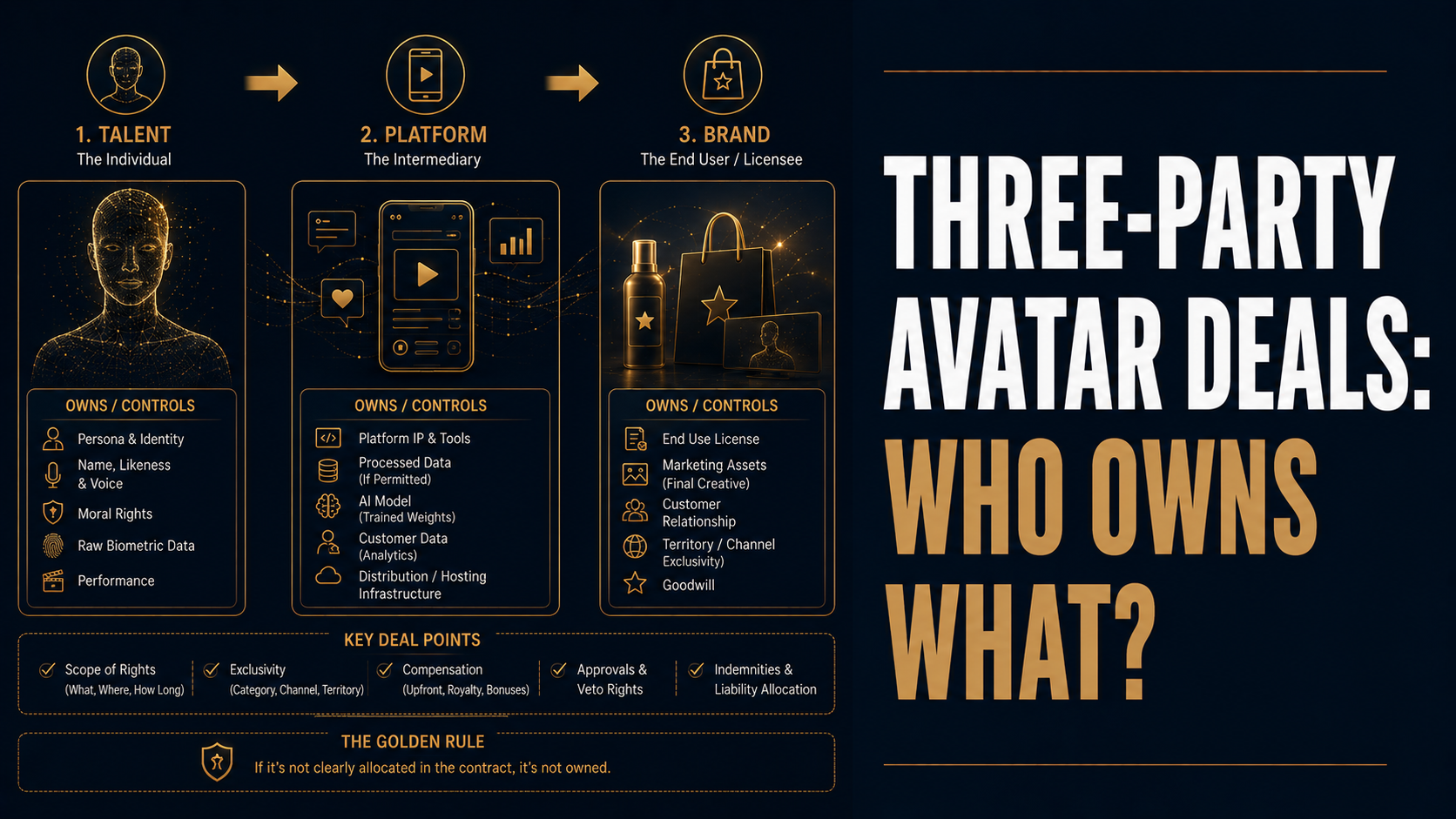
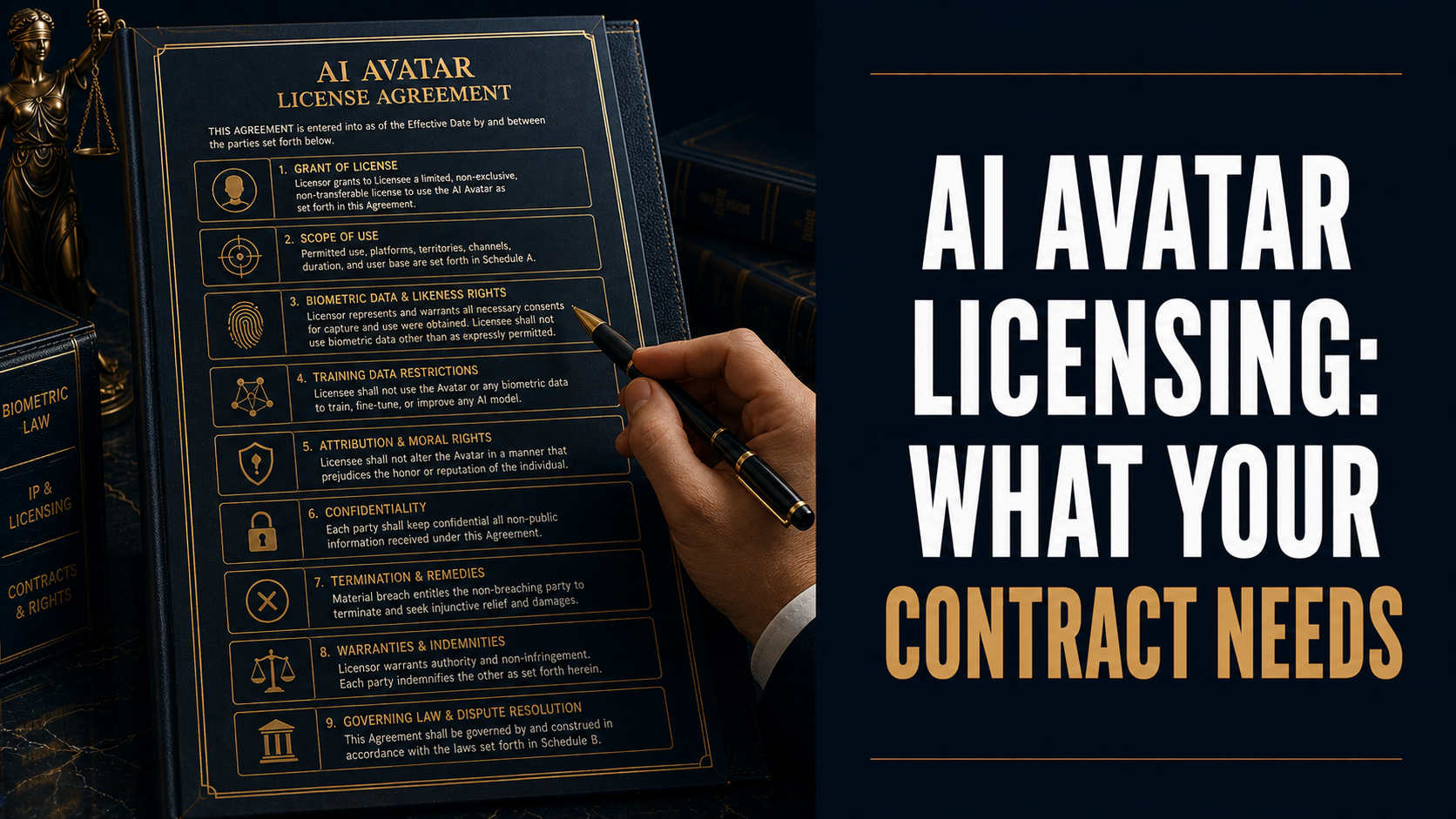
What it covers: AI licensing agreements executed during your lifetime that explicitly cover posthumous use. A well-drafted AI Avatar Licensing Agreement can include perpetual posthumous license terms, revenue sharing that survives death, quality standards, and usage restrictions that bind licensees contractually. The contract outlives you.
Limitations: Only covers parties to the specific contract; does not prevent unlicensed third-party AI use; contract terms may become outdated as AI capabilities change; may conflict with a will clause drafted after signing.
When to use: Any creator entering into an AI voice or likeness agreement during their lifetime. The agreement must explicitly address posthumous use — most standard AI avatar contracts do not.
What it covers: Facebook Legacy Contact (manage memorialized profile), Google Inactive Account Manager (pre-specify data disposition), Apple Digital Legacy (up to 5 designated people access your data). These are platform-specific tools with narrow scope.
Limitations: Cannot authorize AI training use of your content; does not create any right of publicity license; Facebook Legacy Contact cannot post new content or access private messages; platform tools can be changed or removed by the platform without notice.
When to use: Everyone, as a floor-level minimum. Set these up this week. They are free, require no legal expertise, and take under 30 minutes per platform. They do not replace instruments 1–4.
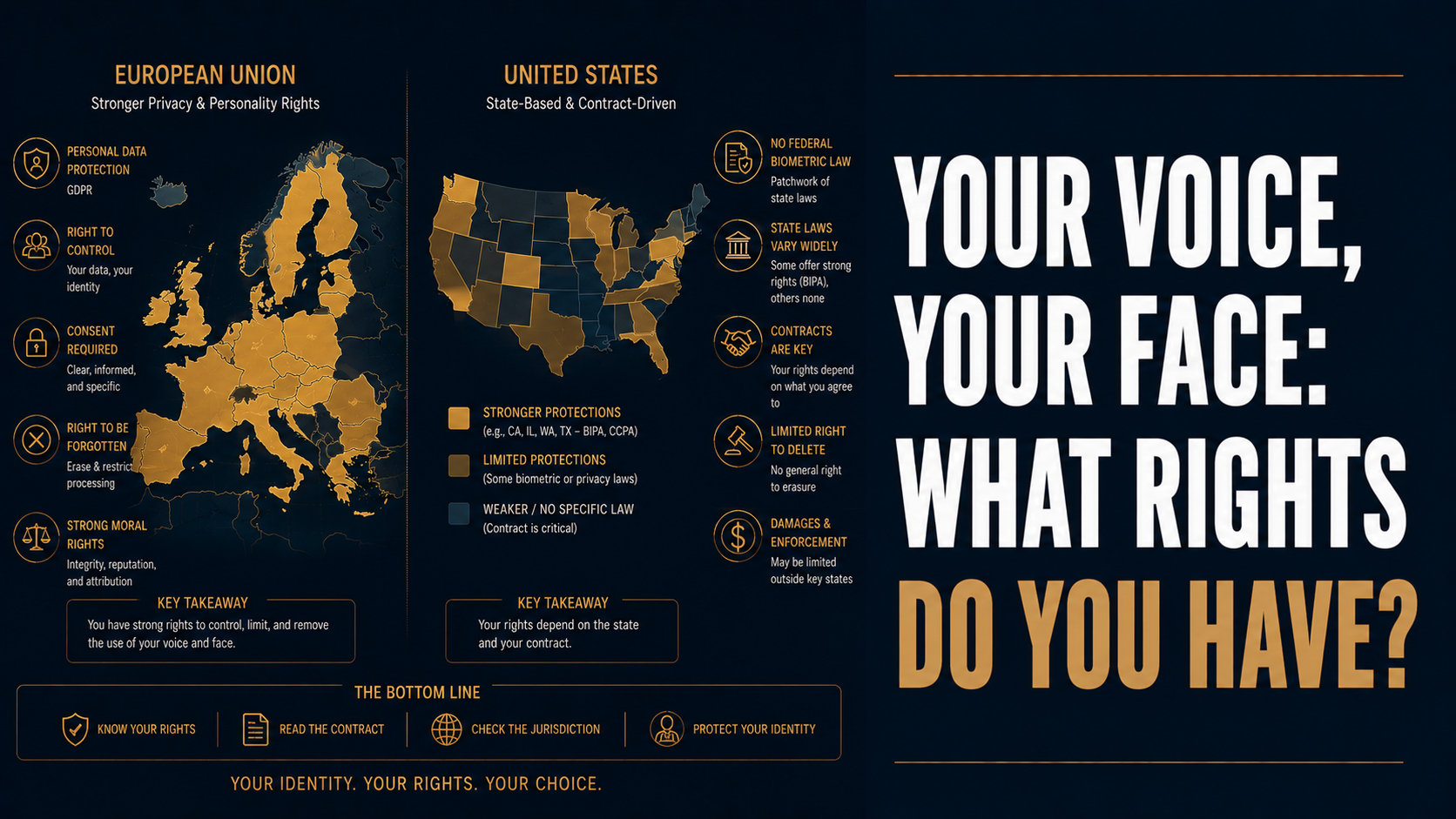
Jurisdiction Comparison: EU, US, UK, UAE
The applicable law at death determines what protections exist. Most estates span multiple jurisdictions.
- GDPR Recital 27 explicitly excludes deceased persons. GDPR data rights do not survive death in the default EU framework.
- Italy: Legislative Decree 196/2003 (Privacy Code) Art. 2-terdecies — relatives may exercise data rights on behalf of deceased.
- France: Loi Informatique et Libertés — allows designation of a person to exercise post-mortem digital rights; instructions can be left with the CNIL or a digital executor.
- Germany: Allgemeines Persönlichkeitsrecht survives for 10 years post-mortem (general). Kunsturhebergesetz (KUG) §22 protects image rights for 10 years post-mortem for public figures. Right is managed by estate / heirs.
Contractual protection is the primary reliable mechanism across the EU. Draft AI likeness agreements during lifetime that explicitly cover post-mortem use and appoint a trustee to manage them.
- Recognized in 35+ states. Post-mortem in most; duration ranges from 10 years (New York) to 100 years (Indiana).
- California: Cal. Civ. Code §3344.1 — 70 years post-mortem for anyone “commercially known.” Descendible and licensable. AB 2602 (2024) requires independent counsel for digital replica contracts signed during lifetime.
- Tennessee ELVIS Act (2024): Right of publicity in voice survives death. AI voice synthesis requires authorization from rights holder.
- NO FAKES Act (proposed): Would create federal post-mortem right in voice and likeness; 10-year retroactive period. Status as of 2026: not yet enacted.
US is the strongest jurisdiction for posthumous AI likeness protection, especially California. If the deceased was commercially active in California, California law likely applies. Document rights in a Digital Persona Trust organized in California.
- England and Wales have no statutory right of publicity. Common law protections are limited to: passing off (requires ongoing goodwill + misrepresentation), defamation (does not survive death in England & Wales), and malicious falsehood.
- UK GDPR follows EU GDPR: no post-mortem application.
- UK GDPR, post-Brexit, maintains the same Recital 27 exclusion for deceased persons.
The UK relies almost entirely on contractual protection. Draft AI likeness agreements during lifetime that include posthumous scope. Appoint a UK-based trustee with authority to enforce contract terms. Consider structuring key rights through a US or EU entity with stronger statutory backing.
- UAE Federal Law No. 11 of 2016 (Consumer Protection) provides limited personal data rights — no post-mortem application.
- No specific law governs posthumous digital likeness or AI voice rights in the UAE federal framework.
- Both follow English-law frameworks via DIFC Courts and ADGM Courts respectively. Contract law and estate law roughly track English common law.
- A trust or contractual arrangement governed by DIFC or ADGM law with English-law mechanics is enforceable and provides flexibility for international estates.
Contractual pre-authorization during lifetime is the only reliable protection in the UAE. Engage UAE-licensed counsel (or DIFC-licensed international firm) for estate structuring. Consider a DIFC-governed Digital Persona Trust for cross-border estates with UAE nexus.
12-Point Documentation Checklist
Click each item to mark it complete. Track your progress below.
Common Mistakes in Wills and Estate Documents
Five ways well-intentioned estate planning fails in practice when AI is involved.
Social media accounts are not property. They are licenses granted by the platform, and those licenses terminate on death under virtually every major platform’s Terms of Service. Your executor cannot inherit a Facebook or Instagram account and has no enforceable claim to its content through this type of bequest.
Designate a legacy contact within each platform’s settings during your lifetime. Address content licensing (not account access) separately in a Digital Persona Trust or will clause.
Without a designated trustee, AI licensing decisions fall to your general executor — who typically has no authority over your right of publicity, no knowledge of your brand values, and no technical expertise to evaluate AI licensing requests. Decisions made by an unequipped executor can bind the estate to unfavorable long-term deals.
Appoint a Digital Persona Trustee by name with explicit authority over AI licensing decisions. The trustee does not need to be a lawyer — but should be someone who understands your values and has access to qualified legal counsel.
If you have signed an AI Avatar Licensing Agreement during your lifetime — especially one with perpetual posthumous license terms — a will clause cannot override it. The contract outlives you. A will that says “no AI use of my likeness after death” is ineffective against a licensee holding a valid perpetual license granted before death.
Conduct a contract audit before drafting will provisions. Identify every AI licensing agreement in force and ensure your will reflects what is actually within your power to restrict.
“Digital assets” has no standard legal meaning. Without an explicit definition, the term may cover or exclude NFTs, cryptocurrency wallets, domain names, software licenses, digital royalty rights, and AI-generated content — depending on jurisdiction and judicial interpretation at the time of estate administration.
Define every category explicitly: “digital assets means NFTs in the following wallets at the following addresses; cryptocurrency in the following exchange accounts; domain names registered under the following email addresses…” Attach a schedule if necessary.
A will or digital directive drafted before 2020 almost certainly contains no provisions about AI voice synthesis, deepfakes, or training data use — because these capabilities did not exist at a consumer level at that time. The Robin Williams estate restriction and Freddie Mercury’s contractual protections were in place before generative AI became mainstream. Estates without such provisions have dramatically weaker positions today.
Review and update any estate document that was last reviewed before 2023. Even a one-page AI addendum incorporated into an existing will is significantly better than no provision at all.
Directive Builder
Answer five questions to generate a draft Advance Digital Identity Directive summary. Share this with your legal counsel as a starting point — it is not a substitute for qualified legal advice.
Yes, in jurisdictions where you hold a post-mortem right of publicity (such as California, which protects the right for 70 years). A will clause prohibiting AI voice synthesis or likeness use is enforceable against your estate and against licensees who receive assets from your estate.
However, a will clause cannot override an AI licensing agreement you signed during your lifetime. If you granted a perpetual AI likeness license before death, that license survives your will. Conduct a contract audit before drafting will provisions.
In the EU and UK, where no codified post-mortem right of publicity exists, a will clause has limited independent legal force against third parties — it instructs your executor but does not bind third parties who have not contracted with your estate.
Without a designated trustee, decisions about your AI likeness pass to your general executor. The executor’s authority depends on the applicable jurisdiction: in California, the executor has authority over your descendible right of publicity; in the UK, they have very limited authority over any personality-based rights.
In practice, if no one is clearly designated, AI licensing decisions may default to: (1) whoever the platforms and licensees choose to negotiate with; (2) the party with the most contractual leverage; or (3) no one, resulting in unauthorized AI use going unchallenged.
Appointing a named trustee with specific authority is the most reliable way to ensure your wishes are followed.
No. GDPR Recital 27 explicitly states that the regulation does not apply to the personal data of deceased persons. Your biometric data — voiceprint, facial geometry, genetic data — is no longer protected under GDPR after your death.
Italy and France have enacted national legislation allowing relatives or a designated digital executor to exercise limited data rights on behalf of the deceased. Germany’s Persönlichkeitsrecht provides a 10-year personality right post-mortem. These are narrow national exceptions, not a general EU rule.
The practical implication: biometric protections must be secured contractually during your lifetime, since GDPR will not protect them after your death.
A Digital Persona Trust is a dedicated trust structure that holds rights related to your digital identity — right of publicity license rights, AI authorization agreements, digital asset wallets, and revenue streams from posthumous licensing. A trustee manages these rights independently from the general estate, under explicit trust terms you set during your lifetime.
A will clause, by contrast, is a provision in your will that instructs your executor on how to handle digital identity matters. A will is subject to probate (becomes a public record), applies only to assets you own at death, and is governed by inheritance law in your jurisdiction.
The key differences: a trust can be structured to avoid probate, can hold specific rights as trust property, can survive across multiple jurisdictions, and provides a dedicated governance structure for complex licensing decisions. A will clause is simpler to draft and sufficient for straightforward estates but less robust for creators with commercial AI licensing value.
Your Digital Identity Deserves a Legal Strategy — Not Just a Wish
WCR Legal advises public figures and creators on digital identity estate planning, AI licensing structures, and Digital Persona Trusts across EU, US, and UAE jurisdictions. The time to document your wishes is while you can.
Contact WCR Legal →
Post Comment