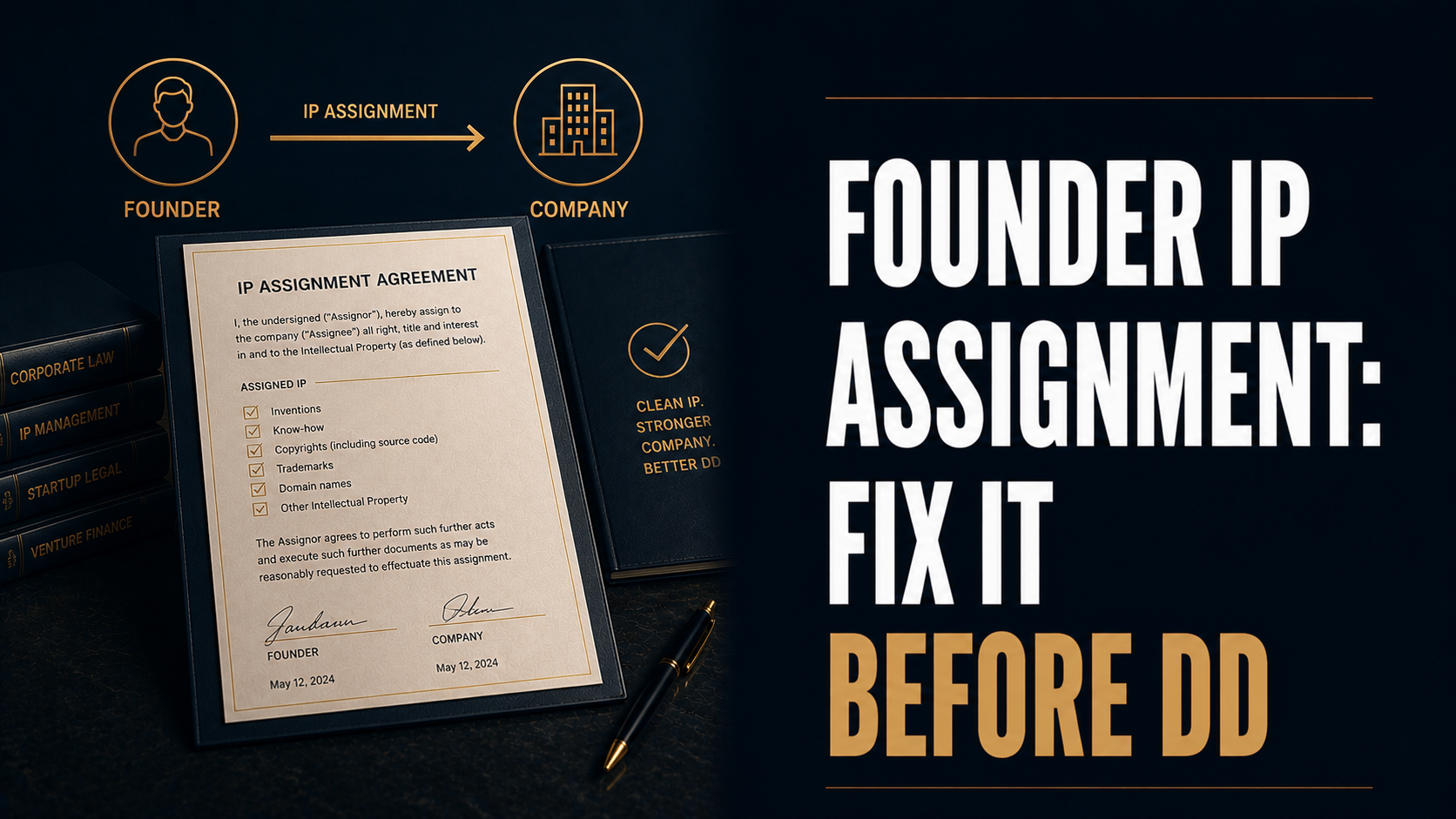
Founder IP Assignment: Why Investors Check It First & How to Fix It

Founder IP Assignment: Why It’s the First Thing Investors Check — and How to Fix It

AI Law · IP & Corporate Structuring

Founder IP Assignment: Why It’s the First Thing Investors Check — and How to Fix It

Pre-incorporation work doesn’t automatically belong to your company. For AI startups this means code, training data, model weights and research may sit outside your cap table — invisible until due diligence reveals the gap.

#1 deal breaker in AI DD Includes model weights + datasets Fixable before term sheet 4 AI-specific IP categories 4-step remediation plan
Contents 6 sections
1
Why This Is the #1 Deal Breaker
The ownership gap nobody talks about
2
What Must Be Assigned
4 AI-specific IP categories
3
How to Fix It
4-step remediation process
4
How Complex Is Your Fix?
Scoring tool — get your answer now
5
FAQ
5 founder questions answered
6
Get a Review
Before due diligence finds it first
The Ownership Gap

Why Founder IP Assignment Is the First Thing Investors Check

At Series A, investors run a full IP chain review before closing. Their first question is always the same: does your company actually own what it’s built? For most AI startups that were founded before formal incorporation, the honest answer is: partly. The rest sits with the founders personally. This is a fixable problem — but only if it is addressed before due diligence starts. Learn more about the full structuring picture in our guide to AI Structuring.

Legal Warning
Work created before incorporation stays with the individual who created it unless explicitly assigned. For AI startups this includes code, training datasets, model weights, fine-tuned model artefacts and research. Investors check this on day one of DD.

The default position under most common-law jurisdictions — including England & Wales, UAE (DIFC/ADGM) and most US states — is that copyright in a work vests in the author at the moment of creation. An employment agreement with the company can transfer future IP automatically. But work that pre-dates the company or any employment contract is a different matter entirely: it stays with the individual unless a separate, explicit assignment is executed.

For traditional software companies this is an inconvenience. For AI startups it is a structural problem. The most valuable assets in an AI business — the trained model, the curated dataset, the fine-tuned weights — are almost always created before the company exists. Investors know this. Their lawyers know this. And the gap will surface in due diligence whether founders are prepared for it or not.

AI IP Categories

What AI-Specific IP Assignment Must Cover

A generic IP assignment clause that says “all intellectual property” is often insufficient. For AI startups, the agreement must itemise each category explicitly — because courts and investors apply different standards to each one.

1
Code & Architecture
Source Code, Libraries & System Architecture
Standard software assignments cover code, but AI projects often involve prior-work carve-outs — libraries, tools and components built before incorporation. The assignment must distinguish between prior work being licenced in and new work being fully assigned. Each file repository, commit history and third-party dependency must be accounted for.
Key Risk
Open-source components ingested into the codebase may carry licence obligations (GPL, LGPL) that restrict how the assignment can operate. Verify licence terms before drafting.
2
Training Datasets
Raw Data, Curated Datasets & Labelled Sets
Training data is a distinct IP asset from the code that processes it. If a founder curated, scraped, cleaned or labelled a dataset before incorporation, that dataset belongs to them personally — not the company — absent an explicit assignment. Investors treat training data ownership as critical, particularly in regulated sectors where data provenance is auditable.
Key Risk
Data sourced from third parties (scraped web data, licensed datasets, customer data) may carry usage restrictions that limit the scope of the assignment or create downstream liability.
3
Model Weights
Trained Models, Fine-Tuned Weights & Artefacts
Model weights are the highest-value IP asset in most AI startups and the one most commonly left unassigned. A fine-tuned model created on a founder’s personal GPU before the company was incorporated is their personal property. The assignment must specifically name the model checkpoints, version numbers and all derived artefacts — not just refer generically to “AI models.”
Key Risk
Models fine-tuned on base models from OpenAI, Anthropic, Mistral or Meta are subject to those providers’ terms of service, which may restrict assignment, sublicensing or commercial use. Check terms before assigning.
4
Research & Inventions
Unpublished Research, Papers & Patent-Eligible Inventions
Research notes, technical write-ups, unpublished papers and patent-eligible inventions developed before incorporation are all personal IP of the researcher. This category is especially relevant for academic founders who developed core methodology during a PhD or post-doc. An assignment must be executed before any patent application is filed, or inventorship and ownership will be contested.
Key Risk
If research was conducted at a university, the institution may claim ownership under its IP policy. A separate release or waiver from the university may be required in addition to the founder assignment.
Contractor Assignments
Founders are not the only source of unassigned IP. Any contractor or freelancer who contributed to pre-incorporation development — a data scientist who cleaned the dataset, a developer who built an early API — retains copyright in their contribution unless they signed an assignment agreement at the time. This is one of the most common gaps found in AI DD. See our full analysis in What Do Investors Check at Series A.
Remediation Process

How to Fix It: 4-Step IP Assignment Process

An IP assignment gap is fixable in most cases. The key is to do it before a term sheet is signed, because post-term-sheet corrections trigger re-disclosure obligations and can reset valuation negotiations. Here is the standard remediation process.

IP Assignment Remediation
Steps to clean up pre-incorporation IP before due diligence
4 Steps
1
Start here
Inventory Everything Created Before Incorporation
Before any documents are drafted, produce a complete list of all IP assets that existed at the moment the company was incorporated. This is the foundation of the entire remediation. Investors will ask for a schedule of assigned assets — if you cannot produce one, the assignment agreement alone will not satisfy DD.
List all code repositories with first-commit dates
Identify all training datasets: source, curation date, who collected them
Enumerate all model checkpoints with creation dates and training runs
List unpublished research, technical notes and patent disclosures
Identify all external contributors (contractors, collaborators, academic supervisors)
2
Core document
Execute an IP Assignment Agreement With an Itemised Schedule
Draft a formal IP assignment agreement between each founder (as individual) and the company. The agreement must include a Schedule of Assigned Assets listing each item from your inventory — by name, version, date and description. A generic “all IP” clause will not satisfy sophisticated investors. For AI-specific assets, each category — code, datasets, weights, research — should be addressed in separate schedule entries.
One agreement per founder-assignor
Itemised Schedule A: code repositories by name and commit hash
Itemised Schedule B: training datasets by name, source and version
Itemised Schedule C: model weights and fine-tuned artefacts by checkpoint name
Itemised Schedule D: research, inventions and patent disclosures
3
Consideration
Include Consideration — Even Nominal
A contract without consideration is void in most common-law jurisdictions. The IP assignment agreement must include consideration flowing from the company to the founder in exchange for the assignment. This does not need to be substantial — a nominal sum (USD 1, GBP 1) is legally sufficient if it is expressly stated in the agreement and actually paid. Do not omit this step thinking it is a formality. Investors’ lawyers will check for it.
State a specific consideration amount in the agreement body
Ensure the payment is actually made and documented
If the founder also receives equity as part of the assignment, document the equity grant separately to avoid ambiguity
In DIFC/ADGM jurisdictions, written deed format may achieve valid transfer without consideration — but payment is cleaner
4
Finalise
Board Resolution and Corporate Records Update
Once executed, the assignment must be formally acknowledged by the company’s board and reflected in the corporate records. This closes the documentation loop that investors will trace during DD — from the asset to the assignment agreement to the board resolution to the IP register. If the company holds patents or registered trade marks, recordal of the assignment with the relevant IP registry may also be required.
Pass a board resolution accepting each assignment
Update the company’s IP register to list all assigned assets
File any required recordals with IP registries (patent offices, trade mark registries)
Store executed agreements with the company’s constitutional documents
Repeat this process for each contractor who contributed pre-incorporation IP
IP Holding Structure
Once IP is correctly assigned to the operating company, consider whether an IP Holding Company structure is appropriate for your stage. Holding IP in a separate entity can provide liability ring-fencing and cross-border licensing flexibility — but only if the foundational assignment is clean first.
Complexity Assessment

How Complex Is Your Fix?

Answer four questions to understand whether your IP assignment situation is a straightforward paperwork task or a multi-party audit. The result guides how urgently you need specialist help.

Founder IP Assignment Complexity Scorer
4 questions — 60 seconds — instant result
1How many founders created IP before incorporation?
1 founder (+1)
2 founders (+2)
3 or more founders (+3)
2Is there training data that was collected or curated before incorporation?
Yes — training data exists from before incorporation (+2)
No — all data was collected after incorporation (+0)
3Were any model weights or fine-tuned artefacts created before incorporation?
Yes — trained models or fine-tuned weights exist from before incorporation (+2)
No — all model training started after incorporation (+0)
4Did contractors or freelancers contribute to pre-incorporation development without a signed assignment agreement?
Yes — there are contractors without an assignment agreement (+3)
No — all contributors had proper agreements (+0)
IP assignment gap identified? The earlier you fix it, the lower the legal cost and the less leverage investors have in renegotiating your term sheet.
Book an IP review →
Frequently Asked Questions
Founder IP assignment — 5 questions answered
1
Does incorporating the company automatically transfer IP I created beforehand?
+

No. Incorporation creates a legal entity but does not transfer any IP to it. In all major common-law jurisdictions — England & Wales, DIFC, ADGM, most US states, Singapore — IP vests at creation in the individual author or inventor. The only way to transfer that IP to the company is through an explicit, written assignment agreement signed by the individual assignor. Simply being a shareholder or director of the company is not sufficient.

2
Can we execute the IP assignment after a term sheet has been signed?
+

Technically yes, but it creates significant complications. Post-term-sheet corrections must be disclosed to the investor, who may re-evaluate the valuation or impose conditions on the assignment. Some investors treat a post-signing IP gap as a material misrepresentation if it was not flagged in the data room. The practical advice is to execute all IP assignments before any investor engagement begins — certainly before providing access to a data room — so that the chain of title is clean when DD starts.

3
What if a contractor who contributed pre-incorporation IP is no longer contactable?
+

This is one of the more difficult situations in AI IP remediation. If the contractor cannot be located to sign a retroactive assignment, the company may need to re-create the affected work from scratch, obtain a legal opinion on the de minimis nature of the contribution, or disclose the gap to investors with a risk assessment. In some cases, a contractual indemnity from the founders can provide partial protection. The right approach depends on how significant the unassigned contribution is relative to the total IP. Specialist legal advice is required before deciding how to proceed.

Going forward, every contractor engagement — however short — should include an IP assignment clause as a baseline requirement. See our analysis of AI output ownership for related considerations.

4
Does a training dataset assignment also cover the model trained on that data?
+

Not automatically. The dataset and the trained model are separate IP assets. Assigning the dataset transfers ownership of the data compilation and any copyright in the curated selection and arrangement. But the model weights — the numerical parameters resulting from the training run — are a separate work. They must be assigned independently. For fine-tuned models, the base model’s licence terms may also affect what can be assigned and to whom. Always address datasets and model weights as separate line items in the assignment schedule. You can learn more about data usage and ownership in our guide to using customer data to train AI models.

5
If the company is incorporated in the UAE (DIFC or ADGM), do the same rules apply?
+

Yes. Both DIFC and ADGM apply English common law principles to IP, which means the same default rule applies: IP vests in the individual creator. An explicit written assignment is required. DIFC and ADGM-incorporated companies often have international investor syndicates who apply the same DD standards as London or New York investors. In practice, the assignment documentation needs to be bilingual or dual-jurisdiction compliant if founders are UAE residents but the company is a DIFC/ADGM entity. A deed of assignment may be preferable over a simple contract in these jurisdictions as it is valid without consideration.

AI Law · IP Structuring

Fix Your IP Chain Before Investors Find the Gap

An IP assignment gap found in due diligence gives investors leverage. The same fix done proactively costs a fraction of the time — and protects your valuation. WCR Legal handles founder IP assignments, contractor retroactive assignments and full pre-round IP audits for AI startups.

Oleg Prosin is the Managing Partner at WCR Legal, focusing on international business structuring, regulatory frameworks for FinTech companies, digital assets, and licensing regimes across various jurisdictions. Works with founders and investment firms on compliance, operating models, and cross-border expansion strategies.

Post Comment