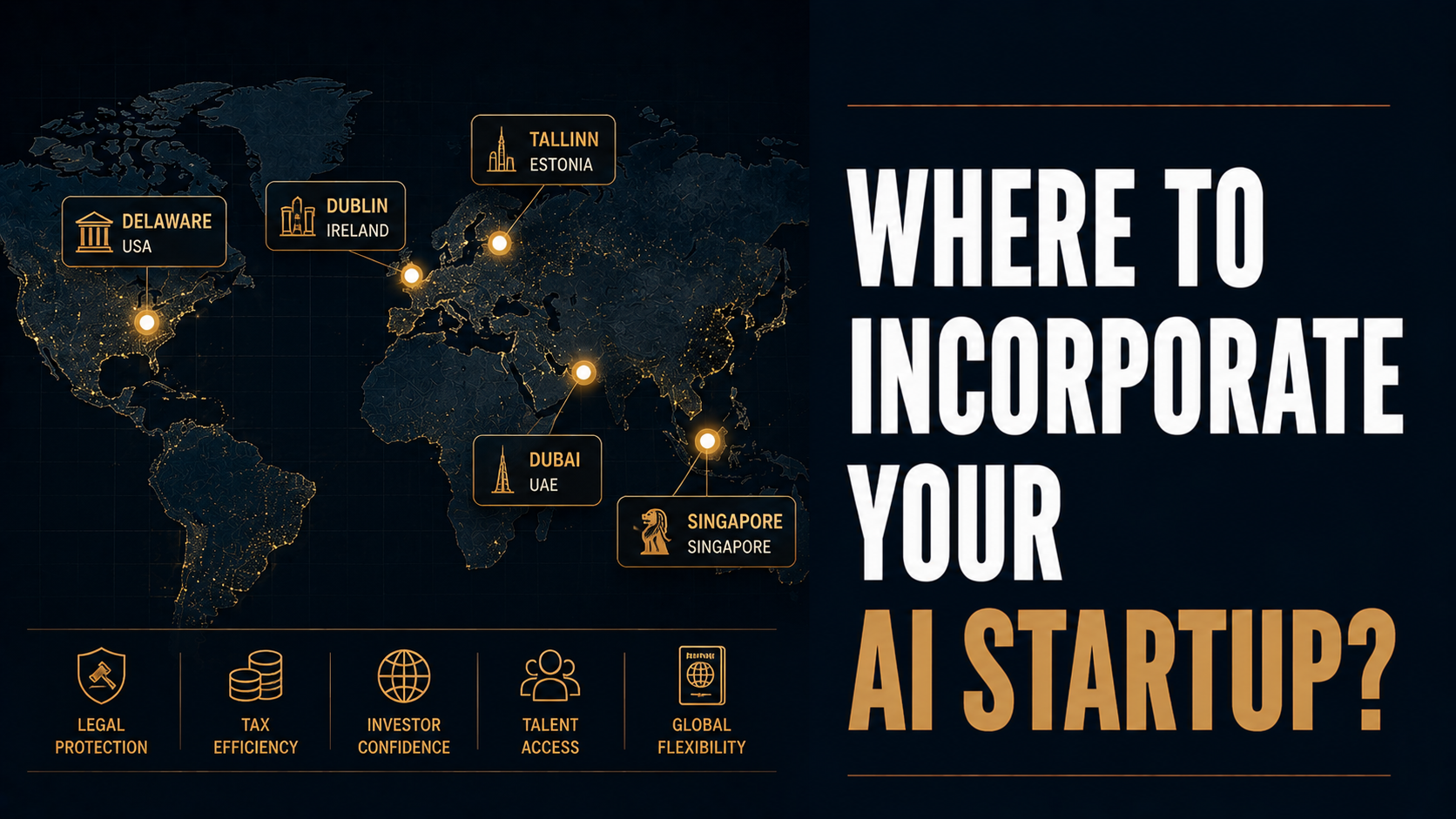
Where Should an AI Startup Incorporate? A Legal Comparison of Five Jurisdictions
Where Should an AI Startup Incorporate?
A Legal Comparison of Five Jurisdictions
Most founders optimise for tax. The more important questions are: where does the EU AI Act apply automatically, which jurisdiction gives investors confidence at Series A, and where does your AI IP get the best protection?
The incorporation question comes up at the same moment for almost every AI founder: just before you take your first significant investment, or when a VC asks what entity structure you have. At that point, the conversation tends to focus on where taxes are lowest. That is the wrong frame.
For an AI company, the structuring decision has four legal dimensions that matter more than corporate tax rates: EU AI Act scope, IP protection quality, investor readiness, and EU market access mechanics. A jurisdiction that optimises for one of these while ignoring the others creates problems that are expensive to fix post-incorporation.
Our AI jurisdiction structuring practice advises founders on entity selection, dual-entity structures, and IP holding arrangements for AI companies at pre-seed through Series A.
Four Legal Criteria That Matter More Than Tax
Before comparing jurisdictions, establish what you are actually optimising for. Most AI founders underweight three of these four criteria and overweight tax — which is the most portable of all.
Five Jurisdictions Compared
Each jurisdiction profile covers EU AI Act status, IP regime, VC readiness, and the specific trade-offs for AI companies. Select a tab to review each profile.
Find Your Jurisdiction — Investor + EU Market Selector
Select your primary investor profile and your EU market priority to see the recommended jurisdiction approach and the key next steps.
Pre-Incorporation Checklist: 9 Decisions Before You File
Work through these nine questions before selecting a jurisdiction. Changing the answer to any of them after incorporation is expensive. Click each item to track completion.
Yes. The EU AI Act applies to any provider or deployer of AI systems whose outputs are used within the EU, regardless of where the company is incorporated. A Delaware company offering AI to EU users is subject to EU AI Act obligations just as an Irish company would be. The difference is that an Irish company has an EU legal entity by default, while a Delaware company must designate an EU representative under Article 22 and faces a more complex compliance structure.
Incorporation outside the EU does not avoid EU AI Act exposure — it only changes the compliance mechanics. For more on this, see our analysis of how the EU AI Act applies to non-EU providers.
US VCs — particularly those investing under standard NVCA documents — strongly prefer Delaware C-Corps because Delaware corporate law is the most developed in the US for venture-backed companies. It provides predictable court outcomes through the Delaware Court of Chancery, well-understood investor protection mechanisms (preferred share rights, drag-along, anti-dilution), and standard documents that both sides of the deal understand without localisation.
Many US VC funds have LPA restrictions that prevent them from investing in non-US entities without additional legal structuring or fund manager approval. For AI companies targeting US institutional capital, Delaware is effectively a requirement. The solution for companies that also need EU presence is a Delaware parent with an EU operating subsidiary.
Ireland’s Knowledge Development Box (KDB) is an IP tax regime that reduces the effective corporate tax rate on qualifying income derived from patented inventions and certain other qualifying assets to 6.25% — against Ireland’s standard 12.5% rate. For AI companies, this can apply to income derived from patented AI systems and software inventions where the qualifying IP was developed by R&D activity in Ireland.
Beyond the KDB, Ireland’s 25% R&D tax credit on qualifying expenditure is particularly valuable for AI companies investing in model development, training, and evaluation. Combined with EU AI Act compliance by default through EU entity status and an established ecosystem of US-funded companies, Ireland is the leading EU incorporation choice for AI companies with IP-intensive business models. The qualification requirements — particularly the nexus approach linking IP income to R&D activity — mean early legal advice on structuring is essential to maximise the benefit.
No. If a UAE-incorporated AI company deploys AI systems that produce outputs used by EU-based users — even passively, through a B2C product available globally — the EU AI Act applies regardless of where the company is incorporated. The company must designate an EU representative under Article 22, comply with all applicable obligations for its AI system’s risk classification, and register in the EU AI database if the system is high-risk.
A UAE incorporation provides EU AI Act flexibility only if the product genuinely has no EU user base. Many Dubai-based AI founders underestimate how quickly EU users appear in a global product — particularly for B2C applications distributed via app stores. We have written specifically about when the EU AI Act applies to Dubai-incorporated companies.
A double company structure — also called a dual-entity or two-entity structure — involves incorporating in two jurisdictions: typically a Delaware C-Corp as the parent entity (holding equity, interfacing with US investors, issuing US-standard options) and an Irish or Estonian subsidiary as the operating entity (holding EU IP, employing EU team members, complying with EU AI Act, accessing EU public procurement and R&D incentives).
This structure is appropriate when: (a) you expect investment from both US and EU VCs; (b) your product will have a material EU B2B user base; (c) you want to benefit from Ireland’s Knowledge Development Box while maintaining US VC compatibility. The cost is real: two audits, transfer pricing documentation, intercompany agreements, and ongoing corporate governance for two entities. For seed-stage companies, this overhead is often premature — a single Delaware entity with an EU representative is usually sufficient until Series A, when the dual structure becomes worthwhile. See our detailed analysis of the double company structure for AI startups.
The right jurisdiction is a legal decision, not a tax one.
WCR Legal advises AI founders on entity selection, dual-entity structuring, IP holding arrangements, EU AI Act compliance from day one, and investor readiness across Delaware, Ireland, Estonia, Singapore, and UAE structures.

Post Comment