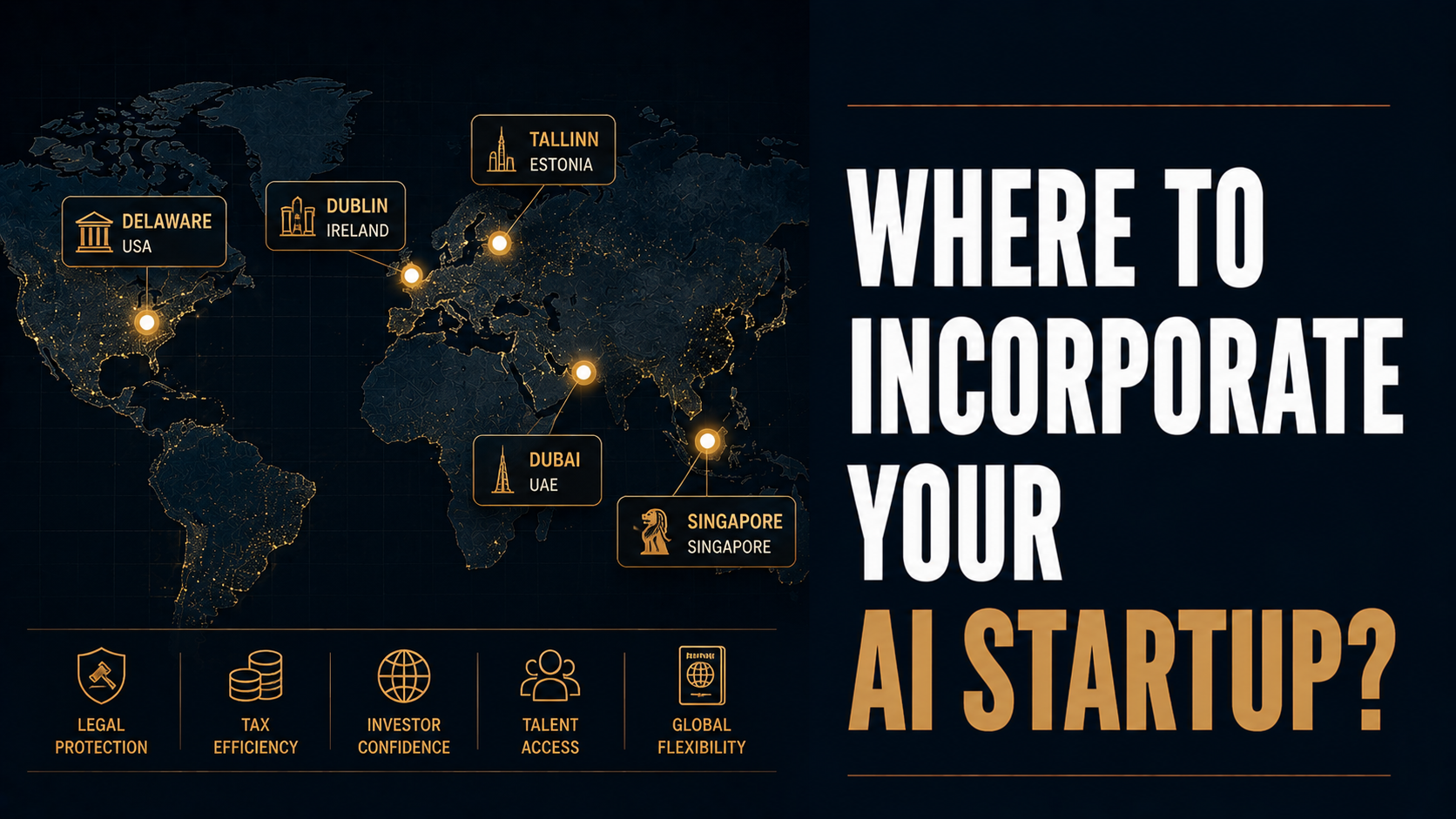
Where to Incorporate an AI Startup: Delaware, Ireland, Estonia, Singapore, UAE | WCR Legal

Where Should an AI Startup Incorporate? A Legal Comparison of Five Jurisdictions

AI Startup Structuring · Jurisdiction Selection

Where Should an AI Startup Incorporate?
A Legal Comparison of Five Jurisdictions

Most founders optimise for tax. The more important questions are: where does the EU AI Act apply automatically, which jurisdiction gives investors confidence at Series A, and where does your AI IP get the best protection?

5 Jurisdictions Compared EU AI Act Scope Factor Investor Readiness Delaware → Dubai Pre-Incorporation Checklist
Contents 6 Sections
1
Four Legal Criteria
More important than tax
2
Delaware + Ireland
US standard & EU IP box
3
Estonia + Singapore + UAE
Digital-first & Asia/MEA
4
Find Your Jurisdiction
Investor + EU market selector
5
Pre-Incorporation Checklist
9 decisions before you file
6
FAQ
EU AI Act, Delaware, KDB & more

The incorporation question comes up at the same moment for almost every AI founder: just before you take your first significant investment, or when a VC asks what entity structure you have. At that point, the conversation tends to focus on where taxes are lowest. That is the wrong frame.

For an AI company, the structuring decision has four legal dimensions that matter more than corporate tax rates: EU AI Act scope, IP protection quality, investor readiness, and EU market access mechanics. A jurisdiction that optimises for one of these while ignoring the others creates problems that are expensive to fix post-incorporation.

Our AI jurisdiction structuring practice advises founders on entity selection, dual-entity structures, and IP holding arrangements for AI companies at pre-seed through Series A.

EU AI Act — Extraterritorial Reach
Incorporation outside the EU does not exempt an AI company from the EU AI Act. Any provider whose AI system produces outputs used by EU-based users is in scope — whether incorporated in Delaware, Singapore, or Dubai. The jurisdiction choice changes your compliance mechanics, not your exposure.
Section 1

Four Legal Criteria That Matter More Than Tax

Before comparing jurisdictions, establish what you are actually optimising for. Most AI founders underweight three of these four criteria and overweight tax — which is the most portable of all.

The Four Legal Criteria Framework
What the jurisdiction decision actually determines
4 Criteria
1
EU AI Act
EU AI Act Scope — Does It Apply Automatically?
The EU AI Act applies to any provider whose AI system is placed on the EU market or whose outputs are used by EU-based users. This is an extraterritorial regulation — it follows the users, not the company. Incorporating in an EU member state (Ireland, Estonia) means your entity is directly subject to the EU AI Act with full in-scope obligations. Incorporating outside the EU means the same obligations apply if you have EU users, but the mechanics differ: you need an EU-authorised representative under Article 22, and enforcement is channelled differently.
EU entity: directly in scope with no additional representative requirement
Non-EU entity with EU users: in scope, must appoint EU representative, register in EU AI database for high-risk systems
Non-EU entity with zero EU users and no EU distribution: outside scope until user base changes
2
IP Protection
IP Regime — How the Jurisdiction Protects AI IP
Model weights, training data rights, fine-tuning methodologies, and AI outputs each need a jurisdiction with a clear IP ownership framework and enforceable IP rights. Beyond bare protection, the economic question is whether the jurisdiction offers an IP box or patent box regime — a reduced tax rate on income derived from qualifying IP. This is where Ireland’s Knowledge Development Box (10% effective rate on qualifying IP income) and similar regimes create real economic value for AI companies.
Ireland: Knowledge Development Box (10% on qualifying IP income) + 25% R&D tax credit
Singapore: IP Development Incentive (5–10% on qualifying income) + strong patent enforcement
Delaware: no IP box, but strong federal patent system and well-developed trade secret law
UAE: no IP box in most free zones, but zero corporate tax on qualifying IP income in DIFC/ADGM
3
Investor Readiness
Investor Readiness — What VCs Require by Jurisdiction
Jurisdiction affects which investors can participate and at what cost. US VCs — particularly those operating under standard NVCA documents — strongly prefer Delaware C-Corps. Many US VC fund LPAs restrict investments into non-US entities without additional legal structuring. EU VCs are comfortable with Irish and Estonian entities and increasingly familiar with the double-entity structure. For Series A+ with mixed investor bases, the entity structure may need to accommodate both, which usually means a Delaware parent with an EU operating subsidiary.
Delaware: required for most US VC investments; clean cap table mechanics, standard SAFE/priced round documents
Ireland: comfortable for EU VCs and US VCs with EU portfolio experience; EIS/SEIS available for UK investors
Estonia: familiar to EU and Baltic VCs; e-Residency reduces setup friction; less familiar to US VC legal teams
Singapore / UAE: requires separate structuring work for US VC participation; adds legal cost at early stages
4
EU Market Access
EU Market Access — Entity vs Representative
If your AI product will be used by EU customers, you need either an EU legal entity or an Article 22 EU representative. These are not equivalent: an EU entity gives you a legal presence for contracting, employment, VAT registration, and public procurement. An EU representative is a lighter-touch compliance mechanism for non-EU providers — it satisfies the EU AI Act representative requirement but does not give you the commercial benefits of a local entity. For companies expecting material EU B2B revenue, an EU entity is almost always the better long-term choice.
EU entity: direct access to EU public procurement, EU customer contracts under familiar law, EU employment framework
EU representative: satisfies EU AI Act obligation, simpler to set up, but limited commercial functionality
No EU presence: only viable if you have no EU users and no EU market plans — increasingly rare for AI companies
Section 2

Five Jurisdictions Compared

Each jurisdiction profile covers EU AI Act status, IP regime, VC readiness, and the specific trade-offs for AI companies. Select a tab to review each profile.

Jurisdiction Comparison Profiles
Delaware · Ireland · Estonia · Singapore · UAE
Delaware
Ireland
Estonia
Singapore
UAE
EU AI Act: Not Automatic
US VC Standard
IP: Federal Patent System
Advantages
The de facto standard for US venture-backed companies — most US VCs require Delaware C-Corp for priced rounds
Delaware Court of Chancery: the most developed corporate court in the US, predictable outcomes on investor disputes
Standard NVCA documents, SAFEs, and convertible notes work without modification
EU AI Act applies only if you have EU users — you can scale US-first without immediate EU compliance overhead
Straightforward path to US IPO or SPAC transaction
Considerations
EU AI Act representative required if you have EU users — adds ongoing compliance cost and complexity
No IP box regime — no reduced rate on IP income, unlike Ireland or Singapore
EU VCs often require a restructuring to an EU entity or dual structure before investing
EU customers may require a local EU entity for enterprise contracts and public procurement
Federal corporate tax (21%) plus state tax; no GDPR-compliant entity by default
Best For
AI companies targeting US institutional VC from day one, with a primarily North American user base at launch. Also the standard parent entity in a Delaware + Ireland dual structure for US/EU companies. See Delaware vs Ireland comparison →
EU AI Act: In Scope (EU Entity)
EU VC Friendly
IP: Knowledge Development Box
Advantages
EU legal entity — EU AI Act compliance by default, no representative required, GDPR-compliant entity structure
Knowledge Development Box: 10% effective rate on income from qualifying patented AI inventions and IP
25% R&D tax credit on qualifying expenditure — highly valuable for model development
12.5% standard corporate tax rate; established US MNC presence means US VC funds familiar with Irish entities
English-language legal system, common law, EU single market access for all 27 member states
Considerations
US VC standard documents require adaptation for Irish company law — additional legal cost at priced rounds
EU AI Act compliance obligations apply immediately — cannot defer as a non-EU entity could
Higher setup and ongoing compliance cost than Estonia for early-stage companies
KDB qualification requires patented IP — not all AI IP qualifies without patent filings
Best For
AI companies with significant EU user base, EU VC investors, or IP-heavy models expecting to benefit from the Knowledge Development Box. Also the standard EU subsidiary in a Delaware + Ireland dual structure for US-funded companies targeting EU enterprise customers.
EU AI Act: In Scope (EU Entity)
EU VC + Digital-First
IP: EU Framework
Advantages
e-Residency programme: founders can manage the company entirely digitally without physical presence in Estonia
EU legal entity — EU AI Act compliance by default, GDPR-compliant, EU single market access
0% corporate tax on retained earnings (tax is deferred until distribution) — capital-efficient for early-stage growth
Low setup cost and fast incorporation (often within 24 hours via e-Residency portal)
EU VC ecosystem increasingly familiar with Estonian OÜ structure; Startup Estonia and Invest Estonia programmes
Considerations
US VCs typically require a redomiciliation (flip) to Delaware before investing — adds legal cost and time
No IP box equivalent to Ireland’s Knowledge Development Box — less advantageous for IP-heavy companies
Local presence requirement for some banking and compliance functions — e-Residency does not replace a local director in some cases
Less familiar to US investors and enterprise customers than Irish or Delaware entities
Best For
Digital-first AI companies at pre-seed or seed stage targeting EU market and EU VC, where founders prefer low-friction setup and remote management. Particularly suited to B2C AI products and developer tools where the product is self-serve and the team is distributed across Europe.
EU AI Act: Not Automatic
Asia-Pacific VC Hub
IP: IP Development Incentive
Advantages
IP Development Incentive: 5–10% concessionary tax rate on qualifying IP income (royalties, licensing fees from developed IP)
17% standard corporate tax rate; established US, Asian, and Middle Eastern VC presence
Strong courts and IP enforcement; one of the best IP regimes in Asia
No EU AI Act obligation unless EU users are acquired — freedom to scale Asia-first without EU compliance overhead
Gateway to Southeast Asia and broader APAC markets; MAS regulatory sandbox for AI/fintech
Considerations
US VC participation requires additional structuring (Delaware flip or SPV) — adds cost and complexity
EU AI Act representative required if EU users are acquired — cannot serve EU market without compliance step
Physical presence requirements for some tax incentives — cannot be a pure holding vehicle without substance
Less straightforward for EU enterprise sales — EU customers often prefer EU-entity counterparties
Best For
AI companies targeting Asia-Pacific or MEA markets with US or Asian institutional VC, where EU market access is a secondary priority. Also appropriate as the Asian HQ in a multi-entity structure alongside a Delaware parent or EU subsidiary. Strong choice when IP income from licensing is a material revenue stream.
EU AI Act: Not Automatic
MEA Hub
IP: DIFC / ADGM Regime
Advantages
DIFC and ADGM: English common law free zones with independent courts — familiar legal system for international founders
Zero corporate tax on qualifying income within DIFC/ADGM for entities meeting substance requirements
No EU AI Act obligation unless EU users are acquired — maximum regulatory flexibility for non-EU products
Access to GCC/MEA sovereign and institutional capital; strong government AI investment programs (UAE AI Strategy)
Dubai AI regulatory sandbox; proximity to large enterprise contracts in energy, government, and finance sectors
Considerations
EU VC typically does not invest directly in UAE entities — requires additional structure for EU fundraising
US VC requires Delaware flip or parallel entity — significant additional legal cost
EU AI Act applies immediately if EU users are present — many Dubai founders underestimate this risk
IP litigation outside DIFC/ADGM courts can be complex; enforcement against infringers in mainland UAE varies
UAE entity may create reputational friction with certain EU enterprise and public sector clients
Best For
AI companies focused on MEA markets — particularly government, energy, and financial services sectors — with access to GCC institutional capital. Optimal when the product has no EU user base and EU VC is not required. Increasingly popular as a holding structure for AI companies with sovereign wealth fund backing. See our note on when EU AI Act applies to Dubai-incorporated companies.
When a Single Jurisdiction Is Not Enough
For AI companies targeting both US VC and EU markets, a dual-entity structure (Delaware parent + Irish or Estonian subsidiary) is often the most practical solution. The Delaware entity holds equity and interfaces with US investors; the EU subsidiary holds EU IP, employs EU team members, and satisfies EU AI Act obligations. The trade-off is administrative cost — two entities, transfer pricing documentation, and two audit trails. See our full analysis of the dual-entity structure for AI startups →
Section 3

Find Your Jurisdiction — Investor + EU Market Selector

Select your primary investor profile and your EU market priority to see the recommended jurisdiction approach and the key next steps.

Jurisdiction Recommendation Selector
Investor profile + EU market → structure recommendation + next steps
Step 1 — Primary Investor Profile
US / Global VC
EU VC
Asia-Pacific VC
MEA / Bootstrapped
Step 2 — EU Market Priority
EU is a core market
Some EU users, not primary
No EU users planned
Select your investor profile and EU market priority to see a recommendation.
Section 4

Pre-Incorporation Checklist: 9 Decisions Before You File

Work through these nine questions before selecting a jurisdiction. Changing the answer to any of them after incorporation is expensive. Click each item to track completion.

Pre-Incorporation Decision Checklist
AI startup jurisdiction selection — work through before filing
0 / 9
A — Business & Market
Confirm whether EU-based users will be part of your initial go-to-market
This single decision determines whether EU AI Act applies from day one. If yes, an EU entity or EU representative is not optional — it is a legal requirement.
Critical
Identify your target investor profile for Seed and Series A
US institutional VC requires Delaware. EU VC is comfortable with Ireland or Estonia. If you are targeting both, a dual-entity structure will be required — factor this into your timeline and legal budget.
Critical
Determine where model development, training, and IP creation will physically occur
IP box regimes (Ireland’s KDB, Singapore’s IDI) require economic substance in the jurisdiction — real R&D activity, not just a holding entity. Where your team actually works matters for qualification.
High
B — Legal & Compliance
Classify your AI system under the EU AI Act risk tiers before choosing an EU or non-EU structure
High-risk AI systems (as defined in Annex III EUAIA) face significantly more compliance obligations. The classification affects how complex an EU entity vs EU representative arrangement is in practice.
High
Assess whether personal data will be used for training — and which GDPR entity structure is needed
GDPR data processing requires either an EU establishment (as controller) or standard contractual clauses for third-country transfers. An EU entity is cleaner for GDPR compliance than a non-EU representative arrangement.
High
Confirm whether your sector has additional financial, health, or sectoral AI regulation that affects entity location
AI in financial services (MiCA, DORA), healthcare (EU MDR for AI medical devices), or critical infrastructure carries additional regulatory layers that may require specific entity locations or licences.
Verify
C — Investor & IP Structure
Decide where to hold model weights, training data rights, and core AI IP
IP holding structure and entity location are separable decisions. In a dual-entity structure, IP is often held in the EU subsidiary to benefit from the Knowledge Development Box while equity remains in the Delaware parent.
Structure
Model the corporate tax structure — including IP box eligibility — before committing to a jurisdiction
Tax structuring should follow entity selection, not drive it. But quantifying the KDB benefit (Ireland) or IDI benefit (Singapore) against the legal cost of maintaining that entity is a necessary input to the decision.
Tax
Get the founder IP assignment done in the chosen jurisdiction before the first investor closes
IP assignment from founders to the entity is the first thing investors check. The form and enforceability of the assignment agreement depends on the jurisdiction. Do not leave this until after term sheet.
Critical
Choosing between Delaware, Ireland, and a dual-entity structure? WCR Legal advises AI founders on jurisdiction selection, dual-entity structuring, IP holding arrangements, and EU AI Act compliance from day one.
Book a Structuring Call →
Frequently Asked Questions
AI startup incorporation — jurisdiction selection
1
Does the EU AI Act apply to AI companies incorporated outside the EU?
+

Yes. The EU AI Act applies to any provider or deployer of AI systems whose outputs are used within the EU, regardless of where the company is incorporated. A Delaware company offering AI to EU users is subject to EU AI Act obligations just as an Irish company would be. The difference is that an Irish company has an EU legal entity by default, while a Delaware company must designate an EU representative under Article 22 and faces a more complex compliance structure.

Incorporation outside the EU does not avoid EU AI Act exposure — it only changes the compliance mechanics. For more on this, see our analysis of how the EU AI Act applies to non-EU providers.

2
Why do US venture capital firms require Delaware incorporation?
+

US VCs — particularly those investing under standard NVCA documents — strongly prefer Delaware C-Corps because Delaware corporate law is the most developed in the US for venture-backed companies. It provides predictable court outcomes through the Delaware Court of Chancery, well-understood investor protection mechanisms (preferred share rights, drag-along, anti-dilution), and standard documents that both sides of the deal understand without localisation.

Many US VC funds have LPA restrictions that prevent them from investing in non-US entities without additional legal structuring or fund manager approval. For AI companies targeting US institutional capital, Delaware is effectively a requirement. The solution for companies that also need EU presence is a Delaware parent with an EU operating subsidiary.

3
What is Ireland’s Knowledge Development Box and why does it matter for AI startups?
+

Ireland’s Knowledge Development Box (KDB) is an IP tax regime that reduces the effective corporate tax rate on qualifying income derived from patented inventions and certain other qualifying assets to 6.25% — against Ireland’s standard 12.5% rate. For AI companies, this can apply to income derived from patented AI systems and software inventions where the qualifying IP was developed by R&D activity in Ireland.

Beyond the KDB, Ireland’s 25% R&D tax credit on qualifying expenditure is particularly valuable for AI companies investing in model development, training, and evaluation. Combined with EU AI Act compliance by default through EU entity status and an established ecosystem of US-funded companies, Ireland is the leading EU incorporation choice for AI companies with IP-intensive business models. The qualification requirements — particularly the nexus approach linking IP income to R&D activity — mean early legal advice on structuring is essential to maximise the benefit.

4
Can a UAE-incorporated AI company serve EU customers without EU AI Act obligations?
+

No. If a UAE-incorporated AI company deploys AI systems that produce outputs used by EU-based users — even passively, through a B2C product available globally — the EU AI Act applies regardless of where the company is incorporated. The company must designate an EU representative under Article 22, comply with all applicable obligations for its AI system’s risk classification, and register in the EU AI database if the system is high-risk.

A UAE incorporation provides EU AI Act flexibility only if the product genuinely has no EU user base. Many Dubai-based AI founders underestimate how quickly EU users appear in a global product — particularly for B2C applications distributed via app stores. We have written specifically about when the EU AI Act applies to Dubai-incorporated companies.

5
What is a double company structure for AI startups and when should I use it?
+

A double company structure — also called a dual-entity or two-entity structure — involves incorporating in two jurisdictions: typically a Delaware C-Corp as the parent entity (holding equity, interfacing with US investors, issuing US-standard options) and an Irish or Estonian subsidiary as the operating entity (holding EU IP, employing EU team members, complying with EU AI Act, accessing EU public procurement and R&D incentives).

This structure is appropriate when: (a) you expect investment from both US and EU VCs; (b) your product will have a material EU B2B user base; (c) you want to benefit from Ireland’s Knowledge Development Box while maintaining US VC compatibility. The cost is real: two audits, transfer pricing documentation, intercompany agreements, and ongoing corporate governance for two entities. For seed-stage companies, this overhead is often premature — a single Delaware entity with an EU representative is usually sufficient until Series A, when the dual structure becomes worthwhile. See our detailed analysis of the double company structure for AI startups.

WCR Legal — AI Jurisdiction Structuring

The right jurisdiction is a legal decision, not a tax one.

WCR Legal advises AI founders on entity selection, dual-entity structuring, IP holding arrangements, EU AI Act compliance from day one, and investor readiness across Delaware, Ireland, Estonia, Singapore, and UAE structures.

Oleg Prosin is the Managing Partner at WCR Legal, focusing on international business structuring, regulatory frameworks for FinTech companies, digital assets, and licensing regimes across various jurisdictions. Works with founders and investment firms on compliance, operating models, and cross-border expansion strategies.

Post Comment