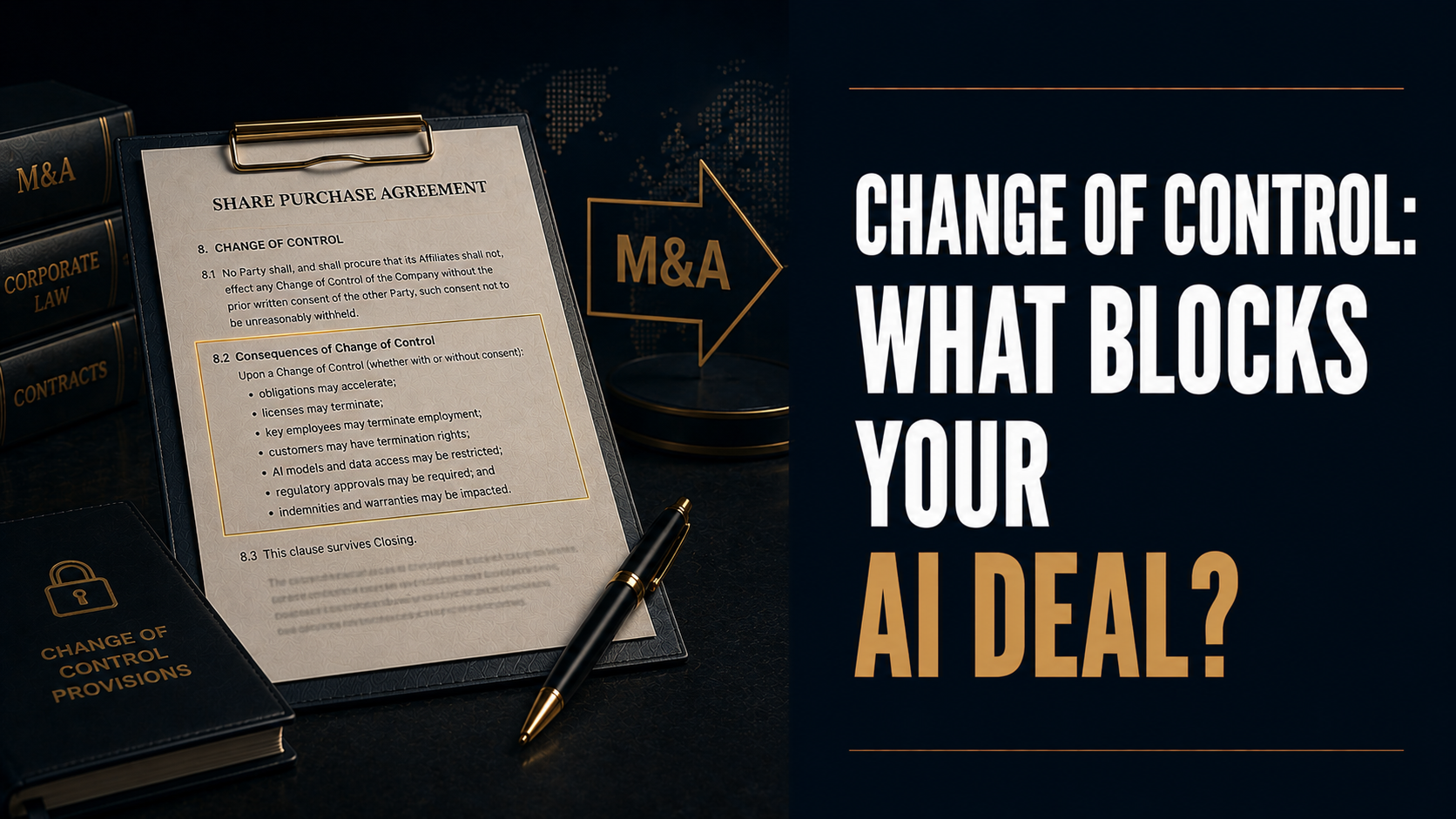
Change-of-Control Clauses in AI Contracts: What Blocks Acquisitions
Change-of-Control Clauses in AI Contracts:
What Blocks Acquisitions
One unreviewed API agreement can terminate your AI company’s product at closing. API providers, open-source model licenses, and training data licensors all have change-of-control provisions — and most M&A teams miss them until it’s too late.
Change-of-control provisions are standard boilerplate in commercial contracts — but in AI transactions they carry a specific risk that traditional tech M&A counsel often underestimates. An AI company’s entire product may run on a small number of API agreements or model licenses that will not transfer automatically on acquisition.
In a conventional SaaS deal, the target’s most critical IP is usually in-house software. In an AI deal, the critical infrastructure is often upstream: an agreement with OpenAI that allows the product to function, a LLaMA-based model fine-tune whose license terms the acquirer inherits, or a training dataset licensed specifically to the original entity. Each of these carries its own change-of-control regime — and they need to be mapped before signing.
Our AI due diligence practice reviews AI contract stacks in M&A transactions and advises on pre-closing consent strategies, deal structuring, and IP representations.
How a Change-of-Control Clause Blocks an Acquisition
The mechanism is consistent across contract types: a triggering event (ownership change) activates a clause that either requires consent, permits termination, or restricts the transfer of rights. In AI contracts, the sequence unfolds in four stages.
Three Contract Types — Three Risk Profiles
Change-of-control risk is not uniform across AI contracts. API provider agreements, open-source model licenses, and training data licenses each have a distinct legal regime for ownership changes. Understanding which applies to the target’s stack is the first step in any AI M&A DD.
Scenario Calculator: Select Contract & Deal Type
Select the type of contract and the deal structure to see the applicable change-of-control risk level and the recommended DD action.
M&A Checklist: What to Review and How to Negotiate
A practical checklist for M&A counsel conducting AI contract DD. Click each item to track completion.
A change-of-control clause is a contractual provision that is triggered when the ownership or control of a contracting party changes — through an acquisition, merger, share transfer, or asset sale. In AI contracts, these clauses are common in commercial API agreements (OpenAI, Anthropic, Google), restricted open-source model licenses (LLaMA), and training data agreements.
When triggered, the clause typically requires the counterparty’s written consent to the transfer, allows the counterparty to terminate the agreement, or creates an automatic termination. The practical effect is that the acquirer cannot assume that the target’s AI infrastructure transfers automatically at closing.
No. Commercial API agreements from providers like OpenAI, Anthropic, and Google are typically non-assignable without the provider’s written consent. An acquisition that changes the controlling shareholder of the target entity is treated as a change of control under these agreements, triggering the consent requirement.
The acquirer may find that on day one of ownership, it controls an entity that is technically in breach of its API agreements if consent was not obtained before closing. Some agreements provide a cure period; others do not. The risk is product-level: without the API, the product may not function.
No — and the differences are material. Apache 2.0, used for many open-source models including early Mistral and Falcon releases, is a permissive license with no change-of-control restrictions. An acquisition has no effect on the license, and no consent is required.
Meta’s LLaMA licenses (both LLaMA 2 and the updated LLaMA 3 terms) are different. They impose use-case restrictions, prohibit certain commercial applications, and — for large-scale operators — include thresholds that the combined entity may exceed post-acquisition. Fine-tuned derivatives of LLaMA carry the same restrictions. “Open source” does not mean “no restrictions” in this context.
As early in the DD process as is practically possible — ideally in the first two to three weeks after signing an NDA or LOI. API providers typically take two to six weeks to respond to consent requests, and larger providers (especially OpenAI and Google) may route requests through enterprise sales or legal teams with longer response times.
Leaving consent requests until late in the process creates scheduling risk. If a major provider declines or delays, the acquirer has fewer options for deal restructuring, and any escrow or price adjustment negotiation with the seller will occur under time pressure. Treat the consent process as a parallel workstream running alongside the rest of DD.
Where pre-signing consent is not available — for example in a competitive auction process — the standard suite of protections includes: (1) a closing condition requiring consent before closing can occur; (2) a price adjustment reflecting the cost of migrating to an alternative API provider; (3) an escrow held against the risk of the provider exercising a post-closing termination right; and (4) enhanced indemnification from the seller for any losses arising from the provider terminating post-closing.
In extreme cases, where the affected API is critical to the product and the provider is unlikely to consent to a transfer to this specific acquirer (for example, for competitive reasons), the acquirer should have a walk right in the SPA. These situations are rare but not unknown in AI transactions.
Your target has AI contracts. Have you read them?
WCR Legal reviews AI contract stacks in M&A transactions — API agreements, model licenses, data contracts, and custom AI agreements — and advises on pre-closing consent strategy, deal structuring, and AI-specific SPA representations.

Post Comment